Showing posts with label eastern tiger salamander. Show all posts

Monday, March 20, 2017

Spring Brings Vernal Pools to Life


Eastern Tiger Salamander   Photo by Caitlin Smith/USFWS.
Springlike weather has arrived and left NJ a few times already in February and March, but as the true spring season arrived this morning, vernal pools will appear and become more actively occupied.

Vernal pools are confined wetland depressions, either natural or man-made, that hold water for at least two consecutive months out of the year and are devoid of breeding fish populations.

Here in New Jersey, rural portions of the Skylands, Piedmont, and Coastal Plain landscapes are home to the majority of our vernal pools. These unique ecosystems provide habitat to many species of amphibians, insects, reptiles, plants, and other wildlife.

An endangered species in NJ, the Eastern Tiger Salamanders (Ambystoma tigrinum) are part of the wildlife ritual that happens around those intermittent pools/ponds. This is where many amphibian species go to breed.

Habitat loss and water pollution have led to the decline of tiger salamander populations in the southern portion of New Jersey and by the mid-1970s their known historic breeding sites had been reduced to half - 19 sites.

Consequently, the Eastern Tiger Salamander was listed as an endangered species in 1974 and still remains on the list.

Protecting vernal ponds has led the NJDEP to adopt regulations that affords them protection under the State Freshwater Wetlands Protection Act.

The Eastern Tiger Salamander is only one challenged amphibian species in our state. Their breeding needs or habitat are impacted by water pollution, pesticides, roads, introductions of fish, off-road vehicles and development, especially on private land.

Some populations have been saved from local extinction by the species ability to utilize human-made "pools" such as trenches and construction areas as breeding ponds.

Spotted Salamander
Another vernal pool visitor is the Spotted Salamander (Ambystoma maculatum). This a big salamander that is about 15–25 cm (5.9–9.8 in) long. They are stout with wide snouts. The spotted salamander's main color is black, but can sometimes be a blueish-black, dark grey, dark green, or even dark brown. Two uneven rows of yellowish-orange spots run from the top of the head (near the eyes) to the tip of the tail.

The Spotted Salamander breeds in large groups in vernal ponds in early spring, when the first
warm rains occur. It prefers deciduous or mixed woods. Outside of breeding season, it may be found under debris in humid conditions.

Adults can be observed moving into vernal pools sometime after the first spring rain as early
as the beginning of March. They will remain in these breeding ponds for up to a month before moving back to their terrestrial dwellings. Their range is the Northern and Western part of the state outside the Pinelands.

Amphibians of New Jersey

Vernal Pools in NJ


Tuesday, March 3, 2015

How Many Salamanders?

Eastern Tiger Salamander (endangered in NJ)

Ecologist Raymond Semlitsch and his doctoral student Katie O’Donnell are researching part of the Mark Twain National Forest in Missouri for salamanders. They crawl along the ground, raking the leaf litter with their hands, looking under rocks and logs, and when they find  salamanders, they lift them gently from the dirt to be weighed and measured.

They are building a model of salamander populations and using the data from the sites they studied, they can estimate salamander populations in other parts of the woods.

How many salamanders are in the woods? The answer, according to the model, is between 1.88 and 2.65 billion salamanders. That’s within a district of the Mark Twain National Forest about 2,800 square kilometers in area, and those numbers 2-4 times higher than estimates made by other scientists in the 1970s.

Those earlier researchers, studying salamanders in the woods of New Hampshire, didn’t account for amphibians hiding underground. And more recent studies of other salamander species have found up to 10 times more salamanders than the 1970s research.

What about here in New Jersey?

NJDEP, Division of Fish and Wildlife’s Endangered and Nongame Species Program and the Conserve Wildlife Foundation of NJ have enhanced a complex of 12 vernal pools in Cape May County to create habitat for state-endangered eastern tiger salamanders and other vernal pool breeding amphibians. The interconnecting pools allowed eastern tiger salamanders to return to vernal pools to breed in early winter.


In mid-December, eastern tiger salamander egg masses can be found in the pools and egg masses collected from other sites have also been introduced into these pools as supplements.

Every year,  volunteers on a wooded road in northwestern New Jersey spend some early spring nights looking for frogs and salamanders to count.

They wait for the amphibians to cross the road on their way from the wooded uplands where they winter to the marshy lowlands and vernal pools where they will do their spring mating

Wood frogs and blue-spotted salamanders are more common amphibians in northern New Jersey and not endangered.

The NJ’s Endangered and Nongame Species Program and Conserve Wildlife, along withe the NJ Audubon Society are partners on the Amphibian Crossing Survey Project. Relying again on volunteers to help monitor sites in Warren and Morris County, they identify additional crossings throughout the northern region of the state. (Due to limited resources, they are currently focusing efforts on northern New Jersey.)


It is estimated that one third of the world’s amphibians are threatened with extinction, according to the International Union for the Conservation of Nature (IUCN).

SOURCES:
A Surfeit of Salamanders
NJ Online Field Guide for Reptiles and Amphibians


Sunday, February 26, 2012

Salamanders At Cape May Vernal Pool

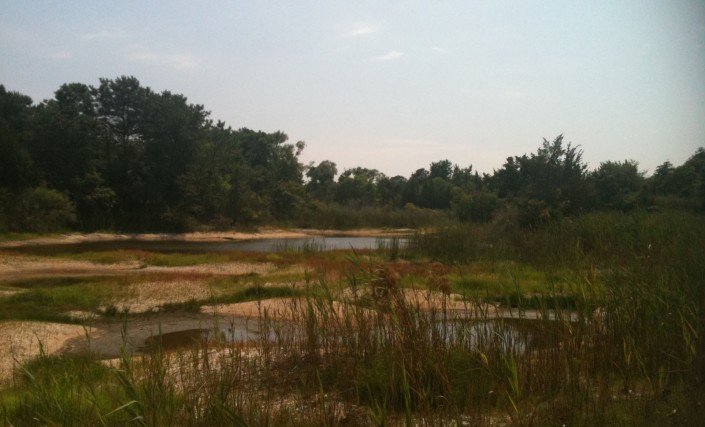
The new vernal pools  Photo: Dave Golden
 As a follow-up to yesterday's post about the spring amphibian crossings now taking place in NJ, here's a link to a post by Karena DiLeo, Wildlife Biologist for Conserve Wildlife Foundation (CWF).

Last fall, NJDEP's ENSP and CWF completed a project to enhance a complex of 12 vernal pools in Cape May County, creating habitat for state-endangered eastern tiger salamanders and other vernal pool breeding amphibians.

The interconnecting pools allowed eastern tiger salamanders to return to vernal pools to breed in early winter.

In mid-December, eastern tiger salamander egg masses were found in the pools. Egg masses collected from other sites have also been introduced into these pools as supplements.