Showing posts with label mink. Show all posts

Thursday, December 1, 2022

Fishers and Minks

Endangered NJ gets lots of reports of wildlife sightings. Unfortunately, the majority are not accompanied by photos, videos, or any kind of physical evidence (such as tracks), so we can't always confirm the sighting.

Jamie in Lincoln Park sent us the backyard trail camera photo below of a fisher taken this month. The area borders the Great Piece Meadows Preserve off of RT 80. 

Fisher 

An earlier email was another possible fisher sighting about a half mile from Bearfort fire tower in West Milford near Cedar Pond, but the photos were too unclear to verify. 

Fishers (Martes pennanti) are the rarest of our state's water-loving mammals. They have made a comeback in northwestern New Jersey. Fishers were extirpated from New Jersey in the 1800s as their range in Sussex and Warren counties was taken over by farmland early in the country's history, forcing the animals to deeper woods. 

They are fierce carnivores and will hunt squirrels, rabbits, chipmunks, mice, raccoons, shrews and even porcupines. 

Fisher    Photo: Mass Audubon

"Also referred to as the fisher cat and Appalachian black cat, this animal looks like fluffy cat meets fox, with a wolverine-like disposition. However, it is neither a feline nor does it catch fish. The fisher is a member of the Mustelidae family, which includes otters, badgers, martens, ferrets, minks, wolverines and more."    source

Minks are also part of that family and are native New Jersey mammals found in and around freshwater. They and other aquatic and semi-aquatic mammals – including beavers, otters, weasels, ermine, fishers and muskrats – live in our state but are not easy to spot.

I recently saw a post on Instagram from the Verona Park Conservancy of their resident mink. You don't always have to go into the deep woods to find wildlife.


You might be surprised to learn that the American mink is actually a very common species found along watercourses, ponds, lakes and swamps throughout New Jersey. However, they are primarily nocturnal and quite solitary animals, so people rarely encounter them.

Mink (Mustela vision) were well known for their beautiful, soft fur which was prized by trappers and for a long time was used for women's fur coats and clothing. Thankfully, that practice became unpopular as awareness of wildlife becoming threatened and endangered became better known. 

The American mink has a lanky body, long tail, short legs, and partially webbed toes, which make them excellent swimmers. They are quite territorial and feed on crayfish, frogs, fish, mice, reptiles, earthworms, and waterfowl. They aren't a threat to humans but like their skunk cousins, they will defend themselves by spraying a foul-smelling liquid.

More of our posts about:
fishers
minks

Thursday, November 26, 2020

What's That Creature in the Water? part 1

North American river otter swimming -Wikimedia

No, it is not the Creature from the Black Lagoon or the Loch Ness Monster but there are some odd aquatic and semi-aquatic mammals that you might spot in the fresh waters of New Jersey.

Mink and beaver are native New Jersey mammals found in and around freshwater that most citizens of the state rarely ever see. Other aquatic and semi-aquatic mammals – including otters, weasels, ermine, fishers, and muskrats – are also here but elusive. They are most active at dawn, dusk, and nighttime when people are less active.

“They are incredibly secretive,” said Dr. Emile DeVito, staff biologist for the New Jersey Conservation Foundation. “Nobody really studies them in New Jersey. They are an overlooked group of animals, except by trappers.”

They are not really endangered or threatened in NJ even though they seem rare. It is thought that these aquatic mammals are actually becoming more common. Why? The reasons are actually good news: cleaner waters, more forest cover, and less trapping. 

Here are three of these elusive mammals. Maybe if you're out today for a Thanksgiving walk in the woods to build up your appetite or burn off the big dinner, you might be lucky enough to spot one. (In part 2, I will cover four others.)

American mink - Wikimedia

Mink (Mustela vison) are known for their exceptionally beautiful and soft fur. The American mink is lanky with a long tail, short legs, and partially webbed toes, which make them excellent swimmers. They are solitary creatures and quite territorial. They like to feed on crayfish, frogs, fish, mice, reptiles, earthworms, and even waterfowl. Take note that like their skunk cousins, mink defend themselves by spraying a foul-smelling liquid.


American beaver

Beavers (Castor candensis) are like humans in that they reshape their environment to suit their needs. That's rare in any animals. They will damn a stream to create a pond, and then build a separate beaver lodge by piling up mud, rocks and sticks inside the lodge to form a “floor” above the water.

Unlike mink, beavers are communal and live in groups. They also differ from most of these other mammals in that they are not carnivorous. They stand apart from their fellow members of the rodent family as vegetarians whose favorite foods include water lily tubers, spatterdock, clover, algae, apples and the leaves and green bark from trees.


North American river otter - Wikimedia

If you have ever spotted some river otters (Lutra canadensis) you would know that they're the most aquatic members of the mustelid family and often appear quite playful - as when they are sliding down riverbanks into the water. 

They have long stiff whiskers that help them find prey. They have flaps that allow them to close off their nostrils and ears to remain underwater for up to eight minutes on one breath. They are very social and form family groups centered on a female and her young. They eat fish, reptiles, amphibians, crustaceans, mollusks, insects, and even small birds and mammals.


Wednesday, June 17, 2020

Mink or Weasel?

I continue to get inquiries from people trying to identify species they see in New Jersey.

Sandi wrote to me because her grandson spotted this mother(?) and two young ones at a stream near her home in Andover. She asks, "Are they mink or weasel?"

Well, reader - what's your call?


The two species (and ferrets) are often confused.

American minks are larger and heavier than North American weasel species, such as the least weasel, the long-tailed weasel and the short-tailed weasel or ermine. Minks are long, slender mammals with long necks and short legs.

Although mink, ermine and weasels all like to live in bottomlands, mink always live near water. They have semi-webbed feet that make them great swimmers.


Residents with homes close to rivers and streams are more likely to encounter minks, while those near woods or farms may have issues with weasels. These animals both prey on chickens and may injure pets if provoked. Weasels and minks will defend themselves against animals twice their size.

The white patch on the front of this young one may be your best clue.

Thursday, March 12, 2020

Mink and Muskrats in NJ

Photos by Richard Angelillo


This month I was contacted by Richard Angelillo who sent the two photos above that he took in Somerset, NJ. He thought at first that it was a muskrat but was told it was a mink. He did not know that we have minks in New Jersey.

He went online and found our article on New Jersey Furbearers.

Besides muskrats, it is easy to confuse a fairly common mink for a less likely fisher. That's especially true when the animals are moving quickly and especially when they are wet.

Can you tell the difference between a mink and a muskrat?

Mink, Muskrat or Otter?  (see comment below)

The muskrat is not the principal prey of the mink but minks are the principal predator of the muskrat. There are a good number of videos online of the two animals battling, with the mink most often coming out the victor.

In NJ and in general, more muskrats are trapped than minks. But as you can see by observation, their fur s different and a mink pelt is more valuable.

Minks are dark-colored, semiaquatic, carnivorous mammals and part of the family Mustelidae, which also includes weasels, otters, and ferrets.

Minks and muskrats also have their predators. Great horned owls, bobcats, foxes, coyotes, and humans are predators of mink.

Mink are sometimes trapped to protect the fish population in lakes and rivers.


Muskrat

Muskrats are fairly common throughout NJ and are sometimes called our "swamp bunnies." They normally live in groups consisting of a male and female pair and their young. During the spring, they often fight with other muskrats over territory and potential mates.

In streams, ponds, or lakes, muskrats burrow into the bank with an underwater entrance, and in marshes, push-ups are constructed from vegetation and mud.

Muskrats are most active at night or near dawn and dusk. They feed on cattail and other aquatic vegetation.

One way to identify a muskrat when it is out of the water by its tapering, almost hairless tail.


Reference document on minks and muskrats

Monday, November 4, 2019

The Fisher Has Returned. Or is it a Mink?


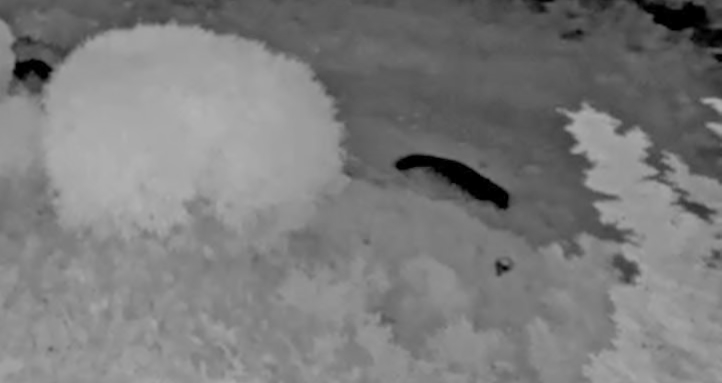
Nicole sent us a video from her home night vision camera that is two blocks from Shark River Park in Neptune Township. She believes it captured fishers in her yard. She saw at least 3 of them - 2 near her landscaping bed (seen in the screen grabs here) and at least one near the street.

Nicole says they look a bit like minks but are larger than any minks she has seen in the area. It's a tough identification - especially from the video - as the two look very similar.

We get several of these identification reports or questions each month and it is difficult to say for sure without the opportunity to examine the specimen up close (teeth, paws, etc.) Earlier someone commented with a link to a photo of a vulture with what appeared to be a small fisher.

Yes, you can and should report sightings of rare wildlife.

The mink is not threatened in NJ and has a trapping season. The fisher (Martes pennanti) was extirpated almost 100 years ago. That doesn't mean the fisher is extinct. That is when there is the complete disappearance of a species. Extirpation, also called local extinction, is the disappearance of a species only from a given area.

It is sometimes called a "fisher cat" or Appalachian black cat. It does look like a blend of a fluffy cat and a fox. But it's a lot meaner - closer to a wolverine.

Oddly enough, it is not a feline and it does not catch fish. It is in The fisher is a member of the Mustelidae family, which includes otters, badgers, martens, ferrets, minks, and wolverines.

Can you tell the difference between these two specimens?  One is a mink, one is a fisher.

Fisher or mink?               images via wikipedia commons
Fisher or Mink?
Through no efforts by the state's wildlife agencies, the fisher is again present in at least Sussex and Warren counties based on trappings by state officials. There are not many and they probably arrived because of re-introduction by New York and Pennsylvania in the last decade.

The fisher is a top predator but it disappeared from our state due to trapping for its pelt and because excessive logging practices during the 19th and 20th centuries caused populations beyond NJ and across its entire range.

This website has received reports on sightings, photos caught by trail cameras and anecdotal stories and questions from homeowners.

Did Nicole capture images of fishers?  It's possible. 

Want to know the answer to the identification of the two photos above? Take a look here and here.


Monday, August 24, 2015

New Jersey Furbearers

American mink
Despite the title of an online article, "The American Mink, one of N.J.’s most common semi-aquatic carnivore," I myself (and I suspect many readers) have never seen a mink in my Jersey travels. The mink (Mustela vison) is native to the state, although it is thought that escapees from mink farms have interbred with wild mink.

The mink is not threatened in the state and has a stable population. Not threatened, unless you consider that The New Jersey Hunting and Trapping Digest lists raccoon, skunk, opossum, weasel, mink, muskrat, red and gray fox, coyote, beaver, otter and nutria as species that have open seasons for trapping in the State of New Jersey. (In New Jersey, a Trapper Education course must be passed and a trapping license obtained to trap in the state - see http://www.state.nj.us/dep/fgw/trapping_info.htm)

Several of these species were not here historically or disappeared and have only returned through re-introductions.

Native to NJ are the river otter (Lontra canadensis), long-tailed (Mustela frenata) and short-tailed ermine (Mustela ermine). Also native are the striped skunk (Mephitis mephitis), raccoon (Procyon lotor) or gray fox (Urocyon cinereorgenteus).

Coyotes, which are now being reported with more frequency in the state, were never present in New Jersey until the past fifty or so years. Their appearance is due to many factors including habitat loss in their previous area of habitation. The current theory is that overall movement (based on DNA sampling) in the last century by the western coyote to the midwest, Great Lake states and through Lower Canada led to some western coyotes mating with gray wolves. Their offspring moved further eastward through Lower Canada and down through the New England states and into the Mid-Atlantic States.

NJ had gray wolves in the state until about the mid-1850s. Today, there are no wolves in New Jersey outside of zoos and preserves. But the eastern coyote appears to be here to stay.

Some of our other furbearing creatures past and present include:
  • Marten (Martes americana) historically present but extirpated since the mid-1800s
  • The fisher (Martes pennanti) also extirpated but again present in Sussex and Warren counties although few in number. Probably due to re-introduction by New York and Pennsylvania in the last decade
  • Beaver (Castor canadensis) had almost disappeared from here by the early 1800s. It is believed that some escapees from the Rutherford-Stuyvesant game preserve in Allamuchy, Warren County established a breeding population. Restocking enabled the beaver to re-establish itself by the mid-20th century. 
  • Most common to us is the raccoon which is, was and has always been a native of New Jersey and was a species that the British explorers to this new land reported, since they did not exist in Britain.
  • Opossum (Didelphis virginiana) was thought to be numerous in the central and southern part of the state in the late 1860s, but in the last hundred years the range of both opossum and raccoons has extended much further north including into Canada where they historically never existed.
opossum