Showing posts with label reptiles. Show all posts

Wednesday, October 2, 2019

New Jersey's Smallest Turtle and State Reptile


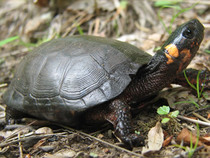
Photo of the Week - Bog Turtle (NJ)
Bog Turtle (NJ) - Photo: Rosie Walunas/USFWS

The Northeast is home to North America's smallest turtle, the threatened bog turtle. Its carapace measures about 10 centimeters (4 in) long when fully grown. The bog turtle is the state reptile of New Jersey.

The bog turtle (Glyptemys muhlenbergii ) is a critically endangered species of semiaquatic turtle in the family Emydidae. The species is endemic to the eastern United States. The bog turtle was listed as an endangered species in New Jersey in 1974, and in 1997, the US Fish and Wildlife Service included the bog turtle on its list of federally threatened species.

Although the bog turtle is similar in appearance to the painted or spotted turtles, its closest relative is actually the somewhat larger wood turtle. The bog turtle can be found from Vermont in the north, south to Georgia, and west to Ohio.

Diurnal and secretive, it spends most of its time buried in mud and during the winter months, it goes into hibernation.

The bog turtle is omnivorous, feeding mainly on small invertebrates.

The bog turtle has a low reproduction rate; females lay one clutch per year, with an average of three eggs each. The young tend to grow rapidly, reaching sexual maturity between the ages of 4 and 10 years. Bog turtles live for an average of 20 to 30 years in the wild. Since 1973, the Bronx Zoo has successfully bred the bog turtle in captivity.

Protected under the United States Federal Endangered Species Act, the bog turtle is considered threatened in Connecticut, Delaware, Maryland, Massachusetts, New Jersey, New York and Pennsylvania.

The invasion of non-native plants, especially purple loosestrife, reed canary grass, and reeds, into its habitat is a large threat to the bog turtles'survival. These thick and tall plants hinder the movement of the turtles and overtake the native species in the bog turtle's habitat.

The development of new neighborhoods and roadways obstructs the bog turtle's movement between wetlands, thus inhibiting the establishment of new bog turtle colonies.

Bog turtles are also illegally collected as pets.

Pesticides, runoff, and industrial discharge are all harmful to the bog turtles' habitat and food supply.

The rebounding of bog turtle colonies now depends on private intervention, land surveys, remote sensing and controlled burns to limit the encroachment of overshadowing trees and bushes.

As of 2018, the Department of Environmental Protection's Endangered and Nongame Species Program estimates that there are fewer than 2,000 of these inhabitants of groundwater-fed freshwater wetlands left in the state.

MORE


Monday, June 10, 2019

Snakes in New Jersey

Common and non-venomous eastern garter snake (Thamnophis sirtalis sirtalis)
Photo: Wilson44691 - Own work, Public Domain   

New Jersey is home to 71 species of reptiles and amphibians. The Division of Fish and Wildlife's "Field Guide to Reptiles and Amphibians of New Jersey" lists reptiles and amphibians and links to fact sheets excerpted from the Field Guide to Reptiles and Amphibians of NJ. The frogs and toads also have a link to each species' calls which are shortened versions of those found on the vocalization CD. This online field guide is intended to provide instant access to pictures, maps, calls and descriptions for New Jersey’s reptiles and amphibians.

In this post, we are focusing on New Jersey's snakes. People more often than not have a fear of snakes. Much of that fear comes from a lack of ability to distinguish species and a fear that a snake id dangerous/venomous.

On this site, we often get comments about snakes that are almost always misidentifications. The most common misidentifications are about venomous snake sighting. We only have two venomous snakes in the state - the Northern Copperhead (more common to the northern part of the state) and the Eastern Timber Rattlesnake (more common in the south).

Northern Watersnake, Nerodia sipedon, non-venomous and found in NJ

Water moccasin or cottonmouth, not present in NJ,
venomous and sometimes misidentified for a water snake
Photo by Ltshears - Own work, CC BY-SA 3.0

  1. Black Rat Snake    Elaphe o. obsoleta
  2. Corn Snake (E)    Elaphe g. guttata
  3. "Coastal Plain" Milk Snake    L. t. triangulum X L. t. elapsoides
  4. Eastern Garter Snake    Thamnophis s. sirtalis
  5. Eastern Hognose Snake    Heterodon platyrhinos
  6. Eastern Kingsnake    Lampropeltis g. getula
  7. Eastern Milk Snake    Lampropeltis t. triangulum
  8. Eastern Ribbon Snake    Thamnophis s. sauritus
  9. Eastern Smooth Earth Snake    Virginia v. valeriae
  10. Eastern Worm Snake    Carphophis a. amoenus
  11. Northern Black Racer    Coluber c. constrictor
  12. Northern Brown Snake    Storeria d. dekayi
  13. Northern Pine Snake (T)    Pituophis m. melanoleucus
  14. Northern Redbelly Snake    Storeria o. occipitomaculata
  15. Northern Ringneck Snake    Diadophis punctatus edwardsii
  16. Northern Scarlet Snake    Cemophora coccinea copei
  17. Northern Water Snake    Nerodia s. sipedon
  18. Queen Snake (E)    Regina septemvittata
  19. Rough Green Snake    Opheodrys aestivus
  20. Smooth Green Snake    Opheodrys vernalis
  21. Southern Ringneck Snake    Diadophis p. punctatus
  22. Northern Copperhead    Agkistrodon contortrix mokasen
  23. Timber Rattlesnake (E)    Crotalus horridus


Wikipedia also has a useful list of snakes in New Jersey with links to individual articles about each species with photos. See wikipedia.org/wiki/List_of_snakes_of_New_Jersey

Timber rattlesnake Photo by Kris Schantz via state.nj.us/dep/

Northern copperhead Agkistrodon contortrix mokasen, one of two venomous snakes found in New Jersey
Photo: Public Domain

Tuesday, June 19, 2018

The Bog Turtle Is Now NJ's Official Reptile

The bog turtle is a tiny, dark turtle with a distinct orange patch
 behind the tympanum (ear membrane) on either side of the head.

The bog turtle is now the state’s official reptile following legislation signed by Governor Phil Murphy.

The Endangered and Nongame Species Program estimates that there are fewer than 2,000 of these inhabitants of groundwater-fed freshwater wetlands left in the state.

Once abundant in New Jersey, this secretive, palm-sized turtle today is now endangered and found only in rural areas such as Sussex, Warren, Hunterdon, and Salem counties.

Bog turtles have very specific habitat needs and are very sensitive to changes to its environment. The DEP has been working to protect land around high-priority populations, restoring habitat by eliminating invasive plant species, and identifying critical movement corridors.


Bog Turtle Fact Sheet

Wednesday, June 15, 2016

Diamondback Terrapins


There is a proposed ban on the commercial harvesting of diamondback terrapins in New Jersey. These turtles could be on the edge of extinction if more measures are not taken to protect them.

In 2013, the Fish and Wildlife Service alerted the state that it had discovered several harvesters had illegally trapped 3,522 adult terrapins from South Jersey marshes for sale to an aquaculture facility in Maryland for breeding.

This medium-size turtle is the only species in the world that lives exclusively in brackish waters with some salinity. It has a patterned brown, black, and sometimes orange and yellow carapace.

They are vulnerable to overharvesting because they "brumate," or hibernate in the mud, at shallow depths, in large clusters during the winters. Commercial harvesters currently are permitted to collect them by hand in New Jersey, but wildlife investigators found many terrapins were raked from the marshy bottom by illegal harvesters using crab dredges and were then scooped into nets.

After the discovery of the illegal harvesting, the Fish and Wildlife Service recommended the state "immediately close the season . . . and begin to develop a longer term solution," the DEP said. The season this year was curtailed in January.

The federal government classifies the terrapin, known as Malaclemys terrapin, as a species of "special concern" and the majority of the states where the terrapins reside have already imposed complete bans or strict controls. Maryland has prohibited all harvesting since 2007, and Delaware places a limit of four terrapins per day during its designated season. Some states, including Rhode Island, have declared the terrapin an endangered species. New Jersey and New York are the last to take action on the terrapins.

SOURCES:

articles.philly.com

www.dailyitem.com/news/

Tuesday, July 9, 2013

Northeast Partners in Amphibian and Reptile Conservation Meeting

The NJDEP Division of Fish and Wildlife is reminding the public that the 2013 annual meeting of the Northeast Partners in Amphibian and Reptile Conservation (NEPARC) will be held at the New Jersey School of Conservation in Branchville, July 24-26.

The conference provides a forum to discuss NEPARC projects, hear presentations on various herp conservation and research activities, network and enjoy the company of like-minded herp enthusiasts, and elect officers.

Visit the NEPARC webpage at http://www.northeastparc.org/meetings/  for registration information and additional details.

Saturday, February 25, 2012

Endangered or Just In Danger Amphibians and Reptiles

A yellow spotted salamander changing lanes

If the unusually warm weather and crocuses blooming in your garden haven't been harbingers of spring, then note that the amphibian migration has begun across a good part of New Jersey.

With the rain yesterday being just about the right temperature, some eager salamanders and frogs are moving to their breeding pools.

Unfortunately, our "Garden State" is also a highway state and crossing is quite dangerous for those creatures. There are some people out there helping out, but keep a watchful eye when driving on rainy nights if you can.

An article in The New York Times, "Bucket Brigade Gives a Lift So Salamanders Can Live to Mate", describes one group of "salamander people" in Mississippi  are out on these rainy, early spring nights scooping up salamanders to help them cross the road. These "herpers" who search for and aid the amphibians or reptiles do their part to try to protect endangered, threatened and just plain in danger creatures.

Some salamanders can live up to 30 years, so they have been down this road (well, really, across this road) before. But they procreate only once a year.

I have written earlier here about similar projects in New Jersey. Saving other, more lovable species might be easier to get attention, volunteers and funding.

The NJDEP, Division of Fish and Wildlife’s Endangered and Nongame Species Program (ENSP), the Conserve Wildlife Foundation of NJ, and the NJ Audubon Society have been partners on the Amphibian Crossing Survey Project. Since 2002, they have been working to protect early-spring breeding amphibians like the wood frog, spotted salamander, jefferson salamander, and spring peeper during their annual migrations, which often lead them across perilous roadways. Volunteers help monitor sites in northern NJ (resources are limited, so that has been the focus area) particularly Warren, Passaic and Morris County. But they also help to identify additional crossings throughout the state.

A single vehicle can crush dozens of the slow-moving animals as they try to cross the road during migration. For example, some major amphibian road-crossings occur in West Milford in Passaic county. On rainy evenings from late February through March, teams of volunteers will be serving as “Crossing Guards” - slowing traffic, moving amphibians across the road, and collecting data about the migration.

According to the ENSP, amphibians are regarded by many scientists as indicators of a region's health and as the first indicators to harmful environmental changes such as pollutants and higher aquatic temperatures. Basically, if we see problems in the amphibian community, it’s just a matter of time before larger organisms (such as birds, mammals, and humans) will be affected as well.

Amphibian populations are declining worldwide as a result of a number of factors, including water pollution, increased pesticide use, and habitat loss, which is the most significant factor for all of New Jersey's species of conservation concern.

Amphibians depend on both terrestrial and aquatic habitats throughout their life cycles. The loss of forests and wetland habitats, including clearing forests, filling in vernal pools, and development that leads to changes in the water table that dry out critical wetlands, only add to these critters’ plight.

Finally, fragmentation of habitat can also play a critical role in the demise of an amphibian population as they attempt to travel from one area to another. Amphibians become easy prey targets in open habitats (lawns, driveways, roads) and at barriers such as curbs and fences that are often impossible to cross.

A spotted salamander being helped across a road.

The Conserve Wildlife Foundation of New Jersey has assembled a resource package to help teachers educate students about New Jersey's reptiles and amphibians. The package includes the Field Guide to Reptiles and Amphibians of NJ and Calls of NJ Frogs and Toads CD, and a teacher's guide full of activities and lesson plans for grades 5-9. The activities are correlated to the state's Core Curriculum Content Standards.

Resource Package Flyer and Order Form (pdf)

Thursday, January 21, 2010

Threatened Northern Pine Snakes

Northern pine snake on sand

The northern pine snake is a relatively large (5-7 feet or 122-172 cm) black and dull white to yellowish or light gray snake. These snakes have blotches that are dark towards the front of the body but may fade to brown near and on the tail.

Known for their noisy hiss, pine snakes are typically ground dwellers and rarely climb vegetation. Since this species is both secretive and fossorial (it burrows underground), it can easily go undetected even in locations where it is known to be common

Let's start out by saying that the pine snake is a nonvenomous constrictor. It kills its prey by coiling itself around it in order to suffocate the animal. Pine snakes are known to eat mammals as large as rabbits, as well as small rodents and birds. They are usually most active in early morning or late afternoon when they leave their burrows to hunt.

The Northern pine snake (Pituophis melanoleucus melanoleucus) is a threatened species in New Jersey and was the September Species of the Month. The designation was part of a yearlong program to commemorate the 30th Anniversary of the New Jersey Endangered Species Conservation Act and the formation of DEP's Endangered and Nongame Species Program (ENSP).

Pine snakes are egg-layers and typically lay their eggs in underground nests that they excavate in open sandy areas. Eggs are usually laid in mid-summer, and adult females have the tendency to re-use their nest sites year after year.

Pine snakes in New Jersey require dry pine-oak forest types growing on very infertile sandy soils such as Lakehurst or Lakewood sands (Burger and Zappalorti 1988, 1989). Both human-caused and natural disturbances (e.g. agriculture, forestry, and fire) are probably involved in creating the types of openings important for nesting and basking. Sandy infertile soil not only provides for persistent openings in disturbed sites, but may also be important because pine snakes are the only snakes known to dig hibernacula and summer dens.

The secretive nature of this snake has lead to some degree of uncertainty about its overall status in the northeastern United States. All indications seem to suggest that pine snake abundance has decreased throughout its northeastern range, however. It is also believed that pine snakes have been extirpated from West Virginia and Maryland. The
New Jersey Pinelands may hold some of the largest populations of pine snakes in the Northeast, but even in the Pinelands this species is at risk.

If unexpectedly encountered on the trail or in the woods, this large, white-and-black patterned snake would most likely vibrate its tail, hiss loudly, and then try to escape. Though its bold appearance and actions may fool or scare some people, this particular species of snake is not venomous. In fact, it is harmless to people and is a beneficial predator in nature.

There are four types of pine snakes that can be found in the United States. The northern pine snake is found in the Northern and Eastern-Central regions of the country, in areas with sandy soils and dry upland forests. The population distribution of this pine snake is spotty and all indications suggest that pine snake abundance is decreasing throughout the Northeastern region.

Coiled Northern pine snake

The northern pine snake populations in New Jersey have been affected by a loss of habitat due to development, illegal collecting (due to its popularity as a pet), and other more individualized behavior such as the thoughtless killing of snakes by hikers, automobile drivers and users of off-road vehicles. Never kill a snake if encountering one in a natural area, either when you are traveling on foot or in a vehicle. Back away slowly and do not disturb it.

Anyone who is interested in reptiles and amphibians and enjoys being outdoors can become a volunteer with the Herp Atlas Project. Department staff and volunteers are collecting data on the locations and abundance of all reptile and amphibian species throughout the state. This data will be used to map the critical habitat and distribution of these species, which will allow the agency to better plan for the state's wildlife conservation efforts. Department staff would like to learn about your sightings of an endangered, threatened or rare species in New Jersey. To file a report of a sighting, download and complete the Threatened and Endangered Species Report Form. This data helps biologists and wildlife managers to look at habitat and population trends and then develop appropriate conservation strategies.

Monday, December 14, 2009

Continued Pine Snake Protection Recommended


In another clash of man and wildlife, the Endangered and Non-game Species Advisory Committee has recommended that NJ maintain the threatened status for the pine snake.

The New Jersey Builders Association had filed a petition contending that the pine snake is actually abundant. The species causes problems for builders, particularly in South Jersey, where their protection can limit construction.

Data from state biologists is still being compiled for the NJ Department of Environmental Protection who will decide whether the snake gets continued protection. A final decision has not been made yet, but is expected this month.

The Northern pine snake (Pituophis melanoleucus) likes flat, dry, sandy areas. It is one of the few snakes that burrow in open sandy fields. Most adults are 4-6 in length. It is most likely to be seen in June and July in the afternoon. It feeds on rabbits, rodents, birds, and their eggs.

This snake uses constriction to overpower its prey. When approached it will loudly hiss and vibrate its tail causing most people to think it is a rattlesnake. Though this may work to its advantage is scaring humans, it also causes some people to think it is poisonous and they will try to kill it. A constrictor squeezes its prey and will not strike - in fact, it is fangless.

They are found in Atlantic, Burlington, Camden, Cape May, Cumberland, Gloucester, Monmouth, and Ocean counties.

New Jersey may have the largest single population of northern pine snakes.

It is a rather secretive species that spends most of its time underground, particularly in the sandy soils of South Jersey. The species is found exclusively within the southern half of the state in the Pine Barrens of the outer coastal plain.

Because they eat rodents, in some areas the removal of snakes from an area can cause an increase in the population of mice which in turn may increase Lyme disease. (Mice are the common carriers during the tick's first larvae stage with deer being the frequent carrier in the adult stage.)

Threats to the pine snake include an increase in natural predators, which includes coyotes and raptors. Of course, many of these raptors are themselves threatened or endangered, so this increase is actually a good thing overall.

Pine snakes are also threatened by increased vehicle traffic on the roads through the Pinelands National Reserve which encompasses 1.1 million acres of pine snake habitat. Reptiles need to move into the sun for warmth and will often use roadways which leave them open to traffic and raptors.

The petition by the builders to delist the snake is the first "formal" to question the protected status of a NJ species in the 35 years since the state passed endangered species legislation.

Saturday, December 5, 2009

Marine Turtles in New Jersey Waters

Green turtle surfacing for air
In New Jersey, we have 4 marine turtles that are protected.
  1. Atlantic loggerhead turtle, Caretta caretta - NJ Status: Endangered, Federal Status: Threatened
  2. Atlantic leatherback turtle, Dermochelys coriacea, NJ & Federal: Endangered
  3. Kemp's ridley turtle, Lepidochelys kempi, NJ & Federal: Endangered
  4. Atlantic green turtle, Chelonia mydas, NJ  & Federal: Threatened
  5. Atlantic hawksbill turtle, Eretmochelys imbricata, NJ & Federal: Endangered
Last week, cold-stunned Kemp's Ridley sea turtles began to wash up on Cape Cod beaches which unfortunately marks the beginning of the turtle stranding season here in the Northeast.

As water temperatures dip below 50 degrees, it becomes too cold for the sea turtles. These species should have moved south for the winter by now, but some marine reptiles get fooled by ocean anomalies around Cape Cod and Long Island.

Turtles described as "cold stunned" are in a torpid state with heart rates slowing down to as low as one beat a minute. They can appear to be dead, but this state actually allows the turtles' bodies to survive as the turtles can bury themselves in the mud on the bottom of the sea and survive for a few weeks in waters below 50 degrees.

Of course, they can survive the entire winter that way, so stragglers that wash up on the beach can be rescued by volunteers.

Unlike land turtles from which they evolved more than 150 million years ago, sea
turtles spend almost their entire lives in the sea. When active, they often come to the
surface to breathe, but can remain underwater for several hours at a time while resting.

Leatherbacks can dive to more than 3,000 feet below sea level. Their habitat preference is based on their preferred diet. Adult green turtles are herbivores, or plant eaters. All the other sea turtles are either carnivores (meat-eaters) or omnivores that eat both plant matter and meat.

Kemp's Ridley

The Kemp's Ridleys, which hatch off the coast of Mexico, are the most endangered of the sea turtles in our water. Kemp's ridley is the smallest of all sea turtles. From above, the short, chunky shell appears broadly heart-shaped to nearly round, with high vertebral projections and serrated edges. Adults weigh between 35 and 42 kg (77-92 lbs.).

The leatherback is the largest of all sea turtles. In fact, the leatherback is one of the largest living reptiles (only some species of crocodiles are larger). It is easily distinguished by its black, leathery skin, huge, spindle- or barrel-shaped bodies and long flippers. Adults generally weigh between 290 and 590 kg (638-1298 lbs.), but can weigh up to 2,000 pounds.

The most colorful sea turtle, the medium-sized hawksbill turtle has an elongated, oval shell
distinguished by overlapping scutes on the carapace.Color varies widely, from very bright colors to heavy dark brown (in the eastern Pacific).

Overharvesting of eggs for food, intentional killing of adults and immatures for their shells and skin and incidental drowning in commercial fishing gear are primarily responsible for the worldwide decline in sea turtle populations. Coastal residential and resort development has also degraded nesting habitat, and pollution of oceans threatens foraging habitats.

The federal government listed the Kemp's Ridley as endangered in 1970, the same year it also listed hawksbill and leatherback turtles as endangered. In 1978, it listed loggerheads as threatened and green turtles as threatened and, in the case of the green turtle's Florida and Mexico breeding populations, as endangered. New Jersey classified the species in 1979.

Thursday, September 3, 2009

Teaching NJ's Herptile Wildlife Species


Southern leopard frog
seen in Double Trouble State Park,
Lacey & Berkeley Townships, NJ.
Originally uploaded by Brett NJ


The Division of Fish and Wildlife has a educational materials focusing on the state's amphibian and reptile (herptile) wildlife species.

The Conserve Wildlife Foundation of New Jersey has assembled a resource package to help teachers educate students about New Jersey's reptiles and amphibians.

The package includes the Field Guide to Reptiles and Amphibians of NJ and Calls of NJ Frogs and Toads CD, the Field Guide to Salamanders, Frogs and Toads of New Jersey's Vernal Pools and a teacher's guide full of activities and lesson plans for grades 5-9.

The activities are correlated to the state's Core Curriculum Content Standards.

Resource Package Flyer and Order Form (pdf, 50kb)

Below are links to pages concerning New Jersey's herp populations.

Field Guide to Reptiles and Amphibians of NJ and related CD
Field Guide to Reptiles and Amphibians of NJ and Related CD Order Form
Herp Atlas Project

Sunday, April 12, 2009

Listen to Some NJ Frogs and Toads

New Jersey is home to 71 species of reptiles and amphibians. In an effort help residents and visitors of the state accurately identify these species, the Division of Fish and Wildlife has created a "Field to Reptiles and Amphibians of New Jersey" with a companion audio CD.

The CD, "Calls of New Jersey Frogs and Toads", was created to help with the identification of the 16 species of calling amphibians found in the state.

The links below will take you to fact sheets about each species (pdf) and 16 of those audio files that are available online.

  1. American Toad Bufo americanus call
  2. Bullfrog Rana catesbeiana call
  3. Carpenter Frog Rana virgatipes call
  4. Eastern Spadefoot (toad) Scaphiopus h. holbrookii call
  5. Fowler’s Toad Bufo woodhousii fowleri call
  6. Green Frog Rana clamitans melanota call
  7. New Jersey Chorus Frog Pseudacris triseriata kalmi call
  8. Northern Cricket Frog Acris c. crepitans call
  9. Northern Gray Treefrog Hyla versicolor call
  10. Northern Spring Peeper Pseudacris c. crucifer call
  11. Pickerel Frog Rana palustris call
  12. Pine Barrens Treefrog (T) Hyla andersonii call
  13. Southern Gray Treefrog (E) Hyla chrysoscelis call
  14. Southern Leopard Frog Rana utricularia call
  15. Upland Chorus Frog Pseudacris triseriata feriarum call
  16. Wood Frog Rana sylvatica call


Pine Barrens Treefrog photo by Breck Kent