Showing posts with label watersheds. Show all posts

Sunday, March 17, 2019

Rivers, Streams, Watersheds and Urban Oases


I love finding little urban oases hidden away in our densely populated state. They are often found surrounding little streams, creeks and ponds. It's easy to write about the Jersey shore and the Pinelands and Highlands, but most of us live in less natural areas of the state.

I have explored all of the little streams, creeks and ponds in my area. For example, in my part of North Jersey, I know of five little streams that flow eastward through neary Montclair. There is Toney's Brook in the center, Nishuane Brook in the southeast, the Wigwam Brook in the southwest, the Pearl Brook in the northwest, and the Yantacaw Brook in the northeast. They are all part of the Passaic River watershed. (Montclair is just north of the northern border of the Rahway River watershed.)

The Yantacaw and Toney's brooks are dammed in parks to create ponds. The Wigwam, Nishuane, and Toney's brook flow into the Second River, and the others flow into the Third River. At one time, north of Bloomfield Avenue between Grove Street and Pine Street there was another dam and another pond that powered a factory.

The Third River is called that because it is the third (upstream) main tributary of the Passaic River in the northern portion of New Jersey. The Third River (AKA Yanticaw River) originates in the Great Notch from the Great Notch Reservoir in Woodland Park, New Jersey. It runs through the towns of Little Falls, Clifton and Montclair, goes into Clifton a second time, then runs through Bloomfield, through the grounds of the Upper Montclair Country Club, the Glen Ridge Country Club, and Bloomfield's North Middle School where it forms Clarks Pond.

Clarks Pond is a good example of a little oasis. (It should not be confused with Clarks Pond Fish and WMA in Cumberland County) The pond is sometimes used by the school's science classes to help teach biology.

The pond has an elevation of 48 meters, or 157 feet and is at Latitude: 40-49'30'' N and Longitude: 074-10'47'' W (40.8251; -74.1795891) if you like precision.

This is a NJDEP-stocked Brook Trout Pond. The 12 acre pond and wooded area is located in back of the Middle School. I recently visited on a weekend so as not to disturb school activities and be assured of parking. I saw two egrets doing some fishing. No other humans that day were fishing or visiting.

If you want to visit, set your GPS for 60 Huck Rd, Bloomfield, NJ 07003.  The school is at the end of Huck Rd and you can park in the Middle School parking lot.

Friday, July 27, 2018

Be a Watershed Steward in New Jersey


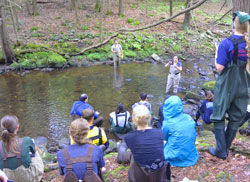
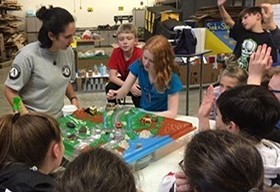
The NJDEP is seeking recruits for its AmeriCorps New Jersey Watershed Ambassadors, a program that engages communities to protect and improve water quality. Watershed Ambassadors are the DEP’s facilitators in the field, collecting water quality information, giving presentations on clean water and championing partnership projects in which the public help make a difference in their communities.

New Jersey's waters are a valuable and vulnerable resource. The AmeriCorps New Jersey Watershed Ambassadors Program plays an important role in raising awareness of how human activities can affect water quality, especially in the most densely populated state in the nation. Each year, a new group of 20 Watershed Ambassadors engage with community members, channeling awareness into action.

The program is now in its 18th year and is administered by the New Jersey Department of Environmental Protection, Division of Water Monitoring & Standards. The goals of the program are to promote watershed stewardship through education and direct community involvement, and to monitor stream health through performing visual and biological assessments. Individual AmeriCorps members are assigned to each of New Jersey's 20 watershed management areas (WMAs) to serve as "Watershed Ambassadors" to their watershed communities.


Info on the Watershed Ambassadors Program
More info in DEP news release

Monday, March 28, 2016

Two Sides of the Sparta Mountain Forest Proposal

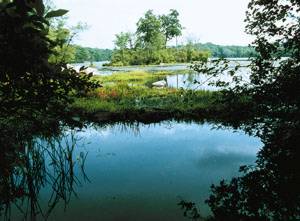
Ryker Lake,one of several bodies of water on the Sparta WMA | Photo by Wilma Frey

Sparta Mountain was preserved as part of the continuous forest of the Highlands that protects the drinking supply for half of New Jersey’s residents. But a proposed logging project may threaten that with increased silt and run-off that will affect trout streams and also that very high water quality water supply.

The NJDEP Division of Fish and Wildlife partnered with the NJ Audubon Society to revise the existing Forest Stewardship Plan (FSP) for the 3,461-acre Sparta Mountain Wildlife Management Area in Sussex County.

NJDEP states its primary goal of the plan is to "maintain ecosystem health, diversity, and integrity by creating a greater balance among the stages of forest succession throughout the property, minimizing further distribution of invasive exotic species, and enhancing biological diversity through responsible silviculture and mimicking natural 'gap disturbances'."


But some people view this "management" as just creating a different habitat more suitable for hunting. Groups such as the NJ Sierra Club say this proposal not only threatens the environment, but it will also interfere with public access, recreation, and hiking.

What NJDEP calls the "Sparta Mountain WMA Forest Stewardship Plan," environmental groups call "logging" and "clear-cutting" and a plan to "turn the Mountain into a field for bird habitat and deer over-population."

You only have until March 31st to let your feelings about this proposal be known, and can post those comments online for the NJDEP at http://www.state.nj.us/dep/fgw/spartamt_comments.htm

Friday, March 18, 2016

The New Jersey Highlands and Watersheds


The New Jersey Highlands are part of the Appalachian Mountains that run along the East Coast from Maine to Georgia, as does the Appalachian Trail.

This region of New Jersey is almost 860,000 acres of forested ridges, farmlands, and a variety of recreation, wildlife and historic gems.

It is also a very important watershed that is continually being threatened and defended to be preserved from pollution and development. It provides more than half of New Jersey's population with clean drinking water. It also supplies industry with water.

The Highlands stretch about 60 miles across our state from Phillipsburg in the southwest to Oakland in the northeast. Of course, it extends, as the map shows, beyond New Jersey.

It covers portions of seven northwest New Jersey counties — Bergen, Hunterdon, Morris, Passaic, Somerset, Sussex, and Warren — and more than 88 municipalities.

One of the main objectives of the Highlands Act was to protect the watershed.

I continue to believe that water will be the oil of the future - an investment that will grow in the very near future.

In 2004, Governor McGreevey signed the Highlands Act into law to establish an independent Highlands Water Protection and Planning Council. they were charged with creating a regional master plan.  That plan was meant to guide development into appropriate areas and protect water resources, forests, critical wildlife habitat, farmland, historic sites, recreation and scenic beauty.

To learn more about the Highlands and what is being done to protect it, go to state.nj.us/njhighlands. and www.njhighlandscoalition.org


Monday, November 30, 2015

Mount Rascal Preserve Now More Than 400 Acres


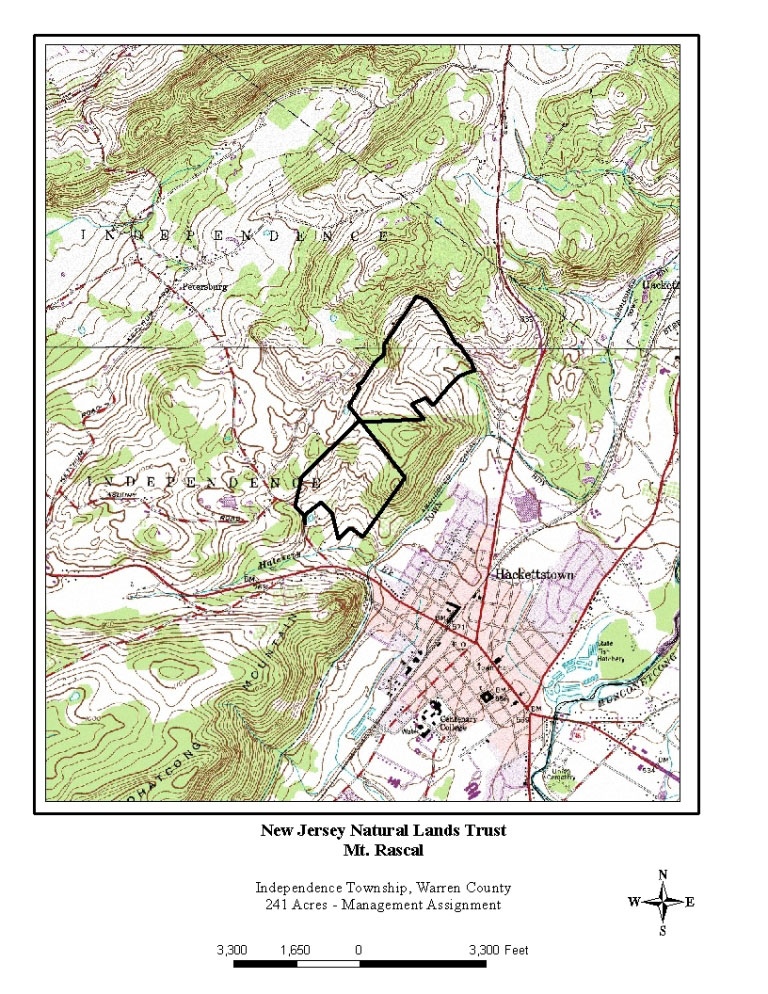
The Mount Rascal Preserve in Warren County now includes the wooded mountain summit for which it is named, as well as a half-mile section of the historic Morris Canal.

The preservation of these 113 acres also protects water quality in the New Jersey Highlands. The newly-preserved property in Independence Township and Hackettstown brings the Mount Rascal Preserve to more than 400 acres and expands access and hiking opportunities. It includes part of the watershed of the Bowers Brook, a headwaters tributary of the Musconetcong River.

The NJDEP Green Acres Program, Warren County, New Jersey Conservation Foundation, Open Space Institute and William Penn Foundation partnered to purchase the land in two parcels.

On November 12, Warren County purchased 46.5 acres that include the canal section and the Bowers Brook, and then on November 20, the state purchased 66.5 adjoining steeply sloped acres at the top of Mount Rascal. The county was assisted by New Jersey Conservation Foundation, which provided funding from the William Penn Foundation and the Open Space Institute toward the purchase.

More at www.njconservation.org/

Monday, July 16, 2012

Applications Being Accepted for Watershed Ambassadors Program

New Jersey is looking for its next generation of environmental leaders, young people with a hands-on desire to improve their state and the quality of life for all of our residents. Some of those future leaders are likely to be found in the Department of Environmental Protection's AmeriCorps Watershed Ambassadors Program, which is now seeking recruits for its 2013 class.

Coordinators are currently accepting applications for the next group of AmeriCorps Watershed Ambassadors through Aug 17. There are 20 potential watershed management areas across the state where an ambassador can be placed. Ambassadors work with all sectors of society to improve the quality of New Jersey’s waterways, nurturing community-based environmental activities, and empowering State residents to make responsible and informed decisions regarding their watersheds.

“Individuals who are selected for the Watershed Ambassadors program go through a rigorous training program that prepares them to work in the environmental field, particularly in the area of water resources,” said Jill Lipoti, DEP’s Division of Water Monitoring and Standards Director. "Ambassadors have proven to be extremely valuable resources in assisting the State in fill water quality information gaps.”

The DEP began hosting this federal AmeriCorps program in 2000. AmeriCorps is a national service initiative that began in 1993 and is also known as the domestic Peace Corps. The organization recently announced grants for programs, nationwide. New Jersey’s Watershed Ambassador Program was a recipient and received $260,000 in federal funding for 2013.

Ambassadors are expected to complete 1,700 hours of service in a 10 to 12 month period. In return, they receive a living stipend of up to $12,100 over the course of the term; eligibility for health benefits during this period; and training prior to and throughout their term of service.

Applicants must be U.S. citizens, have a Bachelor's Degree, and must have a valid driver’s license and reliable transportation to get to and from field sites.

In 2012, 20 individuals served as the DEP’s AmeriCorps Watershed Ambassadors. Current accomplishments to date include:

Nearly 600 visual and biological assessments completed:
  • Second year implementation of a new protocol for assessment of 100 lakes and 20 climate change stations;
  • 1,163 volunteers trained in the DEP’s visual and biological assessment protocols;
  • 1,294 educational watershed demonstrations performed reaching 25,944 people;
  • Engaged in community watershed projects generating about 7,000 stewardship hours;
  • Served as captains for Governor Christie’s Barnegat Bay Blitz initiative;
  • Serve as captains for Delaware River and Bay – Dash for the Trash Cleanups to commemorate National AmeriCorps Week

Interested applicants for the 2012-2013 Program should apply by August 17 online or by sending a resume and cover letter to the address on the website nj.gov/dep/newsrel/2012/12_0076.htm