Showing posts with label horseshoe crab. Show all posts

Saturday, May 23, 2026

Horseshoe Crabs Return to Cape May County


In this annual rite of spring, the beaches of Cape May and the broader Delaware Bay region play host to one of the oldest, most spectacular wildlife phenomena on Earth: the mass spawning of Atlantic horseshoe crabs (Limulus polyphemus).

This ritual has been repeated for nearly 450 million years—meaning these "living fossils" arrived on these exact shores long before the first dinosaurs walked the earth.

While horseshoe crabs begin trickling onto the beaches in late April, the main event happens in May and June. The absolute peak centers around the Full and New Moons, specifically during evening high tides. May 2026 has two Full Moons to start and end the month.


Driven by the high spring tides, tens of thousands of crabs emerge from the deep bay waters simultaneously. Large, smooth-shelled females crawl up to the high-tide line, often trailing one or more smaller males holding onto her carapace (shell) with specialized, boxing-glove-like claws. The female digs a shallow nest in the sand to deposit up to 20,000 tiny, greenish-tan eggs. The males then fertilize them as the waves wash over the cluster.

At its height, the shoreline looks less like a beach and more like a cobblestone street paved in dark, gleaming, olive-green helmets jostling in the surf.

The arrival of the crabs triggers a second, equally spectacular natural event. The Delaware Bay is the largest horseshoe crab spawning site in the world, and the millions of eggs left in the sand are a vital fuel source for migrating shorebirds.


Among these birds is the Rufa Red Knot, a threatened species undertaking an incredible 9,000-mile journey from the tip of South America up to the Canadian Arctic. Cape May is their ultimate refueling station. The birds arrive emaciated, having lost up to half their body weight. They gorge themselves almost exclusively on the lipid-rich, easily digestible horseshoe crab eggs that are churned up to the surface by the waves.

In just about two weeks, a Red Knot must double its body mass to survive the final leg of its journey north to breed. Without a dense concentration of crab eggs, the birds cannot successfully reach the Arctic or reproduce.

If you head down to the Cape May area to see it, the Delaware Bay side beaches (like Reeds Beach, Cook's Beach, or Higbee Beach) offer far more intense spawning activity than the oceanfront Atlantic beaches, as the crabs prefer the calmer, wave-protected waters of the bay.

Because both the horseshoe crabs and the shorebirds are highly vulnerable, many of Cape May's key bay beaches are seasonally closed to the public during the peak weeks to prevent disturbing the birds. However, public viewing platforms and guided walks hosted by organizations like the Cape May Bird Observatory offer spectacular front-row seats to this ancient dance.


Thursday, May 1, 2025

Horseshoe Crabs By the Full and New Moons


horseshoe crabs spawning   (though I object to "invade" as the description)

Horseshoe crabs are commonly found along New Jersey's Delaware Bay beaches, particularly in May and June when they come ashore to spawn. The most significant concentration of spawning horseshoe crabs occurs in the middle reaches of the Delaware Bay. Beaches in Cumberland and Cape May counties are known for high horseshoe crab activity during this time. 

May 12 is the Full Moon, and the 26th is the New Moon and next monthJune 11 is the Full Moon date this year, with the New Moon on the 25th.

New Jersey is known for its sandy beaches, and horseshoe crabs can be found spawning all across the state. The most activity by far is found on the Delaware Bay coastline, in Cumberland and Cape May counties. (A map of spawning beaches

reTURN the Favor is a collaborative effort that enables organized volunteers to save horseshoe crabs stranded on New Jersey’s seasonally closed and open beaches. Since 2013, reTURN the Favor volunteers have been rescuing horseshoe crabs along New Jersey’s Delaware Bay beaches. The program has grown significantly over the past decade, substantially contributing to horseshoe crab conservation.


Sunday, April 20, 2025

Horseshoe Crab Workshop for Teachers


Horseshoe crab migration during mating season in Southern New Jersey

During the full and new moon events in May and June, thousands of horseshoe crabs come ashore to spawn, primarily in Delaware Bay. It is also during this time when migrating shorebirds descend upon the beaches to rest and feed on the horseshoe crab eggs before continuing onto their breeding grounds. This interaction between horseshoe crab, shorebird and humans makes it a perfect time for the latest edition of the Seussically-named Green Eggs & Sand (GE&S) workshop.

Green Eggs and Sand

May 3-4, 2025 Educator Workshop

at The Wetlands Institute, Stone Harbor, NJ

Registration Flyer 

The GE&S workshop focuses on promoting understanding of the issues, the science, and the management of the horseshoe crab/shorebird controversy. Workshop participants learn from top researchers and natural managers in the field, as well as get to visit a horseshoe crab spawning beach.

Educators and natural resource managers from Delaware, Maryland, and New Jersey developed the curriculum and designed it for use with middle and high school students. It is broken down into four modules that introduce students to the lives of horseshoe crabs, their extraordinary history, ecological niche, interrelationships with other species, and the challenges of managing horseshoe crabs.

Thursday, September 15, 2022

New Threat to Horseshoe Crabs and Red Knots

Horseshoe crabs in the Delaware Bay area play a vital role in the life cycles of migrating shorebirds. In the 1990s, horseshoe crabs were overharvested as bait, leading to dramatic drops in crab and red knot bird populations. Red knots are now listed as threatened under the federal Endangered Species Act.

New Jersey has tried to protect red knots for about 14 years by imposing a moratorium on harvesting horseshoe crabs for bait in state-controlled waters. (They can still be taken for their blood, which contains a chemical used by the biomedical industry.)

But a recent Atlantic States Marine Fisheries Commission (ASMFC) proposal would eliminate a longstanding policy decision not allowing the harvesting of any female horseshoe crabs until the populations of both crabs and red knots return to higher levels.

The American Littoral Society is urging citizens to add their voices to oppose the plan. Author and LBI resident Sandy Gingras has created an online petition at change.org/SaveHorseshoeCrabs to oppose the proposition that states:

The Atlantic States Marine Fisheries Commission has proposed a change in the rules governing the protection of horseshoe crabs.  They want to allow the “ harvesting” of female horseshoe crabs. We believe the horseshoe crab population is already dangerously low. And the shorebird population that feeds upon their eggs is also dangerously depleted. We opposed the fisheries’ change of policy and urge them to vote no to horseshoe crab addendum VII. 

The opposing view from the ASMF says that the proposed changes represent “a less than one percent chance of a red knot population decline due to the implementation of potential female harvest under the ARM Revision. Based on this analysis, the Service concludes that take, defined under the Endangered Species Act as killing or injuring of red knots, is not likely.”

The Atlantic States Marine Fisheries Commission is accepting public comments from now through Friday, Sept. 30. Comments should be emailed to comments@asmfc.org, with “Horseshoe Crab Draft Addendum VIII” in the subject line.

To learn more about horseshoe crabs, go to the Horseshoe Crab Recovery Coalition website at hscrabrecovery.org or the American Littoral Society website at littoralsociety.org/horseshoe-crabs.html

To find out more about red knots, go to the Cornell Lab of Ornithology website at www.allaboutbirds.org/guide/red_knot

More information on the FWS’s analysis of the ARM Framework Revision is available at fws.gov/media/us-fish-and-wildlife-service-evaluation-atlantic-states-marine-fisheries-commission-horseshoe

red knots    USFWS photo


Thursday, June 23, 2022

The Ancient Crab That Isn't a Crab

Fossil horseshoe crab dead in its tracks
Fossil horseshoe crab ancestor Mesolimulus an extinct arthropod


You might know that horseshoe crabs go back before dinosaurs. Their fossil ancestors lived 445 million years ago. (Dinosaurs appear about 200 million years later.) And they survived the extinction event that wiped dinosaurs from the planet 66 million years ago. 

There are 4 species today. In New Jersey, we know the species that is found in the Atlantic coastal waters of North America and the Gulf of Mexico. The three others are found in Asia’s coastal waters.

Did you know that are "blue bloods?" They don't have the hemoglobin that makes human blood red. Horseshoe crabs have hemocyanin which is also an oxygen-carrying protein that contains copper (our blood has iron) and that gives horseshoe crab blood a bright blue color.

That unique blood contains an enzyme that causes the blood to coagulate when exposed to deadly bacterial endotoxins, and so biomedical companies use this to test medicines, vaccines, and implants for endotoxins to insure it is safe for people. Unfortunately, many horseshoe crabs die in the process of collecting their blood. Scientists are now looking for synthetic alternatives to the enzyme.

These crabs walk on 10 legs (5 pairs) but they have another pair that they use to bring food to their mouths like arms. Without jaws, they crush worms, algae, clams, and other small prey from the ocean floor with those legs.

Those legs and its pointed tail look pretty scary to a child (and some adults!) but they are harmless. The tail (telson) is only used when a crab gets stuck upside-down so that it can flip over or as a rudder to swim upside down. When washed up on dry land, the tail isn't as effective, so if you see one it's safe to turn it over and get it back to shallow water.

That telson might not work as a sword but their tough shell is a pretty good defense for adults when they are right-side-up against other predators including sea turtles, sharks and gulls. 

Image by Chris Engel from Pixabay

Spotting a horseshoe crab in the water or on a beach is common enough at the Jersey Shore or in the bays that they even appear on t-shirts and as jewelry. Although you may spot this crab at any time of year on a Jersey beach, the most important time for them is from May to early June when they arrive on beaches to lay eggs.

The largest populations live in the Delaware Bay and they hit the beaches there during high tides that coincide with the full moon or new moon. Females dig nests in the sand and bury a cluster of about 4,000 tiny, blue-green eggs, and they can lay about 20 egg clusters each year.

That sounds like more than enough eggs but thousands of shorebirds also arrive there at that time to feast on the eggs. It is a critical food supply for migrating species such as red knots, ruddy turnstones, and sanderlings. The red knots need this final food stop before they complete their 9,300-mile migration from South America to the Arctic.

If eggs survive they will hatch in two to four weeks and the very vulnerable baby horseshoe crabs go to shallow, sheltered waters to live in for their first year as they grow and molt. 

Besides medical uses and marine and bird predators, humans use horseshoe crabs as bait to catch eels and whelk (sea snails), and that has really hurt crab populations in the past few decades.

The Atlantic horseshoe crab is currently considered “Near Threatened” by the IUCN. While not currently listed as a threatened species by the State of New Jersey, there is currently a moratorium on the harvest of horseshoe crabs within the state.

We always refer to this species as a horseshoe crab but they aren't crabs. They are arthropods and are more closely related to scorpions and spiders. They are the only living members of the Xiphosura order.

Horseshoe crab with shells 2
Sometimes you'll see them with some hitchhiking creatures attached to their shell

Tuesday, July 14, 2020

The Amazing Blue-Blooded Horseshoe Crab


Horseshoe crabs are not crabs, but they will always be called by that name.

Horseshoe crabs predate the dinosaurs having been on Earth an estimated 450 million years. That beats out that T-Rex by about 200 million years. 

One of their unique features is their blue blood. That blood is used by the pharmaceutical industry for testing drugs and so has caused their numbers to deplete.

They live in the ocean year-round and make one famous annual sojourn ashore to lay eggs in sandy, wet beaches. You may know that the Delaware Bay and New Jersey are very well known for this spring ritual which is quite amazing.

They are not crabs or even crustaceans because they lack antennae. On the arthropod family tree, they are classified as chelicerates, a subphylum that also includes arachnids - spiders. 

Although they are popularly called “living fossils,” they have evolved over the almost half a billion years. Fossils show us that they once had limbs that split out into two branches unlike their single one today.

Another misconception is that their spiked tail is used to "sting" prey or people. Not so. It is used as a steering rudder and to help right themselves after getting stuck on its back. Don't pick a live one up by the tail because it can break off and cripple the crab.

They eat aquatic worms, algae, carrion, and lots of clams and mussels. They mash food between the spiky upper regions of their legs before pushing it into the mouth. 

The full moons, new moons, and high tides of May and June are when the Delaware Bay has its Atlantic horseshoe crab spawning. It happens at night when a female comes ashore followed by male(s). Like turtles, she digs a hole and deposits her eggs but then males fertilize them. 

This event coincides with migrating shorebirds who gorge themselves on the nutrient-rich eggs which power birds, such as red knots, on their annual migration between the Arctic and South America. 

The horseshoe crabs lay many, many eggs because so many are consumed by the birds. The estimate is that a female can lay 90,000 eggs per clutch and that probably about a dozen of those will ever make it to adulthood. It's not just birds who are predators. The embryos are also eaten by fish and sea turtles.


Horseshoe crab blood contains copper which turns bluish-green when it oxidizes. They also have no infection-fighting white blood cells, but have special cells called amebocytes. This is what interested scientists who found that a vaccine or injectable drug is safe if the blue blood doesn't release the gooey amebocytes that means it did not encounter bacteria.

This makes horseshoe crab blood worth about $15,000 per quart. Though the crabs are released after extracting about 30 percent of its blood, about  0–15 percent of captured crabs die somewhere in the process. Harvesting restrictions have been set in places and researchers have been trying to develop synthetic amebocytes.

Admire these amazing creatures. If you see a live crab flipped on its back, listed by the shell and set it back into the water. They won't hurt you at all. And think about them the next time you get a safe vaccine or injection.
 
More at www.nwf.org

Underside of live horseshoe crab

Friday, May 8, 2020

TODAY: Introduction to Horseshoe Crabs in Delaware Bay

Join Quinn Whitesall for a Facebook Live event today at 11am to learn all about horseshoe crabs. 

Quinn will cover horseshoe crab anatomy, the crabs' significance to Delaware Bay ecology, threats they face, and what the American Littoral Society has been doing to protect them.


Tuesday, June 4, 2019

Horseshoe Crab's Crown

Book illustration by Valentina Gallup

With the New Moon and Full Moons, horseshoe crabs appear on the Delaware Bay shore of New Jersey. At the Jamaica Bay Wildlife Refuge, a free event on June 9th features the debut of Horseshoe Crab's Crown, a children's book by Heather feather about oceanic friends working together to make a better world.

The American horseshoe crab is not a true crab and is not even a crustacean. It is more closely related to spiders and scorpions than to crabs, shrimps, and lobsters.

Horseshoe crabs have been around for at least 450 million years, making them one of the oldest lineages of animals alive today. They were roaming the seafloor more than 200 million years before dinosaurs existed.

A live reading and puppet show will take place at 1:30 at the Jamaica Bay Wildlife Refuge. It will be followed by a reception from 2-4, where attendees can explore the book making process and see the watercolors up close and personal. Crowns or fancy hats are encouraged.

The exhibit, on the creation of the book, runs for two months. Books on sale at the Wildlife Refuge Store.

Sunday, June 9, 1:30 Reading by the author; 2:00 -4:00 PM Opening reception 1:30


Saturday, May 25, 2019

Horseshoe Crabs Come Ashore from the Delaware Bay


Each May and June, millions of Atlantic horseshoe crabs come ashore along the East Coast to spawn. The height is usually when there is a full moon or new moon, creating the highest tides of the month. 

The result is those familiar helmet-shaped shells of Limulus polyphemus and trillions of their greenish eggs.

At least 11 different species of shorebird rely on horseshoe crab eggs as their primary food source for about 2-3 weeks during their migration. Migrating to their breeding grounds in the Arctic, some come from as far away as the southern tip of South America. Recent declines in the horseshoe crab population have triggered similar and more drastic declines in shorebird populations.

Red knots feeding near horseshoe crab. Photo by Gregory Breese/USFWS


Horseshoe crabs are often called "living fossils" as they are thought to have changed very little in the last 450 million years. Scientists are still not sure if they were land-based arachnids that moved into the sea or an ancestor that stayed put in the oceans. Recent genetic research favors arachnids, placing them alongside spiders and scorpions.

The horseshoe crabs spawn from Maine to the Yucatan Peninsula, but our own Delaware Bay is the center of activity. The warm water and mild surf with sandy shores must be appealing because some of the crabs have come from more than 60 miles out from the continental shelf off the mouth of the bay.

The blue blood of the Atlantic Horseshoe crab is used in medical testing of equipment and vaccinations to detect bacterial contamination in minute quantities, and the crabs have always been harvested as bait. The Atlantic horseshoe crab is currently considered “Near Threatened” by the IUCN. While not currently listed as a threatened species by the State of New Jersey, there is currently a moratorium on the harvest of horseshoe crabs within the state. With this law, it is illegal to remove a horseshoe crab, dead or alive, from its habitat in the wild.


conservewildlifenj.org/species/fieldguide/view/Limulus-polyphemus/

fws.gov...Modeling-a-Future-for-Horseshoe-Crabs-and-Red-Knots


Wednesday, January 30, 2019

Division of Fish and Wildlife Videos

The Division of Fish and Wildlife has a growing library of videos depicting the many areas of research, management, and recreation it supports. Videos are hosted on the Department of Environmental Protection's Discover DEP YouTube Channel where visitors will find a range of videos.

Woodrat Research (video) 
Every October, the division's Endangered and Nongame Species Program set out traps to catch the only Allegheny woodrat species left in New Jersey  along the rocky cliffs at the Palisades Interstate Park. Once the woodrat is captured,  a tag is administered, and samples are taken so biologists can accurately monitor this endangered species striving population.


Horseshoe Crab Survey (video)
The NJ Division of Fish and Wildlife monitors horseshoe crab abundance with the Delaware Bay Horseshoe Crab Spawning Survey. The survey estimates spawning densities on Delaware Bay beaches. Our Marine Fisheries staff sample the spawning population on Fortescue Beach and Gandy’s Beach on the New Jersey side of Delaware Bay. Beaches are sampled at nighttime high tides of the new and full moons during the spring months. Data collected is helpful for scientists to track changes in numbers of spawning crabs in the area. DFW continues to work towards protection and improvement of horseshoe crab spawning habitat.


Wednesday, May 23, 2018

Horseshoe Crab and Full Moons

Each year, around the new and full moons of May and June, the Bureau of Marine Fisheries conducts a horseshoe crab survey at Fortescue Beach and Gandy's Beach on Delaware Bay. This year, the Full Moons are May 29 and June 28.

This survey involves heading out to the beach late at night and counting thousands and thousands of horseshoe crabs into the wee hours of the morning with a head lamp.

A tagged female (left) and male (right) horseshoe crab. Females are usually larger.

"A Night On the Horseshoe Crab Survey" is one of the Day In the Life Of a Marine Fisheries Hourly series on the NJDEP Division of Fish and Wildlife website. 

Other articles in this series:

Monday, June 5, 2017

Jersey Beaches, Crabs and Birds

With summer nearing, many of us in New Jersey are ready to drive down the shore. No matter how bad the Garden State Parkway traffic might be, you'll never have the journey that some take to get to a Jersey beach.

These beach visitors come early, mostly before the official Memorial Day weekend that unofficially open the season here. They are birds that have to supply their own nonstop 6,600 mile flight over the Amazon rainforest and ocean,

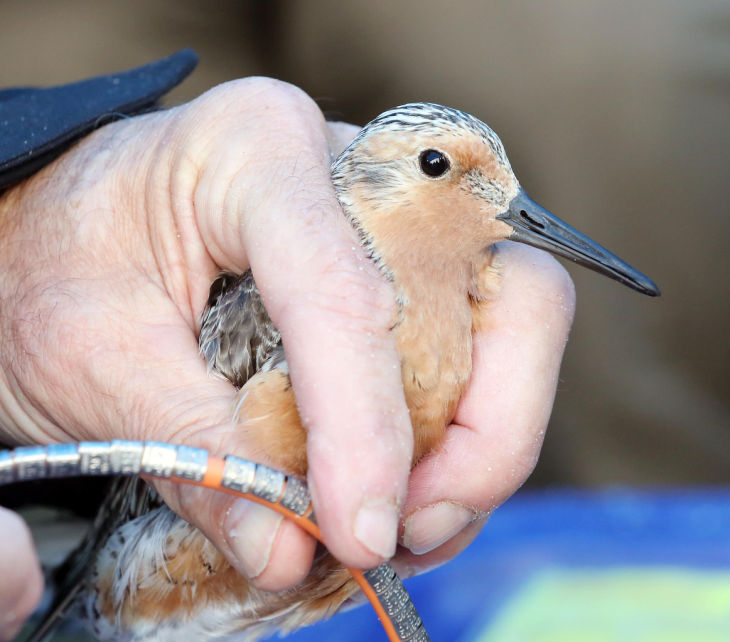
Red Knots
Red knots arrive in New Jersey very hungry and lightweight and bulk up to twice their weight by eating horseshoe crab eggs and adding about 3 percent of their body weight each day.

For thousands of years, this ritual journey has been reenacted and the Delaware Bay has been the critical food rest stop for migrating shore birds each spring.

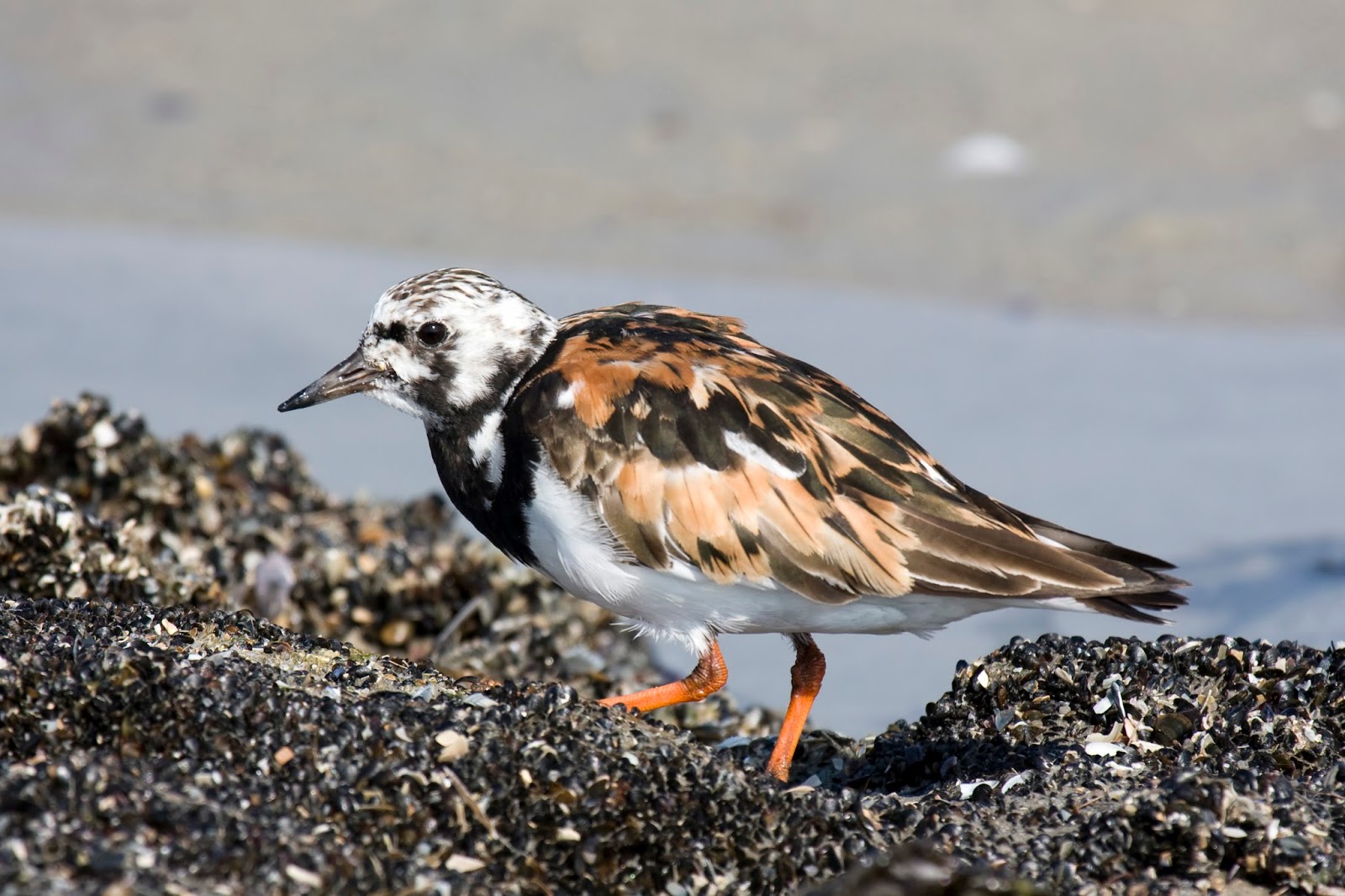
The red knots and ruddy turnstones are here around mid-May after their sojourn from South America.

Ruddy Turnstone
In the late 1800s and early 1900s, their stopover was not very satisfying. In those days, as many as 2 million horseshoe crabs were harvested each year and ground up as fertilizer for farms in South Jersey. That usage fell off as better fertilizers were found and was off by the 1960s.

There were a few decades when the main threat was fishermen who used the crabs for bait. In the late 1990s, the demand for them as bait for eel and conch fishermen increased. Those fishermen had been using shellfish bellies discarded by South Jersey processing plants, but when the processing plants started closing and waste disposal laws were made tighter, the supply disappeared.

The horseshoe crabs were also in demand for the biomedical industry. The crabs’ blue blood is used to make a clotting agent that helps detect human pathogens in patients, drugs and intravenous devices. Thankfully, in this process the crabs are returned to the water after blood is extracted, but not all survive the process. More than a half a million crabs were used for biomedical purposes in 2015.

Of course, not only were the crabs affected, but also the numbers of birds who were returning to the beaches.

After a steep population decline, a harvest management plan was put into place for horseshoe crabs in Delaware Bay, Where once 2.5 million crabs were taken annually, now New Jersey, Delaware, Maryland and Virginia harvesters are restricted to 500,000 male crabs and no females.

New Jersey has gone beyond the restrictions and has had a complete ban on horseshoe crab harvesting since 2008.


Horseshoe crabs at Reeds Beach

Hopefully, the Delaware Bay will remain the largest concentration of the prehistoric horseshoe crabs in the world. Red knot numbers have stabilized. Conservationists still work towards those numbers rebounding up. The red knot is considered threatened, and it is listed as endangered by New Jersey.

And after their visit to our state, the birds still have another 3000 miles to go to their breeding grounds in the Arctic. Think about that the next time you're stuck in Parkway traffic on the way to the beach.

Wednesday, April 19, 2017

Horseshoe Crabs and Shorebirds Return to Delaware Bay

USFWS Photo

Late April means that a ritual of "living fossils" moving onto beaches will happen again.

The Wetlands Institute newsletter reminded me that the migration and spawning of horseshoe crabs has been happening for more than 450 million years is here again.

And where is the largest population of spawning horseshoe crabs in the world? Delaware Bay.

They can be found from Maine to the Yucatan Peninsula. Limulus polyphemus, the American Horseshoe Crab, is actually more closely related to spiders, ticks, and scorpions than crabs.

The migration and spawning also brings shorebirds who are migrating from Central and South America to Delaware Bay for a rest stop and critical meal. The shorebirds have a 3,000 – 9,000 mile annual journey to their Arctic breeding grounds.

Humans have a variety of positive and negative interactions with horseshoe crabs.

  • Native Americans along the Delaware Bay and River ate their eggs. 
  • They were used as fertilizer and hog food in in the 1800s and it was an active industry on Delaware Bay.
  • Their white blood cells contain a chemical (LAL) used to test for contaminants in injectable drugs and vaccines and other medical applications.
  • They are still used as bait to catch eel and channeled whelk, mostly for overseas markets, but NJ has a moratorium on the harvesting of the crabs due to over-harvesting.
  • Development along the Delaware Bay has reduced access for the crabs to spawn, but there are ongoing restoration efforts.

Baby horseshoe crab  - via Wikimedia
The combination of crabs and birds brings many people to the bay to observe. Besides the birds, you might see female crabs with males in tow coming ashore on the incoming tide. Her fertilized sticky, green eggs are placed in the sand in several nests, and the tide will take the crabs back out into the shallows to wait until the next incoming tide and the process will continue. A full moon (May 10) and higher tides are usually the peak times, and a female can lay 80-100,000 eggs during this spawning.


A number of groups participate in the reTURN the Favor project 
which works to rescue stranded horseshoe crabs by freeing crabs 
and working on projects  to help remove debris from beaches.

May 20-21 
with workshops, demonstrations, and field trips that focus on the crabs 
and their role in shorebird migration. 


Mating pair of horseshoe crabs   - via Wikimedia


Wednesday, June 15, 2016

Horseshoe Crab Harvesting


The past month was the time when horseshoe crabs were once again in the news as their egg-laying on the Delaware beaches in New Jersey once again coincided with the arrival of shorebirds that rely on those eggs for sustenance during their migration. Late spring and early summer are the peak Horseshoe Crab mating and spawning time.

Horseshoe crabs are marine arthropods that will be seen throughout the year on New Jersey beaches and bays. We commonly find crabs that are dead and have washed up on the shore. Kids are fascinated by their unusual shape.

Horseshoe Crabs may look like a crustacean, but they are actually a closer relative of spiders and are classified with Arachinda along with scorpions and ticks.

The species found in NJ, limulus polyphemus, is distributed from the coasts of northeastern Maine to Mexico.

They are commonly referred to as “living fossils” that outlasted the dinosaurs and are probably the distant relatives of the more ancient trilobites and Eurypterida or sea scorpions that existed from the Cambrian period 520 million years ago to the Permian 240 million years ago.

The horseshoe crab's threatening-looking spike-shaped tail is not a defensive poisonous stinger. This tail or telson is an adaptation to upright itself after landing in its back or used in steering when swimming upside down underwater.


The ventral side of a horseshoe crab with 5 pairs of walking appendages and overlapping book gills
via Flickr

Horseshoe crabs are harvested as bait. Each year, half a million horseshoe crabs are captured and bled alive. A chemical found in their blue blood is unique. This chemical is found only in the amoebocytes of its blood cells and it can detect mere traces of bacterial presence and trap them in inescapable clots. Pharmaceutical companies use that coagulogen to detect contamination in any solution that might come into contact with blood.

We can question whether or not this bleeding is humane to horseshoe crabs, but we know that the number of horseshoe crabs is decreasing dramatically. Even more so than the medical industry, fisherman use far more horseshoe crabs as bait. They are commonly used in traps meant to catch American eel and conch.

Millions of horseshoe crabs every year as bait. By comparison, the medical industry uses a few hundred thousand horseshoe crabs each year, and the vast majority are returned to the ocean and probably survive.


Thursday, May 7, 2015

Full Moons, High Tides and Horseshoe Crabs

Horseshoe Crabs at Delaware Bay 
Photo: Greg Breese/ U.S. Fish and Wildlife Service

The recent Full Moon for May is a reminder to me that the time is here for horseshoe crabs (Limulus polyphemus) during the high tides of the new and full moons of early spring.

The ancient horseshoe crab evolved during the Paleozoic Era (540-248 million years ago) and although we call it a "crab," it is a species more closely related to spiders and scorpions.

The female horseshoe crabs will emerge from their muddy beds this month for spawning and will dig several nests to lay their eggs.

The males, one-third the size of females, attach themselves to the rear of the female's carapace and are pulled over the nests to fertilize the eggs.

Horseshoe crabs "protect" their eggs by covering their nests with sand, but wind and waves and especially visiting migratory shorebirds take many of those eggs. Shorebirds stopping in Delaware Bay on their travel along the Atlantic coastline. Shorebirds almost double their weight from feeding on horseshoe crab eggs which gives them the energy source that enables them to continue their migration north.

Red Knots at Delaware Bay
Photo: Greg Breese/ U.S. Fish and Wildlife Service
Until the 1990's, the harvest of horseshoe crabs was regulated by individual states, but in 1998, an Interstate Fisheries Management Plan was adopted by the Atlantic States Marine Fisheries Commission (ASMFC). Biologists from state and federal agencies participate in a Cooperative Tagging Program to gain information about horseshoe crab migration patterns, distribution, abundance, and mortality.

Horseshoe crabs will molt several times before they reach sexual maturity at between 9 and 11 years of age.

Horseshoe crabs are harvested commercially primarily as bait to catch whelk (conch), American eel, and sometimes catfish. Pharmaceutical companies extract their blue, copper-based blood which contains a chemical substance, hemocyanin, which clots when exposed to bacteria. The blood is used to test drugs and medical equipment for the presence of harmful bacteria.

Sources:  www.fws.gov/northeast/marylandfisheries/

Monday, April 20, 2015

Beaches on Delaware Bay Continue to Undergo Restoration


A continuing story in New Jersey since Hurricane Sandy has been the restoration of the beach area on Delaware Bay that are spawning grounds for horseshoe crabs and feeding areas for shorebirds.

It's a story worth retelling as these important populations of shorebirds and horseshoe crabs need the  protection that comes this year with the restoration of more beaches on New Jersey’s side of Delaware Bay.

Thompson’s Beach, on a remote stretch of the Cumberland County shore, will see the removal of  shattered bulkheads and the replacement of 40,000 cubic yards of sand for the spawning of thousands of horseshoe crabs.

Four more beaches and a marsh are due for restoration over the next two years in a federally funded $5.1 million operation on behalf of the American Littoral Society and the Conserve Wildlife Foundation of New Jersey.


A ban on horseshoe-crab harvesting on New Jersey beaches has shown an increase in the bay’s population of red knots. But the crabs are still taken for medical uses and as bait and are harvested on Maryland and Virginia shores even though they are part of the Delaware Bay population.


The red knot migrates from southern Argentina to Arctic Canada via the Delaware Bay beaches each spring and relies on horseshoe crab eggs for food to fuel that journey. The bird population was at its lowest in the early 2000s and has recently stabilized at about 25,000.

That is encouraging, but it is less than a third of the 80,000 birds that biologists consider sustainable, and well below its peak of about 92,000 in the 1980s. The red knot was recently listed as threatened under the federal Endangered Species Act,.

Other shorebirds that use the bay beaches have also suffered a sharp decline and may be more endangered than the red know. For example, the ruddy turnstone's numbers are down to 14,000 from some 150,000 during the 1980s.

Larry Niles, a consulting biologist who designs and manages the beach-restoration program and who previously headed the endangered species program at New Jersey’s Department of Environmental Protection, estimates that some 500,000 male crabs and 150,000 females are harvested each year for their blood, which contains LAL, an extract used to ensure that medical products such as intravenous drugs and vaccines are free of contamination. The crabs are bled and then returned to the ocean in an operation that may kill as many as half of them, he said.
The medical harvest has cut the number of females to about 4 million from about 12 million in the 1990s, he said. “There’s no evidence of recovery in the crab population,” he said. “We’re not going to increase the bird population until the crab numbers start increasing.”

Monday, February 16, 2015

Green Eggs and Sand Curriculum Workshop


During the full and new moon events in May and June, thousands of horseshoe crabs come ashore to spawn, primarily in Delaware Bay. It is also during this time when migrating shorebirds descend upon the beaches to rest and feed on the horseshoe crab eggs before continuing onto their breeding grounds. This interaction between horseshoe crab, shorebird and humans is what lays the groundwork for the Green Eggs & Sand (GE&S) workshop.

A Green Eggs and Sand Curriculum workshop will be held May 29-31 at the Wetlands Institute in Stone Harbor (Cape May County). 

The workshop will delve into the ecological connections between horseshoe crabs and shorebirds, human connections to horseshoe crabs, and the challenges encountered in managing this resource via presentations, field trips and hands-on activities. Workshop participants will receive the award-winning, Green Eggs & Sand curriculum pack, recently updated with current information and new activities.

The GE&S workshop is a three-day workshop focuses on promoting understanding the issues, the science and the management of the horseshoe crab/shorebird controversy. 

Workshop participants learn from top researchers and natural managers in the field, as well as get to participate in a horseshoe crab count. 

Educators and natural resource managers from Delaware, Maryland and New Jersey developed the curriculum, and designed it for use with middle and high school students. It is broken down into four modules that introduce students to the lives of horseshoe crabs, their extraordinary history, ecological niche, interrelationships with other species and the challenges of managing horseshoe crabs. 

At the end of the workshop participants take home the activity rich GE&S curriculum package and video that has been correlated to the national-learning standards in science, social studies, math and language arts. 

Workshop FAQs (pdf, 43b)

For further information please contact Karen Byrne at 609-748-4347 or via e-mail at Karen.Byrne@dep.nj.gov.

For more information visit http://www.njfishandwildlife.com/greeneggs.htm 

Friday, November 28, 2014

Red Knot May Get Federal Threatened Status


The pressofatlanticcity.com reports that today federal regulators will decide whether to give greater protections to red knots, a shorebird that comes to and depends on South Jersey each spring to fuel its epic migration.

Scientists in New Jersey have been studying the red knot for more than 20 years, following the robin-sized bird from its winter home at the tip of South America to its high-Arctic breeding grounds.

The birds are drawn to South Jersey by the annual spawn of horseshoe crabs, which crawl onto the beaches once a year to lay their eggs in the sand in an annual wildlife spectacle that has taken place since before the age of dinosaurs. Red knots, ruddy turnstones, laughing gulls and other birds converge on Delaware Bay beaches each May to gobble up the tiny, nutritious eggs.

More NJ Info fws.gov/northeast/njfieldoffice/Endangered/redknot.html

Wednesday, June 5, 2013

Horeshoe Crab Bandits Busted

After a 30-minute nighttime helicopter chase in pursuit of a fleeing boat, the New York Police Department busted two poachers in Jamaica Bay on Memorial Day for possession of 200 illicitly obtained horseshoe crabs.

The arthropods, which come ashore in May and June to lay their eggs along the East Coast, can be sold as bait for up to $5 a piece.

While New Jersey banned harvest of the species in 2008, it’s still legal in New York waters within limits and with proper permits. The poachers, however, lacked the appropriate documentation and could face a $500 fine or up to six months in federal prison.

Sunday, May 19, 2013

Shorebirds on the Delaware Bay

Larry Niles worked for many years for the New Jersey Division of Fish and Wildlife, as a biologist, then as chief of the Endangered and Nongame Species Program. He has been posting photos on his Facebook page of the shorebird and horseshoe crabs on the Delaware Bay, the banding of birds and the restoration of areas such as Moores Beach.


The primary goal of biologists on the Delaware Bay during the stopover is to catch shorebirds and measure their condition and band them with unique ID leg flags. They measure birds and get weights and use leg flags so that birds can be identified later at a distance.

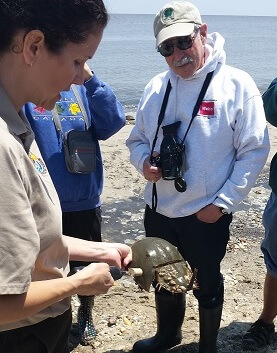
This is the 17th year of the study which includes an international team of shorebird scientists.