United Airlines and Audubon International are teaming up to protect raptors “threatened” by living near Newark Airport. They want to send them to nearby golf courses.
The United Eco-Skies Raptor Relocation Program at Newark Liberty International Airport plans to protect hawks, ospreys and owls by transporting the animals to golf courses certified within the Audubon Cooperative Sanctuary Program.
Since a 2009 accident when a jetliner was forced to land in the Hudson river after birds were sucked into its engine, many birds have been killed in the New York City area in an effort to make flight paths safer.
"The presence of wildlife at our airports can pose a challenge to pilots operating commercial aircraft," said Laura Francoeur, the Port Authority's chief wildlife biologist. "The agency implements wildlife management measures to reduce these challenges, and we continue to work with our airline partners and organizations such as United and Audubon International to ensure safe operations while protecting nature."
But, according to GooseWatchNYC.com, the leading causes of fatal plane crash accidents are not wildlife but pilot error (50%), mechanical error (22%) and weather (12%).
Showing posts with label Audubon Society. Show all posts
Showing posts with label Audubon Society. Show all posts
Tuesday, August 15, 2017


Tuesday, September 9, 2014
North American Bird Species Threatened By Climate Change
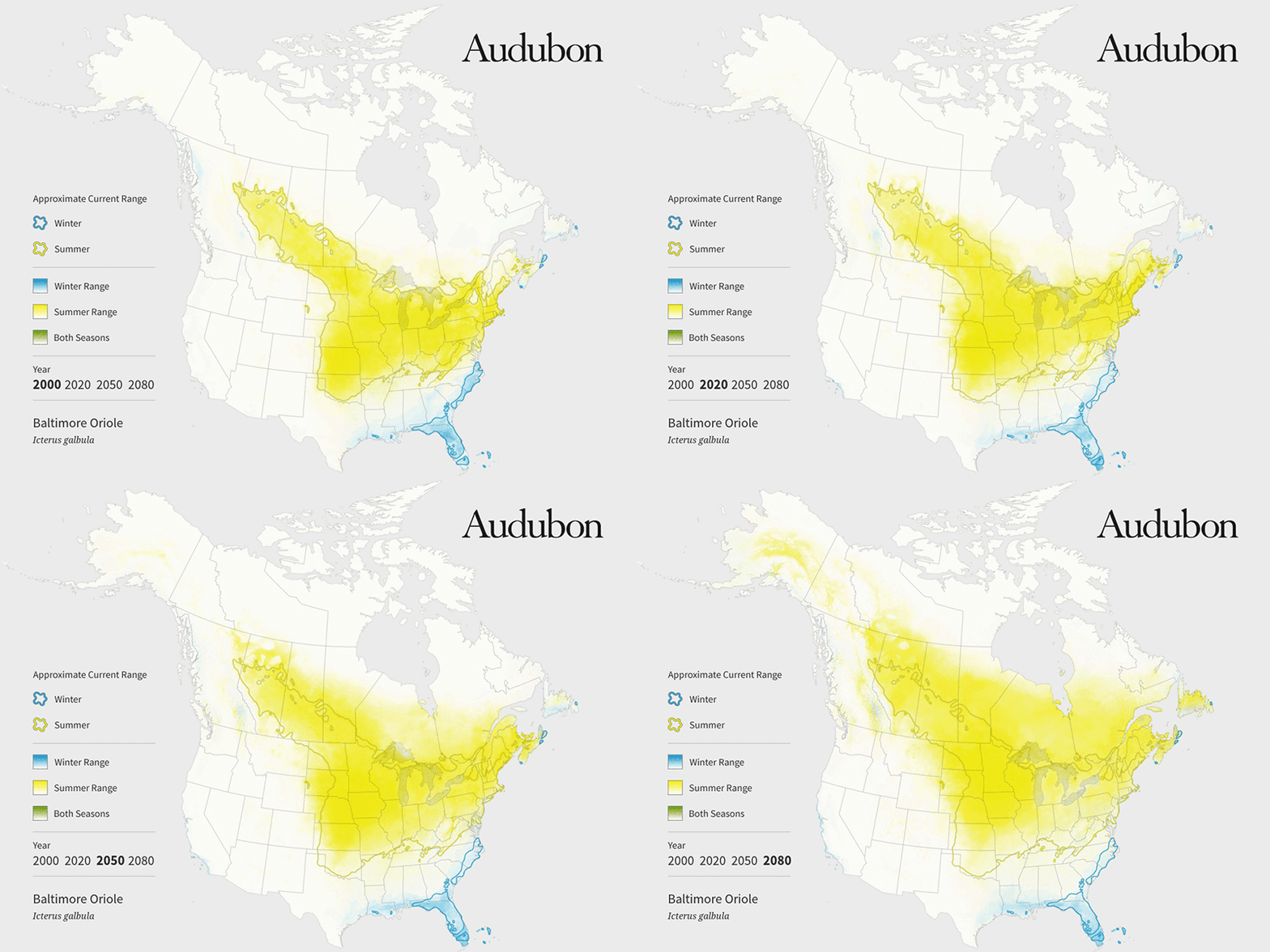 |
| The shift north of species image credit: National Audubon Society via npr.org |
I heard David Yarnold, president and CEO of the National Audubon Society, on NPR talk about a new seven-year study the organization has done that warns that the migratory routes and habitats of more than half of the birds in North America are now or soon will be threatened by climate change.
I still hear arguments against climate change forecasts that are sometimes labeled as "alarmist" but Yarnold says that "... there are forecasts that are far more extreme than this report. If anything, this report is conservative. At every step of the way, we took great care to not overstate data or conclusions. Nothing would make us happier than to be wrong about the fate of many of these birds."
The study, "314 Species on the Brink," look at the entire continent, but you can look close up at New Jersey. The bald eagle, a species that in New Jersey has finally been brought "back from the brink" of being extirpated and endangered, could see its current range decrease by nearly 75 percent in the next 65 years.
One NJ species is the American kestrel.
Photo: Nathan Rupert/Flickr Creative Common via audubon.org
"This colorful little falcon is in serious trouble in some parts of the continent. Yet populations are stable or increasing elsewhere. With the American Kestrel and so many other geographically widespread species, it is essential to engage management and conservation on a region-by-region basis. The Audubon model forecasts overall winter gains and summer losses for the species, but the bigger story is substantial northward movement of suitable climate space at both times of year. The decline of nesting American Kestrels in the northeastern U.S., well along already, seems likely to proceed, perhaps to the point of regional extirpation in New England and the Mid-Atlantic states."

The common loon, an iconic bird in Minnesota and Maine, may no longer be able to breed in the lower 48 states as soon as 2080, according to the report.
 |
| Oriole photo credit: Universal Images Group /Getty Images via npr.org |
The story highlighted Baltimore orioles, a species that is so beloved in Maryland that their major league baseball team bears its name. These orioles are migrating birds and by 2080, there may not be any orioles left in Maryland because they could be forced to nest well north of the state.
In talking about the pace at which this change is happening, Yarnold says:
The report looked at North American birds. It's not likely that birds are going to migrate from Central and South America to replace them. But, remember, what we're talking about are changes at a pace and a scale that we've never seen before. These are the kinds of changes to habitat that have taken tens of thousands of years in the past. And what worries me is that these are the kinds of changes that my 9-month-old grandson could see in his lifetime.
Friday, September 28, 2012
NJ Audubon Offering Tours of Petty's Island

New Jersey Audubon Society is offering first looks at Petty's Island, which was preserved as a natural area in 2009 but is not yet open to the general public.
Petty Island is currently uninhabited, the last residential structure having burned down in 1964. It was subject to industrial development in the 20th century, and is owned by Citgo, which uses the island for fuel storage. The western end of the island is undeveloped and forested. It is the fourth-largest island in the Delaware River's path.
Environmental groups have opposed any development on the island which has become an oasis for birds and other wildlife, including a pair of American Bald Eagles living on the island.
Venezuelan President Hugo Chávez announced in April 2009 that the Venezuelan Government (owner of CITGO) will donate the Island to New Jersey for environmental developments. Petty Island is officially part of Pennsauken Township.
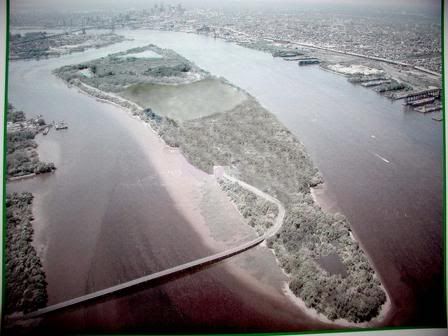
A view of what the future Petty's Island could be: a wildlife reserve of forests,
wetlands and meadows. A green oasis in one of the most developed areas
in the United States
wetlands and meadows. A green oasis in one of the most developed areas
in the United States
The island tours are free, but registration is required. Please call the Rancocas Nature Center at 609.261.2495; no emails please. Access to the island is limited to these field trips, so sign up today!
All Petty's Island Field Trips meet at the island. Directions will be provided upon registration. Facilities on the island are limited, so please plan accordingly.
Tuesday, August 9, 2011
The Everglades of Central Jersey
 |
| Image via appliedeco.com |
Well, the marketing people weren't called in when they named Dismal Swamp in Central New Jersey. The Dismal Swamp Conservation Area is anything but dismal, in the same way that the "Pine Barrens" is not barren.
David Wheeler, Director of Operations for Edison Wetlands Association, (EWA) did several posts on the G.R. Dodge Foundation blog on protecting the Dismal Swamp.
Known as the “Everglades of Central Jersey,” the 1,240-acre Dismal Swamp Conservation Area is the largest natural area remaining in northern Middlesex County, spanning portions of Edison, Metuchen and South Plainfield. EWA is leading a number of coalitions to preserve, restore, promote, and transform this natural oasis from a long-overlooked area in one of New Jersey’s most overdeveloped regions into a nature sanctuary treasured by the public and immensely valuable to wildlife. EWA’s vision, leadership and collaboration resulted in the creation of the Dismal Swamp State Preservation Commission in 2009, with EWA’s Bob Spiegel continuing to strengthen this state oversight as Chair of the Commission.EWA has worked since then to preserve many other key Dismal Swamp properties, partnering with groups like NY-NJ Baykeeper and New Jersey Audubon Society, and agencies like the Middlesex County Freeholders and the NY/NJ Port Authority to save over 800 acres in Edison and nearly 100 acres in South Plainfield from overdevelopment.
The Dismal Swamp serves as a natural oasis holding United States Environmental Protection Agency Federal Priority Wetlands. The Dismal Swamp is home to over 180 species of birds, and two dozen species of mammals, amphibians and reptiles, as well as a dozen threatened and endangered species, such as the American bittern, bald eagle, and spotted turtle. The Dismal Swamp also provides natural flood control and wildlife habitat, while its forests produce oxygen, and its wetlands clean and purify water.
EWA is also working on a number of trails projects to expand opportunities for hiking, birding, and wildlife viewing in the area.
- In 2011 the Middlesex Greenway just opened the newest leg of its trail connecting hikers and bicyclists from Perth Amboy, Woodbridge, and Edison with Metuchen’s portion of the Dismal Swamp. EWA continues to work with elected officials and the Edison Greenways Group to extend the greenway into the heart of South Plainfield’s Dismal Swamp.
David Wheeler is the author of Wild New Jersey. David also posted on the restoration of the Raritan River.


Subscribe to:
Posts (Atom)