Showing posts with label restoration. Show all posts

Wednesday, March 9, 2016

Bobwhite Quail Restoration

Virginiawachtel 2007-06-16 065
Adult male


Have you ever heard that whistled call of "bob-white" in a grassy field or piney woods? You may have heard that distinctive song, but it's likely that you did not see a Northern Bobwhite. Their dappled plumage gives them excellent camouflage.

The birds forage in groups and scurry between cover area and will burst into flight if alarmed. Northern Bobwhite populations declined by 82% between 1966 and 2010, one of the most dramatic declines in the U.S. New Jersey Audubon and others are attempting to restore Northern Bobwhite quail to New Jersey. Bobwhites have been in sharp decline throughout the past half-century, likely owing to habitat loss and changes in agriculture, and they are an increasingly high priority for conservation.


The northern bobwhite, Virginia quail or (in its home range) bobwhite quail (Colinus virginianus) is a ground-dwelling bird native to the United States, Mexico, and the Caribbean. It is a member of the group of species known as New World quails (Odontophoridae).

The name "bobwhite" derives from its characteristic whistling call. Despite its secretive nature, the northern bobwhite is one of the most familiar quails in eastern North America because it is frequently the only quail in its range.

The Northern Bobwhite Restoration Initiative in NJ is dependent upon: (1) areas of high quality habitat and (2); the translocation of true wild birds, not pen raised, with both factors providing significant advantage in the face of severe storm events.

The release site at Pine Island has been stewarded through the implementation of a Forest Stewardship Plan, creating patches of young forest habitat suitable for quail and rich in cover and food resources. In addition, the wild birds are known to more quickly adapt and yield offspring that also exhibit innate survival instincts.

Fossil records show that quail-like birds existed at least a million years ago, but their appearance in most of the northern states across their range probably did not occur until sometime after retreat of the last glacier, approximately 10,000 years ago. Over the last 10,000 years serve storm events obviously have occurred and through it all the Bobwhite has persisted.


                    Project researcher Kaili Stevens tracking the Bobwhite at Pine Island.

For more on the Quail Project see NJ Audubon's Quail webpage.

Help continue this effort by donating at bobwhite.njaudubon.org 

Sunday, April 12, 2015

Bringing the Assunpink Creek Back Into the Daylight in Trenton

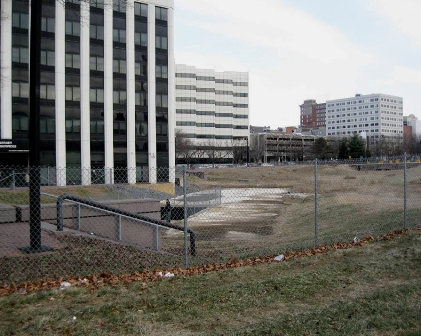
Assunpink Creek flowing through Trenton near Mill Hill Park
Work is expected to begin on a $4 million restoration this spring that is being financed 75 percent by the U.S. Army Corps of Engineers and 25 percent by the DEP through a federal Clean Water Act grant.

What the project hopes to accomplish is to restore the Assunpink Creek in downtown Trenton. You say you've never seen it? That's because decades ago this tributary of the Delaware River was channeled into an underground culvert. It disappears from view between South Broad and South Warren streets.

The idea years ago was certainly to allow for greater development where the creek flowed, but the culvert prevented fish from migrating into the Delaware. The downtown also lost the natural beauty of the stream.

Maybe it was a sign from nature when the nine years ago part of the culvert roof collapsed. The immediate effect was not good - a safety hazard that was fenced off and became an overgrown lot.


But this project to restore the creek looks like it will now happen.

On the New Jersey Future website at www.njfuture.org, you can see maps and historic photos.

The term for this restoration is "daylighting," as in bringing back the water to the light of day from its capture underground.

The Assunpink Creek is 25 miles long, and drains approximately 91 square miles in central New Jersey. The main tributaries that feed Assunpink Creek are Shabakunk Creek and Miry Run. The headwaters begin in Millstone Township, in Monmouth County, and flow into the Delaware River in Trenton.

The creek gathers intensity as it meanders west from Millstone Township in Monmouth County, through the Assunpink Wildlife Management Area and Mercer County Park, across the old, flat clays and silts of the Raritan and Magothy formations into Trenton.

The Lower Assunpink Creek Ecosystem Restoration Project study area is located on a 3- mile section of the Assunpink Creek between the Delaware River and the Trenton city limits. Several former industrial sites, abandoned bridges, and a 500-foot section of the creek between Broad and Warren Streets, contained within a buried box culvert were identified as candidates for ecological restoration.

The buried box culvert, known locally as the Broad Street culvert, was evaluated during the feasibility study and approved for removal and restoration of a natural creek channel. The Broad Street culvert removal project is located in the heart of the downtown Trenton business and historic district on a recovering urban stream that also serves to connect several greenway and urban park facilities.

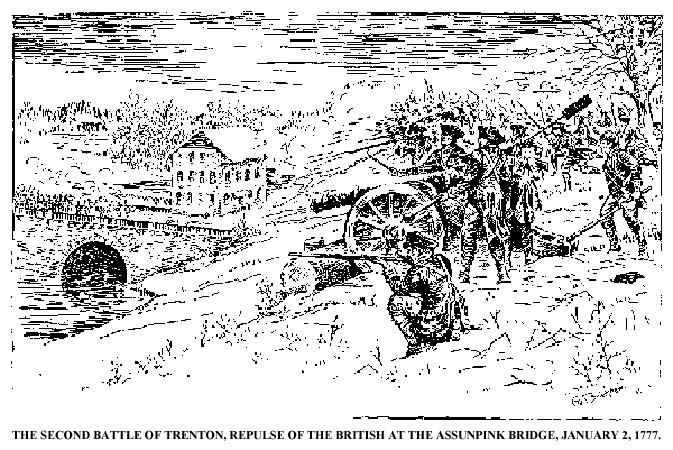
illustration via www.trentonhistory.org


The project site is also the location of the the Battle of Assunpink Creek (AKA the Second Battle of Trenton) during the American Revolution. On Jan. 2, 1777, the Continental Army and supporting militias held a defensive line along the creek's south shore. Under George Washington's command, the Americans repelled charges by British and Hessian soldiers across a stone bridge spanning the creek, as well as an attempt to ford the creek near its mouth.

By morning, Washington had reached Princeton and after a brief battle, the British there were decisively defeated and most of the garrison was captured. With their third defeat in ten days, Cornwallis' superior, General William Howe ordered the army to withdraw from southern New Jersey and most of the way back to New York. The British left forward positions at New Brunswick and Washington moved his army to Morristown for winter quarters.

The daylighting of the stream this year will mean the removal of the culvert structure, allowing the stream to be exposed to natural sunlight, and the resulting open channel design will improve anadromous fish migration. Low-light conditions can disorient migrating fish, hindering their ability to spawn upstream.

The project will also benefit businesses adjacent to the site, provide recreational options for visitors and local residents, and provide historical and educational opportunities for the community.

The name Assunpink comes from the Lenape word for "stony, watery place," describing the gravelly springs of New Jersey's 65 million-year-old ancient coastline. This ironstone "cuesta," or ridgeline divides the inner and outer coastal plains.

Friday, April 3, 2015

Shell-a-Bration on the Delaware Bayshore This Weekend


Everyone is "whelk-come" to join American Littoral Society and Conserve Wildlife Foundation for their Shell-a-Bration on Saturday, April 4 at South Reeds Beach on the Delaware Bayshore from 2-6 PM.

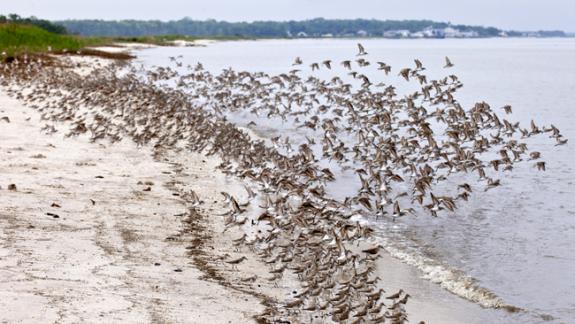
Enjoy a bonfire on the beach, BBQ and oysters, and family-friendly activities! Volunteers will help build an oyster reef throughout the day to test whether the reef bars help reduce beach erosion and create calmer water for spawning horseshoe crabs.

For details and more information visit www.restorenjbayshore.org/shell-a-bration.html

Thursday, July 31, 2014

Hurricane Sandy Restoration: Middle Township


via the U.S. Fish and Wildlife Service  also see the USFWS Northeast website
Hurricane Sandy taught us that the coast is an ever-changing environment, vulnerable to sea-level rise and powerful storms. Since Sandy made landfall in October 2012, The U.S. Fish and Wildlife Service has been working with other federal agencies and conservation partners to restore the Atlantic Coast by enhancing habitats that protect our coastal communities and sustain people and wildlife. These efforts are supported by funding from the Department of the Interior through the Disaster Relief Appropriations Act of 2013.

Recognizing the interconnected nature of our conservation work, today we launch the first in a series of videos highlighting communities impacted by Hurricane Sandy and their journey toward recovery. This first video outlines a $1.65 million beach habitat restoration project along the shores of Delaware Bay that is already benefiting native horseshoe crabs and migrating shorebirds. At the same time, the project will help local communities like Middle Township, New Jersey, whose Mayor Tim Donohue describes how strengthening natural defenses will in turn protect homes and support the area's ecotourism industry.

This project and others like it are designed to support decisive and informed actions now with our partners to safeguard our coastal communities for years to come.

Friday, September 28, 2012

NJ Audubon Offering Tours of Petty's Island


New Jersey Audubon Society is offering first looks at Petty's Island, which was preserved as a natural area in 2009 but is not yet open to the general public.

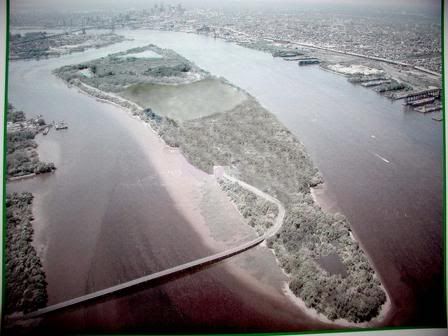
Petty Island is currently uninhabited, the last residential structure having burned down in 1964. It was subject to industrial development in the 20th century, and is owned by Citgo, which uses the island for fuel storage. The western end of the island is undeveloped and forested. It is the fourth-largest island in the Delaware River's path.

Environmental groups have opposed any development on the island which has become an oasis for birds and other wildlife, including a pair of American Bald Eagles living on the island.

Venezuelan President Hugo Chávez announced in April 2009 that the Venezuelan Government (owner of CITGO) will donate the Island to New Jersey for environmental developments. Petty Island is officially part of Pennsauken Township.

A view of what the future Petty's Island could be: a wildlife reserve of forests,
wetlands and meadows. A green oasis in one of the most developed areas
in the United States

The island tours are free, but registration is required. Please call the Rancocas Nature Center at 609.261.2495; no emails please. Access to the island is limited to these field trips, so sign up today!

All Petty's Island Field Trips meet at the island. Directions will be provided upon registration. Facilities on the island are limited, so please plan accordingly.