Showing posts with label beach nesting birds. Show all posts

Monday, June 19, 2017

Protecting Piping Plovers at Island Beach State Park

Newborn piping plover chick - NPS photo

Beginning Friday, June 23, a section of Island Beach State Park ocean beach will be temporarily closed to Mobile Sport Fishing Vehicle (MSFV) traffic.

A vehicle barrier will be erected approximately 3/4 mile north of the jetty.

The closure is to protect Piping Plovers, an endangered species nesting in the Southern Natural Area.

Due to the temporary closure, IBSP may reach its capacity of MSFVs sooner than normal.

Piping Plover - via Flickr, Andrea Westmoreland

For more information visit njfishandwildlife.com/saltwater.htm

Monday, August 29, 2016

Piping Plovers Fledge at Island Beach State Park

Piping plover chick at 2 days


The piping plover pair nesting on the beach in Island Beach State Park successfully fledged two chicks. This was the first ocean side nest in more than 25 years and the first in the park in more than a decade.

For a summary of the nesting season visit njfishandwildlife.com/news/2016/ploversummary16.htm on the NJDEP Division of Fish and Wildlife website.

Friday, July 29, 2016

Update: Piping Plovers at Island Beach State Park

The following is an update from NJDEP Division of Fish and Wildlife biologist Christina Davis on the Piping Plovers nesting on the beach in Island Beach State Park:

It's been a week of highs and lows for our plover brood!  Last Saturday, 7/23, one of the two remaining chicks was observed with a moderate limp. There was no obvious cause of injury and the bird was still quite active, but its mobility was compromised. Piping Plovers (and especially chicks) do not fare particularly well in rehab so our preference is always to leave the individual in the wild, when possible. Given the condition of the chick, we decided to take a wait and see attitude.

By Monday, the limp had not improved. We had already planned to band the chicks that day (four color markers, two on each upper leg, specific to that individual) so we took the opportunity to get the bird in hand and examine the issue. We also had a veterinarian on standby ready to review photos and videos we sent her.

The problem area was the left foot, which was swollen, and the wing, which was a bit droopy. Considering that the chick is still growing (hampering efforts to treat it) , and that there were no signs of breaks or infection, a case could be made to release it. On the flip side, the chick weighed much less than its sibling (20g vs 25g) and the limp was quite pronounced. After much debate, and the appearance of a red fox seemingly attracted to the area by the chick calling, we determined the best course of action would be a stint in rehab. The healthy chick was released and the injured one taken from the site.

At the rehabilitation facility it was confirmed that there did not appear to be any breaks or fractures to the wing or the foot. This was good news as setting or immobilizing growing body parts can do more harm than good. The goal of rehab, therefore, is to allow the chick an opportunity to rest the foot and wing and to increase its weight (which is a lot easier for this species when it isn't burning calories running around).

The chick has done very well in rehab and is expected to be released soon. It has already  gained 5g and is active and alert. The healthy chick has continued to do well on site. We look forward to reuniting them!

When chicks are banded researchers do usually name them. This is primarily for ease of reference as a name is easier to recall/refer to than a band code. These two chicks are named Phipps (healthy chick) and Freeman (injured chick) as a tip of our hats to Island Beach's history. They can be identified by their band colors:

Phipps - Left upper leg is a black over a red band and the upper right is a blue over a yellow band (LR:BY)
Freeman - Left upper leg is a black over red band and the upper left is a blue over a green band (LR:BG)

As you can imagine, it is a lot easier to say (and remember), "Hurray, Freeman is in great shape and almost ready for release!" than "Hurray, Black over red, blue over green is in great shape and almost ready for release!"

The chicks hit an important milestone today (Thursday, July 28), by surviving 25 days. At this point, their flight feathers are coming in and they will start trying to fly very soon. It will take them time to become competent, but just like the Wright brothers, every day forward will bring them closer to mastering this skill.

For information on beach nesting birds in New Jersey visit http://www.njfishandwildlife.com/ensp/beachnester_info.htm

Saturday, March 23, 2013

Piping Plovers Returning to NJ

Piping Plovers   Image: wikimedia.org
Piping Plovers winter primarily on the Atlantic Coast from North Carolina to Florida, although some migrate to the Bahamas and West Indies. Piping plovers return to their breeding grounds, including New Jersey beaches, starting in late March or early April.

The piping plover became a Federally protected species under the Endangered Species Act and in 1984, New Jersey listed the species as "endangered" and it remains one of the state's most endangered species.

The piping plover is a small, stocky, sandy-colored bird resembling a sandpiper. When still, the piping plover blends into the pale background of open, sandy habitat on outer beaches where it feeds and nests.

Its name comes from its call notes, plaintive bell-like whistles which are often heard before the birds are seen.


Our Jersey beaches are also home to the Federally endangered roseate tern, the threatened northeastern beach tiger beetle, the threatened seabeach amaranth, the least tern, the common tern, the black skimmer, and the Wilson's plover.

Starting soon and running into early summer, you will see beach areas along our coast marked with signs warning about beach nesting birds.

Plovers go through nesting and courtship rituals. When a pair mates, they make a nest as a depression in the sand. They are usually located close to the dunes.

Sometimes the nest is lined with small stones or fragments of shell.

There are usually our eggs hatch which will hatch in a bit less than four weeks.

Piping plovers were once common along the Atlantic Coast in the 1800s. Unfortunately, there were hunted for their plumage which was used for fashionable ladies hats.

The population made a comeback after the Migratory Bird Treaty Act of 1918 and peaked during the 1940s.

Since then, the population has declined again due to to increased development in beach areas, predators (including feral cats) and increaseed recreational traffic on beaches which includes humans and pets.

You can help protect beach-nesting birds by resspecting fenced in or posted areas. Don't approach piping plovers or their nests and if you're walking dogs on a beach that allows them, keep them  leashed.  Even leaving trash or food scraps on beaches can attract predators which may prey upon piping plover eggs or chicks.

This summer nesting may be affected by the destruction of the dunes because of Hurricane Sandy and subsequent storms

The downy young plovers will follow their parents and learn to forage for marine worms, crustaceans, and insects. As with the eggs, the young are well camouflaged on the beach - so much so that the eggs and young are sometimes stepped on by people walking near the dunes. Unfortunately, when predators or people come near, the young will freeze motionless on the sand. The parents will try to distract intruders away from the young and to themselves by feigning a broken wing.


If the young can survive that first month, they will be able to fledge and can fly to escape. are flying in about 30 days.

Because of dune damage, or predator and human disturbance, eggs may not hatch. Plovers will often re-nest in the same area. But these later hatchlings will not be flying until August and will need to start their southward migration by mid-September to wintering areas.
    Sources:
    http://www.nps.gov/featurecontent/caco/plover_slideshow.html
    http://www.nps.gov/caco/naturescience/the-piping-plover.htm
    Piping Plover 'Seashore Science' Document
    The Threatened Piping Plover - a photo essay
    Piping Plover Annual Reports

    Wednesday, September 26, 2012

    Birdwatching at the Gateway National Recreation Area

    A woodcock at Gateway.
    NPS PHOTO A woodcock

    The Gateway NRA has three units at Sandy Hook, Staten Island and Jamaica Bay. The three combined have over 325 species of birds, most of them visiting as they migrate along the Atlantic Flyway.

    The Birds of Gateway Field Guide features 12 of the more noticeable species in the parks  along with the seasons when these birds can be seen here. Advanced birders might prefer the Jamaica Bay Bird Checklist.

    Bird Biographies of some of the better known birds you might see at Gateway.


    Thursday, June 2, 2011

    Cape May Ocean, Land and Air To Explore

    Spoontiques Resin Lighthouse - Cape May, NJ - Limited Edition  Cape May Light, NJ Bookmark

    Some resources online for folks who want to do some birding in that beautiful and most southern tip of New Jersey.

    BirdCapeMay.org offers birding maps

    There is also info for kayaking the waters in and around Cape Island which are excellent for trips along the Delaware bayshore just North of the Cape May Canal, or through Spicers and Cape Island Creek. There are many spots to put in and casually enjoy the natural beauty and wildlife of Cape Island.  For a tour plan and map, visit Circumnavigation of Cape Island.
    And for folks who don't want to go out into the ocean and who keep their gaze to the ground...

    Cape May's Gingerbread Gems
    Cape May's Gingerbread Gems

    Explorer's Guide The Jersey Shore: Atlantic City to Cape May: A Great Destination (Second Edition) (Explorer's Great Destinations)
    Explorer's Guide The Jersey Shore: Atlantic City to Cape May: A Great Destination 

    Cape May Walking Tours: Short, Fun, No-stress Tours for All Ages and Abilities
    Cape May Walking Tours: Short, Fun, No-stress Tours for All Ages and Abilities

    Cape May Point: The Illustrated History : 1875 to the Present (Schiffer Books)
    Cape May Point: The Illustrated History : 1875 to the Present

      Monday, January 3, 2011

      Snake Hill

      Snake Hill seen from the Laurel Hill Park
      Snake Hill (known officially as Laurel Hill) is a 150 foot tall (46 m) rock sticking up in the middle of the Meadowlands. This igneous rock intrusion jutting up from the floor of the Meadowlands in Secaucus, New Jersey is the site of a glacial lake, Lake Hackensack, that only started receding in 8000 B.C. The rock along the Hackensack River bank is the highest point on Laurel Hill which was formed by volcanic action over 150 million years ago.

      In Colonial times, people kept away from the peculiar sloped hill because of the many large black snakes found there and the area was nicknamed “Snake Hill.”

      From 1855 to 1962 there were Hudson County penal and charitable institutions on Snake Hill. The Almshouse, Penitentiary, Quarry and Hospital for the Insane, Contagious Diseases Hospital, and Tuberculosis Sanatorium, were all grouped on the north side of Snake Hill. Hundreds of people lived at Snake Hill at any given time. The Hudson County Burial Grounds is a Potter's Field associated with the numerous institutions, which had long been forgotten. They were unearthed during the addition to the New Jersey Turnpike for access to Secaucus Junction at exit 15X.

      In 1962 Hudson County finished closing their facilities on the site. The County entered into a 20 year contract with Callanan Industries to level much of the hill and the rock formation was largely obliterated by quarrying in the 1960s that reduced its height by one-quarter and its base area by four fifths. The diabase rock was used as building material in growing areas like Jersey City. In the 1960s and 70's, Gallo Asphalt had 4 asphalt plants, side by side, adjacent to the quarry and supplied paving materials throughout the surrounding urban region. Production ended in 1982.

      The graffiti-covered remains of Snake Hill are a familiar landmark to travelers on the New Jersey Turnpike's Eastern Spur, which skirts its southern edge.

      The rock is most often referred to as Laurel or Snake Hill (Slangenbergh in Dutch) but has also been called Fraternity Rock (because of the Greek letters painted on it presumably by local college fraternities), Long Neck (because it is a volcanic neck), Graffiti Rock and Mt. Pinhorne (after 17th century plantation owner William Pinhorne). The name changed from Snake Hill to Laurel Hill in 1926, when Hudson County freeholder Katherine Whelan Brown said that it was the "crowning Laurel of Hudson County" because of its unusual height prominence in the low lying meadowlands.

      Most of the original 184-acre (0.74 km2) parcel is currently being utilized as Laurel Hill County Park, which includes a portion of Hackensack RiverWalk.

      Laurel Hill Park is home to the Hackensack Riverkeeper's Field Office and Paddling Center. The Hackensack Riverkeeper also conducts many of its Eco-Cruises from this park.

      There is a narrow Ridge Trail along the top of the hill.

      View from Ridge Trail atop Snake Hill

      The rock is a 61 meter (203 ft) high pipe-like diabase intrusive, which is believed to be an offshoot of the nearby Palisades Sill. It may have been what is known as a volcano plug. Mineralized shales and sandstones, intruded by the diabase, are visible in the north and southwest sections of the property.

      Legend has it that a NY advertising executive, passing the hill on a train, is said to have drawn from it the inspiration for the Prudential "Rock of Gibraltar" logo in the 1890s.

      The mineral Petersite was discovered at Snake Hill in June 1981 by Nicholas Facciolla, who took it to the Paterson Museum. In 1982 the mineral was recognized as a new discovery and named for Thomas Peters and Joseph Peters curators of minerals at the Paterson, New Jersey, museum and the American Museum of Natural History in New York City, respectively.


      Birding, paddling and wildlife trail walking is available at Laurel Hill County Park & Saw Mill Creek Wildlife Management Area. The Saw Mill Creek Trail takes you near the vast mudflat and wide-open space of the Saw Mill Creek Wildlife Management Area (WMA). The base of the trail was initially built in the 1920’s and 1930’s as an access road for what are now high tension electric lines. It was reconstructed as a walking trail in 2001. Stone and soil were added, and six seating areas were incorporated. Native plants were used
      and there are beautifully-designed entrance gates at the trailheads.

      Laurel Hill Park is home to the Hackensack Riverkeeper's Field Office and Paddling Center, which is open weekends from April thru October and weekdays by appointment. Hackensack Riverkeeper also conducts many of its Eco-Cruises from this park.

      During this winter season, hiding along the channels and main creek, using the reeds as windbreaks on cold winter days, you will find Common and Hooded Mergansers, Common Pintail, Gadwall, Northern Shoveler, Bufflehead, Blue-winged and Green-winged Teals, Canada Goose and Mute Swan, some of which also breed in the Meadowlands. A glance at the electrical towers near the Turnpike may turn up a Peregrine Falcon or Red-tailed Hawk. Look across the marsh where the vegetation has died back and see the 3-foot tall dome-shaped lodges made by the common muskrat. Great Cormorants and Bald Eagles may also be seen.

      Directions: Follow County Avenue south from Secaucus. Bear right on New County Road just before the New Jersey Turnpike overpass. Follow for about one mile past the county jail complex (on the left) into Laurel Hill Park. Get driving directions via Google Maps

      Sources:


      Monday, April 5, 2010

      NJ Bobwhite Quail Seminar April 29


      NJ Audubon and the NJ DEP's Division of Fish and Wildlife are hosting a free seminar on Northern Bobwhite Quail Management in New Jersey on April 29th, 2010 from 7:00 p.m. until 8:30 p.m. in Woodstown, NJ.

      Featured speaker Dr. Chris Williams of the University of Delaware, will discuss the characteristics of good bobwhite quail habitat.

      Paul Castelli, Research Scientist for NJ Division of Fish & Wildlife, will discuss the declining population trend, causes for decline, necessary management and the state's new Bobwhite Quail Action Plan.

      Presentations will be followed by a panel discussion with speakers and local bobwhite quail experts.

      The seminar location is the Ware Agricultural Extension Office, 51 Cheney Rd., Woodstown, NJ 08098. RSVP is encouraged. Contact 609-861-1608 ext. 24 to RSVP or for more information.

      The Bobwhite Quail: It's Life and Management

      Wednesday, March 31, 2010

      Red Knots in New Jersey


      Nearly four years after New Jersey banned horseshoe crab harvesting to protect a vanishing shorebird at the Delaware Bay, scientists say they are not optimistic about recent evidence showing the red knots may be on the rebound.

      After journeying from the southern tip of South America, red
      knots appear on the shores of Delaware Bay in May. They are generally so thin that they look like sparrows. There they will try to gorge themselves on the eggs of the horseshoe crab (Limulus polyphemus) and put on a layer of fat. If successful, they will look more like plump doves when they leave for the Arctic.

      Ground surveys at Delaware Bay last spring found 24,000 red knots. That's an improvement from the 15,000 counted in 2008. Biologists also reported increased numbers of crab eggs on the bay estuaries. But neither the horseshoe crabs nor the red knots can be called a "recovered population" and the fate of the birds is linked to the crabs.

      Horseshoe crabs are used as bait in the conch and eel industry. NJ fishermen contend that the cottage crab industry was unnecessarily hurt by by imposing a harvesting ban in 2006 that was extended indefinitely by law in 2008.

      In an nj.com article, biologist Amanda Dey with the New Jersey Endangered and Non-Game Species Program said about last year, "We’ve seen a bump up in the numbers. ... It was a year that we had settled weather, so there were more crabs and more birds. We’d like to think we saw the bottom. But we don’t know."

      Dey is part of the team of scientists studying both the crabs and the birds. They traveled to Tierra del Fuego, where they counted about 14,800 red knots in prime South American wintering grounds. The good news is that amount matches winter counts there over the past three years, which suggests that there has not been further declines. Unfortunately, the overall numbers are still at a potential crash level.

      Our Delaware Bay spring count last year was still less than half the 50,000 birds recorded there in 1998.

      New Jersey has the only moratorium among the 15 coastal states. Neighboring Delaware limits harvests to 100,000, male-only crabs annually.

      It would probably surprise many New Jerseyeans that Delaware Bay is at the center of this dispute. It's because the Bay is where the world’s largest population of breeding horseshoe crabs emerges from winter waters each spring to lay eggs on the estuary shores.

      Red knots are not the only birds that stop in NJ to bulk up on the eggs as they migrate. But red knots have one of the longest migrations flying from their South American wintering grounds to their Arctic breeding grounds.

      More on red knows and NJ at http://www.state.nj.us/dep/fgw/ensp/redknot.htm

      The Flight of the Red Knot: A Natural History Account of a Small Bird's Annual Migration from the Arctic Circle to the Tip of South America and Back

      Red Knot: A Shorebird's Incredible Journey

      Horseshoe Crabs and Shorebirds: The Story of a Food Web

      Horseshoe Crabs

      Horseshoe Crabs (Schaefer, Lola M., Musty-Crusty Animals.)
      Crab Wars: A Tale of Horseshoe Crabs, Bioterrorism, and Human Health

      Biology and Conservation of Horseshoe Crabs

      The American Horseshoe Crab 


      Thousands of Red Knots migrate through New Jersey

      Wednesday, March 10, 2010

      Volunteers Needed in Cape May County

      Volunteers are needed to help install fencing to protect beach nesting birds.

      Stone Harbor Point, Cape May County
      Saturday, April 3, 10 AM in the parking lot at southern end of Stone Harbor.

      Rain or shine event, unless heavy rain.

      Please contact Todd Pover at bnb@hughes.net or 609-628-2103 to RSVP or if
      you have any questions.

      Wednesday, November 11, 2009

      Sedge Invades NJ Beaches


      It looks innocent enough all alone...


      It's a foreign attack, and it's hitting the Jersey dunes.

      It's an invasive foreign plant that is getting into New Jersey's critical dune systems.

      It is called Asiatic sand sedge and it could take over the habitat of endangered and threatened species, such as the piping plover, as well as lowering the dunes which protect communities from flooding. (Only 105 plover pairs nested on NJ beaches this year, down from 111 pairs in 2008 according to the Conserve Wildlife Foundation of New Jersey.)


      The plant has no known predators or diseases here.

      The yellow-green plant was actually first spotted in the United States in Island Beach State Park in 1929. It forms a dense mat and drives out native plants, such as American beach grass and beach panic grass.

      According to the Fish and Wildlife Service, the plant occupies more than 90 acres in Island Beach State Park and on Sandy Hook and Asiatic sand sedge populations also have been found in Sea Bright, Monmouth Beach, Long Branch, Manasquan, Harvey Cedars, Long Beach Township, Edwin B. Forsythe National Wildlife Refuge and other locations.
      A group of students from Georgian Court, Marine Academy of Science and Technology on Sandy Hook, and Brookdale Community College are studying the sedge, mapping its extent and studying ways to get rid of it. Digging and pulling out sedge plants by hand can be effective with small infestations, but the plant's roots are 3 to 4 feet deep.


      but let it get hold in a sand dune...

      More information at http://www.courierpostonline.com
      Photos via National Park Service

      Monday, July 13, 2009

      Watch Out For Beach Nesters

      The piping plover and least tern are two of a the birds that nest and raise their chicks on our NJ beaches.

      June through August is generally the critical nesting and chick rearing period for these endangered and threatened birds - and, obviously, it's the busiest time for humans on our beaches.

      Some Delaware Bay beaches were closed from May 9 to June 5 this year because they are major migratory stopovers along the Atlantic flyway where shorebirds stop each spring to feed on the fat-rich eggs of the horseshoe crab before heading to the Canadian Arctic to breed.

      Other Atlantic Coast beaches will be closed from April 1 to October 30 or later to protect the threatened black skimmer, as well as other beach nesting birds.

      Not all beaches have special areas such as the circular predator exclosure with mesh top surrounded by an electrified wire fence that is seen in the photo above, so your cooperation is a key element in protecting the nests.

      Here are some simple ways you can help when you are on these critical beaches:

      Avoid nesting areas which are usually "fenced" or marked in some way with signage. Unfortunately, sometimes I think the sign actually attract people to walk over and look for the birds!

      Keep pets off the beach or leashed from mid April to mid September. Plovers and terns perceive even leashed dogs as potential predators. It's not that your dog will attack the birds (though they may!) but that the parents may abandon their nest or young when you or a dog approaches. On a hot summer day, a nest that is abandoned for even a few hours can be fatal for eggs or young. Think about mama plover (as seen in the photo) sitting on the eggs NOT to keep them warm, but to keep them from hard boiling.

      Avoid Frisbees, footballs, kites etc. in the the nesting areas. They lead people to accidentally disturb areas. With kites, I have read that plovers and terns may actually mistake kites for hawks and leave their nests to ward off the "intruders."

      Take that trash and food scraps out with you because it attracts gulls, foxes, raccoons, and skunks which will also prey on eggs and young.

      Of course, it's not all human and pet problems. Coastal storms and predators also negatively affect beach-nesting birds toll.

      Beach Nesting Birds in NJ Brochure (pdf, 183kb)
      Beach Nesting Bird Management and Reports
      Piping Plover - July 2003 Species of the Month
      Piping Plover Fact Sheet (pdf, 55kb)
      Black Skimmer Fact Sheet (pdf, 63kb)
      Least Tern Fact Sheet (pdf, 41kb)

      Tuesday, June 16, 2009

      Endangered Piping Plovers in Sea Girt


      The Sea Girt Borough Council voted this month to amend a beach use ordinance to ban kite flying and dog walking on the borough beach to protect endangered piping plovers who use the beach area to nest.

      The ban would be in effect from March 15 to September 30 which certainly covers the entire summer tourist season.

      It is another example of the difficult line between protection and economics that we walk in New Jersey. The ban would also include play with hard balls and Frisbees during bathing hours, and allows members of the beach patrol to designate certain areas for play with soft balls.

      Sea Girt is making the change partly to protect itself from possible fines for violating the Endangered Species Act. They had already been fined in 2007 by the DEP $25,000 for raking an area of the beach near a plover nest. They were also fined by the U.S. Department of Fish and Wildlife at $28,000 fine for the death of a plover chick that he agency contended was killed by the beach rake. (Sea Girt is appealing the fines.)

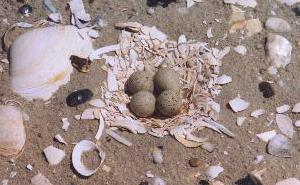
      Plover beach nest

      The exposed nature of the nests for many beach-nesting bird species make them particularly vulnerable to human intervention, both intentional and unintentional.