Showing posts with label fossils. Show all posts

Monday, July 14, 2025

Beyond Endangered: Fossils in New Jersey

I have been finding the occasional fossil in NJ since I was a kid, kicking around my local creeks. When a species goes beyond endangered, it becomes extinct, and that's what you are usually dealing with in fossil hunting.

One of the top spots in New Jersey for fossil hunting is  Big Brook Preserve in Colts Neck, Monmouth County. (88 Hillsdale Rd., Colts Neck, NJ 07722).

Fossil hunting is great for adults and fun to do with kids if they have some guidance. Check out this family outing.

You need to be prepared with some equipment and need to follow the regulations in many places. For example, at Big Brook, there are several rules and restrictions:
  1. Groups of 15+ require a permit
  2. The collection of fossils within the preserve is limited to those fossils found within the actual stream waterline. Fossil extraction is prohibited from the walls of streambed above the stream waterline. AKA: stick to the water and the gravel bars; no digging the banks
  3. The use of equipment for the collection of fossils is restricted to trowels with a maximum blade of six inches, and small screens with an eighteen-inch-square maximum at all times
  4. No person may harvest more than five fossils per day.

Big Brook identification page

The Fossil Guy's Guide to Big Brook

rockchasing.com/fossils-in-new-jersey/

To explore and learn more about New Jersey's fossils, two places to visit are the New Jersey State Museum in Trenton, and the Edelman Fossil Park and Museum in Mantua.


shark teeth

Shark's teeth are one of the most common fossil finds. 

Don't set your expectations too high. You are not going to find a dinosaur like the NJ State dinosaur, the Hadrosaurus foulkii. It is a type of hadrosaur, often called the “duck-billed” dinosaur because of its flat, wide mouth. They were plant-eaters that were about 25 feet long. Finding one in NJ was very special because it’s the first nearly complete dinosaur skeleton ever found. Prior to its discovery (in Haddonfield), scientists only had small bits and pieces of dinosaur fossils.


Wednesday, September 27, 2017

Our Fossil State

We worry about a threatened species becoming endangered and about an endangered species becoming extinct. But there are some species that are extinct that we still study and protect: fossils.


The world’s first nearly complete dinosaur skeleton was discovered in Haddonfield, NJ. It revolutionized the study and helped put New Jersey on the paleontological world map. At the NJ State Museum, an exhibit features a 25 foot long cast of Hadrosaurus foulkii, the world's first nearly-complete dinosaur skeleton that was discovered here in 1858.

Paleontologists, both professional and amateur, are still unearthing fossilized remains of dinosaurs and other prehistoric creatures at several active sites in the state.

"The fossil state - New Jersey" is a document published by njconservation.org that discusses the narrow diagonal band across our state known to geologists as the Inner Coastal Plain. This area runs along the center of New Jersey from Salem County on the Delaware Bay to the Raritan Bay in Monmouth County. During the Cretaceous period, when the earth was much warmer and sea levels higher, the Atlantic coastline followed the band of the Inner Coastal Plain. (Maybe one day it will again be the coastline.)

This shallow ocean was home to sea creatures like mosasaurs and giant crocodiles, and sometimes land-dwelling creatures would be pulled into the ocean. The sediments in this area contain fossils of both land and sea creatures.

One of the soil types that is very fossil-rich is called greensand, known locally as “marl.”  It was once the sea floor. It is still soft and can be dug with a trowel, rather than the typical chipping away at rock for fossils. You may know some sites of marl deposits of the Inner Coastal Plain because of NJ towns that carry the name such as Marlton and Marlboro.

NJ has 9 of the 11 fossil-rich geologic periods represented in its geology and fossils have been found in 19 of the state’s 21 counties.

Today’s paleontologists are especially focused on fossils of the late Cretaceous period, found at sites in Monmouth, Burlington and Gloucester Counties.

The Discover DEP  Official Podcast of the NJ Department of Environmental Protection covered in Episode 40 the Jean & Ric Edelman Fossil Park at Rowan University with Dr. Ken Lacovara.  Give a listen at http://www.podbean.com/media/share/pb-3qc47-66bf12

NJ Physiography
JimIrwin at English Wikipedia
CC BY 2.5 via Wikimedia Commons

Tuesday, June 14, 2011

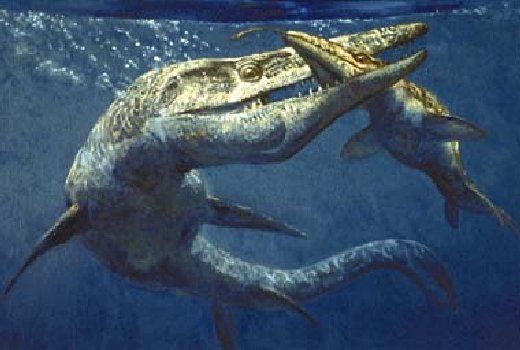
Mosasaur fossil found in Mantua Township

http://www.oceansofkansas.com/Varner/varner.jpg

Well beyond "endangered" are dinosaurs. And dinosaur finds in New Jersey may be even more rare.

Mosasaurs (from Latin Mosa meaning the 'Meuse river', and Greek sauros meaning 'lizard') are large extinct marine lizards. The first fossil remains were discovered in a limestone quarry at Maastricht on the Meuse in 1764. Mosasaurs are now considered to be the closest relatives of snakes, and were varanoids closely related to terrestrial monitor lizards. They probably evolved from semi-aquatic aigialosaurs, which were more similar in appearance to modern-day monitor lizards, in the Early Cretaceous.

So, it's exciting that the assistant curator of natural history at the New Jersey State Museum has found one as part of a paleontological expedition working a site at Inversand [in Mantua] recently.

Although they have been undisturbed for 65 million years, Jason Schein is rushing to get his hands on the fossilized skeletons of sea-dwelling animals and dinosaurs from the depths of a marl pit here.

Schein’s fear is that, if he waits a day, the opportunity to excavate skeletons from the site may disappear forever.

Inversand’s manganese greensand pit in the township — the company has long asked that the exact location not be disclosed — is the last known site of its kind in South Jersey.

“In South Jersey in the late 1800s and early 1900s, there were dozens and dozens of these pits,” Schein explained as he took a break from the triple-digit heat on Thursday.

How do you think towns such as Marlton and Marlboro got their names, he asked.

The paleontologists who would dig in the pits hung out in Philadelphia, sharing finds and stories.

“Some of the most famous stories in the history of science got started here,” Schein observed.

Farmers had no use for the skeletons found in the pits.

“They originally dug it up as fertilizer,” he said of marl. Inversand markets the material that it digs from the pit here as a municipal and industrial water treatment.

Marl was also the right material to preserve the skeletons of what was trapped inside.

This week’s dig, financed with $1,500 from the Delaware Valley Paleontological Society and involving scientists from the state museum in Trenton, Drexel University and the Academy of Natural Sciences, has yielded “lots of good stuff.”

Wednesday, the team “took out of the ground the entire top shell of a big sea turtle.” The shell, Schein said, is “three feet across.”

More importantly, it is both “very well preserved” and “almost 100-percent complete.”

Thursday, the ground yielded the brain case of a mosasaur — a giant swimming komodo dragon.

“If there was ever a real life sea monster, this was it,” Schein suggested.

Sixty-five million years ago, South Jersey was a shallow sea home to fish, sharks, birds, sea turtles, crocodiles and mosasaurs.

The skeletons are headed first to Drexel and eventually to the state museum for study and possible display.

Such sites in the past have yielded the first substantially complete dinosaur skeleton — known as Hadrosaurus foukii. That skeleton was unearthed in Haddonfield and turned over to the Academy of Natural Sciences.


Mosasaur fossil found in Mantua Township marl pit | via NJ.com

Wednesday, October 13, 2010

Riker Hill Park

Riker Hill is a 204.68-acre complex off Beaufort Avenue located in the western section of Essex County in Roseland and is composed of three parts: 1) The Riker Hill Art Park, a 42-acre former US Nike missile tracking base, acquired in 1977. Its former army barracks are now occupied by artists, sculptors and craftsmen; 2) Dinosaur Park, a fossil site of 16 acres (6.5 ha) at the border between Roseland and Livingston. It is one of the major sites in United States where a large number of dinosaur tracks are preserved. It was acquired in 1970 and 3) Becker Park, a 147-acre tract of undeveloped parkland that was purchased in 1969 in part through the Green Acres Program.

Riker Hill Art Park was a United States Army Nike Missile Base in the 1950's. The tract was purchased from the federal government for one [$1.00] dollar, in 1974. The buildings that once housed army facilities have been converted to art studios where sculpture, painting, photography, and various crafts now flourish.

Not only does Riker Hill Art Park provide a unique opportunity for local artists to work together in a communal setting, but it is the only self-supporting park in the park system. The art studios rented to the artists, along with art instruction, the gallery, and concerts held there, produce revenues for the County that help support the cost of the park's operation.

Originally, the site was part of a 55 acre Roseland Quarry owned by the Kidde Company. (There is still quarrying nearby.) In 1968, dinosaur tracks were discovered at the quarry. A 14-year-old named Paul E. Olsen who lived in Livingston started visiting the site with his friend Tony Lessa. They eventually uncovered more than one thousand dinosaur, animal and insect tracks from the Late Triassic and Early Jurassic period over the course of several years.

Paul and Tony helped get the Riker Hill Fossil Site named a National Natural Landmark. The two teens thought that one way to prevent the site from being developed was to send a cast from a footprint of Eubrontes Giganteus to President Richard Nixon to get his support.

Cast of Eubrontes giganteus track by Paul Olsen (1970)
Photo taken at National Archives, Washington, D.C.(2009) via wikimedia.org/


Two happy endings to the story. First, the quarry was divided and the most productive portion was preserved and donated to Essex County Park Commission and named after Walter Kidde. It was declared a National Natural Landmark in June 1971. The rest of the quarry was later developed into the Nob Hill apartment complex.

The second happy ending is that young Paul Olsen grew up to become an actual paleontologist.

He studied and wrote about where he grew up too. The Newark Group, also known as the Newark Supergroup, is the Late Triassic and Early Jurassic sedimentary rocks which outcrop intermittently from Nova Scotia to North Carolina that is named for the city of Newark, New Jersey.

The red rock beds that he explored feature ripple marks, mud cracks, and even rain drop prints. Dinosaur footprints are common, though actual body fossils are very rare. The beds dip to the east, while the faults dip westward.

These beds of sedimentary rock are intruded by numerous dikes and sills made from igneous activity like lava and magma flows. The New Jersey Palisades sill is a huge example of that.

The Passaic Formation was previously known as the Brunswick Formation since it was first described in the vicinity of New Brunswick, New Jersey. It is now named for the city of Passaic, New Jersey, which is near where its type section was described by paleontologist and Professor Paul Olsen.

I took my son's Scout troop to Riker Hill more than a decade ago and explained that we were basically standing at the edge of glacial Lake Passaic where lava from deep within the Earth once flowed and where dinosaurs may have once stood to drink from the lake.

Following these USGS Directions, from Interstate 280 westbound, take Exit 4A and turn south on Eisenhower Parkway. Drive 1.1 miles and turn left onto Beaufort Avenue. After another 0.4 mile turn left onto the entrance road to Riker Hill Park. Drive up hill and park at the Geology Museum. Follow the trail from the museum parking past the ruins of a Nike missile platform, and down hill through the woods about .25 miles to an abandoned stone quarry.

You will see fresh exposures of sedimentary red beds of the Early Jurassic Towaco Formation. They consist of layered shale and intervening sandstone that preserves a variety of sedimentary structures like ripple marks, mud cracks and even trace fossils (rare dinosaur tracks which are very tiny).

It is illegal to remove anything, especially fossils, from the area.

About 200 feet further, there is a high wall of basalt, which is an igneous rock intrusion feature. Though the red rocks you see there are sedimentary rocks, this igneous rock was formed through the cooling and solidification of magma or lava.