As I wrote in part one of this post, we don't have any huge creatures in any green or black New Jersey lagoons, but we do have an interesting group of fur-bearing, aquatic mammals in the state.
In part one, I wrote about minks, beavers and river otters. Today I look at four other elusive creatures that are often mistaken for each other and probably best known by fur trappers and biologists rather than the general public who may never have seen any of them in the wild.
Note that these species are rarely seen but not endangered or threatened in NJ and some are seeing their populations increase. even though they seem rare. Cleaner waters, more forest cover, and less trapping (all good things, I think) are helping their numbers.
 |
| muskrat |
One that you are more likely to spot near water is the
muskrat (Ondatra zibethicus). Despite the "rat" in their name and their long skinny tails, these rodents are not rats.
Muskrats will sometimes build water houses like beavers, but they do not build dams. They get their name from their scent glands that secrete a musky odor.
 |
| Short-tailed weasel AKA ermine or stoat, standing upright |
I have never seen an
ermine (Mustela erminea) in the wild. Ermine is another name for the short-tailed weasel and they are best known and easily identified because of their white fur that appears fully in winter. But on a dry winter day in the woods, that white makes them easier to see - not that it has ever helped me spot one. In summer, their coats are brown with white chests and bellies. They look much like mink and other weasels - long bodies, short legs, round ears, long tails and long whiskers.
Now, to totally confuse you, we also have long-tailed weasels (Mustela frenata).
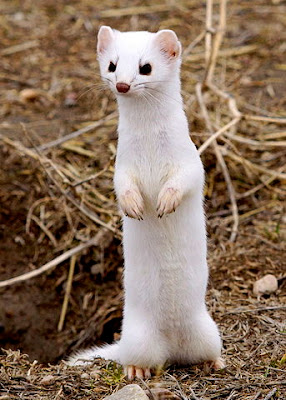 |
long-tailed in winter coat looking very much
like an ermine/stoat
|
 |
long-tailed in summer
|
All weasels are carnivores. The semi-webbed toes on their hind feet help them swim, and they eat roots, stems, leaves and fruits of aquatic plants, as well as small fish, clams, snails, crayfish and turtles.
 |
Fisher - NPS photo by Emily Brouwer, PD via Wikimedia
|
The most elusive and fiercest of all the mammals in these two posts is the Fisher (Martes pennanti).
Other posts on this blog about fishers have gotten a lot of comments from people who believe they have spotted this rarest of New Jersey’s water-loving mammals. They are making a comeback primarily in northwestern New Jersey after an absence of 100 years.
They are fierce carnivores that will hunt squirrels, rabbits, chipmunks, mice, raccoons, shrews and even porcupines. According to the Conserve Wildlife Foundation of New Jersey website, “The best description of a fisher would be to imagine a cross between a cat and a fox with the nasty attitude of a wolverine.”


