Showing posts with label landlocked salmon. Show all posts

Friday, November 21, 2025

Stocking Landlocked Atlantic Salmon in New Jersey


NJDEP Fish & Wildlife’s Hackettstown State Fish Hatchery staff have been stocking landlocked Atlantic Salmon this fall. With the cooler weather, water temperatures dropped into the low 50s, allowing staff to safely stock the fish. 

Landlocked Atlantic Salmon are a freshwater form of Atlantic Salmon that do not migrate to the ocean. In New Jersey, they are actively stocked in select lakes each fall and are thriving as a recreational fishery.

The salmon averaged 14 inches and ranged from 11.7–16 inches, with some reaching 24 inches and 6 pounds.

Stocking occurs when surface temperatures drop below 60°F, typically in October–November. Each year’s salmon is marked with a distinctive fin clip to track age and health over time.

Following the stocking, staff were able to split next year’s fish into two tanks to allow room for growth.

The following waterbodies were stocked with Landlocked Salmon. These lakes are deep, cold, and well-oxygenated, with Alewife forage fish to support salmon year-round.

Tilcon Lake – 440

Lake Aeroflex – 505

Wawayanda Lake – 1,275

Merrill Creek Reservoir – 720

Holdover Trout Lakes (Tilcon, Aeroflex, Wawayanda)

Salmo salar sebago, is a freshwater variant of Atlantic Salmon. Native to eastern Canada and Maine; they were introduced successfully to New Jersey, New York, Massachusetts, and other northeastern states. Unlike their ocean-migrating cousins, landlocked salmon live entirely in freshwater lakes and reservoirs.

For anglers, the minimum size: 12 inches.
Daily limit: 2 salmon per day
Spring pre-season closure: All salmon must be released unharmed.
Trophy Trout Lake (Merrill Creek Reservoir): Minimum size: 15 inches. Combined daily limit: 2 fish (includes salmon, rainbow, and brown trout

All salmon stocked from 2022-2025 have a distinct fin clip marking the year they were stocked. This will help Fisheries Biologists assess the growth rates and condition factors of these fish during sampling. 


Thursday, November 20, 2025

Salmon Versus Trout

New Jersey stocks landlocked Atlantic salmon and trout. They are closely related cold-water fish, but they differ in origin, behavior, appearance, and fishing regulations. Landlocked salmon are a freshwater form of Atlantic salmon, while trout encompass several species with diverse traits.

Landlocked Atlantic Salmon (Salmo salar sebago) are a freshwater variant of Atlantic salmon, originally native to Maine and eastern Canada but live entirely in lakes and reservoirs.


Salmon caught in NJ

Salmon prefer deep, cold lakes with forage fish, like alewives. They are stocked annually in NJ lakes like Wawayanda and Merrill Creek. They are often more migratory in behavior, even when landlocked. Salmon have a silvery body with small black spots mostly above the lateral line. Known for strong, acrobatic fights.Slightly forked tail and thinner caudal peduncle. Sleek, torpedo-shaped profile. Single row of vomerine teeth (roof of mouth). Adipose fin present, like all salmonids.


Rainbow trout caught in NJ

Trout (e.g., Rainbow, Brown, Brook): Includes multiple species across genera (Oncorhynchus, Salmo, Salvelinus). Native to North America, Europe, and Asia, with varied habitats. Trout thrive in streams, rivers, and lakes, and are less migratory and more territorial.

Rainbow trout (which are stocked by the state) have a pink stripe and speckled body. Their tails are forked. Rainbow trout can adapt to lakes and rivers. They have a marbled pattern with white-edged fins and zig-zag vomerine teeth. They are considered easier to catch in streams and stocked ponds, and are popular for fly fishing and beginner anglers.

Brown trout are golden-brown with black and red spots. 

Brook trout prefer small, cold streams. Their tail shape is square.

Friday, November 16, 2018

Autumn Trout and Salmon in New Jersey

Almost 4,400 trout will be stocked in New Jersey next week, and 325 landlocked salmon were introduced into Merrill Creek Reservoir last week, providing more great fishing opportunities in the state.


The trout, measuring 14-18 inches, will be stocked in 18 waters throughout the state on Monday and Tuesday.

The salmon were stocked in Merrill Creek Reservoir in Warren County last Thursday.

Native to eastern Canada and Maine, landlocked salmon are closely related to Atlantic salmon and are nearly identical in appearance. Unlike Atlantic salmon, which migrate from saltwater to spawn in freshwater streams, the landlocked salmon has adapted to spend its entire life cycle in freshwater. Landlocked salmon have been successfully introduced to suitable waters outside their native range, including New Jersey, New Hampshire, Vermont, Massachusetts and New York.

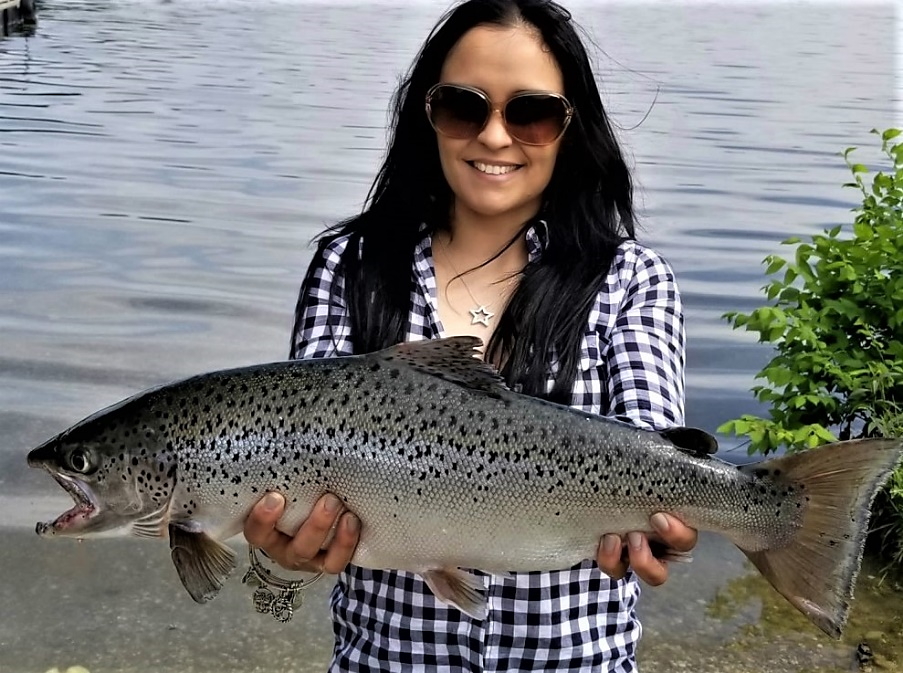
Runelvy Rodriguez of Northvale shows off her state record 25 3/4-inch landlocked salmon,
caught June 2, 2018 in Lake Aeroflex

Landlocked salmon were once privately stocked in New Jersey around 1950. The state launched its current stocking program in 2006, with stockings at Lake Waywayanda in Waywayanda State Park and Lake Aeroflex in Kittatinny Valley State Park. The program expanded to Tilcon Lake in Allamuchy Mountain State Park in 2014.

The Massachusetts Division of Fisheries and Wildlife provides free surplus fingerlings to the New Jersey Division of Fish and Wildlife, which rears them in the Hackettstown Fish Hatchery until they are ready for release. In return, New Jersey has given Massachusetts surplus northern pike.

For information visit the following links:

Monday, April 3, 2017

Salmon in New Jersey

When you think of salmon, your first images may well be of that species jumping up a stream and some grizzly bears grabbing them for a meal. Or maybe your first thought is salmon is as a healthy meal. You probably don't associate them with New Jersey.

But New Jersey has salmon in some of its waters. They are not spawning in our streams. They are the hard-fighting landlocked salmon. This species is the lake-dwelling form of the Atlantic salmon, Salmo salar. Unlike the anadromous Atlantic salmon that is better known for its migration from saltwater to spawn in freshwater streams, the landlocked form is able to complete its entire life cycle in freshwater.

Landlocked salmon are native to eastern Canada and Maine, and have been successfully introduced to suitable waters outside their native range in New Hampshire, Vermont, Massachusetts, New York and New Jersey.

The species was introduced in 2006 to two NJ lakes. The fish require deep lakes that have a suitable year round habitat for coldwater fish like trout and salmon. Salmon prefer water temperatures less than 70°F and dissolved oxygen levels greater than 5 mg/L, though they can withstand lesser water conditions for short periods.

Salmon were actually stocked in several NJ waters a half-century ago. In fact, the historical state record for landlocked salmon is an 8 pound fish caught from Lake Aeroflex back in 1951.

Atlantic Landlocked Salmon

The two lakes that were deemed suitable in 2006 are Wawayanda Lake and Lake Aeroflex.

Wawayanda Lake is located in Wawayanda State Park in northern Sussex County near Vernon. It has a maximum depth of 80 feet.

Lake Aeroflex (also known as New Wawayanda Lake) is in southern Sussex County (within Kittatinny Valley State Park) and has a maximum depth of 101 feet and is considered the deepest natural lake in our state.

Alewife
Both lakes have suitable coldwater fish habitat year round and a forage base of alewives for the salmon to feed upon. The alewife (Alosa pseudoharengus) is an anadromous species of herring found in North America. Like salmon, as an adult it is a marine species found in the northern West Atlantic Ocean, moving into estuaries before swimming upstream to breed in fresh water habitats. But like our landlocked salmon, some populations live entirely in fresh water.

Alewives actually "invaded" the Great Lakes via a canal and bypassed Niagara Falls and their population surged between the 1950s and 1980s. This caused a detrimental effect on native species of fish. Pacific salmon were introduced to the lakes to naturally control them.

Lake Aeroflex and its small neighbor, Gardner's Pond, are a part of the Pequest River headwaters in Sussex County and as such need adequate protection to ensure continued good water quality. There are no swimming beaches or campgrounds within the 2000-acre park.

Lake Aeroflex, as with many other NJ lakes, ponds and rivers, was created by glacial action. Those ancient glaciers receding dug deep holes that became these waterways. In hot summer days, the salmon, trout and other coldwater species will go deep into the lake bottom to find the coldest water.

Lake Aeroflex

Lake Aeroflex is a popular spot for those who enjoy paddle sports. Only electric and trolling motors are allowed. Fishermen will often fish from a kayak to get out to the depths where the most fish can be found. All fishermen at Lake Aeroflex are required to have a trout stamp in addition to a New Jersey fishing license and must observe all special fishing regulations. Certain periods of the year are catch-and-release only. The fish that survive the critical spring period are called 'hold-overs', and are then considered keepers if they meet size and creel limits.

The lake also holds bluegill, largemouth bass, chain pickerel and a variety of panfish. Two docks extend into the lake near the south end and can be used for fishing as well as casting from along the shore.

If you're not an angler, Lake Aeroflex and three other lakes within Kittatinny Valley State Park offer a quiet place to paddle and view scenery and wildlife. Gardner's Pond, Twin Lakes and White's Pond are popular with canoe and kayak users. The forest, meadows and wetlands around the shorelines offer foliage and wild turkey, whitetail deer, squirrel, beavers and muskrat and a variety of northern songbirds.