Showing posts with label preservation. Show all posts

Sunday, February 13, 2022

Princeton's Largest Remaining Undeveloped Property Now Protected

The largest remaining undeveloped property in Princeton is more than 150 acres of mature oak, beech and hickory forest, and contains wetlands. It is now permanently protected, thanks to a partnership among several government agencies and nonprofits It is located on Province Line Road, in the town’s northwest corner.  

The purchase price was $8.8 million from the Lanwin Development Corp. and the family of the late Bryce Thompson. The purchase is part of an initiative called “Princeton’s Emerald Necklace” that seeks to connect preserved green spaces in the town and beyond. A partnership of organizations – led by the town of Princeton and including the Friends of Princeton Open Space, Ridgeview Conservancy, The Watershed Institute, Mercer County, the state Green Acres Program and New Jersey Conservation Foundation – worked cooperatively on the acquisition. Nearly $3 million in private donations were received. The land is now jointly owned by Princeton, the Friends of Princeton Open Space, The Watershed Institute and the Ridgeview Conservancy.

It is now open to the public for passive recreation, including hiking, birding and nature observation. It is also an important habitat for endangered and threatened species, including the red-shouldered hawk and barred owl, as well as songbirds, salamanders and other species whose numbers are in steep decline.

The purchase is important since a development of large homes was previously approved on the land, despite local opposition. Approximately 4,000 trees would have been cut down on the site had the land not been preserved.

planetprinceton.com

fopos.org 

Friday, January 10, 2020

Endangered Historic Sites in New Jersey: East Point Lighthouse

Besides the species that are threatened and endangered in New Jersey, there are also places that are threatened and endangered.

Founded in 1978, Preservation New Jersey is a statewide member-supported non-profit historic preservation organization. They publish the annual 10 Most Endangered Historic Places in order to draw attention to remarkable sites and to their many challenges.

The point of the list is to bring attention and therefore be a catalyst for positive solutions. Their program spotlights irreplaceable historic, architectural, cultural, and archaeological resources in New Jersey that are in imminent danger of being lost.

The list is generated from nominations by the public. Half of the sites on this year’s list are owned by the government and suffer from prolonged deferred maintenance, damage by forces of nature, and from a general lack of awareness or respect for the resource. Not surprisingly, insufficient financial resources are a major problem in saving these places.


One example from the 2019 list is the East Point Lighthouse in Maurice River Township (Cumberland County). This lighthouse sits on an outcropping of land where the Nationally-designated Wild and Scenic River system of the Maurice River enters the Delaware Bay in Cumberland County.

It was built in 1849 making it the second oldest existing lighthouse in New Jersey.

Despite a full restoration done in 2017 through the assistance of New Jersey Historic Trust and Federal Department of Transportation grant funds, this picturesque brick Cape Cod style lighthouse is considered far from safe and secure. The mouth of the Maurice River and the adjacent bayshore is rapidly eroding, and tidal waters erosion has already washed out the protective dunes. Stewards of the lighthouse are left with sandbag brigades in a futile attempt to hold back tidal waters and storm surge. Even with this effort, bay waters regularly lap at the front of the lighthouse and the basement fills with water.

Certainly, some of the erosion is the same as other water-adjacent historic resources around the world caused by climate change. 

The East Point Lighthouse is still being used as an active navigational aid and so should get a more immediate response than what has been proposed to date. The site is owned by the State of New Jersey who will hopefully act expediently in 2020 to protect this National and State Register listed site before the structure is gone forever.

Wednesday, December 13, 2017

Preserving New Jersey

Preservation in New Jersey means many things. It can mean preserving natural area for wildlife or recreation or establishing a local historic district, nominating a building to the New Jersey and National Registers of Historic Places, or even restoring your house.

Although on this site the focus is usually on fish and wildlife, we also look at historical preservation and preservation in general across the state.

Preservation sign at  John W. Berry House (Rutherford, New Jersey)


The New Jersey Historic Preservation Office is located within the Department of Environmental Protection and provides expertise and resources for preserving historic resources. They respond to more than 40,000 calls yearly from people working to preserve, protect and promote New Jersey's historic resources. This work requires historians, researchers, planners, architectural historians, architects, engineers, and archaeologists.

National Heritage Areas are places where we find historic, cultural, and natural resources but, unlike national parks, these areas are large lived-in landscapes. One New Jersey example is Crossroads of the American Revolution, a National Park Services program in our state that spans from the Palisades at Fort Lee to the shores of the Delaware River at Red Bank Battlefield. At revolutionarynj.org, you will find 14 places from the Long Pond Ironworks State Park in the northern part of NJ to Somers Mansion in the south.

Here are some links that can lead you to more information from both public and private organizations.

New Jersey Land Preservation and Environmental Organizations
Association of New Jersey Environmental Commissions
D&R Greenway Land Trust
Garden State Preservation Trust
Morris County Planning, Development and Technology Department
New Jersey Conservation Foundation
New Jersey Pinelands Reserve
The Nature Conservancy New Jersey
The Highlands Council
The Pinelands Commission
Crosswicks/Doctors Creek Regional Greenway Planning Group

Markers at Hemlock Ridge Preserve trailhead on Frog Pond Road, Warren County.


New Jersey History, Cultural and Arts Statewide Organizations
New Jersey Historic Trust
New Jersey Historical Commission
New Jersey Historical Society
New Jersey State Council on the Arts
NJDEP Division of Parks and Forestry
Preservation New Jersey who nominates the 10 most endangered historic places in our state each year.


Thursday, April 14, 2016

The Great Falls Today


Yesterday, I wrote about some of the history of the Great Falls of the Passaic River in Paterson. Today, I'm looking at what is there today.

It is a natural wonder, but it is only 15 miles from downtown Manhattan and surrounded by a very urban and troubled city.

It is New Jersey's newest national park - officially the Great Falls National Historic Park.

We know it for the 77-foot falls that is so often photographed with its arched iron bridge and historic redbrick mill buildings that were once powered by the falls and its raceway system.

The smash hit Broadway musical Hamilton about Paterson's founding father has made Paterson a place to visit if the story intrigues you and you want to dig deeper. The connection between the musical's story and Alexander Hamilton's economic legacy began not in New York City but at Paterson's Great Falls.

Hamilton chose the site of the Great Falls to propel his brainchild, a "national manufactory," Paterson was America's first planned industrial city. In 1791 the Society for the Establishing Usefull Manufactures (S.U.M) was incorporated.

The Great Falls is the east coast's second largest waterfall. Everyone knows #1 - Niagara Falls - and the hope was that New Jersey could pull some tourists to our Great Falls and the surrounding Paterson historic district.

But, just like other natural areas like forests and beaches, and historic areas and wildlife species, the Great Falls needs protection.

The area was named a National Natural Landmark in 1967, a National Historic Landmark District in 1976, And getting a national historic park designation in 2009 helps, but it is not enough.

Last fall, Paterson's Planning Board approved a 156-unit apartment complex atop the ridge overlooking the historic district and falls. Huh? Doesn't that destroy the very thing that you want to promote?

Perhaps the tourism dollars from the park have not come or have not come quickly. Selling land and having construction done is fast and easy money, but will a dangerous half-life to the future.

Short-term tax ratables versus long-term planning and a revitalized Paterson is much more difficult and will take much longer - but will have a much longer and lasting impact on the city, area and state.


Cultural Center at the park

Thursday, November 6, 2014

NJ Voters Approve Ballot Question on Preservation


New Jersey voters voted YES this week on Ballot Question 2, amending the state constitution to set aside a larger percentage of the corporate business tax (from 4 to 6%) for preservation. This does not mean an increase in the corporate or other taxes, just a reallocation of how the collected taxes are dispensed. 
 
The question was approved by an overwhelming 65 percent of Garden State voters. According to the New Jersey Conservation Foundation, this is the fourteenth time in 52 years that voters have approved efforts to preserve New Jersey's clean water, productive farmland, parks, natural lands and historic sites.

Being the nation's most densely populated state, makes saving land for all of our communities even more critical. For example, with rising sea levels and increasingly severe storms, protecting lands that mitigate flooding all the more urgent.  

New Jersey is considered to be the first state projected to be fully "built out" - with all land either preserved or developed. Preserving and adding what we can to parks, farmlands,  and forests, and investing in open spaces can help protect and expand a healthy environment for current and future generations.


Friday, March 7, 2014

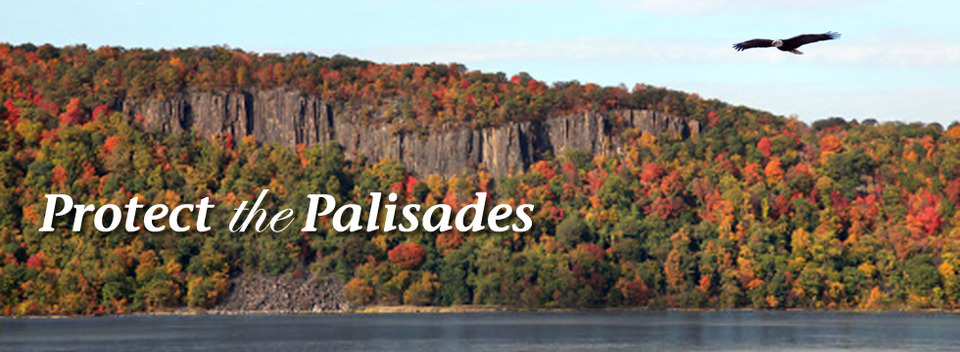
Protect the Palisades


I only became aware this week that New Jersey is celebrating its 350th anniversary. That's pretty good, considering the United States is only 238 years old. But that doesn't seem like much if you consider that the now endangered Palisades cliffs over the Hudson River are 200 million years old.

An update from Michele Byers at www.njconservation.org alerted me to the Protect the Palisades website.

The issue is that LG Electronics wants to build a 143-foot office tower that would rise high above the tree line, more than four times the height of existing buildings next to Palisades Interstate Park.


What continues to amaze people about the Palisades is that the view from the Hudson River north of the George Washington Bridge has remained unchanged over centuries. Pretty amazing for this most densely populated state in the nation that gets plenty of abuse for it.

It's certainly not the first threat to the Palisades. In the early 1900s, it was threatened by rock quarrying. Citizens fought then for preservation and the Palisades Interstate Park Commission was created. Before we had land conservancy groups very visible, prominent families of the day bought lands along the cliffs and donated them for conservation. Zoning for towns north of the GW Bridge wrote height restrictions limiting building to 35 feet so that the tree line of Palisades Interstate Park was maintained.

The National Park Service supports the low-rise alternative continuing and reminds us that the Palisades have the rare distinction of being both a "National Natural Landmark" and a "National Historic Landmark."


But in 2012, Englewood Cliffs granted a variance allowing the LG office tower, and opening up a larger area for more high-rise development. (The NJ Federation of Women's Clubs sued to stop the project, along with Scenic Hudson and the NY-NJ Trail Conference and it is a case that's still before the courts.)

Hopefully, the NPS and concerned citizens can protect our vista in the same way that the Grand Canyon, Yellowstons and Yosemite National Park are protected.

In a Star-Ledger editorial last summer:
LG spokesman John Taylor said the company has not ruled out a redesign, although it would be costly. Opponents of the current design, such as Michele Byers of the New Jersey Conservation Foundation, said if the company lowers the building, they’ll get behind the project to expedite it and minimize costs. Taking the building down to a lower height would ensure the preservation of the Palisades and earn priceless goodwill for the company.

PROTECT THE PALISADES asks you to join in at 1pm on Saturday, March 8th around New Jersey and in NYC as people stand up and show LG how strong the opposition to their plan to build a tower on the Hudson River Palisades really is! Spread the word and sign up new supporters.

You can also follow Protect the Palisades on Facebook for updates.


Thursday, August 1, 2013

NJ Gets Federal Grants to Protect Habitat in Sussex County

Bog turtle with its distinctive orange patch on the head
The NJ Department of Environmental Protection has been awarded two federal grants totaling $440,000 to be earmarked for the purchase of 164 acres of sensitive habitat in Sussex County that will particularly target preservation and protection of the endangered bog turtle population in New Jersey.

The awards from the U.S. Fish and Wildlife Service will partially finance purchases of two separate tracts, both of which will provide connecting greenways for existing turtle populations, and which will benefit other plant and animal species in the region. In addition, the land preservation would add to existing nature watching areas in Sussex County.

“Continued preservation of key open spaces in New Jersey, whether for habitat protection or recreational uses, is a priority of the Christie Administration,’’ said Commissioner Bob Martin. “It enhances our environment and provides a better quality of life for our state’s residents.’’

“Preservation of this type of very specialized, unique habitat not only will protect the federally threatened bog turtle, offering it a brighter future in New Jersey, but will add to preserved lands that will be available for recreational pursuits, such as hiking and bird watching,’’ added Dave Chanda, Director of the DEP’s Division of Fish and Wildlife.

The purchase of these properties will improve habitat connectivity, as they connect to approximately 350 acres of already permanently preserved property owned by the state.

The federal money, coming from the U.S. Fish and Wildlife Service’s endangered species fund, would pay about 40 percent of the estimated $950,000 cost of the land preservation in Lafayette and Wantage Township, with the state’s Green Acres Program financing the balance.

One $400,000 federal grant will be used towards acquisition of four tracts, totaling 143.6 acres, of existing bog turtle habitats, while also connecting to land already preserved by the state. A second $40,000 federal grant will target the purchase of 20 acres of bog turtle habitat within a unique spring-fed wetland complex, in an area that also hosts a rare plant, the spreading globe flower.

Bog turtle nesting
The bog turtle is quite elusive behavior and rare as a result of habitat destruction. It prefers marshes, wet meadows, and fens featuring plant species such as sedges,rushes, mosses, skunk cabbage, cattail, jewelweed, and smartweed. If you do spot one, it is likely to be in mid-April through June as it basks in the sun.

Their range is throughout NJ and they were once abundant throughout the state. Bog turtles are now primarily found in the remaining rural areas of Sussex, Warren, Hunterdon and Salem counties. Intense land uses such as large-scale agriculture, urbanization, wetland alterations and stormwater outputs are incompatible with bog turtles and have depleted bog turtle populations from much of the state.

The properties also provide landscape-level protection for upland forest and grassland habitats, thus conserving the hydrology and water quality of the wetlands.

The preserved lands will be managed by the New Jersey Natural Lands Trust in cooperation with the DEP’s Endangered and Nongame Species Program. Management of the property will include removal of woody vegetation to establish a more open canopy and ensuring that a proper wetlands area exists for the bog turtle population.

For more information on the state’s Threatened and Endangered species, please visit: http://www.nj.gov/dep/fgw/ensphome.htm


SOURCE: http://www.nj.gov/dep/newsrel/2013/13_0078.htm

Wednesday, July 29, 2009

The Highlands Trail


The Highlands Trail highlights the natural beauty of the New Jersey and New York Highlands region, and draws the public's attention to this endangered resource. It is a cooperative effort of the New York - New Jersey Trail Conference, conservation organizations, state and local governments, and local businesses.

When completed, the trail will cover over 150 miles from Storm King Mountain on the Hudson River in New York south to Riegelsville, New Jersey, on the Delaware River. The route will connect major scenic attractions in both states. Ultimately, a network of trails including alternate routes and multi-use paths is envisioned.

The Highlands Trail is a combination of co-alignment on established trails, new trails, and road walking. The Highlands Trail blaze is a teal-colored diamond. The co-aligned sections bear both trails' blazes, except for the Appalachian, Sterling Ridge, and Allis Trails, which have plastic Highlands Trail logos at critical points. Hikers must pay attention at intersections as the Highlands Trail often leaves one trail to join another.

Camping is not permitted along the Highlands Trail. Thru-hikers must stay at bed-and-breakfast facilities along the route, or at established State Park camp grounds.


Click image to enlarge

Tuesday, April 28, 2009

Preservation New Jersey

Founded in 1978, Preservation New Jersey advocates for and promotes historic preservation to protect and enhance the heritage of New Jersey’s communities. PNJ is the only statewide private membership-supported historic preservation organization in New Jersey.

They publish an annual 10 Most Endangered Historic Sites in NJ list, which draws attention to remarkable sites in the hope of being a catalyst for for solutions for their preservation.

They are advocates for sound public policy at the local, state and federal levels on behalf of the historic preservation community in New Jersey. they also conduct tours, workshops, lectures and conferences to educate the public about historic sites and preservation issues.

Sunday, April 19, 2009

Paterson's Great Falls Named National Historical Park


President Obama recently signed into law the Paterson Great Falls National Historical Park Act. The Paterson Act is part of an omnibus parks and historic preservation bill.

Hamilton statue at the Great Falls
photo via Flickr by Ken Ronkowitz

As the nation’s first Secretary of the Treasury, Alexander Hamilton founded the City of Paterson to begin implementing his plan to harness the force of the Great Falls—then the nation’s largest waterfall—to power new industries that would secure America’s economic independence.

Considering that one federal agency has ranked Paterson as the most economically distressed city in the United States, the local community leaders hope the creation of the national historical park, along with preservation and redevelopment of the historic center of the city, will have a positive impact on Paterson’s 175,000 residents.

Groups such as NJ Heritage Development Coalition are recommending that the state enact a state historic preservation tax credit that will jump start redevelopment in Paterson and across the state.

President Barack Obama’s Remarks
"As Americans, we possess few blessings greater than the vast and varied landscapes that stretch the breadth of our continent. Our lands have always provided great bounty – food and shelter for the first Americans, for settlers and pioneers; the raw materials that grew our industry; the energy that powers our economy.

What these gifts require in return is our wise and responsible stewardship. As our greatest conservationist President, Teddy Roosevelt, put it almost a century ago, “I recognize the right and duty of this generation to develop and use the natural resources of our land; but I do not recognize the right to waste them, or to rob, by wasteful use, the generations that come after us.”

That’s the spirit behind the bipartisan legislation I’m signing today – legislation among the most important in decades to protect, preserve and pass down our nation’s most treasured landscapes to future generations."