Showing posts with label right whale. Show all posts

Monday, March 20, 2023

Slow Down for Whales


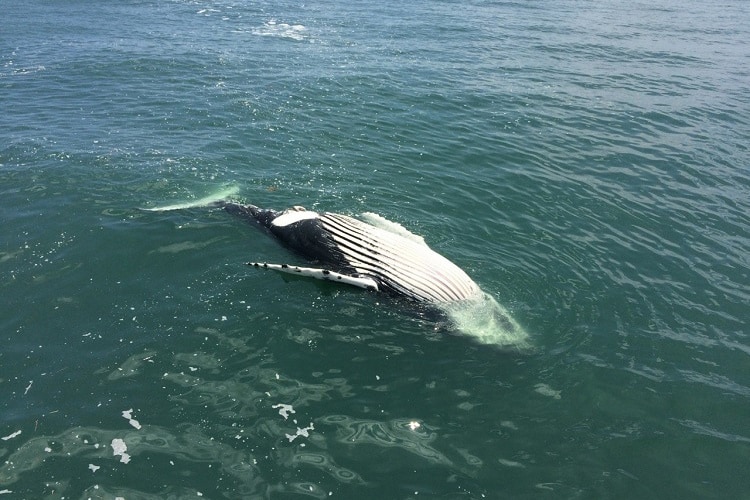
Humpback whales are the most common whale seen in New Jersey’s waters. The Atlantic Ocean humpback whale population has been increasing in recent years and they were federally delisted as Endangered in 2016. More humpback whales have been observed overwintering in our nearshore waters, likely due to factors related to climate change, increased food abundance, and improved water quality.  

But all whales face certain challenges along New Jersey’s coast. Those challenges include the potential for vessel strikes, stranding and gear entanglement. NJ Fish & Wildlife, in cooperation with NOAA and its stranding response partners, strives to respond to all whale stranding and mortality events. Completing a necropsy (animal autopsy) is a priority for each stranding to help determine the cause of death. 

If you come across a stranded marine mammal in New Jersey, remain a safe and legal distance from the animal and immediately contact the NOAA Fisheries 24-hour Stranding Hotline at (866) 755-6622 to report its location.

NOAA Fisheries administers vessel speed reduction zones which include both mandatory (Seasonal Management Areas) and voluntary (Slow Zones) speed reduction areas for vessels to reduce the likelihood of deaths and serious injuries to critically endangered North Atlantic right whales that result from collisions with vessels. In addition to protecting North Atlantic right whales, Slow Zones provide added protection to all large whales and marine mammals.  

In the Seasonal Management Areas, all vessels 65 feet or longer must travel at 10 knots to reduce the threat of vessel collisions. Voluntary Slow Zones are triggered when 3 or more right whales are recorded in an area. In these areas, all vessels are encouraged to travel less than 10 knots. 

All boaters from Maine to Virginia, or interested parties, can sign up for email or text notifications about the latest Right Whale Slow Zones. 


Monday, March 13, 2023

Ship Strikes Probably Accounts for Some East Coast Whale Deaths


The Wildlife Society quotes The New York Times in a post about the 23 whales that have washed up on the coast of the eastern United States since December.

North Atlantic right whales (Eubalaena glacialis), considered endangered by the National Oceanic and Atmospheric Administration, humpback whales (Megaptera novaeangliae) also endangered, and even a minke whale (Balaenoptera acutorostrata) have been found on beaches from New York state to Virginia. 

Most of the dead whales have been humpbacks, with ship strikes likely being the cause of most of the deaths. Changing shipping routes and methods in the sea due to a shifting consumer market related to the COVID-19 pandemic may have contributed to the increased death rate.


Monday, November 16, 2015

Whale Migration at the Jersey Shore

Humpback Whales Feeding 1
Humpback whales feeding.       http://www.flickr.com/photos/mistermoss/ / CC BY 2.0


Whales do pass New Jersey on their migrations and during fall beach walkers and boaters get some great views.

Recent reports include a humpback just a few hundred feet from the Bay Head shoreline and off Chadwick beach. Humpbacks are adding bulk for winter which they spend in Silver Bank Sanctuary, a shallow water area off the coast of the Dominican Republic.

Southern waters are where they mate, birth and nurse their calves.

We will see them again when they follow the food north in April.

Pods of the baitfish, menhaden, and striped bass and bluefish often coincide with the fall migration of marine mammals, so whales and bottlenose dolphins and seals are more common at the shore.

Bob Schoelkopf, founder and director of the Marine Mammal Stranding Center in Brigantine said the humpback whales are the primary whale species that have been spotted by numerous boaters because they come closest to the shore, using it to pin the bait up so they can eat it.

Boaters are always warned to stay clear of whales and dolphins. At 80,000 pounds, a humpback can do real damage to boats. They can eat upwards to 3,000 pounds a fish per day.

The warning is also a legal one because humpbacks are an endangered species that are safeguarded by the U.S. Endangered Species Act and the Marine Mammals Protection Act while they pass through our waters. Boats must stay at least 200 feet from them.

You won't see them near shore, but boaters may spot right whales and minke whales further out and they move south to waters off Georgia and Florida. Right whales are the most endangered whale species in the world.

Do any whales remain of the NJ coast through winter? Yes, the mackerel-loving and endangered fin whales. Next to blue whales, they are the second-largest whales growing up to 80 feet.

The only visitors to Jersey that will see on shore are the one fur-bearing species that comes south to visit for the holidays. That is the harbor seal. They are spotted onshore sunning, maybe on a dredge pipe on the Manasquan River or resting on the beach at Seaside Heights.

More at app.com/story/sports/outdoors/fishing/hook-line-and-sinker/2015/11/11/humpback-whales-jersey-shore/

Saturday, July 12, 2014

Whales Off the NJ Coast This Month May Be Threatened By Research


Eubalaena glacialis with calf.jpg

RIGHT WHALE Eubalaena glacialis with calf. Licensed under Public domain via Wikimedia Commons.


Recent whale sightings off Deal and Lavalette are a reminder that whales are in the middle of their annual migration north past our beaches. Seeing a humpback breaching the surface and landing with thunderous splashes is still rare enough to be news, but the whales are out there.

In what may seem surprising, some environmental groups have opposed a recent "climate change" study by Rutgers University because of whales and other marine mammals.

Environmentalists have joined Governor Chris Christie in opposing research funded by the National Science Foundation and the National Oceanic and Atmospheric Administration and conducted by Rutgers University and the University of Texas. They planned to to send ear-shattering sound blasts to the ocean floor off the New Jersey shore to create three-dimensional images of sediment lying thousands of feet beneath the seabed. This will supposedly help determine how the coastline has advanced and retreated during times of historic climate change.

But many environmental groups and some commercial and recreational fishing interests argue that the study would harm dolphins, whales, and other marine life by subjecting them to sounds blasts of 250 decibels or more every five seconds for 34 days.

Cassandra Ornell, a staff scientist for Clean Ocean Action, a coalition of more than 125 groups, conceded that opposing a federally funded climate change study “is kind of unusual for us.”

Whales are more plentiful off the Jersey coast now because of the annual spring migration from their southern winter grounds to their northern summer grounds.

Sightings have been of the dramatic humpback whale. They are feeding on small schooling fishes, such as menhaden (aka bunker). We also have right whales, minke whales and fin whales passing by our coast, though those species tend to stay further offshore.

The research is also of concern because humpbacks are traveling with calves.


Right whale size.svg
 Size compared to an average human - via Wikimedia Commons.


Fishermen can encounter whales while fishing on top of schools of bunker for striped bass. This occurred this summer off Asbury Park when fisherman met up with a fin whale.

The right whale, in particular, is considered highly endangered and boaters are supposed to keep a distance of 100+ feet from all whales and 500 yards from right whales.

The seriously endangered right whale (whose name came from whalers who said it was the "right" whale to hunt) are estimated at only 300 living mainly off the eastern coast of the United States and Canada. The right whale was friendly, slow swimming, floated when killed, and yielded lots of oil and baleen and whalers killed thousands of them. The population in the North Atlantic is the most endangered in the world.


Federally Endangered Whales That Migrate Past NJ
Whale, North Atlantic right**Eubalaena glacialis**
Whale, blue**Balaenoptera musculus**
Whale, fin**Balaenoptera physalus**
Whale, humpback**Megaptera novaeangliae**
Whale, sei**Balaenoptera borealis**

Wednesday, March 7, 2012

Stressing Out Right Whales

Right whales come to the Bay of Fundy
in late summer to feed.
Research indicates that North Atlantic right whales, which are New Jersey's rarest whale species, are showing greater stress because of increasing ocean noise.
We overlook some of our marine species because they are not frequently seen. We don't think of whales as "living in New Jersey" but if you look at the list of endangered mammals for NJ, 6 of the 9 species are whales. You may need to remind children (and some adults!) that whales are mammals.
MAMMALS
Endangered
Bat, Indiana**
Myotis sodalis**
Bobcat
Lynx rufus
Eubalaena glacialis**
Whale, blue**
Balaenoptera musculus**
Whale, fin**
Balaenoptera physalus**
Whale, humpback**
Megaptera novaeangliae**
Whale, sei**
Balaenoptera borealis**
Whale,sperm**
Physeter macrocephalus**
Woodrat, Allegheny
Neotoma magister
**Federally Endangered

These whales are under the state's protection primarily during the seasons when they migrate up or down the Atlantic coast. North Atlantic right whales (Eubalaena glacialis) roam up and down the east coast of North America, coming to the Bay of Fundy typically in late summer to feed.

In an article from the BBC:
Ships' propellers emit sound in the same frequency range that some whales use for communicating, and previous studies have shown the whales change their calling patterns in noisy places. Now, researchers have measured stress hormones in whale faeces, and found they rose with the density of shipping.

The species studied in the Bay of Fundy in Canada, the North Atlantic right whale, is listed as endangered. It had been thought that hunting by the Basque people a few hundred years ago brought a robust population down to barely sustainable levels. But recent research suggests the big population decline happened much earlier, for reasons that are unclear.
Whales (particularly mothers and calves) communicate
using low frequency sounds
Ocean noise has risen substantially in recent decades along with the growth in global shipping. For example, one analysis showed that the north-eastern Pacific is 10-12 decibels louder now than in the 1960s.

Significant numbers of right whales are hit by ships and entangled in fishing nets and it is hard to determine how much of a factor noise is in affecting whales' communication and navigation.

One successful effort in the Bay of Fundy has been in relocating shipping lanes away from the feeding grounds. This has reduced ship strikes by 80-90%, while similar measures have been taken elsewhere along the coast.

Friday, November 6, 2009

Right Whales


The Right whale is one of the ocean's most endangered species with only a few hundred left in the North Atlantic, and a few thousand of its counterparts in the entire Southern Hemisphere.

The Right whale was historically a favorite of whalers (hence it was the "right" whale to hunt) because of its slow swimming speed. This species also floats after it is killed, making it easier to harvest.

Right whales are baleen whales that range from 35-55 feet long and weigh up to 117 tons.

The leading cause of death among the North Atlantic Right Whale, which migrates through some of the world's busiest shipping lanes whilst journeying off the east coast of the United States and Canada, is injury sustained from being struck by ships.

The United States government introduced measures to curb the decline of this species. The National Oceanic and Atmospheric Administration's (NOAA) Atlantic Large Whale Take Reduction Plan was introduced in 1997. A key part of the plan was the introduction of mandatory reporting of large whale sightings by ships using U.S. ports. This requirement was implemented in July 1999.

Thursday, April 23, 2009

Endangered Right Whales May Be Rebounding On Atlantic Coast

Some good news about North Atlantic right whales. These whales do not receive as much attentions as humpbacks and killer whales in the press, and good news about the environment also doesn't get the attention that dying whales do.

Only about 400 of these marine mammals are thought to exist, making right whales one of the most endangered large whale species in the world.

Their name comes from the fact that they were considered the "right whale" to kill during the whaling era because of the thick layers of valuable blubber beneath its skin, and because the whales are so chunky that they float quickly to the surface after they're harpooned.

The calving season for these school-bus-sized whales formally ended March 31, and the whales are now headed north along the East Coast of the United States.

These right whales birthed a record number calves this year off the coast of the southeast United States, which gives scientists hope that this rare and overlooked species can recover. There were recorded 39 new calves, each weighing in at about 3,000 pounds, born off the Atlantic coast of Florida and Georgia.

Right whales have to make it to age 5 to 7 before they too can give birth and continue the species' gradual rebound. Young whales face threats from humans before they reach that age. These whales migrate through a channel of ocean that's heavily trafficked by cargo and fishing ships and ships are known to strike right whales, partly because the black creatures are difficult to spot on the water.

Five whales were also found entangled in fishing gear this year in the southeast Atlantic. These thick ropes can rub through a whale's skin and hit bone, and restrict the ability of the whales to feed. There have been some new restrictions on the use of these ropes (sinking ropes are safer for whales) in Maine.

Kate Longley, who works on a team with the Provincetown Center for Coastal Studies to monitor right whales in Cape Cod Bay, was cautiously optimistic: "There hasn't been much indication that the species is rebounding significantly. It's definitely good news [the 39 births], and it's the most that we've seen, but it's only one year. So I think it would be premature to make any sort of prediction or any sort of statement about the state of the species based on one year of high calving."

Monday, April 20, 2009

Endangered Whales Off The NJ Coast

There are nine mammals protected as endangered in NJ, and six of those are whales.

All six are also Federally Endangered, and so they are protected by Federal laws while off the coast of New Jersey.

Those 6 whale species are:
  1. North Atlantic northern right whale (or Black right whale), balaena glacialis
  2. Blue Whale, balaenoptera musculus
  3. Fin Whale, balaenoptera physalus
  4. Humpback Whale, megaptera novaeangliae
  5. Sei Whale, balaenoptera borealis
  6. Sperm whale, physeter macrocephalus
Cetaceans is the order that includes whales, dolphins and porpoises. It is then divided into two suborders: Odontoceti and Mysticeti.

Odonoceti have teeth and a single blowhole (nostril) at the top of the head. The sperm whale is well known, if only from pictures and movies, for being one that regularly produces a visible spout or blow.

(Photo of right whale skim feeding via The Whale Center of New England)

The Mysticetes are the baleen whales. The other 5 listed here are baleen whales. That means they have no teeth and filter their food through their baleen. They also have two blowholes.

Baleen is made of the same material as our fingernails and hair, and has been described to the touch as similar to thick plastic hair. The baleen plates overlap each other and hang from the upper jaw of the whale. (They are sometimes compared to vertical blinds.) Each plate is frayed on the bottom and edges so that they mat together and help trap food. Right whales have the longest baleen.

My childhood fascination with whales has never faded, so I will write more about each species here in the months to come. I also admit to listing Melville's Moby Dick in my five books list despite its portrayal of whale hunting.