Tuesday, July 19, 2011

Deer In Velvet

Male deer with antlers in velvet
http://njwight.tumblr.com/post/7803845759/antlers

Now is the time that you can see male deer in NJ showing new antlers.

Each antler grows from an attachment point on the skull called a pedicle. While an antler is growing, it is covered with highly vascular skin called velvet, which supplies oxygen and nutrients to the growing bone. Growth occurs at the tip, and is initially cartilage, which is mineralized to become bone. Once the antler has achieved its full size, the velvet is lost and the antler's bone dies. This dead bone structure is the mature antler.

When summer ends, you can begin to see "deer rubs" which are the abrasions that male deer make by rubbing its forehead and antlers against the base of a tree. These can be found in any area with high deer populations. Deer rubs are used by hunters to find locations for hunting. The deer are rubbing the velvet off their antler growth. This is especially true during rut season because that area between the forehead and antlers contains a large number of apocrine sweat glands, and leave a scent that communicates a challenge to other male deer while also attracting potential mates. The size of the rub usually varies with the size of the deer.

Wednesday, July 13, 2011

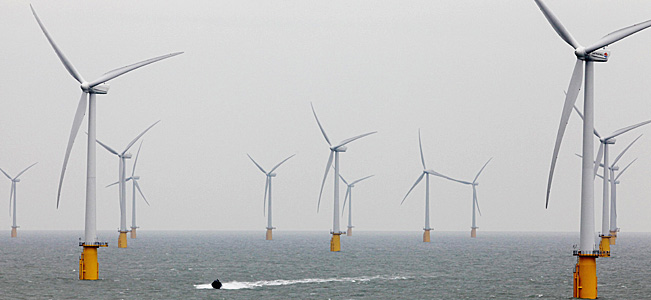
U.S. Closer to Allowing Wind Farms Off New Jersey


According to The Wall Street Journal

The U.S. Interior Department expects little environmental impact from testing the feasibility of wind farms off the coast of four Atlantic coast states, according to a draft document released Monday.

The findings, which could be changed after the department reviews public comments, are an indication that the agency may be prepared to lease the areas for wind development without a more lengthy environmental review.

The document released Monday is a preliminary assessment of a proposal to lease areas off the coasts of New Jersey, Virginia, Delaware and Maryland and to allow companies to test whether the areas are viable for generating wind power. It is part of a wider push by the Obama administration to speed up the permitting process for what are known as wind farms.

In a news release asking for public comment on the document, Interior Secretary Ken Salazar said that, "with today's announcement, we are taking another step toward ensuring that renewable [energy] development along the Atlantic outer continental shelf becomes a reality."

The areas under consideration for lease include about 354,000 acres off southern New Jersey, 139,000 acres off the Virginia coast, 103,000 acres off Delaware's shores and 80,000 acres off the coast of Maryland. Leasing the areas and allowing testing there would have a relatively small effect on wildlife, commercial fishing, water quality and other concerns, the draft environmental review found.


Thursday, July 7, 2011

The Fight Against Invasive Species


The IUCN recently posted an article about "invasive aliens."  No, these are not the type found in summer movies like Super 8. These are the species - animal and plant - that invade habitats where they do not belong.

Biodiversity is being lost at an unprecedented rate, with a whole host of factors contributing to the disastrous declines. Habitat destruction is well-documented as being one of the leading causes of species extinctions, but invasive alien species are also to blame. But what exactly is an invasive species? Invasive species are those organisms which have been introduced by man, either accidentally or on purpose, to areas in which they are not naturally found, and have thrived to the extent that they have taken over their new environment.

It is important, however, to make the distinction between these species and ‘non-native’ species. Plenty of species are introduced to areas outside of their natural range, and are hence non-native, but not all of these will become invasive. Many will not be able to adapt to the new environment at all, and may eventually die off. Other non-native species cope well in their new surroundings without ousting native species from the ecosystem, co-existing without competition. An ecosystem can support this change as its original components and key players are still there. The non-native species may itself prove beneficial to human wellbeing and in some cases may become part of the landscape, as in the case of the Mediterranean Cypress (Cupressus sempervirens) in Tuscany or the Common Pheasant (Phasianus colchicus) in many areas of North America and Europe. What causes a species to be labelled as invasive rather than simply non-native is its ability to out-compete native species, impacting on the biological diversity of the region and even on the livelihoods of human communities.

Stink Bug  via http://media.nj.com/hunterdonnews_impact/

Invasive species in New Jersey include foreign bugs, plants, animals and aquatic creatures. Invasive species are introduced species that can thrive in areas beyond their natural range. They are characteristically very adaptable, aggressive, and have a high reproductive capacity. Their vigor combined with a lack of natural enemies often leads to outbreak populations that threaten and endanger native species.

For example, the East Asian stink bug is in NJ now and does literally stink.

The European green crab and the Asian Shore Crab threaten our native acquatic populations.

Flathead Catfish caught in the Delaware River near Lambertville
blogs.courierpostonline.com
The Flathead Catfish which is normally found in the Mississippi basin, has been found in NJ in places like the Delaware and Raritan Canal.


Giant Hogweed flower head
The Giant Hogweed sounds like something from science-fiction. This species that can grow up to 20 feet and it produces sap that cause blisters and severe burns that leave scars on humans.

Last fall, the first North American instance of invasive Chinese pond mussel was confirmed by New Jersey state biologists in Hunterdon County after DNA testing.

The USDA's website offers state lists and news. For NJ information, see invasivespeciesinfo.gov/unitedstates/nj.shtml

Further Reading

Tuesday, July 5, 2011

Latest estimates on endangered species

Over 19,000 species of animal and plant are in danger of extinction worldwide, up from just over 11,000 in 2000, according to the latest "Red List of Threatened Species" from the International Union for Conservation of Nature (IUCN).

via http://www.economist.com/blogs/dailychart/2011/06/endangered-species


About one-third are considered "threatened" (critically endangered, endangered or vulnerable).

Between 2000 and 2011 the number of species assessed by the IUCN grew by over 60%.

Amphibians (frogs, toads and salamanders) who were not fully assessed until 2004 show the greatest loss partially because of the increased evaluation.

Habitat loss, pollution, disease and invasive species continue to diminish all species.

Mammals fare the best with the percentage of endangered species down since 2000.

Arabian Oryx (Oryx leucoryx)
 After the last wild individuals of the Arabian Oryx (Oryx leucoryx) were killed in the early 1970s, a captive breeding program and protective legislation were established to bring the species back from the brink of extinction. Formerly occurring throughout most of the Arabian Peninsula, the Arabian Oryx has been reintroduced to five countries. The wild population currently numbers 1000 mature individuals. Illegal live capture for sale to private collections remains a constant threat, and poaching continues to threaten individuals who wander outside of release sites. Drought and overgrazing have affected habitat quality in places, limiting potential future release sites. Despite these issues, its relatively steady wild population growth qualifies the Arabian Oryx to be downlisted in 2011 from Endangered to Vulnerable. Photo © D Mallon/Antelope Specialist Group