Showing posts with label wildlife management. Show all posts

Thursday, February 15, 2024

Fooling Beavers


A beaver dam is a structure built by beavers using branches, twigs, mud, sticks, rocks, and grass. The dam's shape can vary based on the number of beavers and the amount of water in the area. Beaver dams are usually semicircular or crescent-shaped. 

It turns out these dam-building actions can help the environment. They recharge groundwater, filter out sediments, and create habitat for waterfowl, amphibians, fish, and aquatic invertebrates—all while providing ecological services including flood control, drought management, and carbon sequestration. Those are not why beavers build them. A dam stops the flow of water and creates ponds that are safe from predators like coyotes, wolves, and bears, and provide food during winter.

Beaver pairs mate for life and produce one or two pups a year. When pups reach maturity at around two years, they strike out on their own, traveling an average of 3.5 miles in search of new terrain. Over time, beaver populations began to rebound, returning to their historical habitat—much of which included cities. According to a Sierra Club article, park officials are seeing the return of these aquatic rodents as the source of some wrecked landscapes as they have toppled trees, flooded trails and roads, and damaged infrastructure. 

Solutions are to trap the pioneering beavers and remove their dam debris, but they are persistent. Then someone found a way to baffle the beavers into better behavior.

It turns out that beavers build dams instinctively in order to stop the sound of running water. It is an innate quirk of the species. Building a flow device (some are trademarked as Beaver Baffler, Castor Master, and Beaver Deceiver) tricks the beaver into thinking they’ve built the perfect dam by eliminating the noise and sensation of flowing water. They use a long perforated pipe to divert water from the center of a pond out through a hole in the dam and down into the stream. The pipe helps muffle the sound of running water until it’s past the dam, and exclusion fencing on each end of the pipe keeps the beaver from plugging the system. 


Beavers have been a part of the North American landscape for 24 million years, evolving from bear-size rodents into their current form. Indigenous communities coexisted with a population ranging from 60 to 400 million animals and used them for food fur, and castoreum, a sweet-smelling gland excretion used in traditional medicines and—eventually—vanilla ice cream. But it was their fur—with 75,000 to 150,000 hairs per square inch—that nearly led to their downfall. Demand for the warm, waterproof pelts drove much of European exploration and colonization of North America. By the time beaver hats fell out of fashion, only remote pockets of the animals remained.


Wednesday, January 31, 2018

Hackettstown State Fish Hatchery Stocked a Record 5 Million Fish in 2017

The Hackettstown State Fish Hatchery in Warren County stocked a record five million cold, cool, and warm water fish consisting of 15 species in 2017, Department of Environmental Protection Commissioner Bob Martin announced today.

The fish, totaling 5,082,841 with a total weight of more than 26,000 pounds, were produced at the location and many were stocked in approximately 200 waters throughout the state from March through November.

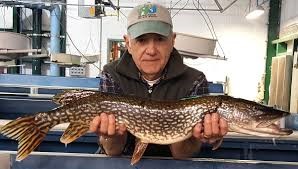
Fishery staff with Northern Pike
“This is an incredible achievement by our staff at the Hatchery,” said Commissioner Martin. “Anglers are reporting catching 40-inch Northern pike, 10-pound walleyes, and 50-inch muskellunge in many of our waters where these species are stocked. It is through the Hatchery’s staff and their hard work that New Jersey is a world class fishing destination for anglers.”

Those five million plus fish included cool water species such as Northern Pike, Walleye, and Muskellunge. Hackettstown stocked 308,808 Northern pike, 2.3 million walleye, and 343,311 muskellunge for New Jersey anglers.

The season also included strong year classes of warm water species such as channel catfish – 598,174, largemouth bass – 110,445, and hybrid striped bass – 47,315. These three species are providing excellent, exciting recreation for anglers throughout the state.

Not all the Hackettstown fish stocked are directly available to anglers, however. County mosquito commissions utilized 548,000 fathead minnows, and Gambusia (commonly called mosquitofish) to combat mosquito larvae in stagnant waters. Since 1991, the hatchery has reared more than 5.6 million fish to help combat mosquito borne diseases such as West Nile Virus, Eastern Equine Encephalitis and Chikungunya.

In addition, 655,000 golden shiners were stocked in Round Valley Reservoir to help boost the forage base in one of New Jerseys best cold water fisheries. The hatchery has stocked more than 1.5 million shiners in Round Valley over the past five years.

In addition, some 171,788 fish of other species were raised in 2017 setting the facility’s new yearly production record at 5,082,841, far surpassing the previous high of 3,774,885 set in 2014.

Some of the many factors that contributed to a great season included the successful collection of broodstock and their eggs, an excellent hatch and extensive on-site pond management. Modern fish diets and nutrition also played important roles, as well as ideal temperatures, sunlight and precipitation for adequate growth, proper health monitoring and avoiding the hazards of overcrowding.

Fishery staff handling fingerlings at Hackettstown
The Hackettstown State Fish Hatchery opened in 1912 and is predominantly a put, grow, and take fish culture operation. This simply means that most of the fish are stocked as sub-legal fry and fingerlings that will take a year or more growing in the wild to reach a catchable size. The fish-rearing operation requires a combination of intensive fish culturing both indoors in fiberglass tanks and outdoors in earthen ponds.

“The Hackettstown Hatchery has stocked nearly 20 million cool and warm water fish over the past five years,” said Division of Fish and Wildlife Director Larry Herrighty. “Staff take immense pride in the quality of fish produced at the hatchery and constantly strive to find ways to improve both hatchery operations and the number of fish produced. This is a great way to conclude the celebration of our agency’s 125th anniversary and I commend our staff at Hackettstown for a job well done.”

Funding for operations at the Hackettstown State Fish Hatchery is provided by anglers through fees derived from the purchase of fishing licenses and by the Federal Aid in Sportfish Restoration program.

More information about the Hackettstown State Fish Hatchery,
including its history, feature articles, species raised and stocking summaries can be found at state.nj.us/dep/fgw/hacktown.htm

Source: http://www.nj.gov/dep/newsrel/2018/18_0003.htm

Tuesday, August 15, 2017

Birds and Airports. Not Perfect Together.

United Airlines and Audubon International are teaming up to protect raptors “threatened” by living near Newark Airport. They want to send them to nearby golf courses.

The United Eco-Skies Raptor Relocation Program at Newark Liberty International Airport plans to protect hawks, ospreys and owls by transporting the animals to golf courses certified within the Audubon Cooperative Sanctuary Program.

Since a 2009 accident when a jetliner was forced to land in the Hudson river after birds were sucked into its engine, many birds have been killed in the New York City area in an effort to make flight paths safer.

"The presence of wildlife at our airports can pose a challenge to pilots operating commercial aircraft," said Laura Francoeur, the Port Authority's chief wildlife biologist. "The agency implements wildlife management measures to reduce these challenges, and we continue to work with our airline partners and organizations such as United and Audubon International to ensure safe operations while protecting nature."

But, according to GooseWatchNYC.com, the leading causes of fatal plane crash accidents are not wildlife but pilot error (50%), mechanical error (22%) and weather (12%).

Monday, April 5, 2010

NJ Bobwhite Quail Seminar April 29


NJ Audubon and the NJ DEP's Division of Fish and Wildlife are hosting a free seminar on Northern Bobwhite Quail Management in New Jersey on April 29th, 2010 from 7:00 p.m. until 8:30 p.m. in Woodstown, NJ.

Featured speaker Dr. Chris Williams of the University of Delaware, will discuss the characteristics of good bobwhite quail habitat.

Paul Castelli, Research Scientist for NJ Division of Fish & Wildlife, will discuss the declining population trend, causes for decline, necessary management and the state's new Bobwhite Quail Action Plan.

Presentations will be followed by a panel discussion with speakers and local bobwhite quail experts.

The seminar location is the Ware Agricultural Extension Office, 51 Cheney Rd., Woodstown, NJ 08098. RSVP is encouraged. Contact 609-861-1608 ext. 24 to RSVP or for more information.

The Bobwhite Quail: It's Life and Management