Showing posts with label Warren County. Show all posts

Friday, November 14, 2025

Geological Hike at Haney's Mill


The Delaware Water Gap is bounded by Mt. Minsi in Pennsylvania and Mt. Tammany in New Jersey. Once touted as a scenic Wonder of the World, it is an impressive site when motoring through on Interstate 80 or viewed from the overlooks along Route 611 on the Pennsylvania side.

Before the Gap formed. Mt. Minsi and Mt. Tammany formed one continuous ridge -- the Kittatinny Ridge, along which the Appalachian Trail runs through the park today. Here at the Gap, this ridge is composed of two different sedimentary rock formations: the Shawangunk Formation and the Bloomsburg Redbeds.

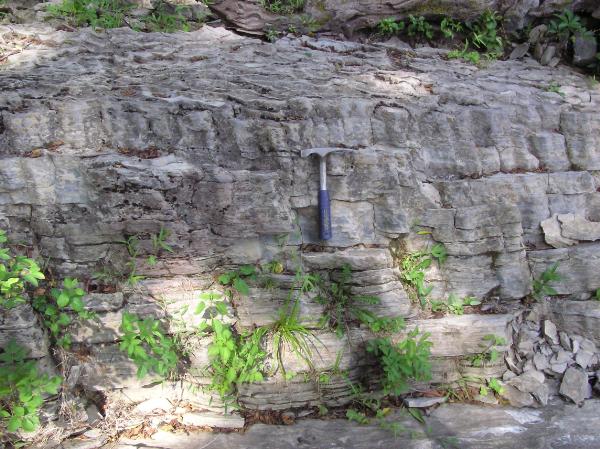
Haney’s Mill is in the Delaware Water Gap National Recreation Area of New Jersey, and it offers a beautiful view and an interesting geologically themed hike that allows you to walk back 430 million years. (That should impress the kids.)

via http://www.geocaching.com

The presence of limestone not far from the sandstones and shales on neighboring Kittatinny Mountain is evidence of environmental changes that occurred in this region over millions of years.

If you look up and to the west, you’ll see the crest and western flank of Kittatinny Mountain. The rocks you see on Kittatinny Mountain are older than the limestones in the outcrop there.

The gray, white, and red rocks on Kittatinny Mountain, called sandstones and shales, formed from sediments that were deposited in rivers and shallow marine environments. The light gray rocks where you will be hiking are limestones, formed under different conditions, in the quieter waters of lagoons and intertidal zones.

The gray sandstones are middle Silurian in age, approximately 430 million years old. They formed from quartz-rich sediments left behind by fast-moving rivers that once flowed through the Taconic Mountains. The Taconic Mountains were part of a mountain range that once existed to the east and north of this site, but has since eroded away.

Over several million years, conditions changed, and the environment became more tranquil. Slow-moving rivers carried less sand and clay to the coast, and the coastal waters became clear. Slowly the type of sediment that formed in the marine waters changed from river-supplied sand and clay to limestone formed by marine animals.

THE TRAIL: A footpath, located across Capner Street, can be accessed through the paved parking lot on the north side of the park. The entrance to the footpath is just before the electrical transfer station adjacent to the Morales Nature Preserve. Once on the footpath, proceed north approximately 50 yards, until you see a path to the right angling down toward the brook. The exposures run north-south along the brook. You can park in the small dirt lot just south of the bridge over Flat Brook. This is also a popular fly-fishing spot.


Information for Teachers and Lifelong Learners:
http://www.nps.gov/dewa/forteachers/curriculummaterials.htm
http://www.njgeology.org/
DELAWARE WATER GAP  (Images of America)
When Dinosaurs Roamed New Jersey

Monday, August 4, 2025

The New Jersey Highlands

The Highlands of New Jersey is one of those areas that people from other parts of the country just don't associate with NJ. (The Pinelands is another area like that.) The forested ridges, rocky cliffs, and the streams, lakes, ponds, and reservoirs for fishing and recreation are all there. 

The Highlands covers 840,000 acres and includes 188 municipalities. There are 7 Highlands counties – Bergen, Passaic, Morris, Sussex, Warren, Hunterdon, and Somerset – and all contain a diversity of forests, wetlands and grasslands. That habitat diversity is also home to threatened and endangered wildlife.

There are 72 New Jersey-listed endangered, threatened, and rare animal species, including mammals, birds, amphibians, reptiles, butterflies, dragonflies, damselflies, and mussels, and two species (the Indiana bat and bog turtle) are Federally-listed. There are also 137 endangered, imperiled, and rare plant species.

The Highlands also contains historic structures and archaeological heritage sites that need protection.

Hikers can find miles of trails, including both the Appalachian Trail and the Highlands Millennium Trail.

For over half of New Jersey’s residents (4 million+), the Highlands is a critical area for their drinking water. The NJ Highlands Water Protection and Planning Act was passed in 2004, dividing the 840,000-acre region into a “Preservation Area” with strict NJDEP regulations and mandatory Regional Master Plan conformance, and a “Planning Area” with voluntary Plan compliance.

As is often the case in NJ, suburban sprawl is the greatest threat to the Highlands’ drinking water supply, and to the forests, farms, wildlife habitat, and historic, recreational and scenic resources.

There are several areas in NJ that are a focus for Highlands Coalition.

The Wyanokie and Farny Highlands (Passaic and Bergen) contain unprotected lands in nearby Wanaque and Split Rock reservoirs that would connect existing State and county parks and forests in these two heavily utilized recreational areas. This focal area was ranked highly due to its value for water resources and recreation, and secondarily for biodiversity and forest land.

The Pequannock Watershed (Morris, Passaic, and Sussex) serves as the core of the northern New Jersey Highlands and serves as a major hub connecting existing open space areas. This focal area was ranked highly due to its multiple values for water resources, forest land, biodiversity, and recreation.

The wooded ridges of Sparta Mountain/Lubber’s Run (Morris and Sussex) provide an important greenway corridor connecting Mahlon Dickerson Reservation in the north and Allamuchy Mountain State Park in the south. Major gaps in conservation protection include the nearby areas of Mase Mountain. This focal area was ranked highly due to its value for productive forest land, biodiversity, and recreation.

Upper Pohatcong/Pequest area (Warren) also contains forested ridges and wetlands centered around the Pequest Wildlife Management Area, which serve as an important groundwater recharge, wildlife habitat, and outdoor recreation area. This focal area was ranked highly due to its value for water resources and recreation and secondarily for its productive forest and farmland.

Scott Mountain/Musconetcong Ridge in Warren and Hunterdon counties and the neighboring productive farmland of the Delaware, Pohatcong, and Musconetcong valleys form a large contiguous area of high-quality rural landscape. This focal area was ranked highly due to its value for biodiversity and productive farmland, and secondarily for forest land and recreation.

MORE

Friday, July 25, 2025

Hiking Through New Jersey 200 Years Ago


If you are up for a weekend to hit the trails, maybe you will want to see New Jersey as it was 200 years ago. 

Okay, this is not a time travel story. The New Jersey stretch of the Appalachian Trail (AT) starts in the northern-most corner of the state at High Point State Park at Route 23 and extends down to the Delaware Water Gap. This is another one of those areas of NJ that will surprise even natives - you will forget that you are in NJ, or you will realize (as with our beaches) that we compete very well with other states that are more known for their outdoor recreation and scenery. 
Some sections of the AT look very much as they did 200 years ago. That was not colonial days, and NJ had become more industrialized and cities were growing, but this part of the state was still mostly undeveloped.

Most of us will never be the full AT. "Through-hikers" that do the 2000-mile Appalachian Trail across the tops of the Appalachian Mountains from Georgia to Maine are a unique breed of hiker. More people hike the trail in sections, and the 72 miles of it through New Jersey can be further divided into some great one-day hikes.

The NJ AT is intersected by country lanes or Park roads about every 5 to 10 miles, which makes it easier to do the trail in stages. The trail is well-maintained by volunteers.


Pochuck Boardwalk, AT in Glenwood

If you are doing a section of 6 or more miles, you should have decent hiking boots (thick soles and high enough to give ankle support) that allow for some heavy socks and swollen feet. Dress for the weather and the bugs of the season (bring some spray). A light pack (the kids' school backpack can do for a day), lunch, and some trail snacks (trail mix is not required!),  and a good supply of water. A fully charged cell phone is a must these days.

The New Jersey stretch of the Appalachian Trail is 74 miles long and begins at Abram S. Hewitt State Forest in the northernmost point, running west and south through Wawayanda State Park, High Point State Park, Stokes State Forest, and ending at Worthington State Forest.


Wawayanda Mountain to Warwick Turnpike (6 miles) is a good one-day hike. Wawayanda State Park extends across 13,000 acres of wild land. It is a remote plateau covered by rhododendron bogs where bears forage, craggy cliffs where coyote and bobcat make their dens, and hemlock ravines through which fast-moving streams surge and plummet. 

This mountain boasts some of the oldest bedrock along the entire AT. Go back 200 years? This area has a history of habitation that stretches back 12,000 years.

Sunrise Mountain and High Point at 17 miles is a more challenging one-day hike. (There are camping opportunities on sections of the trails.) The northern Kittatinny Ridge rises in an uninterrupted rampart, climbing to 1803 feet at High Point, the greatest elevation above sea level in New Jersey. This rugged AT ridge walk is punctuated by craggy ledges, far-reaching vistas. There are also manmade features, such as the Normanook Fire Tower, Sunrise Mountain Pavilion, and High Point Monument.

SOME SITES FOR INFORMATION & MAPS

http://www.AppalachianTrail.org

http://www.trails.com/activity.aspx?area=10129

http://www.njskylands.com/odhikeaptrl.htm

http://www.appalachiantrail.org
 and New Jersey focus from the Appalachian Trail Conservancy

Monday, January 14, 2019

Want to Lease the Rockport Game Farm Property?


The Department of Environmental Protection’s Division of Fish and Wildlife is looking for ideas from individuals and organizations that may be interested in leasing the former Rockport Game Farm in Mansfield Township, Warren County.

The Division of Fish and Wildlife last year closed the facility, which reared pheasants, due to the cost of complying with recent changes to U.S. Department of Agriculture avian influenza control requirements.

The 160-acre facility, situated within the 1,380-acre Rockport Wildlife Management Area and just minutes from Hackettstown, had been in operation for more than 100 years. Game pheasants reared at the facility were known as Rockport Rockets.

The Division of Fish and Wildlife has issued a Request for Expressions of Interest for projects that are compatible with the rural environment of this part of the state. The goal is to eventually bid out the site for agricultural purposes to a bidder that can improve and utilize the site while providing lease revenue to the DEP.

“Located amid picturesque rolling hills and farmland, the Rockport Game Farm is a wonderful property that could be re-utilized for a number of purposes such as a farm, to raise poultry, a tree nursery, or even a vineyard,” said Division of Fish and Wildlife Director Larry Herrighty. “We are very eager to gather ideas on how this property can remain in active, productive use that is compatible with its rural surroundings.”

The 160-acre game farm consists of a number of structures, including a barn, a garage, rearing pens and houses, a pole barn, and brooder and incubator building.

Diverse uses are welcome provided they cause no detrimental environmental impacts. Those interested should note that the sale or consumption of alcoholic beverages is prohibited on land owned by the Division of Fish and Wildlife but that the rule may be relaxed if a bidder can show the potential for significant revenue.

For details and to view the full Request for Expressions of Interest, visit www.njfishandwildlife.com/news/2019/rockport_rfei.htm

Tuesday, September 18, 2018

Endangered Plant Discovered in NJ After a Century Missing

A rare and endangered plant species last seen in New Jersey a century ago has been discovered growing north of Worthington State Forest in Warren County.

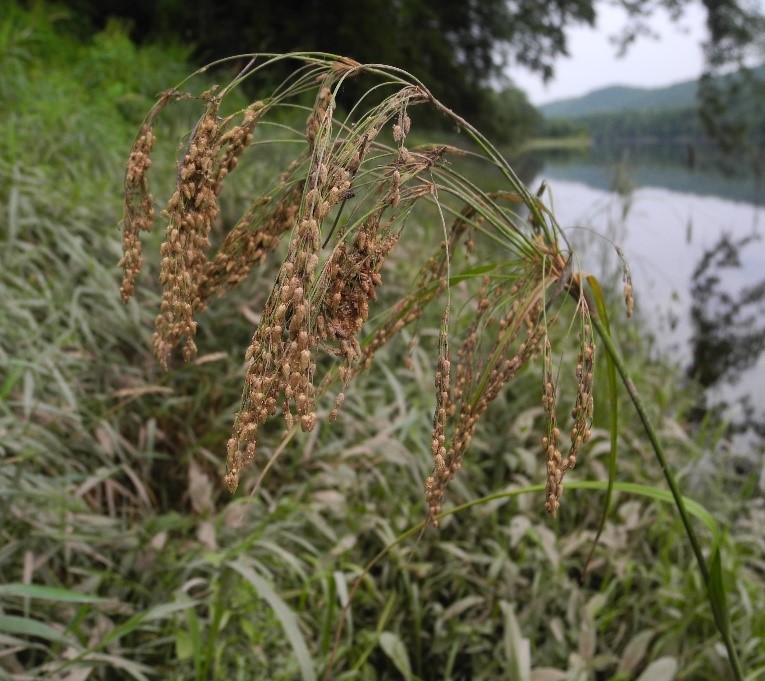
A botanist with the New Jersey Department of Environmental Protection’s Office of Natural Lands Management discovered stalked woolgrass (Scirpus pedicellatus) along the shore of the Delaware River in July. The last sighting of the plant was in Sussex County on July 4, 1918.


Commissioner McCabe said. “The presence of this rare plant and others reminds us to appreciate and strengthen the ecological diversity in New Jersey so that future generations may enjoy these beautiful plants.”

Stalked woolgrass is listed as endangered in New Jersey. Although it had not been seen in a century, stalked woolgrass and many other rare and historic plant species are assumed to exist if the habitat that supports the plant also exists. There are 10 other species of woolgrass that grow in the state, but stalked woolgrass is the rarest, having been observed only once before, by Edwin B. Bartram, a member of the Philadelphia Botanical Club, in 1918.

Stalked woolgrass belongs to a large family of plants known as sedges. It has grass-like leaves that form large clumps and produces flowering stems that grow up to five feet tall. The mature seeds are covered with feathery plumes, which gives the plant its characteristic wooly look. The species is more common in states north and west of New Jersey and reaches the southeasternmost limit of its range in this state. Its habitat is open marshes on floodplains and river shores.

The Natural Heritage Program, part of the New Jersey Forest Service’s Office of Natural Lands Management, identifies and tracks more than 800 endangered and rare plant species as well as rare and unique ecological communities.

More on Scirpus pedicellatus gobotany.newenglandwild.org/species/scirpus/pedicellatus

For a complete list of plant species tracked by the Natural Heritage Program, visit www.nj.gov/dep/parksandforests/natural/heritage/njplantlist.pdf

To view a report on the status and trends of endangered plants in New Jersey, visit https://www.nj.gov/dep/dsr/trends/pdfs/endangered-plant.pdf

Wednesday, January 31, 2018

Hackettstown State Fish Hatchery Stocked a Record 5 Million Fish in 2017

The Hackettstown State Fish Hatchery in Warren County stocked a record five million cold, cool, and warm water fish consisting of 15 species in 2017, Department of Environmental Protection Commissioner Bob Martin announced today.

The fish, totaling 5,082,841 with a total weight of more than 26,000 pounds, were produced at the location and many were stocked in approximately 200 waters throughout the state from March through November.

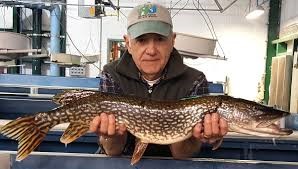
Fishery staff with Northern Pike
“This is an incredible achievement by our staff at the Hatchery,” said Commissioner Martin. “Anglers are reporting catching 40-inch Northern pike, 10-pound walleyes, and 50-inch muskellunge in many of our waters where these species are stocked. It is through the Hatchery’s staff and their hard work that New Jersey is a world class fishing destination for anglers.”

Those five million plus fish included cool water species such as Northern Pike, Walleye, and Muskellunge. Hackettstown stocked 308,808 Northern pike, 2.3 million walleye, and 343,311 muskellunge for New Jersey anglers.

The season also included strong year classes of warm water species such as channel catfish – 598,174, largemouth bass – 110,445, and hybrid striped bass – 47,315. These three species are providing excellent, exciting recreation for anglers throughout the state.

Not all the Hackettstown fish stocked are directly available to anglers, however. County mosquito commissions utilized 548,000 fathead minnows, and Gambusia (commonly called mosquitofish) to combat mosquito larvae in stagnant waters. Since 1991, the hatchery has reared more than 5.6 million fish to help combat mosquito borne diseases such as West Nile Virus, Eastern Equine Encephalitis and Chikungunya.

In addition, 655,000 golden shiners were stocked in Round Valley Reservoir to help boost the forage base in one of New Jerseys best cold water fisheries. The hatchery has stocked more than 1.5 million shiners in Round Valley over the past five years.

In addition, some 171,788 fish of other species were raised in 2017 setting the facility’s new yearly production record at 5,082,841, far surpassing the previous high of 3,774,885 set in 2014.

Some of the many factors that contributed to a great season included the successful collection of broodstock and their eggs, an excellent hatch and extensive on-site pond management. Modern fish diets and nutrition also played important roles, as well as ideal temperatures, sunlight and precipitation for adequate growth, proper health monitoring and avoiding the hazards of overcrowding.

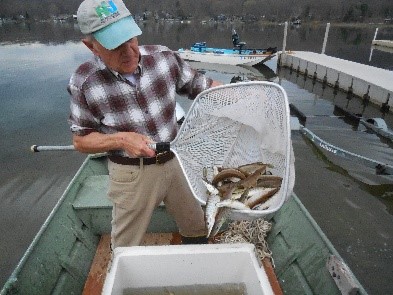
Fishery staff handling fingerlings at Hackettstown
The Hackettstown State Fish Hatchery opened in 1912 and is predominantly a put, grow, and take fish culture operation. This simply means that most of the fish are stocked as sub-legal fry and fingerlings that will take a year or more growing in the wild to reach a catchable size. The fish-rearing operation requires a combination of intensive fish culturing both indoors in fiberglass tanks and outdoors in earthen ponds.

“The Hackettstown Hatchery has stocked nearly 20 million cool and warm water fish over the past five years,” said Division of Fish and Wildlife Director Larry Herrighty. “Staff take immense pride in the quality of fish produced at the hatchery and constantly strive to find ways to improve both hatchery operations and the number of fish produced. This is a great way to conclude the celebration of our agency’s 125th anniversary and I commend our staff at Hackettstown for a job well done.”

Funding for operations at the Hackettstown State Fish Hatchery is provided by anglers through fees derived from the purchase of fishing licenses and by the Federal Aid in Sportfish Restoration program.

More information about the Hackettstown State Fish Hatchery,
including its history, feature articles, species raised and stocking summaries can be found at state.nj.us/dep/fgw/hacktown.htm

Source: http://www.nj.gov/dep/newsrel/2018/18_0003.htm

Friday, June 23, 2017

American Shad Return to the Musconetcong River

It has been at least 100 years since we could say that there were American shad in the Musconetcong River in Hunterdon and Warren counties. But that is what the Department of Environmental Protection’s Division of Fish and Wildlife and U.S. Fish and Wildlife Service announced this month.

Shad is a benchmark species indicative of the overall ecological health and diversity of a waterway. This recovery of the river is the result of the removal of dams on the lower Musconetcong River several years ago, followed by the removal of the Hughesville Dam in Warren County last year. These projects – made possible by a partnership of state, federal, nonprofit and private entities – opened nearly six miles of the Musconetcong to migratory fish, such as shad, that spend much of their lives in the ocean but return to rivers and their tributaries to spawn.

“The return of shad, a benchmark species indicative of the overall ecological health and diversity of a waterway, is an exciting milestone,” said DEP Commissioner Bob Martin. “This achievement is the direct result of an ongoing partnership among state and federal agencies, nonprofit groups, and dam owners – all committed to making this beautiful waterway free-flowing again.”

As the shad population continues to rebuild, anglers are reminded that this fish may not be taken from any New Jersey freshwater area except the Delaware River.

NJDFW biologist Pat Hamilton holds a shad near the Warren Glen Dam


The return of shad to the Musconetcong was confirmed earlier this month after anglers fishing for trout reported seeing small schools of shad in the river above the site of the former Hughesville Dam. Biologists from the DEP’s Bureau of Freshwater Fisheries responded and captured shad at the base of the Warren Glen Dam in Holland Township, Hunterdon County.

American shad is the largest member of the herring family, weighing from four to eight pounds at maturity. Shad once supported important commercial and recreational fisheries along the Atlantic coast, especially the Delaware River. But dams built to generate power, for mills and for other now-obsolete purposes greatly reduced their spawning habitat.

The 48-mile-long Musconetcong flows from Lake Hopatcong in the northwestern part of the state and through the wooded and rocky hills of Morris and Warren counties. It flows into the Delaware River at a point in Hunterdon County about 10 miles south of Phillipsburg.

Long stretches of the Musconetcong are on the National Park Service National Wild and Scenic Rivers inventory. The DEP classifies much of the river as a Category 1 stream, affording it the state’s highest level of protection due to its exceptional ecological and fisheries values.

Partners in restoring the Musconetcong to a free-flowing river also include the Musconetcong Watershed Association; American Rivers, the National Park Service, the federal Natural Resource Conservation Service, the U.S. Army Corps of Engineers, North Jersey RC&D, Trout Unlimited, The Nature Conservancy, and International Process Plants and Equipment Corp.

Wednesday, January 18, 2017

Seeing Wolves in New Jersey


Wolf Woods habitat at Turtle back Zoo in Essex County - via state.nj.us/gspt/photo_gallery.htm

Wolves can be found in North America, Europe, and Asia. Expanding development, farming, and ranching activity has drastically reduced the wolf’s range and population. Suitable habitat now restricts wolves to remote areas of their traditional range.

But conservation and education efforts will hopefully protect and preserve wolves throughout the world. There are no wolves in the wild in NJ, but you can visit them in captivity.

Reintroduction programs are being implemented and captive wolves in zoos, and wolf research centers are being maintained to insure that the genetic purity of wolf species is preserved. Turtle Back Zoo’s wolves come from Wolf Park Research Center in Battle Ground, Indiana.

In the urban wilderness of Essex County, you can visit wolves at the Turtleback Zoo which has a Wolf Woods habitat. You can see timber wolves close up but safely through glass panels that let you feel like a member of the pack. Several viewing stations let you see the wolves from different angles. You will wolves see crossing a stream, resting on logs and rocky outcroppings and nose-close right at the window. The Zoo is located at 560 Northfield Avenue, West Orange, New Jersey.

If you want to hear the howling of wolves in NJ, you can also head to the mountains of the Delaware Water Gap in Warren County, NJ. At the Lakota Wolf Preserve, there are great photo opportunities with packs of Tundra, Timber, and Arctic wolves in a natural surrounding. There are also bobcats and foxes at the reserve. The preserve is at at 89 Mt. Pleasant Road, Columbia, NJ - see http://www.lakotawolf.com/ for information.


Saturday, April 9, 2016

Fishers Return to New Jersey

Fisher - via wikipedia commons
Since the days of logging operations and unregulated trapping in New Jersey back in the early 1900s, you haven't heard or seen much of the fisher in our state. This species was once widely taken for its fur and was eliminated (extirpated) statewide.

But it seems to be making a comeback. Recently, two trappings of fishers by state officials in North Jersey, seems to indicate a return of fishers to the state.

Fishers are long, slender animals usually measuring between 20 and 25 inches with dark brown or black fur with white-tipped hair over most of their bodies.They prefer to live in forested areas, making dens in hollow trees and preying on small animals, including mice, squirrels, shrew and even porcupines.

Fishers are good swimmers and may be found by lakes, timbered swamps and bogs. They can have a home range of 1-3, but up to 15 square miles.

Sometimes confused with the wolverine (which does not exist in NJ), fishers are found only in North America. Also referred to as the fisher cat and Appalachian black cat, this animal may look like a cat or fox, but has a tough wolverine-like disposition.

Its name is a misnomer in that it is neither a feline nor does it catch fish. The fisher (Martes pennanti) is a member of the Mustelidae family, which includes otters, badgers, martens, ferrets, minks, and wolverines.

According to conservewildlifenj.org, this carnivore will eat anything it can catch — typically small- to medium-sized mammals and birds, carrion and some nuts and fruits also make up a portion of its diet. They can take down weak or injured deer, especially in times of heavy snow pack.

One distinction is that it is the  only predator of porcupines in the country. Those ominous prickly porcupine quills are effective against most predators except the fisher. It pursues a porcupine up a tree until it can go no further and falls. The fall stuns the porcupine, allowing the fisher to access the unprotected underside.


The fishers found in New Jersey probably came from some that were reintroduced in Northern Pennsylvania in the 1990s or from the Catskill Region of New York State, where they were introduced in the late 1970s to early 1980s,

There have only been three previous live discoveries of fishers in New Jersey in the last decade.

This year, one was captured in January in Mansfield Township and another fisher was caught and released in February in Washington Township, according to New Jersey Department of Environmental Protection.

Being that fishers have no natural enemies and few disease occurrences, without trapping by humans, vehicle collisions are the most likely reason for their death.


A fisher in West Virginia via Wikipedia Commons

Monday, November 30, 2015

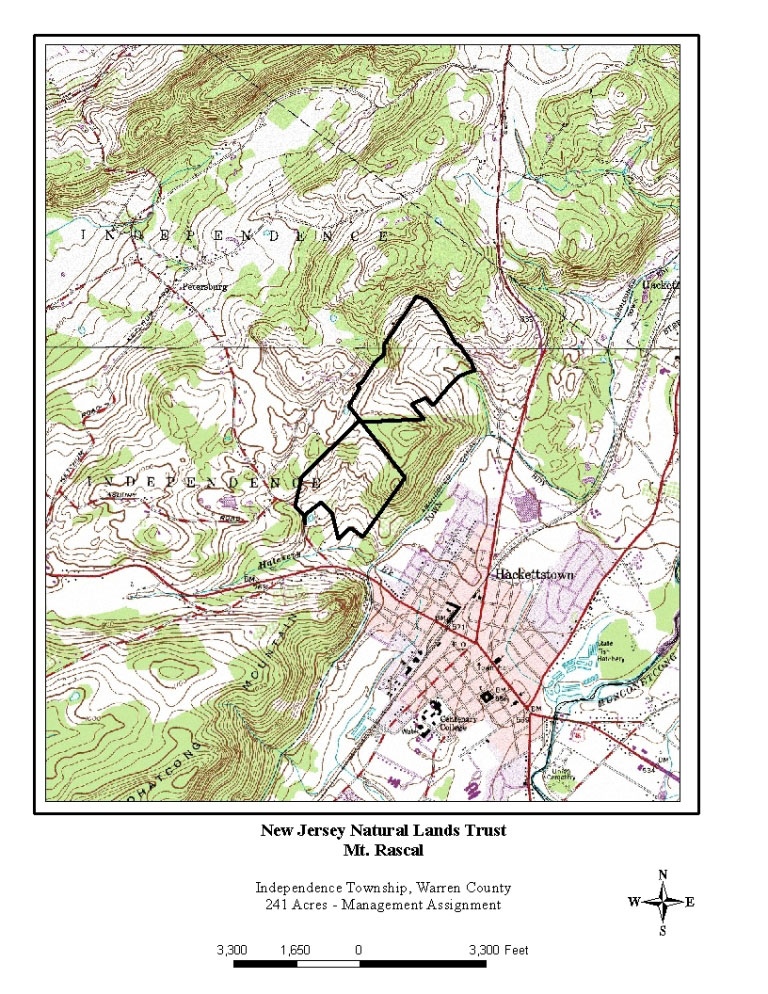
Mount Rascal Preserve Now More Than 400 Acres


The Mount Rascal Preserve in Warren County now includes the wooded mountain summit for which it is named, as well as a half-mile section of the historic Morris Canal.

The preservation of these 113 acres also protects water quality in the New Jersey Highlands. The newly-preserved property in Independence Township and Hackettstown brings the Mount Rascal Preserve to more than 400 acres and expands access and hiking opportunities. It includes part of the watershed of the Bowers Brook, a headwaters tributary of the Musconetcong River.

The NJDEP Green Acres Program, Warren County, New Jersey Conservation Foundation, Open Space Institute and William Penn Foundation partnered to purchase the land in two parcels.

On November 12, Warren County purchased 46.5 acres that include the canal section and the Bowers Brook, and then on November 20, the state purchased 66.5 adjoining steeply sloped acres at the top of Mount Rascal. The county was assisted by New Jersey Conservation Foundation, which provided funding from the William Penn Foundation and the Open Space Institute toward the purchase.

More at www.njconservation.org/

Friday, June 1, 2012

Hackettstown State Fish Hatchery Marks 100th Anniversary

The NJDEP Division of Fish and Wildlife will mark the 100th anniversary of the Hackettstown State Fish Hatchery in Warren County with an open house the weekend of June 2-3. Visitors will get a behind-the-scenes look at the storied facility that for the past century has raised a wide variety of species to benefit anglers across the state.

In 1911, the Roberts Farm in Hackettstown, along with several adjoining properties totaling 100 acres, was secured for a state fish hatchery. This farm was chosen for its ample supply of pure, cool spring water, a running brook (Trout Brook) and convenient, nearby shipping capabilities. Several weeks later, the New Jersey Fish and Game Commission appointed Charles O. Hayford as the superintendent of the facility which would be officially dedicated to him in 1953 and now bears his name.

The open house will feature a unique tour of the intricate fish hatching operations, while young anglers will have an opportunity for hands-on fishing experiences at two newly renovated education ponds or at the "Kiddie Fishing Tank." A giant mobile aquarium will display some of the state's finest fish specimens and there will be bird walks, hatchery tours and archery, an outdoor flea market, historic displays in the original hatchery building, and on Sunday entertainment by a bluegrass band.

Food can be purchased from vendors, but visitors are welcome to bring their own food. No dogs will be allowed at this event, since this is an operating fish hatchery with many open ponds and raceways.

Admission is free.

Hours are from 10 a.m. to 5 p.m. for both event days.

Pre-registration will be required for some activities on the day of the event.

For more information, including a complete list of programs, directions to the Hackettstown State Fish Hatchery and an extensive history of the hatchery itself visit
http://www.njfishandwildlife.com/hacktown100.htm on the division's website.

Historic shot of a stocking truck

Saturday, February 25, 2012

Endangered or Just In Danger Amphibians and Reptiles

A yellow spotted salamander changing lanes

If the unusually warm weather and crocuses blooming in your garden haven't been harbingers of spring, then note that the amphibian migration has begun across a good part of New Jersey.

With the rain yesterday being just about the right temperature, some eager salamanders and frogs are moving to their breeding pools.

Unfortunately, our "Garden State" is also a highway state and crossing is quite dangerous for those creatures. There are some people out there helping out, but keep a watchful eye when driving on rainy nights if you can.

An article in The New York Times, "Bucket Brigade Gives a Lift So Salamanders Can Live to Mate", describes one group of "salamander people" in Mississippi  are out on these rainy, early spring nights scooping up salamanders to help them cross the road. These "herpers" who search for and aid the amphibians or reptiles do their part to try to protect endangered, threatened and just plain in danger creatures.

Some salamanders can live up to 30 years, so they have been down this road (well, really, across this road) before. But they procreate only once a year.

I have written earlier here about similar projects in New Jersey. Saving other, more lovable species might be easier to get attention, volunteers and funding.

The NJDEP, Division of Fish and Wildlife’s Endangered and Nongame Species Program (ENSP), the Conserve Wildlife Foundation of NJ, and the NJ Audubon Society have been partners on the Amphibian Crossing Survey Project. Since 2002, they have been working to protect early-spring breeding amphibians like the wood frog, spotted salamander, jefferson salamander, and spring peeper during their annual migrations, which often lead them across perilous roadways. Volunteers help monitor sites in northern NJ (resources are limited, so that has been the focus area) particularly Warren, Passaic and Morris County. But they also help to identify additional crossings throughout the state.

A single vehicle can crush dozens of the slow-moving animals as they try to cross the road during migration. For example, some major amphibian road-crossings occur in West Milford in Passaic county. On rainy evenings from late February through March, teams of volunteers will be serving as “Crossing Guards” - slowing traffic, moving amphibians across the road, and collecting data about the migration.

According to the ENSP, amphibians are regarded by many scientists as indicators of a region's health and as the first indicators to harmful environmental changes such as pollutants and higher aquatic temperatures. Basically, if we see problems in the amphibian community, it’s just a matter of time before larger organisms (such as birds, mammals, and humans) will be affected as well.

Amphibian populations are declining worldwide as a result of a number of factors, including water pollution, increased pesticide use, and habitat loss, which is the most significant factor for all of New Jersey's species of conservation concern.

Amphibians depend on both terrestrial and aquatic habitats throughout their life cycles. The loss of forests and wetland habitats, including clearing forests, filling in vernal pools, and development that leads to changes in the water table that dry out critical wetlands, only add to these critters’ plight.

Finally, fragmentation of habitat can also play a critical role in the demise of an amphibian population as they attempt to travel from one area to another. Amphibians become easy prey targets in open habitats (lawns, driveways, roads) and at barriers such as curbs and fences that are often impossible to cross.

A spotted salamander being helped across a road.

The Conserve Wildlife Foundation of New Jersey has assembled a resource package to help teachers educate students about New Jersey's reptiles and amphibians. The package includes the Field Guide to Reptiles and Amphibians of NJ and Calls of NJ Frogs and Toads CD, and a teacher's guide full of activities and lesson plans for grades 5-9. The activities are correlated to the state's Core Curriculum Content Standards.

Resource Package Flyer and Order Form (pdf)

Monday, November 22, 2010

Rockport Pheasant Farm

Pheasant Male1
Pheasant in Hopatcong by HVargas, on Flickr

The state-owned Rockport Pheasant Farm in Mansfield has raised pheasants since 1923. Now the facility has been improved and expanded.

The $1.3 million project was financed by sportsmen's fees and stamps. The complex replaces an outdated facility that was long overdue for an overhaul. It is expected that they will release 55,000 of the birds annually.

The pheasant farm includes a new brooder house, egg incubators and hatching room. The upgrades create a modern operation that includes automatic egg turning in forced-air circulating incubators, and automated feeding.

State Division of Fish and Wildlife Director David Chanda said the upgrades will ensure reliable annual production of superior pheasants for the same or lower cost than if birds were purchased from suppliers.

The farm is a 492-acre facility located within the 1,200 acre Rockport Wildlife Management Area. The pheasants are stocked in 25 Wildlife Management Areas statewide.

Based on the 2007-08 state Firearm Hunter Harvest Survey, nearly 12,000 hunters spent more than $4,300,000 (excluding license and permit fees but including income to local businesses, such as gas stations, diners and restaurants, convenience stores, sporting goods stores and taxidermists. The pheasants are called "Rockport Rockets" because these state-raised pheasants have a reputation for being extremely fast in flight.

The Rockport Pheasant Farm is open daily from 7:30 a.m. to dusk. It is located on Rockport Rd. (Rt. 629) roughly 3.5 miles south of Main St. (Rt. 46), Hackettstown, in scenic Warren County. At Rockport there are pens holding exotic pheasants, turkeys and other birds.

The historic Morris Canal, its towpath intact, passes through the farm. The canal basin (explaining the "port" in Rockport’s name), where boats would dock for the night, was recently drained as a precaution against the introduction of avian flu but remains visible. Picnicking is allowed but there are no food or toilet facilities available. For more information call 908-852-3461.

Monday, September 6, 2010

Merrill Creek Reservoir

Merrill Creek Reservoir is a 650-acre reservoir (manmade lake) surrounded by a 290-acre Environmental Preserve and 2000 additional acres of woods and fields.

Its basic purpose is to provide stored water that can be released to the Delaware River to make up for the evaporative water usage at certain electric generating units in times of low flow in the river.

In addition to that basic purpose, Merrill Creek Reservoir provides a tranquil setting of water and land that allows people to interact with the natural environment.

Though Merrill is probably best known for its fishing opportunities (it is a Trophy Trout lake), it was also designed and managed specifically for low impact recreational uses.

Hiking, cross-country skiing, photography, wildlife observation, and nature study are all encouraged.

The 290-acre preserve features a variety of habitats including woodlands, fields, evergreen plantations, and wetlands.

Merrill Creek Reservoir's resident bald eagles are in their twelfth nesting season in 2010. Though you won't be able to observe the nesting bald eagles, bald eagles are usually spotted gliding over the area during the fall hawk watch. They are occasionally joined by golden eagles also passing through on their migratory journey.


Merrill Creek Reservoir offers a wide variety of environmental education opportunities for all age groups ranging from Pre-K through adults. Check out their current public programs.


For directions:  http://www.merrillcreek.com/directions.html

Saturday, March 27, 2010

Pequest Open House This Weekend


2010 Pequest Open House and Fishing Flea Market
March 27 & 28, 2010
10 a.m. - 4 p.m. daily
FREE!

This event is great for people of all ages and there are so many things to see and do throughout the day, so plan to celebrate the beginning of trout season and spring. Bring your families, friends, scout troops, church groups, fishing clubs and anyone else for a fun time in the outdoors.

Kids between the ages of 8 and 16 can try their hand at trout fishing a week before the season opens in our Fishing Education Pond. They will be given expert instruction by our staff, Wildlife Conservation Corps volunteers and volunteers from Trout Unlimited. Kids under 8 can try catching one of our trout in the "Kiddie Fishing Tank". And the best part is - we supply all the equipment! Children of all ages can do fish printing, the ancient Japanese art known as Gyotaku. Displays will be set up about fisheries management, aquatic insects and much more.

Visitors at raceway Inside the Natural Resource Education Center, visit with representatives from various conservation groups and learn how they are helping to protect our natural resources. There will also be ongoing fly tying demonstrations and many different wildlife artists, carvers and taxidermists will be here with their artwork and equipment for sale. Don't forget to look inside the Exhibit Hall and learn about the history of Pequest and what we do here. For even more information about the hatchery, don't forget to take the self-guided tour of the facility, where everything will be in full swing in anticipation of the upcoming trout season.


Just outside the main building, our Fishing Flea Market is sure to offer some good deals on both new and used equipment, lures, gear and so much more! So if you're looking to upgrade your fishing equipment or if you're just starting out, you'll want to check out the vendors here.


There will be food vendors on hand at the event or you can bring your own lunch and enjoy one of our 3 picnic areas nestled in the heart of the Pequest Valley.


The Pequest Trout Hatchery and Natural Resource Education Center is located 9 miles west of Hackettstown on Route 46 in scenic Warren County. Come for a family or group outing during the Open House or anytime throughout the year.  Directions to Pequest.

For more information on public or group visitation/programs call 908-637-4125 or see the on-line schedule of public programs. 

Schedule of Activities (pdf, 21kb) 

Press Release via http://www.state.nj.us/dep/fgw/peqoh.htm

Monday, February 15, 2010

Short Hikes on the Appalachian Trail in New Jersey

The Appalachian Trail (AT) is America's first National Scenic Trail. It stretches from Mount Katahdin in Maine south to Springer Mountain in Georgia.

Originally conceived as a greenway between these states in the 1920s, it has become the most popular trail in the Appalachian Mountains.

Though "thru-hikers" will take on its 2,160 miles, many more day, weekend and section hikers will use it.

In New Jersey, here are 72 miles of the AT. The sections range in difficulty from 2-5 on a scale where 10 is the most difficult. I have hiked 6 of the 8 popular sections in NJ and all of them were great experiences.

There is a lot of information available free online about the trail (see below) and many excellent books on the AT, including the NJ section.

Our part of the Appalachian Trail runs from High Point State Park at Route 23 in the very northern-most corner of the state down to the Delaware Water Gap where it enters Pennsylvania. The ridges of the Kittatinny Mountains run parallel to the Delaware River to the west.


Even a good road map of New Jersey will probably show show the trail, and a stop at the ranger offices at High Point on Route 23 in Sussex County, Stokes Forest on Route 206 in Sussex County, and the National Park Service on Route 80 at the Water Gap in Warren County, all have maps showing the trail. Still, I would invest in a detailed trail map or book if I planned to walk the length of the NJ AT.

One good shorter hike on the AT in NJ is near Sunfish Pond. Atop the Kittatinny Ridge, Sunfish Pond was created by a glacier long ago and today is along the Appalachian Trail in Worthington State Park near the Delaware Water Gap.

The Appalachian Trail runs around the pond. Don't be surprised to find any number of rock cairns that have been created by passing hikers. A cairn (carn in Irish, carnedd in Welsh, càrn in Scots Gaelic) is a manmade pile of stones, often in a conical form left as a marker. The rocky shores of Sunfish Pond offer a beautiful contrast to the crystal clear lake water.

The suggested hike here is a good day's adventure. Weekdays and winter are good times to go and have the trail pretty much to yourself and some wildlife (which is more likely to be seen too).

You can drop by the Delaware Water Gap National Recreation Area Information Center at Kittatinny Point and talk to a ranger and get books on local flora, fauna, history, and geology for the hike.

The visitor center offers a great view of the Water Gap. The river flows by Pennsylvania's Mt. Minsi and New Jersey's Mount Tammany which form the Gap at about 1200 feet above and show us millions of years of geological history.

Features long the way includes Dunnfield Hollow hemlock ravine, Sunfish Pond (actually a glacial lake) and beautiful views from Mt. Mohican.


Sunfish Pond


The hike as listed on most trail maps run 8.8 total miles. Though the elevation gain is considered minimal (from 350 to 1500 feet), this point-to-point (rather than circular) hike is considered "strenuous." It should take a prepared hiker about 6 hours. Of course, n one says you have to do the entire length n one day if you're not prepared. New hikers shuld be cautioned that even a short hike like this is not like walking through he park or equal to the 8 miles you do on a track or treadmill.

Take a look at one online topographical map of the area.

Hiking this trail in NJ can give you a sense of what New Jersey was 200 years ago. In some sections, it is a time machine that will take you out of the present.

Coming back to 2010, there is still much of it that is undeveloped, with a few towns visible in the valleys that might be considered country villages.

The AT through NJ is intersected by country lanes or Park roads about every 5 to 10 miles. This makes it useful for teaming up with a partner and leaving one car at your starting place and one at the end.
You won't need much equipment for a day hike, but don't just throw a sandwich in a backpack and put on your basketball sneakers. Decent hiking boots or trail shoes (most have thick Vibram soles and are high enough to give ankle support) should feet well with your heavier hiking socks and some swollen feet. Don't attempt a hike more than two miles with new boots or shoes - break them in first.

Dress for the weather and have layers so that you can add and subtract as the day changes and your own body reacts. A hat is good. So is bug spray - especially in the spring.

There are lots of hiking equipment lists online but a light pack and water with lunch and some snacks is essential. The pack gets lighter along the way, but pack out all of your trash and any that you find and can carry along.  Leave the trail cleaner than when you entered.

I always add weight with a camera and cell phone. The camera is optional but the phone is a good safety idea.


Along those ridges of the Kittatinny Mountains, hawks and eagles can be seen along with common trail companions like the little Towhee.


The Trail is marked with white painted blazes on trees and rocks along the way. Two blazes, one above the other, indicate a change in direction of the trail.


Is their danger on the trail? Probably the greatest danger is in you attempting more hiking than you can handle or a trip, fall or twisted ankle. Snakes are rare and the only poisonous one you would encounter is the copperhead who would rather not encounter you.

There are certainly black bears in the area, but they also will do their best to avoid you. (Campers with food supplies are more likely to attract the nterest of bears, raccoons and other creatures.)

There are some trail shelters along the way, but if there's a chance of rain, bring some protection.

Do you have a favorite short hike in New Jersey? Post a comment and let us know and maybe we can feature it on the site.


http://www.njskylands.com/odhikeaptrl.htm
http://www.trails.com/activity.aspx?area=10129
http://www.appalachiantrail.org/
Appalachian Trail Guide to New York - New Jersey (Appalachian Trail Guides)
Hikes in the Mid-Atlantic States: MD PA NJ NY the Appalachian Trail
Nature Walks in New Jersey, AMC Guide to the Best Trails from the Highlands to Cape May

Friday, November 13, 2009

Encountering Bobcats in New Jersey

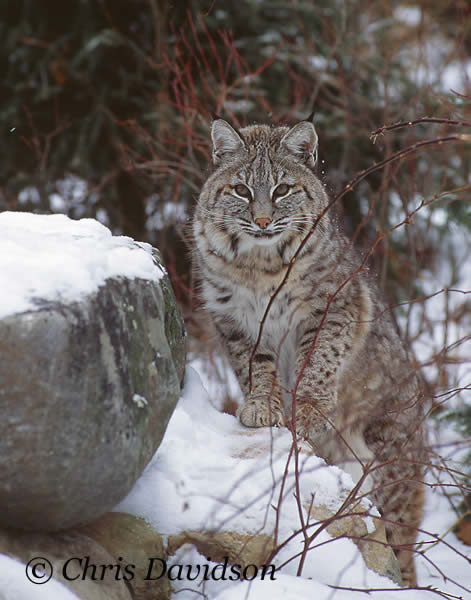
Bobcat by Chris Davidson via http://www.state.nj.us/dep/fgw/

The bobcat (Lynx rufus) is one of NJ's endangered mammals. The are not usually seen by residents because of their habits, but I was not shocked to read an article recently in via The Daily Record that a photographer was able to get a shot of one last month in the Delaware Water Gap National Recreation Area.

"I was doing nature photography and in early spring, I spotted it numerous times," George Draney recalled. So be began staking out a narrow, scrub-lined path twice a week, for about three or four months. A couple of times the bobcat crept by him but was gone before he could shoot a photo, he said.

The morning he finally got the shot, he was sitting in his car near the path and the bobcat was between 25 and 50 yards away, he said.

"I saw it going up the pathway in a hurry, so I thought to make a noise to make it look my way," Draney said. "So I whistle real loud, and it stopped. When I shot, it turned, and I got two more shots."

He described it as appearing healthy, about the size of a medium dog and weighing about 25 pounds.

The State estimates our population of bobcats to be at least 90, with most living north of Route 80.

They had disappeared from NJ by the early 1970s because of habitat loss. About 20 bobcats (from Maine) were reintroduced from 1978 to 1982 to repopulate them here.

One unfortunate indicator of their return are the dozen road kills found in the past year, including one on Route 46 in Parsippany near the Boonton Reservoir this past spring.

Taxonomically, bobcats belong to the order Carnivora, or carnivores, meaning that they are
primarily flesh-eaters. They are members of the Felidae family and are commonly known as felines. All members of this family look somewhat similar in appearance. (here is a comparative track guide)


Bobcats live in both the northern and southern portions of NJ. In the north, typical bobcat habitat consists of large areas of contiguous forest and fragmented forests interspersed with agricultural areas or early succession vegetation.

Bobcats often use areas with rock outcrops, caves, and ledges that provide shelter and cover for hunting, resting and rearing young. Where rocky areas are not available, swamps, bogs, conifer stands and rhododendron and mountain laurel thickets provide good cover and excellent hunting grounds.

In southern New Jersey, dense thickets of briars and conifers serve as resting and escape cover, so the bobcat have the ability to adapt to a wide variety of habitat types and prey species.


The Delaware Water Gap and other areas of Kitatinny Ridge are the best habitat areas the state has for bobcats, says Mick Valent, a wildlife biologist for the state Division of Fish and Wildlife, who said there's no reason to doubt Draney's account.

State biologists have found bobcat tracks and scat in the Water Gap area, and have photographed them there with motion-sensitive cameras baited with scent, Valent said.

Bobcats are so shy that they pose no danger for people, and are so reclusive that you would be lucky to actually see one.

Their individual territories ranging from one square mile to 25 square miles. Habitat continues to be the major problem in maintaining their numbers. They find a good supply of mice, chipmunks, squirrels and birds in the areas where they exist.

NJDEP document on bobcats

Bobcats in the Conserve Wildlife Newsletter, Winter 2007


Monday, September 21, 2009

Wildlife Heritage Festival at Pequest September 26

The NJDEP Division of Fish and Wildlife will hold its popular Wildlife Heritage Festival from 10 a.m. to 4 p.m. on Saturday, September 26 at the Pequest Trout Hatchery and Natural Resource Education Center in Oxford.

The festival is free and will be held rain or shine.

The festival is held on National Hunting and Fishing Day, an annual celebration of hunter and angler heritage. Hunters and anglers were the first to recognize that rapid development and unregulated use of wildlife was a serious threat to the future of many species. They called for the first laws restricting the commercial slaughter of wildlife. They urged sustainable use of fish and game, created hunting and fishing licenses, and lobbied for taxes on sporting equipment to provide funds for state conservation agencies. These actions were the foundation of the North American wildlife conservation model, a science-based, user-pay system that would foster the most dramatic conservation successes of all time.

The festival is an invitation to the public to experience and learn about activities associated with the hunter and angler heritage and the protection, management and wise use of our fish and wildlife resources. This year's event will feature fish and wildlife research and management exhibits and presentations, wildlife artists, taxidermists, conservation organization exhibits, archery and shotgun ranges, a Sportsmen's Flea market and the opportunity for children to fish at the Pequest fishing education pond. An introduction to Kayaking course will also be offered this year, as will a Hunter Education course for prospective hunters.

For more information about the festival and to see the entire schedule of events visit the Fish and Wildlife Web site at http://www.njfishandwildlife.com/festival09.htm .

Some of the activities require pre-registration, so be sure to check the schedule of events closely for sign up dates.

For more information about National Hunting and Fishing Day visit http://www.nhfday.org/ .

The Pequest Trout Hatchery and Natural Resource Education Center is located on Route 46 approximately nine miles west of Hackettstown in scenic Warren County.

Friday, June 19, 2009

Why Did the Amphibian Cross the Road?

Eastern Tiger Salamander (endangered in NJ)

Not only can you ask "Why Did the Amphibian Cross the Road?" but why would it try to cross a Jersey road?

In the article "Death by Rubber" on ScienceLine, they look at global amphibian declines and the scientists and volunteers who are trying to preserve backyard biodiversity.

That article looks at some volunteers on a wooded road in northwestern New Jersey, last March who were looking for frogs and salamanders to count. They wait for the amphibians to cross the road on their way from the wooded uplands where they winter to the marshy lowlands and vernal pools where they will do their spring mating.

Their night wasn't very successful and it's interesting that even experts are unsure what exactly triggers the spring migration. It might be rising ground temperatures, dropping barometric pressure and even the sound of the raindrops since the amphibians need the rain to stay moist and will need the vernal pools when they cross the road. In that case, they were hoping to see at least wood frogs and blue-spotted salamanders (pdf) which are more common amphibians in northern New Jersey and not endangered.

The NJDEP, Division of Fish and Wildlife’s Endangered and Nongame Species Program, the Conserve Wildlife Foundation of NJ, and the NJ Audubon Society are partners on the Amphibian Crossing Survey Project(pdf). They use volunteers to help us monitor sites in Warren and Morris County and to identify additional crossings throughout the northern region of the state. Due to limited resources, they are currently focusing efforts on northern New Jersey.

Seven years ago, volunteers had reported over 400 amphibians crossing the road in one night. Of course, crossing an NJ road has got to be a bit more hazardous than some other places and traffic has only increased in those 7 years.

It is estimated that one third of the world’s amphibians are threatened with extinction, according to the International Union for the Conservation of Nature (IUCN).

One habitat in Morris County, has probably lost its local population of blue-spotted salamanders which are an endangered species in the state, probably because of road kill during these crossings.

But roads also cause problems because of car exhaust, road salt & chemicals that leach into neighboring waterways and damage amphibian eggs and tadpoles and the simple fact that roads break large amphibian breeding groups into small, fragmented populations.

And NJ is not immune to other factors besides loss of suitable habitat. Even in safe areas, droughts and drier conditions have made these vernal pools disappear, perhaps due to climate change.


NJ Online Field Guide for Reptiles and Amphibians

Thursday, June 11, 2009

Bats in New Jersey

Nine species of bats are considered regular residents of New Jersey. These include the little brown bat, big brown bat, northern long-eared bat, small-footed myotis, Eastern pipistrel, Indiana bat (state and federally endangered), hoary bat, red bat and silver-haired bat.


Endangered Indiana bat

The hoary, red and silver-haired bats are part-time residents that are found here from spring through fall when they migrate to southern states for the winter. The other six species remain here throughout the entire year and require special habitats for winter hibernation.

Natural caves once provided hibernating habitat for bats, but today most caves are subject to disturbance by people and thus are not suitable for use by bats. Abandoned mines and tunnels have replaced natural caves as the primary winter habitat for bats in many parts of the country because they are often unsafe to enter or inaccessible to people.

New Jersey's largest known bat hibernaculum is the Hibernia Mine in Rockaway Township, Morris County. The mine was abandoned in the early 1900s and the first record of bats using the mine is from the 1930s. In the decades that followed, the mine continued to provide winter habitat for bats but frequent and constant human disturbance limited the mine's potential.

Unsuccessful attempts were made by landowners to keep people out of the mine, but these efforts also made it unavailable to the bats. During the summer of 1994, the Endangered and Nongame Species Program negotiated an agreement with landowners to install a special bat conservation gate to keep people out but allow free access by the bats.

The state has also acquired the property through the Green Acres Program and it is currently part of the Wildcat Ridge Wildlife Management Area and is listed as a Watchable Wildlife Site.

The ENSP conducts a biennial winter survey to assess the bat population in the Hibernia Mine. A 1999 survey found a peak of more than 30,000 bats.

Starting in 2003, a Summer Bat Count has been done to map summer roosting locations throughout New Jersey.

New hibernacula have been located and protected including a tunnel in Worthington State Forest in Warren County.

Cooperating with the ENSP on these efforts are the Division of Parks and Forestry, the US Army Corps of Engineers, the US Fish and Wildlife Service and Bat Conservation International.