Showing posts with label habitat. Show all posts

Wednesday, November 20, 2024

How Droughts Affect Wildlife

New Jersey is going through a historic drought period this autumn. It affects people with fire hazards and drinking water concerns. Drought also has a significant impact on wildlife, affecting their habitat, food availability, behavior, and survival. Dry conditions increase the likelihood of wildfires, destroying habitats and killing or displacing animals.

Reduced Water Availability - has an impact on aquatic life as streams, rivers, ponds, and wetlands dry up or shrink, reducing habitats for fish, amphibians, and other aquatic species.

Terrestrial species - Animals may need to travel longer distances to find water, increasing the risk of dehydration, exhaustion, and predation.

Decline in Food Sources - Drought can stunt plant growth, reducing the availability of leaves, seeds, fruits, and flowers that many animals rely on. Suburban deer, for example, are more likely to visit homes to feed on landscaping. Animals may enter new areas, increasing human-wildlife conflicts.

Predators suffer when prey populations decline due to lack of food or water.

Habitat Loss comes with shrinking water bodies and drying vegetation reducing nesting, breeding, and shelter areas for species such as birds, amphibians, and insects. Species that fail to adapt may face population declines, impacting predators and prey in the food chain.

Animals compete for limited resources, leading to heightened stress, aggression, and displacement of weaker species.

Migration patterns may change as species search for water and food, disrupting ecosystems.

Health and Survival Challenges occur because drought increases vulnerability to diseases, especially in weakened animals. The risk of starvation and dehydration rises. Limited water can concentrate animals around scarce waterholes, making them more vulnerable to predators.


Sunday, February 13, 2022

Princeton's Largest Remaining Undeveloped Property Now Protected

The largest remaining undeveloped property in Princeton is more than 150 acres of mature oak, beech and hickory forest, and contains wetlands. It is now permanently protected, thanks to a partnership among several government agencies and nonprofits It is located on Province Line Road, in the town’s northwest corner.  

The purchase price was $8.8 million from the Lanwin Development Corp. and the family of the late Bryce Thompson. The purchase is part of an initiative called “Princeton’s Emerald Necklace” that seeks to connect preserved green spaces in the town and beyond. A partnership of organizations – led by the town of Princeton and including the Friends of Princeton Open Space, Ridgeview Conservancy, The Watershed Institute, Mercer County, the state Green Acres Program and New Jersey Conservation Foundation – worked cooperatively on the acquisition. Nearly $3 million in private donations were received. The land is now jointly owned by Princeton, the Friends of Princeton Open Space, The Watershed Institute and the Ridgeview Conservancy.

It is now open to the public for passive recreation, including hiking, birding and nature observation. It is also an important habitat for endangered and threatened species, including the red-shouldered hawk and barred owl, as well as songbirds, salamanders and other species whose numbers are in steep decline.

The purchase is important since a development of large homes was previously approved on the land, despite local opposition. Approximately 4,000 trees would have been cut down on the site had the land not been preserved.

planetprinceton.com

fopos.org 

Wednesday, May 29, 2019

One Million Species Moving to Extinction


A United Nations-backed report released this month has gotten a lot of media attention for its findings. The headline "The One Million Species Moving to Extinction" is not hyperbole and that number catches the eye of even those people who might not normally read or listen to a report on endangered species.

Here, I write about things threatened and endangered and, thankfully, less often about species that go extinct, but the report suggests that I could write a lot about extinctions on the global scale.

Up to one million plant and animal species face extinction, many within decades, because of human activities, says the report, said to be the most comprehensive one yet on the state of global ecosystems.

About 75% of the planet’s land and 66% of its ocean areas have been “significantly altered” by people, driven in large part by the production of food, according to the IPBES report, which will be released in full later this year. Crop and livestock operations currently co-opt more than 33% of Earth’s land surface and 75% of its freshwater resources.

Without drastic action to conserve habitats, the rate of species extinctions—already tens to hundreds of times higher than the average across the last ten million years—will only increase, according to a United Nations-backed panel, the International Science-Policy Platform on Biodiversity and Ecosystem Services (IPBES).

I was surprised that they found that agriculture is one of the biggest threats to Earth’s ecosystems, especially in ecosystems that people depend on for food, clean water and a stable climate. The loss of species and habitats is as much a danger to life on Earth as climate change.

Nearly 150 authors from 50 nations worked for three years to compile the report by the Intergovernmental Science-Policy Platform on Biodiversity and Ecosystem Services — a panel with 132 member nations, including the United States. Representatives of each member nation signed off on the findings.

Without “transformative changes” to the world’s economic, social and political systems to address this crisis, the IPBES panel projects that major biodiversity losses will continue to 2050 and beyond.

Besides agriculture, other serious threats to nature are the exploitation of plants and animals through harvesting, logging, hunting and fishing, climate change, pollution and the spread of invasive species.

The report also find inextricable links between biodiversity loss and climate change.

A 2 °C of warming above pre-industrial levels (which the world could breach in the next few decades unless greenhouse gas emissions are drastically reduced) would mean an estimated 5% of the planet’s species would be threatened with extinction by. Earth could lose 16% of its species if the average global temperature exceeds 4.3 °C. These losses would undermine global efforts to reduce poverty and hunger and promote more sustainable development.

The report is not without hope. The biodiversity crisis could be reversed with proactive environmental policies, the sustainable production of food and other resources and a concerted effort to reduce greenhouse-gas emissions.

SOURCES
scientificamerican.com/article/humans-are-driving-one-million-species-to-extinction/

washingtonpost.com...one-million-species-face-extinction-un-panel-says-humans-will-suffer-result/

Wednesday, October 17, 2018

To Rake or Not To Rake


It's time to start raking leaves. Or is it?

Most of us rake up our leaves. Some of us bag them, some can dump them on the roadside and let the town pick them up. Fewer people mulch them. But you might want to consider letting them stay where they fall.

The leaves that fall and stay there in woods (known as leaf litter) are habitat for salamanders, spiders, centipedes, millipedes, worms, and lots of insects that most of can't identify.

Leaves are important for wildlife and there is a cycle of life contained there. If you raked under that fallen forest log, you would be destroying some wildlife.


One species you might find there are the butterflies that find shelter (in the egg, pupal, or adult form) as a protected place to over winter and wait for spring.

Besides shelter, leaves offer food to some invertebrates who in turn help break down the leaves, which feeds the soil.

Deeper piles support spiders but ladybugs, salamanders, toads, and other predators of pest insects (like aphids) are fine with naturally occurring piles.

Of course, I understand if you don't want piles on your front lawn, but consider leaving a pile or two in the backyard corner. When spring comes, you can watch the birds picking through the leaves in search of a natural meal.

And more people are trying out leaving the leaves and using them as mulch or running a mulching mower over them and letting the leaves help the lawn's soil.

Leaving them is not as easy with all the oak leaves that I have in my backyard. Their size and chemicals make them slower to break down than most other deciduous tree leaves. They might form a mat that could actually rot your plants underneath.

Even if you rake your leaves or don't have leaves to clean up, there is the possibility for a good lesson here for kids on what is "alive" in and under those leaf piles.

Check out these sites for information about leaves, raking (or not raking), and leaf pile  wildlife:
agreenhand.com/who-lives-in-the-leaves-great-play-outdoors-fun/
beautifulwildlifegarden.com
healinglandscapes.org
insects.about.com


And don't forget The Lorax  by Dr. Seuss. I wrote a post about that book elsewhere but it's a good environmental stewardship tale for all of us.

Wednesday, October 25, 2017

Connecting Habitat Across New Jersey


Connecting Habitat Across New Jersey (CHANJ) is a statewide effort to make our landscape and roadways more permeable to wildlife movement.

Whether they’re small like a salamander or big and wide-roaming like a bear, animals need to be able to move through the landscape to find food, shelter, mates, and other resources. Without that ability to move, healthy populations simply will not persist over the long term. Here in New Jersey, wildlife are up against steady urbanization, a dense network of roads, and now a changing climate, all of which put the connectedness of our habitats and wildlife populations in jeopardy.


For example, one project is the Waterloo Road Amphibian Passage System in Byram Twp., Sussex County.

At Waterloo Road in Byram, more than 300 salamanders and frogs per hour have been tallied crossing a quarter-mile stretch on peak migration nights. Their goal is to reach the vernal pool on the other side, lay eggs, and journey back to the forest again. The tiny migrants are up against about 50 vehicles per hour or more - grim odds given that just 15 cars per hour can kill more than 50% of all amphibians trying to cross a road. Even with rescue teams patrolling Waterloo on foot, roadkill rates are always over 10% (Hall and Triece 2012-2017). For Spotted Salamanders, annual road mortality of more than 10% can lead to local extirpation (Gibbs and Shriver 2005).

Another project is creating Bobcat Alley in Sussex and Warren Counties, which we have written about here before. For more information: state.nj.us/dep/fgw/ensp/pdf/chanj_bobcatalley.pdf

Wednesday, April 19, 2017

Horseshoe Crabs and Shorebirds Return to Delaware Bay

USFWS Photo

Late April means that a ritual of "living fossils" moving onto beaches will happen again.

The Wetlands Institute newsletter reminded me that the migration and spawning of horseshoe crabs has been happening for more than 450 million years is here again.

And where is the largest population of spawning horseshoe crabs in the world? Delaware Bay.

They can be found from Maine to the Yucatan Peninsula. Limulus polyphemus, the American Horseshoe Crab, is actually more closely related to spiders, ticks, and scorpions than crabs.

The migration and spawning also brings shorebirds who are migrating from Central and South America to Delaware Bay for a rest stop and critical meal. The shorebirds have a 3,000 – 9,000 mile annual journey to their Arctic breeding grounds.

Humans have a variety of positive and negative interactions with horseshoe crabs.

  • Native Americans along the Delaware Bay and River ate their eggs. 
  • They were used as fertilizer and hog food in in the 1800s and it was an active industry on Delaware Bay.
  • Their white blood cells contain a chemical (LAL) used to test for contaminants in injectable drugs and vaccines and other medical applications.
  • They are still used as bait to catch eel and channeled whelk, mostly for overseas markets, but NJ has a moratorium on the harvesting of the crabs due to over-harvesting.
  • Development along the Delaware Bay has reduced access for the crabs to spawn, but there are ongoing restoration efforts.

Baby horseshoe crab  - via Wikimedia
The combination of crabs and birds brings many people to the bay to observe. Besides the birds, you might see female crabs with males in tow coming ashore on the incoming tide. Her fertilized sticky, green eggs are placed in the sand in several nests, and the tide will take the crabs back out into the shallows to wait until the next incoming tide and the process will continue. A full moon (May 10) and higher tides are usually the peak times, and a female can lay 80-100,000 eggs during this spawning.


A number of groups participate in the reTURN the Favor project 
which works to rescue stranded horseshoe crabs by freeing crabs 
and working on projects  to help remove debris from beaches.

May 20-21 
with workshops, demonstrations, and field trips that focus on the crabs 
and their role in shorebird migration. 


Mating pair of horseshoe crabs   - via Wikimedia


Wednesday, October 19, 2016

NJDEP Gets Grant to Protect Bog Turtle Habitat

The U.S. Fish and Wildlife Service has awarded the Department of Environmental Protection an $850,000 grant under the federal Endangered Species Act Grants Program. The Cooperative Endangered Species Conservation Fund (CESCF) Recovery Land Acquisition grant for New Jersey will go toward the future acquisition of hundreds of key acres of habitat for the bog turtle, which is found predominately in the northern half of New Jersey.

“Preservation of this unique habitat protects the federally threatened bog turtle, while also enhancing our environment and providing a better quality of life for residents of the state,” Commissioner Bob Martin said. “We are grateful to the U.S. Fish and Wildlife Service for our inclusion in this federal grant program.”

New Jersey is one of 20 states to receive funding to support projects that conserve at-risk species and their habitats.


“These grants will enable state fish and wildlife agencies to advance the stewardship of our nation’s fish and wildlife resources,” said Dave Chanda, Director of DEP’s Division of Fish and Wildlife. “We appreciate the strong ties formed by state agencies and their partners to protect these imperiled wildlife species and their habitats, which are critical to the on-the-ground success of these projects.”

The bog turtle is native only to the eastern United States and is found in the northern half of New Jersey. The species, considered threatened at the federal level and endangered at the state level, congregates in small colonies often of fewer than 20 individuals. They prefer calcareous wetlands (areas containing lime), including meadows, bogs, marshes, and spring seeps, that have both wet and dry regions.

Once the purchases of the properties are completed, the preserved lands will be managed by the New Jersey Natural Lands Trust in cooperation with the DEP’s Endangered and Nongame Species Program,

CESCF funding is provided through three competitive grant programs: the Habitat Conservation Planning Assistance Grants Program, which provides funds to support the development of Habitat Conservation Plans (HCPs) that protect habitat for listed species; the Recovery Land Acquisition Grants Program, which provides funds for the acquisition of habitat in support of approved and draft species recovery plans; and the HCP Land Acquisition Grants Program, which provides funds to acquire habitat for listed species associated with approved HCPs.

The grants are funded in part by the Land and Water Conservation Fund, which was established by Congress in 1965. The fund promotes access to outdoor recreation resources for present and future generations by providing funding to federal, state and local governments to purchase land, water and wetlands for the benefit of all Americans. For the past 51 years, the fund has supported more than 40,000 conservation and outdoor recreation projects nationwide.

To learn more about the U.S. Fish and Wildlife Service’s Ecological Services Program visit: www.fws.gov/endangered

For more information on the state’s Threatened and Endangered species, please visit: www.nj.gov/dep/fgw/ensphome.htm

For more information on turtles in New Jersey, please visit: www.nj.gov/dep/fgw/ensp/fieldguide_herps.htm#turtles

For more information about the New Jersey Natural Lands Trust, please visit:
http://www.njnlt.org/

Source:  http://www.nj.gov/dep/newsrel/2016/16_0088.htm

Saturday, February 27, 2016

Puffins Off the Coast of New Jersey?

Photo: Stephen Kress

Where do puffins spend the winter? Maybe some of them spend it off the coast of New Jersey.

Researchers have been uncertain about where Maine's Atlantic puffins spend the winter. New findings from the National Audubon Society using locators on the birds show that at least some of them winter several states away near New Jersey and New York.

Though an article on nj.com says the birds winter off NJ, the study tracked the birds to an area over underwater canyons and sea mountains on the U.S. Continental Shelf, about 200 miles southeast of Cape Cod, Massachusetts.

Puffins are seabirds that are less comfortable and at home on land and in the air. In the spring breeding season and summer, they are in coastal areas of Maine but leave for open ocean waters in the autumn and winter.

Puffins are a threatened species and data about their movements are needed to inform conservation efforts. In 2015, scientists and conservationists began advocating for a Marine National Monument around the coral canyons and seamounts near Cape Cod. If approved, it would be the first marine monument in the U.S. side of the Atlantic, and would protect the region against potential future threats like dredging by fishing vessels, undersea mining, and oil drilling.


Wednesday, March 11, 2015

Bobcats and Connecting Habitat Across New Jersey


The Endangered and Nongame Species Program is launching a new project called “Connecting Habitat Across New Jersey,” which maps critical habitat for bobcats and other species and identifies connecting corridors.

A Statewide Habitat Connectivity Plan will serve as a blueprint for strategic habitat conservation and will also highlight additional actions necessary to restore and maintain critical habitat linkages. The end products of this effort will consist of:  1) a statewide map depicting areas crucial for habitat connectivity, and  2) a menu of implementation actions, relating to each identified corridor that will provide guidance on how to secure, or restore each corridor. 

The state Department of Transportation is part of the study group, and could use information from the mapping to create new safe crossings where roads have become barriers, and make existing passage areas safer in high-mortality spots.

Data collected on bobcats is now being analyzed by researcher at Rutgers University, who will come up with a “conservative” population estimate and identify population trends over time. Those numbers will be used to assist with the recovery of New Jersey’s bobcats. In 1991, the bobcat was placed on the state’s endangered species list.

They’re pretty rare to see because they are hard to spot in the wild, but it appears that their numbers are increasing. That's a great comeback story since they had virtually vanished from New Jersey by the 1970s due to habitat loss. Restoration projects began then with wildlife officials bring bobcats trapped in Maine to the state from 1978 to 1982. Those 24 bobcats were released in sections of Warren, Sussex and Morris counties north of Interstate 80.

Bobcats are our only native cat. Although they may look like a housecat (especially when young), they can be twice the size of a domesticated housecat. Females generally weigh 18 to 25 pounds, while males can weigh up to 38 pounds. These predators mostly eat small mammals like rabbits, squirrels and mice, although they can take down small or sick deer and wild turkeys.

MORE INFORMATION
conservewildlifenj.org/blog/2014/12/17/new-jerseys-little-lion-biologists-shed-light-on-elusive-bobcat
dailyrecord.com/story/opinion/2015/03/07/bobcat-population-rebounding-new-jersey/24483389/
conservewildlifenj.org/blog/tag/connecting-habitat-across-new-jersey-chanj/

Thursday, August 1, 2013

NJ Gets Federal Grants to Protect Habitat in Sussex County

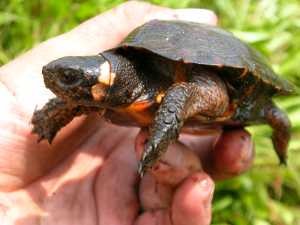
Bog turtle with its distinctive orange patch on the head
The NJ Department of Environmental Protection has been awarded two federal grants totaling $440,000 to be earmarked for the purchase of 164 acres of sensitive habitat in Sussex County that will particularly target preservation and protection of the endangered bog turtle population in New Jersey.

The awards from the U.S. Fish and Wildlife Service will partially finance purchases of two separate tracts, both of which will provide connecting greenways for existing turtle populations, and which will benefit other plant and animal species in the region. In addition, the land preservation would add to existing nature watching areas in Sussex County.

“Continued preservation of key open spaces in New Jersey, whether for habitat protection or recreational uses, is a priority of the Christie Administration,’’ said Commissioner Bob Martin. “It enhances our environment and provides a better quality of life for our state’s residents.’’

“Preservation of this type of very specialized, unique habitat not only will protect the federally threatened bog turtle, offering it a brighter future in New Jersey, but will add to preserved lands that will be available for recreational pursuits, such as hiking and bird watching,’’ added Dave Chanda, Director of the DEP’s Division of Fish and Wildlife.

The purchase of these properties will improve habitat connectivity, as they connect to approximately 350 acres of already permanently preserved property owned by the state.

The federal money, coming from the U.S. Fish and Wildlife Service’s endangered species fund, would pay about 40 percent of the estimated $950,000 cost of the land preservation in Lafayette and Wantage Township, with the state’s Green Acres Program financing the balance.

One $400,000 federal grant will be used towards acquisition of four tracts, totaling 143.6 acres, of existing bog turtle habitats, while also connecting to land already preserved by the state. A second $40,000 federal grant will target the purchase of 20 acres of bog turtle habitat within a unique spring-fed wetland complex, in an area that also hosts a rare plant, the spreading globe flower.

Bog turtle nesting
The bog turtle is quite elusive behavior and rare as a result of habitat destruction. It prefers marshes, wet meadows, and fens featuring plant species such as sedges,rushes, mosses, skunk cabbage, cattail, jewelweed, and smartweed. If you do spot one, it is likely to be in mid-April through June as it basks in the sun.

Their range is throughout NJ and they were once abundant throughout the state. Bog turtles are now primarily found in the remaining rural areas of Sussex, Warren, Hunterdon and Salem counties. Intense land uses such as large-scale agriculture, urbanization, wetland alterations and stormwater outputs are incompatible with bog turtles and have depleted bog turtle populations from much of the state.

The properties also provide landscape-level protection for upland forest and grassland habitats, thus conserving the hydrology and water quality of the wetlands.

The preserved lands will be managed by the New Jersey Natural Lands Trust in cooperation with the DEP’s Endangered and Nongame Species Program. Management of the property will include removal of woody vegetation to establish a more open canopy and ensuring that a proper wetlands area exists for the bog turtle population.

For more information on the state’s Threatened and Endangered species, please visit: http://www.nj.gov/dep/fgw/ensphome.htm


SOURCE: http://www.nj.gov/dep/newsrel/2013/13_0078.htm

Thursday, April 11, 2013

New Jersey Osprey Project

days old osprey at Great Bay

The osprey was listed as an endangered species in 1973 and quickly after that the New Jersey Osprey Project began.

Starting with a spring 1974 aerial survey to determine the number of active osprey nests from Toms River to Atlantic City, the results were not good.

With a baseline historic count of 500 osprey nests, it was expected that the numbers would be down due to the effects of DDT and habitat loss and in the 1974 count only 50 nests remained.

New Jersey habitat was also lost because of a growing shore population. New construction eliminated trees needed for nesting and it increased the ground predator populations.

The project began to supply man-made nest platforms for the birds to replace snags and trees that lost to development on the barrier islands.

DDT in the food chain caused reproduction to fail. DDT was banned in 1968, but the negative effects and residual DDT continued for a number of years. Used in and near marine environments, it was absorbed by both organisms and soils and accumulated in the food chain. Because DDT is fat soluble it bioacummulated in predators, especially birds of prey.

It did not kill the birds, but rather caused the thinning of eggshells which often broke under the weight of the incubating female.

3 young
By 1986, the osprey population had surpassed 100 pairs. This allowed their status to be changed to "threatened"in NJ.

During that time, some of my volunteer work for the Endangered and Nongame Species Program involved monitoring and tracking nest success.

2006 found the NJ osprey population at a new post-DDT high of just over 400 active nests, and that was surpassed in 2009 with 486 nesting pairs.

The next aerial survey was scheduled for this year.

MORE
The Osprey Project at conservewildlifenj.org/protecting/projects/osprey/ and follow them on Facebook.
Endangered NJ posts on osprey


Thursday, December 1, 2011

Undiscovered and Yet Endangered

According to EndangeredSpeciesInternational.org, more than ten million species remain to be discovered in the world.

Most of them are already highly threatened since they are located within regions of great habitat destruction. Among the 46,000 species assessed, more than 17,000 are likely to become extinct in the very near future if no aggressive actions are taken. Plus, their natural ecosystems are vanishing at an alarming rate.

Plants and animals are part of our unique heritage, they keep us alive, purifying water, fixing nitrogen, recycling nutrients and waste, and pollinating crops. They are vital for the physical and spiritual well-being offering us a colorful and rich world.

A hundred bird species have vanished since 1600, nearly all due to human activities, chiefly habitat loss, overhunting, and introduced predators. Island birds are especially vulnerable. A list of some of these birds, the year each was last seen in the wild, and the cause(s) of extinction.is at endangeredspeciesinternational.org/birds5.html

The huia (Heteralocha acutirostris) from New Zealand
has already vanished. © Paddy Ryan 


Friday, January 14, 2011

N.J. DEP tentatively agrees to allow Walmart store in Pine snake neighborhood

Science update from NewJerseyNewsroom.com

The state has reached a tentative agreement with a developer that would allow the construction of a Walmart store on 21 acres of Pinelands off Route 37 on the Toms River and Manchester border.

The Department of Environmental Protection Thursday said the agreement calls for the permanent preservation of 212 acres of forest near the store site an attempt to enhance pine snake habitat that would be adjacent to the property.

Large-scale development of the 212 acres is already constrained by Pinelands and endangered species regulations and the proposed agreement would preserve the land as undeveloped forest.

Under the agreement, Jaylin Holdings would construct five hibernacula, or den areas, thin sections of forest canopy to create sunny areas snakes need for basking, create upland forest clearings for nesting, and block access to limit human activity that may stress snakes.

N.J. DEP tentatively agrees to allow Walmart store in Pine snake neighborhood

Wednesday, November 10, 2010

Invasive Species Comment

I received a private email comment (I wish all commenters used the comment box below each blog post...) on my recent story about invasive species in NJ.

I can't believe you praised that article - it was one of the most idiotic, ill-informed pieces I have ever read! PS: feral cats aren't the problem...plus they didn't mention mice & rats. So if we kill all the ferals, we'll be overrun by rodents. If you were genuinely worried about Endangered NJ, you'd concentrate on humans as the #1 invasive species here (specifically developers).
My response: I thought the Star-Ledger article was well done. The information was accurate and succinct - not a science paper, but for mainstream readers. It covered a wide variety of species. I recommend it.

I think the commenter is definitely a cat person. She locked onto one item - feral cats - in an article that covered much more. Those cats who have "gone wild" do threaten many birds and especially endangered and threatened ones that are beachnesters.

She's right that habitat loss by human intervention is a bigger problem. But humans in NJ are a very naturally occurring species.


This has been well documented. You can read a report online at http://www.abcbirds.org/newsandreports/NFWF.pdf that includes a five-state review of New York, New Jersey, Florida, California, and Hawaii.

Domestic cats are considered primarily responsible for the extinction of 33 bird species since the 1600s. Many managed cat colonies occur in public parks and beaches, where they pose a significant threat to wildlife and human health.

Since 1995, the City of Cape May, NJ has sponsored a program for people who register their cat colonies with the City’s Animal Control Department. There are currently 12 registered feral cat caretakers in Cape May. This program has been widely cited as a model for other New Jersey coastal communities to use to control their stray and feral cat populations.

The commenter had an emotional response to the article. I understand that. I understand it when people in NJ react emotionally to controlled hunts to reduce deer population. My own town had a good number of "Stop the deer slaughter" signs on lawns earlier this year, and I'm sure they will be back again soon.

People change and destroy habitats. We have a responsibility to correct that when we can and manage species when we can't.

We created the feral cat population. It's not a naturally occurring "species." As with other species that become invasive, we need to deal with it. Letting invasive species take their "natural" course is actually quite unnatural. They were not meant to be here and we need to protect those species that are natural to the area.

Photo via http://www.petside.com/petsideblog/

Wednesday, June 23, 2010

Mapping To Prevent Common Species From Becoming Endangered


Could a new U.S. map of ecosystems help keep healthy species from ending up endangered?

Ground and satellite surveys of land cover by the U. S. Geological Survey’s Gap Analysis Program produces data that conservationists may be useful to create and sustain habitat for wildlife.

The Gap Analysis Program (GAP) national land cover viewer displays data on the vegetation and land use patterns of the continental United States. It combines land cover data generated for the Southwest Regional Gap Analysis project completed in 2004, the Southeast Regional Gap Analysis Project completed in 2007, the Northwest Regional Gap project, and the updated California Gap project completed in 2009. For areas of the country without an Ecological System level Gap project, data created by the Landfire Project was used.


All these projects use consistent base satellite imagery, the same classification systems and similar mapping methodology allowing for the creation of a seamless national land cover map.

Eastern box turtle

Research and mapping related to endangered species is done nationwide, but other species (known as common species) are often not as well studied. The Gap Analysis Program works to determine which common species’ habitats may not be well represented by existing parks and conservation areas.

They do that partially by doing a "mash up" of data and maps about species and land use.

You can view and search the mapping system online and also download data.

barn swallow
Looking at New Jersey there, you find a diversity of land use. We have developed, open space that includes areas with a mixture of some constructed materials, but mostly vegetation in the form of lawn grasses. Impervious surfaces account for less than 20 percent of total cover. These areas most commonly include large-lot single-family housing units, parks, golf courses, and vegetation planted in developed settings for recreation, erosion control, or aesthetic purposes.

We also have oak and pine forest. These forests stretch across large areas in the central Appalachians and northern Piedmont, north to central New England. The setting ranges from rolling hills to steep slopes, with occasional occurrences on more level topography. The soils are coarse and infertile; they may be deep (on glacial deposits in the northern part of the range), or shallow, on rocky slopes of acidic rock. The well-drained soils and exposure create dry conditions.

The forest is mostly closed-canopy but can include patches of more open woodlands. It is dominated by a variable mixture of dry-site oak and pine species such as chestnut oak, white oak, red oak, black oak, scarlet oak, pitch pine, and white pine; these may occur as oak forest, mixed oak-pine forest, or patches of pine forest. Heath shrubs (hillside blueberry, huckleberry, and mountain laurel, etc.), often dense, are characteristic.

Monday, April 12, 2010

Keep It Green

The NJ Keep It Green Campaign is a coalition of over 145 statewide, local and regional organizations ranging from sportsmen’s groups and environmental organizations to affordable housing and urban park advocates.

Their mission is to secure a long-term stable source of funding for the acquisition of open space, farmland and historic sites as well as the capital improvement, operation, maintenance, and stewardship of state and local natural areas, parks and historic sites in New Jersey.

This work is guided by the belief that every New Jersey resident deserves well-maintained, accessible neighborhood parks, wildlife areas and historic sites. Our communities rely on these areas for a high quality of life, livable neighborhoods and sustainable economies.

One of their recent successes was in working for the passage of the NJ Yes vote this past November to continue investing in preserving our land, water and history for the benefit of citizens today, and for future generations.

A majority of voters, voted to continue funding to the state's highly successful preservation programs. The Yes vote was bipartisan, winning in eight counties carried by Republican Chris Christie and seven counties carried by Democrat Jon S. Corzine.

Funding for the Green Acres Program, the Farmland Preservation Program, and the NJ Historic Trust will now continue for the next two years, giving New Jersey time to identify a long-term funding source for these programs.

In the meantime, the $400 million in approved funding will:

* Preserve sources of clean drinking water
* Protect water quality in our rivers, lakes and streams
* Preserve wildlife habitat, working farms, historic sites and natural areas
* Invest in our ecological resources that save on the high costs of degradation, protect New Jersey's multi-billion dollar outdoor tourism industries, and create jobs restoring natural and historic landmarks.
* Cost each household less than $1 per month
* Require continued full public disclosure of all spending
* Leave a legacy for future generations.

You can follow NJ Keep It Green on Facebook.

Monday, January 11, 2010

Backyard Corridors


Freedom to Roam is an environmental program at Patagonia.com to preserve and protect big wildways for large animals.

What is a backyard corridor? What does it mean to animals that live near you?

Some wildlife is probably roaming through your backyard, neighborhood, or town. Different animals require different roaming areas and migration corridors. One animal may require one square mile while another may need 1,000 square miles.

Patagonia selected eight corridor hotspots – each one connected with an iconic animal species - to represent a diverse array of species and habitats, across our entire country.  Hotspots Map

The 3 pressing problems for wildlife corridors are:

1. Global Warming and its effects on habitat (drought, flooding, glacier melt, warming temperatures).

2. Human development, including housing sprawl, energy and resource extraction, population growth, expanding urban areas, and highways and freeways.

3. Diverse and competitive land-use across large corridor areas, including the rights of private landowners, parks and their uses, national forests, the needs of recreationists.

What can we do to help? Create, restore and protect wildways or corridors linking animal habitats, parks and other protected areas and migration routes.


Corridor Ecology: The Science and Practice of Linking Landscapes for Biodiversity Conservation
Linkages In The Landscape: The Role Of Corridors And Connectivity In Wildlife Conservation

Monday, November 23, 2009

Habitats and Partnerships

The NJFO’s Partners for Fish and Wildlife program recently wrote an article for the New Jersey League of Municipalities Magazine that highlights how the U.S. Fish and Wildlife Service can interact with municipalities across the State that want to create wildlife habitat.

Many of the 6,500 acres of wetlands, 3,000 miles of grasslands and other uplands, and 50 miles of riparian and in-stream habitat the Partners for Fish and Wildlife program has restored since it’s New Jersey inception in 1991 have come from partnerships with municipalities.


A good example of a successful partnership is Partners for Fish and Wildlife's "Partnership Project with NJ Audubon and Verizon" which won the Governor’s Environmental Excellence Award in 2007. That was a partnership of the USFWS's NJ Field Office’s Partners for Fish and Wildlife program, Verizon and the New Jersey Audubon Society.

The Verizon Center, located a mile upstream of the Great Swamp National Wildlife Refuge, is restoring 18 acres of uplands and 7 acres of riparian habitat. Verizon has also publicized the merits of voluntary corporate land stewardship.

Specific enhancements at the site include the removal and control of invasive vegetation; native grass and wildflower plantings; and the installation of a vernal pool, nest boxes and turtle nesting areas. These enhancements are currently providing suitable habitats for a variety of wildlife, including numerous bird and herptile species.

Verizon restored 25 acres on its property that are home to various grassland, riparian and wetland habitats. They planted over 500 native trees and shrubs on the site and plan to plant another 500 in 2008. They installed more than 10 acres of native grasses and wildflowers and removed invasive non-native vegetation on the land. They have implemented a delayed mowing schedule to promote wildlife breeding and have instituted a policy of zero chemical application on the restoration areas.

In addition they installed sand pits for turtle nesting areas, a vernal pool for amphibian breeding, installed numerous bird nesting boxes and outlined a monitoring and Stewardship Plan to track future progress on the site. A Stewardship Plan considers all aspects of resource management and documents management decisions and practices designed to maintain the land in a productive and healthy condition for present and future owners. It specifies actions that will increase the environmental and economic values of the land and the region.

The benefits extend beyond habitat restoration. The site extends along more than 3,700 feet of the Passaic River. In addition to improving water quality in the river the restored area in less than a mile upstream from a New Jersey Natural Heritage Priority Site known as the "Great Swamp Macrosite", an important area for the breeding of several threatened and endangered wetland species.

Restoring this habitat is part of Verizon's national commitment to green energy practices that include pursuing aggressive network equipment and building energy-reduction initiatives; utilizing alternative energy sources in the network, buildings and vehicle fleet; and promoting the company's technology as an alternative to travel, among other efforts.

Friday, November 13, 2009

Encountering Bobcats in New Jersey

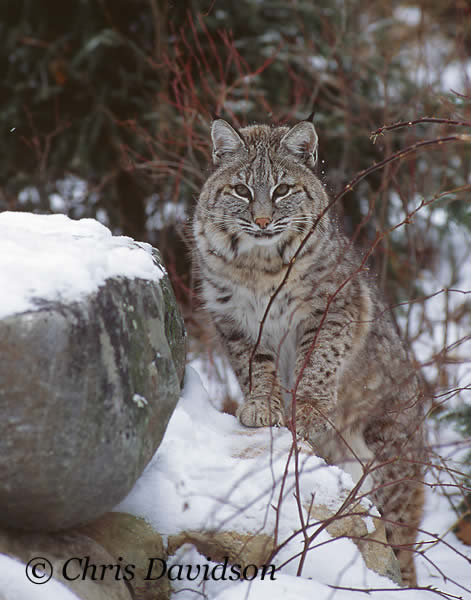
Bobcat by Chris Davidson via http://www.state.nj.us/dep/fgw/

The bobcat (Lynx rufus) is one of NJ's endangered mammals. The are not usually seen by residents because of their habits, but I was not shocked to read an article recently in via The Daily Record that a photographer was able to get a shot of one last month in the Delaware Water Gap National Recreation Area.

"I was doing nature photography and in early spring, I spotted it numerous times," George Draney recalled. So be began staking out a narrow, scrub-lined path twice a week, for about three or four months. A couple of times the bobcat crept by him but was gone before he could shoot a photo, he said.

The morning he finally got the shot, he was sitting in his car near the path and the bobcat was between 25 and 50 yards away, he said.

"I saw it going up the pathway in a hurry, so I thought to make a noise to make it look my way," Draney said. "So I whistle real loud, and it stopped. When I shot, it turned, and I got two more shots."

He described it as appearing healthy, about the size of a medium dog and weighing about 25 pounds.

The State estimates our population of bobcats to be at least 90, with most living north of Route 80.

They had disappeared from NJ by the early 1970s because of habitat loss. About 20 bobcats (from Maine) were reintroduced from 1978 to 1982 to repopulate them here.

One unfortunate indicator of their return are the dozen road kills found in the past year, including one on Route 46 in Parsippany near the Boonton Reservoir this past spring.

Taxonomically, bobcats belong to the order Carnivora, or carnivores, meaning that they are
primarily flesh-eaters. They are members of the Felidae family and are commonly known as felines. All members of this family look somewhat similar in appearance. (here is a comparative track guide)


Bobcats live in both the northern and southern portions of NJ. In the north, typical bobcat habitat consists of large areas of contiguous forest and fragmented forests interspersed with agricultural areas or early succession vegetation.

Bobcats often use areas with rock outcrops, caves, and ledges that provide shelter and cover for hunting, resting and rearing young. Where rocky areas are not available, swamps, bogs, conifer stands and rhododendron and mountain laurel thickets provide good cover and excellent hunting grounds.

In southern New Jersey, dense thickets of briars and conifers serve as resting and escape cover, so the bobcat have the ability to adapt to a wide variety of habitat types and prey species.


The Delaware Water Gap and other areas of Kitatinny Ridge are the best habitat areas the state has for bobcats, says Mick Valent, a wildlife biologist for the state Division of Fish and Wildlife, who said there's no reason to doubt Draney's account.

State biologists have found bobcat tracks and scat in the Water Gap area, and have photographed them there with motion-sensitive cameras baited with scent, Valent said.

Bobcats are so shy that they pose no danger for people, and are so reclusive that you would be lucky to actually see one.

Their individual territories ranging from one square mile to 25 square miles. Habitat continues to be the major problem in maintaining their numbers. They find a good supply of mice, chipmunks, squirrels and birds in the areas where they exist.

NJDEP document on bobcats

Bobcats in the Conserve Wildlife Newsletter, Winter 2007


Saturday, September 5, 2009

School Yard Habitats

The New Jersey Coalition for School Yard Habitats has helped dozens of schools throughout New Jersey develop and maintain on-site outdoor classrooms that are used by students.

These habitats can be used across disciplines - not just in science, but in social studies, language arts, mathematics and art.

Imagine students being actively engaged in learning while using outdoor trails, butterfly and flower gardens, man-made ponds and wetlands, observation decks, bird blinds, amphitheaters and diverse wooded areas. Such sites are both popular as well as possible on most school properties, including very built urban and suburban environments.

The New Jersey Coalition for Schoolyard Habitats is dedicated to training, networking and promoting the development or enhancement of schoolyard habitat projects for educational purposes. NJDEP's Division of Fish & Wildlife workshops (WILD School Sites) are open to any teacher or environmental resource person interested in establishing, maintaining, and effectively using this type of learning environment.

The coalition is an affiliate of the Alliance for New Jersey Environmental Education (ANJEE). Staff within the New Jersey Department of Environmental Protection helped develop the coalition and assist with coordinating its activities.

The NJ Division of Fish & Wildlife offers certification and a sign proclaiming certified "Wild School Site" status for schools that meet the criteria for certification. They also offer mentoring to teachers who need help getting started and can facilitate training opportunities among coalition members.