Showing posts with label shorebirds. Show all posts

Monday, October 20, 2025

Guide to Watchable Wildlife Areas


In 2009, I posted here about the original New Jersey Wildlife Viewing Guide (shown above). Since then it has been updated. There are lots of places to see wildlife in New Jersey, and the New Jersey Wildlife Viewing Guide is a good directory to some of those places, which are great family field trips.

The guide lists 99 viewing sites for wildlife in NJ and was a joint effort of the ENSP and Defenders of Wildlife. It contains eight eco-region tours for ecology-minded tourists.


Here are two viewing areas that we suggest for watching wildlife.

One well-known place is the Sandy Hook Gateway National Recreation Area. This long, slender peninsula goes 6.5 miles into NY Harbor and has 1665 acres. Popular as a swimming beach in summer and a fishing area year-round, it is also a major beach nesting area.

The visitors center (2 miles in from the entrance) can guide you to trails & observation areas, and warn you of nesting areas for piping plovers (at right), black skimmers, least terns and many shorebird species.

On the bay side, the Horseshoe Cove Salt Marsh is a good place to look for great blue herons, green herons and egrets. Offshore viewing from the beaches in summer may allow you a view of passing whales (hence the naming of the Spermaceti Cove Visitor Center)

From the Garden State Parkway, take exit 117 from the North or 105 from the south and follow the signs on Route 36 for 12 miles. Admission is charged during the summer season.


Some areas are less well-known, such as the Walkill National Wildlife Refuge. This large waterfowl habitat (7500 acres) is located along a 9-mile section of the Walkill River.

The Wallkill River NWR is located in Sussex County, New Jersey, and Orange County, New York. Congress established the refuge in 1990 to preserve and enhance lands and waters in a manner that conserves the natural diversity of fish, wildlife, plants, and their habitats for present and future generations. The management emphasis is on Federally-listed endangered and threatened species, migrating waterfowl and shorebirds, nesting and wintering grassland birds, and forest-dwelling birds.

There are three nature trails on the refuge. Each nature trail provides an excellent wildlife viewing opportunity. In winter months, with proper snow conditions, cross-country skiing and snowshoeing are allowed on these trails.

225 species of birds have been seen, including 24 raptor species. The occasional black bear & bobcat are also seen. There is a wildlife observation deck, Wood Duck Trail & hundreds of acres of upland grassland.

The Refuge is near Sussex & Unionville. Follow Rt. 23 to Rt. 565 for 1.4 miles to the Refuge office.

The NJ viewing guide is available on Amazon, along with a set of Field Guides to Wildlife, Birds, Trees & Wildflowers of New Jersey that would be useful to bring along on any trip out into nature.


Thursday, June 23, 2022

The Ancient Crab That Isn't a Crab

Fossil horseshoe crab dead in its tracks
Fossil horseshoe crab ancestor Mesolimulus an extinct arthropod


You might know that horseshoe crabs go back before dinosaurs. Their fossil ancestors lived 445 million years ago. (Dinosaurs appear about 200 million years later.) And they survived the extinction event that wiped dinosaurs from the planet 66 million years ago. 

There are 4 species today. In New Jersey, we know the species that is found in the Atlantic coastal waters of North America and the Gulf of Mexico. The three others are found in Asia’s coastal waters.

Did you know that are "blue bloods?" They don't have the hemoglobin that makes human blood red. Horseshoe crabs have hemocyanin which is also an oxygen-carrying protein that contains copper (our blood has iron) and that gives horseshoe crab blood a bright blue color.

That unique blood contains an enzyme that causes the blood to coagulate when exposed to deadly bacterial endotoxins, and so biomedical companies use this to test medicines, vaccines, and implants for endotoxins to insure it is safe for people. Unfortunately, many horseshoe crabs die in the process of collecting their blood. Scientists are now looking for synthetic alternatives to the enzyme.

These crabs walk on 10 legs (5 pairs) but they have another pair that they use to bring food to their mouths like arms. Without jaws, they crush worms, algae, clams, and other small prey from the ocean floor with those legs.

Those legs and its pointed tail look pretty scary to a child (and some adults!) but they are harmless. The tail (telson) is only used when a crab gets stuck upside-down so that it can flip over or as a rudder to swim upside down. When washed up on dry land, the tail isn't as effective, so if you see one it's safe to turn it over and get it back to shallow water.

That telson might not work as a sword but their tough shell is a pretty good defense for adults when they are right-side-up against other predators including sea turtles, sharks and gulls. 

Image by Chris Engel from Pixabay

Spotting a horseshoe crab in the water or on a beach is common enough at the Jersey Shore or in the bays that they even appear on t-shirts and as jewelry. Although you may spot this crab at any time of year on a Jersey beach, the most important time for them is from May to early June when they arrive on beaches to lay eggs.

The largest populations live in the Delaware Bay and they hit the beaches there during high tides that coincide with the full moon or new moon. Females dig nests in the sand and bury a cluster of about 4,000 tiny, blue-green eggs, and they can lay about 20 egg clusters each year.

That sounds like more than enough eggs but thousands of shorebirds also arrive there at that time to feast on the eggs. It is a critical food supply for migrating species such as red knots, ruddy turnstones, and sanderlings. The red knots need this final food stop before they complete their 9,300-mile migration from South America to the Arctic.

If eggs survive they will hatch in two to four weeks and the very vulnerable baby horseshoe crabs go to shallow, sheltered waters to live in for their first year as they grow and molt. 

Besides medical uses and marine and bird predators, humans use horseshoe crabs as bait to catch eels and whelk (sea snails), and that has really hurt crab populations in the past few decades.

The Atlantic horseshoe crab is currently considered “Near Threatened” by the IUCN. While not currently listed as a threatened species by the State of New Jersey, there is currently a moratorium on the harvest of horseshoe crabs within the state.

We always refer to this species as a horseshoe crab but they aren't crabs. They are arthropods and are more closely related to scorpions and spiders. They are the only living members of the Xiphosura order.

Horseshoe crab with shells 2
Sometimes you'll see them with some hitchhiking creatures attached to their shell

Tuesday, July 14, 2020

The Amazing Blue-Blooded Horseshoe Crab


Horseshoe crabs are not crabs, but they will always be called by that name.

Horseshoe crabs predate the dinosaurs having been on Earth an estimated 450 million years. That beats out that T-Rex by about 200 million years. 

One of their unique features is their blue blood. That blood is used by the pharmaceutical industry for testing drugs and so has caused their numbers to deplete.

They live in the ocean year-round and make one famous annual sojourn ashore to lay eggs in sandy, wet beaches. You may know that the Delaware Bay and New Jersey are very well known for this spring ritual which is quite amazing.

They are not crabs or even crustaceans because they lack antennae. On the arthropod family tree, they are classified as chelicerates, a subphylum that also includes arachnids - spiders. 

Although they are popularly called “living fossils,” they have evolved over the almost half a billion years. Fossils show us that they once had limbs that split out into two branches unlike their single one today.

Another misconception is that their spiked tail is used to "sting" prey or people. Not so. It is used as a steering rudder and to help right themselves after getting stuck on its back. Don't pick a live one up by the tail because it can break off and cripple the crab.

They eat aquatic worms, algae, carrion, and lots of clams and mussels. They mash food between the spiky upper regions of their legs before pushing it into the mouth. 

The full moons, new moons, and high tides of May and June are when the Delaware Bay has its Atlantic horseshoe crab spawning. It happens at night when a female comes ashore followed by male(s). Like turtles, she digs a hole and deposits her eggs but then males fertilize them. 

This event coincides with migrating shorebirds who gorge themselves on the nutrient-rich eggs which power birds, such as red knots, on their annual migration between the Arctic and South America. 

The horseshoe crabs lay many, many eggs because so many are consumed by the birds. The estimate is that a female can lay 90,000 eggs per clutch and that probably about a dozen of those will ever make it to adulthood. It's not just birds who are predators. The embryos are also eaten by fish and sea turtles.


Horseshoe crab blood contains copper which turns bluish-green when it oxidizes. They also have no infection-fighting white blood cells, but have special cells called amebocytes. This is what interested scientists who found that a vaccine or injectable drug is safe if the blue blood doesn't release the gooey amebocytes that means it did not encounter bacteria.

This makes horseshoe crab blood worth about $15,000 per quart. Though the crabs are released after extracting about 30 percent of its blood, about  0–15 percent of captured crabs die somewhere in the process. Harvesting restrictions have been set in places and researchers have been trying to develop synthetic amebocytes.

Admire these amazing creatures. If you see a live crab flipped on its back, listed by the shell and set it back into the water. They won't hurt you at all. And think about them the next time you get a safe vaccine or injection.
 
More at www.nwf.org

Underside of live horseshoe crab

Saturday, May 25, 2019

Horseshoe Crabs Come Ashore from the Delaware Bay


Each May and June, millions of Atlantic horseshoe crabs come ashore along the East Coast to spawn. The height is usually when there is a full moon or new moon, creating the highest tides of the month. 

The result is those familiar helmet-shaped shells of Limulus polyphemus and trillions of their greenish eggs.

At least 11 different species of shorebird rely on horseshoe crab eggs as their primary food source for about 2-3 weeks during their migration. Migrating to their breeding grounds in the Arctic, some come from as far away as the southern tip of South America. Recent declines in the horseshoe crab population have triggered similar and more drastic declines in shorebird populations.

Red knots feeding near horseshoe crab. Photo by Gregory Breese/USFWS


Horseshoe crabs are often called "living fossils" as they are thought to have changed very little in the last 450 million years. Scientists are still not sure if they were land-based arachnids that moved into the sea or an ancestor that stayed put in the oceans. Recent genetic research favors arachnids, placing them alongside spiders and scorpions.

The horseshoe crabs spawn from Maine to the Yucatan Peninsula, but our own Delaware Bay is the center of activity. The warm water and mild surf with sandy shores must be appealing because some of the crabs have come from more than 60 miles out from the continental shelf off the mouth of the bay.

The blue blood of the Atlantic Horseshoe crab is used in medical testing of equipment and vaccinations to detect bacterial contamination in minute quantities, and the crabs have always been harvested as bait. The Atlantic horseshoe crab is currently considered “Near Threatened” by the IUCN. While not currently listed as a threatened species by the State of New Jersey, there is currently a moratorium on the harvest of horseshoe crabs within the state. With this law, it is illegal to remove a horseshoe crab, dead or alive, from its habitat in the wild.


conservewildlifenj.org/species/fieldguide/view/Limulus-polyphemus/

fws.gov...Modeling-a-Future-for-Horseshoe-Crabs-and-Red-Knots


Wednesday, April 19, 2017

Horseshoe Crabs and Shorebirds Return to Delaware Bay

USFWS Photo

Late April means that a ritual of "living fossils" moving onto beaches will happen again.

The Wetlands Institute newsletter reminded me that the migration and spawning of horseshoe crabs has been happening for more than 450 million years is here again.

And where is the largest population of spawning horseshoe crabs in the world? Delaware Bay.

They can be found from Maine to the Yucatan Peninsula. Limulus polyphemus, the American Horseshoe Crab, is actually more closely related to spiders, ticks, and scorpions than crabs.

The migration and spawning also brings shorebirds who are migrating from Central and South America to Delaware Bay for a rest stop and critical meal. The shorebirds have a 3,000 – 9,000 mile annual journey to their Arctic breeding grounds.

Humans have a variety of positive and negative interactions with horseshoe crabs.

  • Native Americans along the Delaware Bay and River ate their eggs. 
  • They were used as fertilizer and hog food in in the 1800s and it was an active industry on Delaware Bay.
  • Their white blood cells contain a chemical (LAL) used to test for contaminants in injectable drugs and vaccines and other medical applications.
  • They are still used as bait to catch eel and channeled whelk, mostly for overseas markets, but NJ has a moratorium on the harvesting of the crabs due to over-harvesting.
  • Development along the Delaware Bay has reduced access for the crabs to spawn, but there are ongoing restoration efforts.

Baby horseshoe crab  - via Wikimedia
The combination of crabs and birds brings many people to the bay to observe. Besides the birds, you might see female crabs with males in tow coming ashore on the incoming tide. Her fertilized sticky, green eggs are placed in the sand in several nests, and the tide will take the crabs back out into the shallows to wait until the next incoming tide and the process will continue. A full moon (May 10) and higher tides are usually the peak times, and a female can lay 80-100,000 eggs during this spawning.


A number of groups participate in the reTURN the Favor project 
which works to rescue stranded horseshoe crabs by freeing crabs 
and working on projects  to help remove debris from beaches.

May 20-21 
with workshops, demonstrations, and field trips that focus on the crabs 
and their role in shorebird migration. 


Mating pair of horseshoe crabs   - via Wikimedia


Monday, August 17, 2015

Shorebirds Make Their August Return to New Jersey

Baird's Sandpiper (Calidris bairdii) by Dominic Sherony [CC BY-SA 2.0 via Wikimedia Commons

Via the "Seen in New Jersey" column written by Pete Bacinski (New Jersey birder and retired NJ Audubon All Things Birds program director) comes the reminder that shorebirds are now returning from nesting grounds in the high Arctic to the Jersey shore.

Like many NJ people, these birds have found that the late summer and after Labor Day are very nice times to enjoy our state. People think of migrations as an autumn event, but in this case this part of August is the time for neotropic migrant passerines, or perching birds, to migrate and it is the peak of shorebird migration. Pete says that the second half of August has the highest shorebird diversity of the year.

This is a great time to see birds foraging in mudflats, sandy beaches, sod farms and grassy areas. A choice spot is the Forsythe National Wildlife Refuge. This refuge has 47,000 acres of marshland and forest and the Brigantine Division in Galloway is the place to be for shorebirds at this time of year.

Other locations worth checking:
  • Barnegat Impoundments, in Barnegat Township, also part of Forsythe NWR
  • TNC Meadows in Cape May
  • Stone Harbor
  • Island Beach State Park
  • Sandy Hook (north end)
  • New Jersey Meadowlands, around the DeKorte Environment Center
  • Whitesbog cranberry bogs and mudflats (when drained)
Baird's sandpiper (shown at top) and the buff-breasted sandpiper, as well as the rare American golden plover love sod farms and grassy fields in places like Brigantine.These two sandpipers (AKA grasspipers) don't appear here in spring migration because they take a central flyway when they head north. Upland sandpipers, a New Jersey endangered species, is ending its migration through NJ now.


New Jersey Audubon's All Things Birds will sponsor these birding field trips:

Aug. 23: Forsythe (Brigantine) National Wildlife Refuge
Aug. 30: Forsythe (Brigantine) National Wildlife Refuge
There is a fee for these events: $20 for members and $25 for nonmembers. For more information or to register, call the Scherman-Hoffman Wildlife Sanctuaries at (908) 766-5787.

Thursday, May 7, 2015

Full Moons, High Tides and Horseshoe Crabs

Horseshoe Crabs at Delaware Bay 
Photo: Greg Breese/ U.S. Fish and Wildlife Service

The recent Full Moon for May is a reminder to me that the time is here for horseshoe crabs (Limulus polyphemus) during the high tides of the new and full moons of early spring.

The ancient horseshoe crab evolved during the Paleozoic Era (540-248 million years ago) and although we call it a "crab," it is a species more closely related to spiders and scorpions.

The female horseshoe crabs will emerge from their muddy beds this month for spawning and will dig several nests to lay their eggs.

The males, one-third the size of females, attach themselves to the rear of the female's carapace and are pulled over the nests to fertilize the eggs.

Horseshoe crabs "protect" their eggs by covering their nests with sand, but wind and waves and especially visiting migratory shorebirds take many of those eggs. Shorebirds stopping in Delaware Bay on their travel along the Atlantic coastline. Shorebirds almost double their weight from feeding on horseshoe crab eggs which gives them the energy source that enables them to continue their migration north.

Red Knots at Delaware Bay
Photo: Greg Breese/ U.S. Fish and Wildlife Service
Until the 1990's, the harvest of horseshoe crabs was regulated by individual states, but in 1998, an Interstate Fisheries Management Plan was adopted by the Atlantic States Marine Fisheries Commission (ASMFC). Biologists from state and federal agencies participate in a Cooperative Tagging Program to gain information about horseshoe crab migration patterns, distribution, abundance, and mortality.

Horseshoe crabs will molt several times before they reach sexual maturity at between 9 and 11 years of age.

Horseshoe crabs are harvested commercially primarily as bait to catch whelk (conch), American eel, and sometimes catfish. Pharmaceutical companies extract their blue, copper-based blood which contains a chemical substance, hemocyanin, which clots when exposed to bacteria. The blood is used to test drugs and medical equipment for the presence of harmful bacteria.

Sources:  www.fws.gov/northeast/marylandfisheries/

Monday, April 20, 2015

Beaches on Delaware Bay Continue to Undergo Restoration


A continuing story in New Jersey since Hurricane Sandy has been the restoration of the beach area on Delaware Bay that are spawning grounds for horseshoe crabs and feeding areas for shorebirds.

It's a story worth retelling as these important populations of shorebirds and horseshoe crabs need the  protection that comes this year with the restoration of more beaches on New Jersey’s side of Delaware Bay.

Thompson’s Beach, on a remote stretch of the Cumberland County shore, will see the removal of  shattered bulkheads and the replacement of 40,000 cubic yards of sand for the spawning of thousands of horseshoe crabs.

Four more beaches and a marsh are due for restoration over the next two years in a federally funded $5.1 million operation on behalf of the American Littoral Society and the Conserve Wildlife Foundation of New Jersey.


A ban on horseshoe-crab harvesting on New Jersey beaches has shown an increase in the bay’s population of red knots. But the crabs are still taken for medical uses and as bait and are harvested on Maryland and Virginia shores even though they are part of the Delaware Bay population.


The red knot migrates from southern Argentina to Arctic Canada via the Delaware Bay beaches each spring and relies on horseshoe crab eggs for food to fuel that journey. The bird population was at its lowest in the early 2000s and has recently stabilized at about 25,000.

That is encouraging, but it is less than a third of the 80,000 birds that biologists consider sustainable, and well below its peak of about 92,000 in the 1980s. The red knot was recently listed as threatened under the federal Endangered Species Act,.

Other shorebirds that use the bay beaches have also suffered a sharp decline and may be more endangered than the red know. For example, the ruddy turnstone's numbers are down to 14,000 from some 150,000 during the 1980s.

Larry Niles, a consulting biologist who designs and manages the beach-restoration program and who previously headed the endangered species program at New Jersey’s Department of Environmental Protection, estimates that some 500,000 male crabs and 150,000 females are harvested each year for their blood, which contains LAL, an extract used to ensure that medical products such as intravenous drugs and vaccines are free of contamination. The crabs are bled and then returned to the ocean in an operation that may kill as many as half of them, he said.
The medical harvest has cut the number of females to about 4 million from about 12 million in the 1990s, he said. “There’s no evidence of recovery in the crab population,” he said. “We’re not going to increase the bird population until the crab numbers start increasing.”

Monday, February 16, 2015

Green Eggs and Sand Curriculum Workshop


During the full and new moon events in May and June, thousands of horseshoe crabs come ashore to spawn, primarily in Delaware Bay. It is also during this time when migrating shorebirds descend upon the beaches to rest and feed on the horseshoe crab eggs before continuing onto their breeding grounds. This interaction between horseshoe crab, shorebird and humans is what lays the groundwork for the Green Eggs & Sand (GE&S) workshop.

A Green Eggs and Sand Curriculum workshop will be held May 29-31 at the Wetlands Institute in Stone Harbor (Cape May County). 

The workshop will delve into the ecological connections between horseshoe crabs and shorebirds, human connections to horseshoe crabs, and the challenges encountered in managing this resource via presentations, field trips and hands-on activities. Workshop participants will receive the award-winning, Green Eggs & Sand curriculum pack, recently updated with current information and new activities.

The GE&S workshop is a three-day workshop focuses on promoting understanding the issues, the science and the management of the horseshoe crab/shorebird controversy. 

Workshop participants learn from top researchers and natural managers in the field, as well as get to participate in a horseshoe crab count. 

Educators and natural resource managers from Delaware, Maryland and New Jersey developed the curriculum, and designed it for use with middle and high school students. It is broken down into four modules that introduce students to the lives of horseshoe crabs, their extraordinary history, ecological niche, interrelationships with other species and the challenges of managing horseshoe crabs. 

At the end of the workshop participants take home the activity rich GE&S curriculum package and video that has been correlated to the national-learning standards in science, social studies, math and language arts. 

Workshop FAQs (pdf, 43b)

For further information please contact Karen Byrne at 609-748-4347 or via e-mail at Karen.Byrne@dep.nj.gov.

For more information visit http://www.njfishandwildlife.com/greeneggs.htm 

Monday, December 29, 2014

Red Knot Is Now On The Federal Threatened Species List

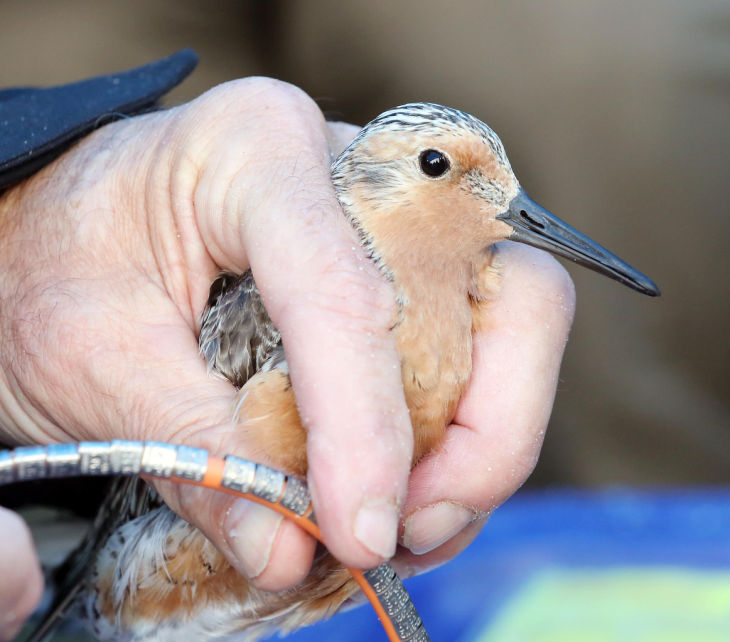
Red knots             Source: U.S. Fish and Wildlife Service

The U.S. Fish and Wildlife Service has designated the red knot, a migratory shorebird, as “threatened” under the Endangered Species Act. A “threatened” designation means a species is at risk of becoming endangered throughout all or a significant portion of its range.

“This federal designation will make a big difference in strengthening the protections of this incredible shorebird,” said David Wheeler, executive director for Conserve Wildlife Foundation of New Jersey. “Here in New Jersey, we are restoring the vital beach habitat that had been decimated by Hurricane Sandy, and this designation ensures the safeguards we are providing can be complemented along the East Coast,” Wheeler added.

Since the 1980s, the knot’s population has fallen by about 75 percent in some key areas. Wildlife biologists believe the major threat to the red knot is the dramatic decline of horseshoe crab eggs, an essential food source at the most critical stopover during their 8,000-mile trip from southern wintering grounds to Arctic breeding territory. High-energy horseshoe crab eggs provide nourishment for red knots to refuel and continue their journey.

“The major decline of horseshoe crabs in Delaware Bay is one of the largest threats to the survival of the shorebird,” explained Larry Niles, a biologist who leads the beach restoration efforts for Conserve Wildlife Foundation of New Jersey and American Littoral Society, and has studied red knots for three decades. 


Shorebird Makes Federal Threatened Species List - The SandPaper

Sunday, December 7, 2014

NJ Audubon Says Red Knot Will Be Listed As Threatened


Red Knot - Bob William philly.com/philly/news/new_jersey
The Red Knot, a shorebird which has undergone a drastic decline in recent years, will be listed by the U.S. Fish and Wildlife Service as a threatened species under the Endangered Species Act, according to the New Jersey Audubon.

The action, which is expected to be announced next week, is a critical step toward the long-term protection and recovery of the species, said New Jersey Audubon, which has long addressed issues related to the Red Knot and other shorebirds. The listing would mean that the species meets the Endangered Species Act criteria of being likely to become in danger of extinction in the foreseeable future throughout all or a significant portion of its range.

"The Red Knot utilizes the shores of the Delaware Bay extensively during its amazing bi-annual migration between its Arctic breeding grounds and South America," said New Jersey Audubon's President and CEO Eric Stiles. 

 Read more

Friday, November 28, 2014

Red Knot May Get Federal Threatened Status


The pressofatlanticcity.com reports that today federal regulators will decide whether to give greater protections to red knots, a shorebird that comes to and depends on South Jersey each spring to fuel its epic migration.

Scientists in New Jersey have been studying the red knot for more than 20 years, following the robin-sized bird from its winter home at the tip of South America to its high-Arctic breeding grounds.

The birds are drawn to South Jersey by the annual spawn of horseshoe crabs, which crawl onto the beaches once a year to lay their eggs in the sand in an annual wildlife spectacle that has taken place since before the age of dinosaurs. Red knots, ruddy turnstones, laughing gulls and other birds converge on Delaware Bay beaches each May to gobble up the tiny, nutritious eggs.

More NJ Info fws.gov/northeast/njfieldoffice/Endangered/redknot.html

Sunday, May 19, 2013

Shorebirds on the Delaware Bay

Larry Niles worked for many years for the New Jersey Division of Fish and Wildlife, as a biologist, then as chief of the Endangered and Nongame Species Program. He has been posting photos on his Facebook page of the shorebird and horseshoe crabs on the Delaware Bay, the banding of birds and the restoration of areas such as Moores Beach.


The primary goal of biologists on the Delaware Bay during the stopover is to catch shorebirds and measure their condition and band them with unique ID leg flags. They measure birds and get weights and use leg flags so that birds can be identified later at a distance.

This is the 17th year of the study which includes an international team of shorebird scientists.


Thursday, February 21, 2013

Winter Birding at Brigantine Island

Marbled Godwits and Western Willets:  Image:Harvey Tomlinson

At Forsythe NWR (Brig), New Egypt, and Brigantine Island near Atlantic City, birders are enjoying winter birding.

From the Voice of NJ Audubon hotline, we find reports of "19 MARBLED GODWITS, 73 WESTERN WILLETS, 240 AMERICAN OYSTERCATCHERS, and 5 WESTERN SANDPIPERS" earlier this month.

Reports also have useful links like a Feb. 13 report of BARNACLE GOOSE, PINK-FOOTED GOOSE, PACIFIC LOON, NORTHERN LAPWING, CRESTED CARACARA, RUFOUS/ALLEN'S HUMMINGBIRD.

Not to ignore Northern NJ - there were also sightings from the NJ Meadowlands (DeKorte area) on Feb. 10 including a ROUGH-LEGGED HAWK a mixed flock of HORNED LARKS, SNOW BUNTINGS, and one LAPLAND LONGSPUR; an unseasonal GRASSHOPPER SPARROW and a flock of 40 COMMON REDPOLLS

Saturday, January 26, 2013

Horseshoe Crabs, Red Knots and Hurricane Sandy


Hurricane Sandy tore up much of New Jersey's coastline and the boardwalks and homes have gotten a lot of attention. But it also tore up natural areas in bays that are important to fish and wildlife.

One of those effects will probably be felt by our horseshoe crabs and the Red Knot sandpipers who depend on them and visit us each spring.

The Red Knot is one of the well-traveled shore birds that migrate in spring. Their trip is from a winter home in Tierra del Fuego (at the southern tip of South America) all the way to summer breeding grounds in the North American Arctic. Midway on that incredible journey, is a very important stopover in New Jersey.

Our Delaware Bayshore is a critical feeding place where the birds rely on eggs laid by horseshoe crabs. Red Knots can almost double their body weight in a few weeks of feeding.

Two unfortunate things are limiting their chances this year.

1) The superstorm damaged important horseshoe crab nesting beaches. The high water pushed sand higher into the dunes on salt marshes. It also exposed some mudflats, marsh plant roots, and debris.

2) Our state Senate and Assembly introduced bills to lift the moratorium on the harvest of horseshoe crabs for bait.

The NJ Endangered and Non-Game Species Program scientists have shown in great detail for several decades the importance of the horseshoe crabs to the migratory birds having sufficient energy stores to complete the journey to their Arctic breeding grounds.


The crabs will still go to the beaches to lay eggs. The birds will still arrive. Neither species follows the news about Hurricane Sandy.

But there may not be enough eggs to feed the birds AND to propagate sufficient numbers of crabs. The birds actually eat excess and dying eggs that will not become crabs. The viable eggs are buried and generally birds would not go after them.

In the past 30 years, we have gone from horseshoe crabs on top of each other battling for nesting space to far fewer egg-laying females on the beaches.

Part of the problems has been the harvesting of the crabs for the bait industry. Horseshoe crabs are also bled for lysate which is important to pharmaceutical uses. In both cases, the crabs used, even if returned to the water usually die.

NJ created a harvest moratorium starting in 2006 to help in the recovery of the crabs and to help prevent problems with the red knots.


MORE INFO

Friday, November 2, 2012

Hurricane Sandy and the Birds

I found myself wondering this week, as I sat without power and heat, how birds and wildlife were dealing with Hurricane Sandy.

One story I found online from magblog.audubon.org discusses some of the rare visitors that the storm swept into our area. In New York’s Finger Lakes Region, a Ross’s gull was sighted. This small, dove-like bird is seldom seen outside of the Arctic.
Seabirds likely get pulled into a hurricane’s spiral, and then move into its calm eye to ride out the storm. “When the storm reaches land, some of them may start fighting the winds,” avian expert Kenn Kaufman tells Audubon in a Q&A about birds and hurricanes. “Others may go with it and travel with the eye until the hurricane dissipates. The majority of seabirds, if they are not too weakened from having flown for so long without food, will probably find their way back to shore quickly. They have great powers of navigation.”
On the other hand, using satellite transmitters, it was revealed that whimbrels don’t try to avoid or ride out hurricanes but actually force their way through the storms.

A northern gannet - which spends most of its life at sea - spotted in West Fairview, PA.

Did you notice any unusual wildlife activity in your area during the hurricane? Post a comment below and let us know.

MORE

eBird has resources about birds that Hurricane Sandy blew in

Get suggestions for the best places to see birds, broken down by region

Monday, March 12, 2012

Red Knots Move from Threatened to Endangered


Red Knot in summer breeding plumage
Photo: Heather Forcier/AP via The Daily News
It's not a good sign that the Red Knot shorebird has joined the the New Jersey endangered wildlife list. This migratory shorebird was recently designated as an endangered species by the NJ Department of Environment Protection.Previously, the species was in the lower category of threatened wildlife. Unfortunately, the new NJDEP  designation is more of a warning than a "law" and it does not add any additional protection for the species.

The New Jersey side of Delaware Bay is a critical stopover feeding location on their flight from the coast of Brazil in South America to the Arctic. On a single day, perhaps 90% of the entire migrating population can be on a New Jersey beach.

horseshoe crabs moving ashore to lay eggs
They arrive in NJ emaciated and need to feed on the once more plentiful horseshoe crab eggs in order to have the required energy store to complete their migration.

The Red Knot migrates more than 10,000 miles a year to the Delaware Bay, so it is certainly a tough species. Nevertheless, its migratory population has been steadily in decline. How much of a decline? Since the early 1990s, it is estimated that the Delaware Bay population has gone from 100,000 to 15,000 which is almost a 90% decrease.

A critical issue in this story is the parallel decline in the horseshoe crab eggs in the Delaware Bay. The harvesting of the horseshoe crab eggs for fishing bait is one of the key problems in the Red Knot population crisis. NJ is actually given more credit for attempting to decrease that harvesting as compared to other surrounding states.

In a NY Daily News article, Dave Jenkins, bureau chief for the Endangered and Nongame Species Program, said that “In New Jersey, we are already doing everything we can. But this needs to be unified.” said Jenkins. “The species is also in a crucial one-year process for being listed as endangered at the federal level, and the New Jersey field office is definitely taking a lead on that. But if this population trend continues, it is possible that extinction is imminent."

Wednesday, June 10, 2009

Mid-Atlantic Governors Agree To Protect Ocean Resources

Earlier this month, Gov. Jon Corzine signed an interstate agreement with other Mid-Atlantic governors to attempt to protect the Atlantic Ocean.

The main goal of the newly-formed Mid-Atlantic Regional Council on the Ocean will be to advocate for greater state influence with the federal government on the management of offshore waters.

"Ensuring the health of our ocean ecosystems and the resources they provide is paramount to Mid-Atlantic oceanfront states like New Jersey. Any threat to these natural resources brings economic consequences that threaten jobs, local economies, and our economic well being. New Jersey is committed to working with our Mid-Atlantic partners to provide adequate safeguards and formulate a shared vision for the region's future," said Corzine at the meeting.


tidal pool


New Jersey has 127 miles of Atlantic Ocean coastline and an additional 83 miles of shore along the Raritan and Delaware Bays.

Oddly enough, part of the agreement has the states collaborating on improving energy security and independence in the region through development of offshore renewable energy. Though that sounds anti-ocean protection, the plan is not for drilling but using the Outer Continental Shelf as a wind energy resource.

The agreement also has more obvious environmental aspects including increased protection of offshore habitats, climate change and sea level rise study, attempts to increase federal support for water quality infrastructure improvements and the reduction of marine debris.

The meeting included Corzine, NY Gov. David A. Paterson, representatives of the governors of Delaware, Maryland and Virginia, White House Council on Environmental Quality Chairwoman Nancy Sutley, National Oceanic & Atmospheric Administration Administrator Dr. Jane Lubchenco and actor/activist Sam Waterston.

Source: NEWJERSEYNEWSROOM.COM

Friday, April 17, 2009

Part-Time Assistants Needed to Protect Critical Shorebird Beaches of Delaware Bay in Cape May County

Here's a good opportunity to help with NJ's endangered species program and get paid.

Short-term shorebird stewards are needed by the Endangered and Nongame Species Program to protect critical shorebird beaches along the Delaware Bay in Cape May County.

The job includes educating beach visitors as to the importance of the beaches to horseshoe crabs and migrating shorebirds, by handing out literature, answering questions and showing people the shorebirds and horseshoe crabs.

Stewards are needed from May 10-11 and May 17- June 1.

Interested applicants must be available to work at least two full days, 7-8 hours a day.

Pay Rate is $8.50 an hour. A training will be held on May 3rd

No housing is available. Applicants must have own transportation.

Please submit a short one-page resume explaining your interest, and any training and experience, both with wildlife and people. Also tell us whether you would be available to work full-time or part-time.

CONTACT by e-mail: Larissa.Smith@hughes.net

or by mail:
Larissa Smith
NJ Division of Fish and Wildlife
2201 County Route 631
Woodbine, NJ 08270
(609) 628-0402


Horseshoe crabs provide important benefits. Each spring, the crab's eggs feed hungry shorebirds that stop along Delaware Bay to fuel up for the migration north to Arctic nesting grounds. In human medicine, one of the crab's most important contributions is a compound in its blood which is used by the pharmaceutical industry to test intravenous drugs for bacteria. Blood for this test is removed without harming the animal. (Photo by Bill Hall via NOAA)