Showing posts with label outdoor recreation. Show all posts

Monday, October 20, 2025

Guide to Watchable Wildlife Areas


In 2009, I posted here about the original New Jersey Wildlife Viewing Guide (shown above). Since then it has been updated. There are lots of places to see wildlife in New Jersey, and the New Jersey Wildlife Viewing Guide is a good directory to some of those places, which are great family field trips.

The guide lists 99 viewing sites for wildlife in NJ and was a joint effort of the ENSP and Defenders of Wildlife. It contains eight eco-region tours for ecology-minded tourists.


Here are two viewing areas that we suggest for watching wildlife.

One well-known place is the Sandy Hook Gateway National Recreation Area. This long, slender peninsula goes 6.5 miles into NY Harbor and has 1665 acres. Popular as a swimming beach in summer and a fishing area year-round, it is also a major beach nesting area.

The visitors center (2 miles in from the entrance) can guide you to trails & observation areas, and warn you of nesting areas for piping plovers (at right), black skimmers, least terns and many shorebird species.

On the bay side, the Horseshoe Cove Salt Marsh is a good place to look for great blue herons, green herons and egrets. Offshore viewing from the beaches in summer may allow you a view of passing whales (hence the naming of the Spermaceti Cove Visitor Center)

From the Garden State Parkway, take exit 117 from the North or 105 from the south and follow the signs on Route 36 for 12 miles. Admission is charged during the summer season.


Some areas are less well-known, such as the Walkill National Wildlife Refuge. This large waterfowl habitat (7500 acres) is located along a 9-mile section of the Walkill River.

The Wallkill River NWR is located in Sussex County, New Jersey, and Orange County, New York. Congress established the refuge in 1990 to preserve and enhance lands and waters in a manner that conserves the natural diversity of fish, wildlife, plants, and their habitats for present and future generations. The management emphasis is on Federally-listed endangered and threatened species, migrating waterfowl and shorebirds, nesting and wintering grassland birds, and forest-dwelling birds.

There are three nature trails on the refuge. Each nature trail provides an excellent wildlife viewing opportunity. In winter months, with proper snow conditions, cross-country skiing and snowshoeing are allowed on these trails.

225 species of birds have been seen, including 24 raptor species. The occasional black bear & bobcat are also seen. There is a wildlife observation deck, Wood Duck Trail & hundreds of acres of upland grassland.

The Refuge is near Sussex & Unionville. Follow Rt. 23 to Rt. 565 for 1.4 miles to the Refuge office.

The NJ viewing guide is available on Amazon, along with a set of Field Guides to Wildlife, Birds, Trees & Wildflowers of New Jersey that would be useful to bring along on any trip out into nature.


Monday, August 2, 2021

Has the Outdoors Seemed More Crowded This Summer?

Hiking the Black Diamond Trail
On a challenging Black Diamond trail in Monmouth County - Photo via Flickr


Though hiking and camping have been showing increased popularity in the past decade, there has been a big jump in the past three summers.

An article at outsideonline.com made this personal observation.

In 2013, I hiked to one of the most beautiful places in the world: a glowing turquoise lake cradled by alpine tundra and framed by 13,000-foot peaks. It was a clear fall day, and I didn’t see another person on the entire 3.5-mile Ice Lakes Trail, in southwest Colorado.

I was so enchanted that I returned the following year, and the year after, and every year after that. Each time I saw more and more people as I huffed up the steep switchbacks to Ice Lake, one of two high-altitude lakes accessed by the trail. By 2019, 125 to 250 hikers a day were tackling the trek on busy weekends. A year later, even that figure seemed low. As hiking emerged as one of the few safe activities during the COVID-19 pandemic, 400 to 600 people a day came to the Ice Lakes Trailhead—every day of the week, all season long.

Trails around the country, including New Jersey, have seen increased use. I know two couples who drove cross-country this summer and tried to visit some national parks. They told me the crowds were big and without reservations there was no way they were camping or even getting into a few of them. Some national parks' visitation numbers almost doubled from 2019 to 2020. That was pre-pandemic. 

People might have stayed home in 2020 but the pent-up desire to hit the road and get outside has hit hard this summer. Last year, I saw increases in our local parks and trails with people wanting to out of the house.

A study commissioned by the Outdoor Industry Association (OIA), showed that 8.1 million new hikers hit the trails in the United States in the same time period.

What have you observed about numbers in your local outdoor places lately?

Thursday, October 31, 2019

First Reported Case of Eastern Equine Encephalitis in NJ Deer

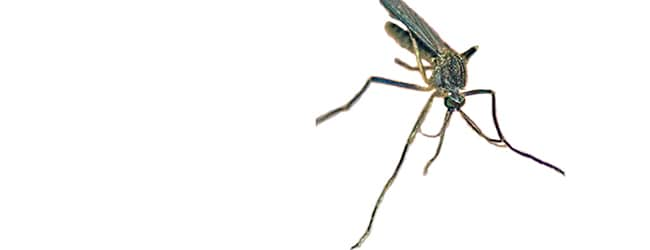
The NJ Division of Fish and Wildlife is advising hunters and anyone who spends time outdoors to take precautions against mosquito bites as the first reported case of Eastern Equine Encephalitis (EEE) in deer in New Jersey has recently been documented in Winslow Township, Camden County. Four human cases have been reported in New Jersey this year.

The disease, which is similar to West Nile virus, can infect humans, mammals and birds through the bites of mosquitoes that have fed on infected reservoir hosts. While most people infected with the EEE virus show no signs of illness and make a full recovery, the disease is serious with 4 to 5 percent of those infected developing flu-like symptoms that advance rapidly, often leading to permanent disability. The virus can also cause death.

The deer in Winslow was described as disoriented, thin, and drooling. When it was approached it was unafraid and was lying down with its head up. The deer was euthanized by a Division of Fish and Wildlife Conservation Police Officer and submitted to the NJ Department of Agriculture for testing.

Other symptoms in deer can include depression, weakness, loss of coordination, circling, seizures, blindness, excitability, aggression, and irritability. The disease appears to minimally impact deer populations in North America and is unlikely to significantly impact the overall deer population.

Most birds with EEE do not show any symptoms and never become ill. However, EEE can cause illness and death in some bird species including pigeons, pheasants, turkeys, emu, and quail. Birds infected with EEE may exhibit a staggering gait, drooping wings, twisted neck, or tremors.

If you observe wild birds or mammals exhibiting unusual behaviors or the symptoms described above, please call the Division's Wildlife Pathology Office at 908-735-6398 or the DEP Hotline at 877-WARN-DEP (877-927-6337).

The Division offers the following tips to reduce the potential for contracting EEE:
  • Use insect repellent when outdoors and cover exposed skin, especially at dusk when mosquitoes are most active. 
  • Standing water around homes also should be removed because mosquitoes lay their eggs in water. Host seeking mosquito activity may persist during the day at this time of year if temperatures are warm enough for mosquitos to fly (55 degrees F and higher). The first killing frost is the official end of the adult mosquito season in any given area.
  • Take precautions when field-dressing harvested animals to avoid contracting potentially infectious diseases. Wear gloves when field dressing, skinning, and/or processing game. and clean knives thoroughly before and after using them. Thoroughly wash hands when through.

SOURCE: njfishandwildlife.com/news/2019/eee_advisory.htm

Friday, February 24, 2017

Expanding Newark’s Riverfront Park


Last year, the NJ Department of Environmental Protection, the city of Newark The Trust for Public Land announced the groundbreaking for a nearly $8 million expansion of the city’s Riverfront Park.

Riverfront Park is an urban greenway meant to connect city residents to the Passaic River waterfront.

This is actually the beginning of the third phase of the park’s development, which entails two stretches of riverfront land that will be developed with a boardwalk, walkway system, a fitness zone, an overlook with seating, a bikeway, space for open-air events and a gateway to the downtown area. A walkway will also be constructed under the Jackson Street Bridge, allowing safe pedestrian crossing between the Ironbound section of Newark and downtown.

The first phase of the park system – developed as the result of a partnership among the city, Trust for Public Land and Essex County Parks Department – opened in 2012 and provides playing fields for baseball, soccer and football, as well as basketball and tennis courts.

A second phase of the park opened in 2013. This phase connected the recreational complex to the park through a gateway linked to riverfront green space, which was developed with a boardwalk noted for its burnished orange planking made from recycled plastic, walkways and a floating dock.

The DEP is providing approximately $6.3 million toward the estimated $7.76 million cost of this phase of the project, including funding for park construction and remediation. The Trust for Public Land has provided the balance of the funding through private donations and other local sources. Horizon Blue Cross/Blue Shield of New Jersey, based nearby, is funding the Horizon Wellness Trail through the Horizon Foundation and the Healthcare Foundation of New Jersey is providing funding for the Fitness Zone.

NJDEP Commissioner Bob Martin said. “Rivers have long been an integral part of urban communities. Connecting people to them again is an important aspect of redeveloping urban areas. The Administration has a proven track record of working with government leaders, community groups and nonprofit organizations to improve the quality of life in New Jersey’s cities through revitalization."

"Our continued work on Riverfront Park allows the Passaic River to serve as a front door to the city,” said Newark Mayor Baraka.

“In addition to providing a great outdoor space for city residents and downtown workers to enjoy Newark’s riverfront, our partnership is helping to create a healthier community,” said Trust for Public Land New Jersey Director Anthony Cucchi. “For example, the park’s expansion will soon provide a Fitness Zone to exercise in, a new dedicated lane for cyclists, and the Horizon Wellness Trail to connect Newark’s Ironbound neighborhood with downtown Newark.”

The DEP added the park development sites to its Brownfield Development Area Program in 2009. Under this initiative, the DEP works closely with communities to design and implement plans that transform contaminated and/or underutilized properties into productive places again. The last use of the park development area was the Balbach Smelting and Refining Works.

The project is expected to be completed in 2017. The first phase of work will include and remediation of contaminants from historic fill – slightly contaminated dirt moved from other parts of the city many decades ago to reclaim waterfront land – as well as a small area of contamination from polycyclic aromatic hydrocarbons and total petroleum hydrocarbons. These areas will be capped with clean fill, grass, trees and shrubs.

The Christie Administration has played a pivotal role in another key component of revitalization – making sure the river is remediated from decades of industrial pollution that has contaminated sediments with pesticides, metals, PCBs and dioxins from the production of the Vietnam War-era defoliant Agent Orange.

In partnership with the DEP, the federal Environmental Protection Agency has launched a $1.4 billion remediation of the most heavily polluted stretch of river sediments, an 8.3-mile stretch of the lower river downstream of the park site. This project includes removing 3.5-million cubic yards of contaminated sediments to out-of-state facilities as well as bank-to-bank capping.

The EPA has removed the most heavily contaminated sediments from portions of the river near the Diamond Alkali Superfund site. The company polluted the river with toxic dioxins resulting from the manufacturing of Agent Orange.

The Passaic River was vital to the region’s economy for more than 100 years, attracting thousands of jobs and bringing prosperity, but pollution ultimately led to bans on any harvesting of crabs and limitations on eating fish from the river.

Today, due to many years of efforts – including cleaning up past contamination and park development such as the Riverfront Park project – Newark is realizing its potential as an important recreational and natural resource.

Though they live along the Passaic River, many Newark residents hardly know it's there.
For decades, pollution and development have kept the people and the Passaic apart.
But with the opening of Newark Riverfront Park, that's starting to change.


For more on the project from the Trust for Public Land, visit: www.tpl.org/our-work/parks-for-people/newark-riverfront-park

SOURCE: http://www.nj.gov/dep/newsrel/2016/16_0094.htm
PHOTO: Micro Documentaries for the Trust for Public Land

Tuesday, May 31, 2011

Mushrooms As Recyclers


I saw a headline that read "Mushrooms Can Break Down 90% of Diaper Materials Within 2 Months" and followed it to a post on Treehugger.

It was already known that mushrooms can be great at breaking down pollutants. WE also know that disposable diapers are slow-degrading poop-containers that are filling up landfills.

What about a kind of mushroom that feasts on diapers? Researchers at the Metropolitan University in Mexico City seem to have followed this divergent thinking and found some.

In an article published in the journal Waste Management, Alethia Vázquez-Morillas describes her research in cultivating the right type of mushroom. She discovered that certain species can break down 90% of the material they are made of within two months. Within four, they are degraded completely.

What is more, she says, despite the unsavory diet of the fungi in question, Pleurotus ostreatus (better known as oyster mushrooms) are still safe to eat. (To prove the point she has eaten them. I think I would be more hesitant.)

Oyster mushrooms are good at this job because they feed on cellulose, the main material used in disposable diapers. In the wild, the Oyster mushrooms grow on dead trees, so they have the enzymes to break down cellulose.


Mycelium Running: How Mushrooms Can Help Save the World

Monday, April 18, 2011

Round Valley Reservoir


View Larger Map


The Round Valley Reservoir in Clinton Township, New Jersey was formed in 1960 when the New Jersey Water Authority constructed two large dams and flooded a large valley in the state's Hunterdon County.

The reservoir is named after the naturally formed circular valley surrounded by Cushetunk Mountain. The deep Valley was caused by erosion of the soft sedimentary rock. The surrounding ridges of Cushetunk Mountain endure because they were underlaid with dense and durable volcanic rock diabase that cooled slowly under the surface of the earth.

Here are some big numbers for this body of water:  Round Valley reaches depths of 180 feet (55 m). This 2,000 acre (8 km²) reservoir is best known for its pristine clear blue waters. The reservoir contains 55 billion gallons of water for use in central New Jersey, and is distributed during times of drought via the nearby south branch of the Raritan River.

The reservoir has been called the Bermuda Triangle of New Jersey as over 25 people have drowned there since 1971 and 6 of them have never been found.

The New Jersey Division of Wildlife claims the reservoir is the southernmost body of water that contains naturally reproducing lake trout. Some of the other species of fish in the lake include bass, pickerel, catfish, american eel, yellow perch, brown trout, and rainbow trout. The park also has a wilderness area for camping, swimming facilities, a boat ramp and nature hiking and biking trails.

http://www.njparksandforests.org/parks/round.html
http://www.nynjtc.org/park/round-valley-state-park
http://www.roundvalleyfishing.com

Friday, February 25, 2011

Delaware and Raritan Canal


Historic map of the D&R Canal
click image for large size via http://mapmaker.rutgers.edu
The Delaware and Raritan Canal (D&R Canal) is a canal in central New Jersey, that was built in the 1830s and served to connect the Delaware River to the Raritan River.

Delaware and Raritan Canal Company 24x36 Giclee
D&R Canal Company
It was intended as an efficient and reliable means of transportation of freight between Philadelphia, Pennsylvania and New York City, especially coal from the anthracite coal fields in eastern Pennsylvania. Before the advent of the railroads, the canal allowed shippers to cut many miles off the traditional route from the Pennsylvania coal fields. That route took the coal down the Delaware, into the Atlantic Ocean, around Cape May, and up along the coast to New York City.

Delaware and Raritan Canal at Work, The (NJ) (Images of America)The canal system was dug mostly by hand tools, mostly by Irish immigrants. Work began in 1830 and was completed in 1834, at an estimated cost of $2,830,000. When the canal first opened, teams of mules were used to tow canal boats through it (the steam engine was not yet applied to such uses).
The canal's greatest usage occurred during the 1860s and 1870s during the area's Industrial Revolution. On May 18, 1872, the D&R Canal Company was merged with several parallel railroads into the United New Jersey Railroad and Canal Company, and leased by the Pennsylvania Railroad. Over time, the importance of the D&R Canal waned as railroads were used to perform, more rapidly, the same function as canals, but it remained in operation until 1932.

Over the years, sections were filled for various road and rail projects and other sections of the canal were piped underground.

Today, the D&R Canal offers us a number of natural and historical resources, including 160 species of birds, wooden bridges, canal locks, historic bridge & canal houses, and former mill sites. The park can be enjoyed individually or at one of the many nature and history related programs that are offered throughout the year by the park's naturalist and historian.

The total length of the entire canal system was approximately 66 miles (106 km).

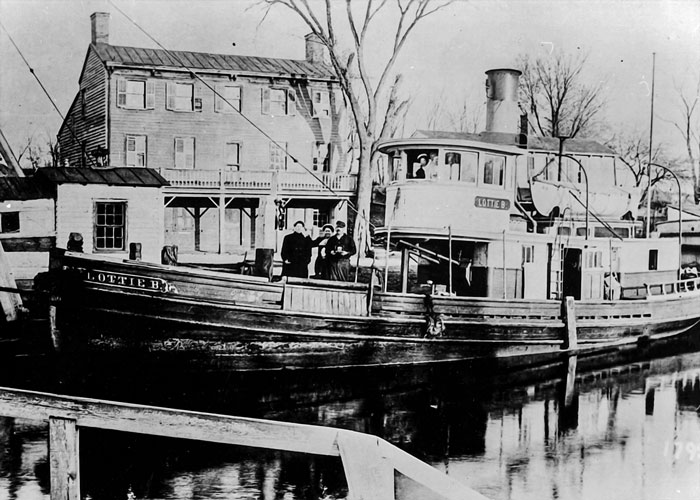
A steam tug docked on the canal in front of a Princeton hotel.

Unfortunately, some sections of the canal are forever lost. A section of the main D&R Canal in Trenton, along Mulberry Street, has been covered over (the water still flows below) and redeveloped, and is inaccessible to public use. The portion of the canal that provided access to the Delaware River in Bordentown is also abandoned. In Trenton it has been covered by NJ Route 129, which opened in 1996. Another section south of Trenton is located in Hamilton Township, Mercer County, New Jersey between the southern boundary of Trenton and the Crosswicks Creek.

Locks were used to overcome elevation differences along the D&R canal. Many of the locks are still present along the canal route; however, the lock gates have been replaced on the upstream side with small dams and water outfalls. The downstream gates have been removed, so the water in the locks is level with the water on the downstream side. Some of the locks have been buried or removed due to construction projects in the vicinity of the canal.

A number of spillways, which drained excess water from the canal into nearby waterways during periods of heavy flow, are located along the canal route. Spillways are evident as a dip in the tow path along the canal.


Image: bikinghikingwithkids.com

In 1974, most of the canal system was declared a New Jersey state park. It remains one today, and is used for canoeing, kayaking, and fishing.

A graded natural-surface trail along the side of the canal, which was the tow path that mules used to tow barges on the canal before steam powered barges, is now used for hiking, jogging, bicycling, and horseback riding. Some 36 miles (58 km) of the main canal, and all 22 miles (35 km) of the feeder canal, still exist. The feeder canal along the Delaware, being a former railroad rather than a towpath, is especially suited to bicycling. The park is operated and maintained by the New Jersey Division of Parks and Forestry.

The D&R Canal trail is a recreational trail of 77 miles (124 km) trail is made up of three segments that transverse three counties: a canal towpath from New Brunswick to Trenton; a canal towpath / rail trail from Trenton to Bull's Island; and a rail trail from Bull's Island to Frenchtown. The three combined trails together form the largest completed trail entirely in New Jersey. Much of the trail runs inside the state park. [Note: There is no direct connection between the main canal and the feeder canal paths along the Delaware River. Signed on-street connections are required to traverse the entire trail system.]

The proposed Capital to Coast Trail is planned to connect to the D&R Canal Trail.

The canal is accessible from many points along its route, with small parking areas providing access at most road crossings. One of the most scenic and popular sections of the D&R Canal state park is the segment along Lake Carnegie in Princeton, New Jersey, which features the canal on one side of the path and the lake on the other side. Another attractive section borders the Colonial Park Arboretum and Gardens in East Millstone.

The Delaware and Raritan Canal was added to the National Register of Historic Places in 1973 and the many historic canal houses where the bridgetenders lived (such as the Blackwells Mills Canal House and the Port Mercer Canal House) were listed as contributing properties.

Tuesday, December 7, 2010

Non-Hunting Areas in NJ For Outdoor Recreation

In addition to the information posted here yesterday, here are some other sources of information on places in NJ to use for hiking, birding and other recreational outdoor pursuits during the various hunting seasons.

A list of "Public Deer Hunting Land in New Jersey" is available online from NJ Fish & Wildlife at http://www.state.nj.us/dep/fgw/huntland.htm

There's also information on "Lands Open or Closed to Sunday Bow Hunting" which includes Wildlife management Areas and public lands that are still closed to hunting on Sundays. The latest list I could find is from 2009 so I'm assuming there haven't been changes - see http://www.njfishandwildlife.com/news/2009/sundayhunt.htm


Of course, some of the smaller parks have no hunting allowed and those are good locations during this time too.

You can try Cheesequake State Park, Wells Mills County Park (Ocean County), the Watchung Reservation (Union County), South Mountain (Essex County), Apshawa Preserve(Passaic County) and the Ramapo Valley County Reservation (Note that the surrounding areas of Ramapo Mountain State Forest and Ringwood State Forest do allow hunting.)

For hikers, two good resources are: