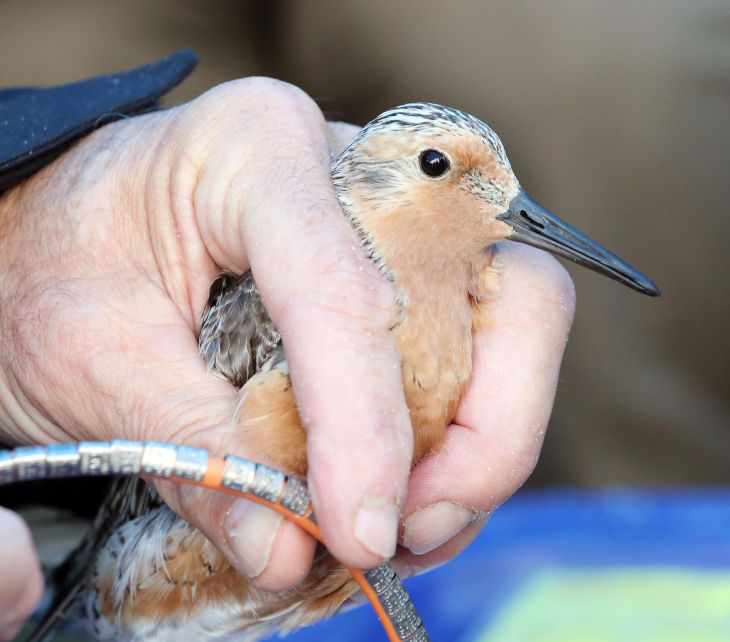
Showing posts with label red knots. Show all posts

Saturday, May 23, 2026

Horseshoe Crabs Return to Cape May County


In this annual rite of spring, the beaches of Cape May and the broader Delaware Bay region play host to one of the oldest, most spectacular wildlife phenomena on Earth: the mass spawning of Atlantic horseshoe crabs (Limulus polyphemus).

This ritual has been repeated for nearly 450 million years—meaning these "living fossils" arrived on these exact shores long before the first dinosaurs walked the earth.

While horseshoe crabs begin trickling onto the beaches in late April, the main event happens in May and June. The absolute peak centers around the Full and New Moons, specifically during evening high tides. May 2026 has two Full Moons to start and end the month.


Driven by the high spring tides, tens of thousands of crabs emerge from the deep bay waters simultaneously. Large, smooth-shelled females crawl up to the high-tide line, often trailing one or more smaller males holding onto her carapace (shell) with specialized, boxing-glove-like claws. The female digs a shallow nest in the sand to deposit up to 20,000 tiny, greenish-tan eggs. The males then fertilize them as the waves wash over the cluster.

At its height, the shoreline looks less like a beach and more like a cobblestone street paved in dark, gleaming, olive-green helmets jostling in the surf.

The arrival of the crabs triggers a second, equally spectacular natural event. The Delaware Bay is the largest horseshoe crab spawning site in the world, and the millions of eggs left in the sand are a vital fuel source for migrating shorebirds.


Among these birds is the Rufa Red Knot, a threatened species undertaking an incredible 9,000-mile journey from the tip of South America up to the Canadian Arctic. Cape May is their ultimate refueling station. The birds arrive emaciated, having lost up to half their body weight. They gorge themselves almost exclusively on the lipid-rich, easily digestible horseshoe crab eggs that are churned up to the surface by the waves.

In just about two weeks, a Red Knot must double its body mass to survive the final leg of its journey north to breed. Without a dense concentration of crab eggs, the birds cannot successfully reach the Arctic or reproduce.

If you head down to the Cape May area to see it, the Delaware Bay side beaches (like Reeds Beach, Cook's Beach, or Higbee Beach) offer far more intense spawning activity than the oceanfront Atlantic beaches, as the crabs prefer the calmer, wave-protected waters of the bay.

Because both the horseshoe crabs and the shorebirds are highly vulnerable, many of Cape May's key bay beaches are seasonally closed to the public during the peak weeks to prevent disturbing the birds. However, public viewing platforms and guided walks hosted by organizations like the Cape May Bird Observatory offer spectacular front-row seats to this ancient dance.


Thursday, September 15, 2022

New Threat to Horseshoe Crabs and Red Knots

Horseshoe crabs in the Delaware Bay area play a vital role in the life cycles of migrating shorebirds. In the 1990s, horseshoe crabs were overharvested as bait, leading to dramatic drops in crab and red knot bird populations. Red knots are now listed as threatened under the federal Endangered Species Act.

New Jersey has tried to protect red knots for about 14 years by imposing a moratorium on harvesting horseshoe crabs for bait in state-controlled waters. (They can still be taken for their blood, which contains a chemical used by the biomedical industry.)

But a recent Atlantic States Marine Fisheries Commission (ASMFC) proposal would eliminate a longstanding policy decision not allowing the harvesting of any female horseshoe crabs until the populations of both crabs and red knots return to higher levels.

The American Littoral Society is urging citizens to add their voices to oppose the plan. Author and LBI resident Sandy Gingras has created an online petition at change.org/SaveHorseshoeCrabs to oppose the proposition that states:

The Atlantic States Marine Fisheries Commission has proposed a change in the rules governing the protection of horseshoe crabs.  They want to allow the “ harvesting” of female horseshoe crabs. We believe the horseshoe crab population is already dangerously low. And the shorebird population that feeds upon their eggs is also dangerously depleted. We opposed the fisheries’ change of policy and urge them to vote no to horseshoe crab addendum VII. 

The opposing view from the ASMF says that the proposed changes represent “a less than one percent chance of a red knot population decline due to the implementation of potential female harvest under the ARM Revision. Based on this analysis, the Service concludes that take, defined under the Endangered Species Act as killing or injuring of red knots, is not likely.”

The Atlantic States Marine Fisheries Commission is accepting public comments from now through Friday, Sept. 30. Comments should be emailed to comments@asmfc.org, with “Horseshoe Crab Draft Addendum VIII” in the subject line.

To learn more about horseshoe crabs, go to the Horseshoe Crab Recovery Coalition website at hscrabrecovery.org or the American Littoral Society website at littoralsociety.org/horseshoe-crabs.html

To find out more about red knots, go to the Cornell Lab of Ornithology website at www.allaboutbirds.org/guide/red_knot

More information on the FWS’s analysis of the ARM Framework Revision is available at fws.gov/media/us-fish-and-wildlife-service-evaluation-atlantic-states-marine-fisheries-commission-horseshoe

red knots    USFWS photo


Saturday, May 25, 2019

Horseshoe Crabs Come Ashore from the Delaware Bay


Each May and June, millions of Atlantic horseshoe crabs come ashore along the East Coast to spawn. The height is usually when there is a full moon or new moon, creating the highest tides of the month. 

The result is those familiar helmet-shaped shells of Limulus polyphemus and trillions of their greenish eggs.

At least 11 different species of shorebird rely on horseshoe crab eggs as their primary food source for about 2-3 weeks during their migration. Migrating to their breeding grounds in the Arctic, some come from as far away as the southern tip of South America. Recent declines in the horseshoe crab population have triggered similar and more drastic declines in shorebird populations.

Red knots feeding near horseshoe crab. Photo by Gregory Breese/USFWS


Horseshoe crabs are often called "living fossils" as they are thought to have changed very little in the last 450 million years. Scientists are still not sure if they were land-based arachnids that moved into the sea or an ancestor that stayed put in the oceans. Recent genetic research favors arachnids, placing them alongside spiders and scorpions.

The horseshoe crabs spawn from Maine to the Yucatan Peninsula, but our own Delaware Bay is the center of activity. The warm water and mild surf with sandy shores must be appealing because some of the crabs have come from more than 60 miles out from the continental shelf off the mouth of the bay.

The blue blood of the Atlantic Horseshoe crab is used in medical testing of equipment and vaccinations to detect bacterial contamination in minute quantities, and the crabs have always been harvested as bait. The Atlantic horseshoe crab is currently considered “Near Threatened” by the IUCN. While not currently listed as a threatened species by the State of New Jersey, there is currently a moratorium on the harvest of horseshoe crabs within the state. With this law, it is illegal to remove a horseshoe crab, dead or alive, from its habitat in the wild.


conservewildlifenj.org/species/fieldguide/view/Limulus-polyphemus/

fws.gov...Modeling-a-Future-for-Horseshoe-Crabs-and-Red-Knots


Thursday, May 7, 2015

Full Moons, High Tides and Horseshoe Crabs

Horseshoe Crabs at Delaware Bay 
Photo: Greg Breese/ U.S. Fish and Wildlife Service

The recent Full Moon for May is a reminder to me that the time is here for horseshoe crabs (Limulus polyphemus) during the high tides of the new and full moons of early spring.

The ancient horseshoe crab evolved during the Paleozoic Era (540-248 million years ago) and although we call it a "crab," it is a species more closely related to spiders and scorpions.

The female horseshoe crabs will emerge from their muddy beds this month for spawning and will dig several nests to lay their eggs.

The males, one-third the size of females, attach themselves to the rear of the female's carapace and are pulled over the nests to fertilize the eggs.

Horseshoe crabs "protect" their eggs by covering their nests with sand, but wind and waves and especially visiting migratory shorebirds take many of those eggs. Shorebirds stopping in Delaware Bay on their travel along the Atlantic coastline. Shorebirds almost double their weight from feeding on horseshoe crab eggs which gives them the energy source that enables them to continue their migration north.

Red Knots at Delaware Bay
Photo: Greg Breese/ U.S. Fish and Wildlife Service
Until the 1990's, the harvest of horseshoe crabs was regulated by individual states, but in 1998, an Interstate Fisheries Management Plan was adopted by the Atlantic States Marine Fisheries Commission (ASMFC). Biologists from state and federal agencies participate in a Cooperative Tagging Program to gain information about horseshoe crab migration patterns, distribution, abundance, and mortality.

Horseshoe crabs will molt several times before they reach sexual maturity at between 9 and 11 years of age.

Horseshoe crabs are harvested commercially primarily as bait to catch whelk (conch), American eel, and sometimes catfish. Pharmaceutical companies extract their blue, copper-based blood which contains a chemical substance, hemocyanin, which clots when exposed to bacteria. The blood is used to test drugs and medical equipment for the presence of harmful bacteria.

Sources:  www.fws.gov/northeast/marylandfisheries/

Monday, April 20, 2015

Beaches on Delaware Bay Continue to Undergo Restoration


A continuing story in New Jersey since Hurricane Sandy has been the restoration of the beach area on Delaware Bay that are spawning grounds for horseshoe crabs and feeding areas for shorebirds.

It's a story worth retelling as these important populations of shorebirds and horseshoe crabs need the  protection that comes this year with the restoration of more beaches on New Jersey’s side of Delaware Bay.

Thompson’s Beach, on a remote stretch of the Cumberland County shore, will see the removal of  shattered bulkheads and the replacement of 40,000 cubic yards of sand for the spawning of thousands of horseshoe crabs.

Four more beaches and a marsh are due for restoration over the next two years in a federally funded $5.1 million operation on behalf of the American Littoral Society and the Conserve Wildlife Foundation of New Jersey.


A ban on horseshoe-crab harvesting on New Jersey beaches has shown an increase in the bay’s population of red knots. But the crabs are still taken for medical uses and as bait and are harvested on Maryland and Virginia shores even though they are part of the Delaware Bay population.


The red knot migrates from southern Argentina to Arctic Canada via the Delaware Bay beaches each spring and relies on horseshoe crab eggs for food to fuel that journey. The bird population was at its lowest in the early 2000s and has recently stabilized at about 25,000.

That is encouraging, but it is less than a third of the 80,000 birds that biologists consider sustainable, and well below its peak of about 92,000 in the 1980s. The red knot was recently listed as threatened under the federal Endangered Species Act,.

Other shorebirds that use the bay beaches have also suffered a sharp decline and may be more endangered than the red know. For example, the ruddy turnstone's numbers are down to 14,000 from some 150,000 during the 1980s.

Larry Niles, a consulting biologist who designs and manages the beach-restoration program and who previously headed the endangered species program at New Jersey’s Department of Environmental Protection, estimates that some 500,000 male crabs and 150,000 females are harvested each year for their blood, which contains LAL, an extract used to ensure that medical products such as intravenous drugs and vaccines are free of contamination. The crabs are bled and then returned to the ocean in an operation that may kill as many as half of them, he said.
The medical harvest has cut the number of females to about 4 million from about 12 million in the 1990s, he said. “There’s no evidence of recovery in the crab population,” he said. “We’re not going to increase the bird population until the crab numbers start increasing.”

Monday, December 29, 2014

Red Knot Is Now On The Federal Threatened Species List

Red knots             Source: U.S. Fish and Wildlife Service

The U.S. Fish and Wildlife Service has designated the red knot, a migratory shorebird, as “threatened” under the Endangered Species Act. A “threatened” designation means a species is at risk of becoming endangered throughout all or a significant portion of its range.

“This federal designation will make a big difference in strengthening the protections of this incredible shorebird,” said David Wheeler, executive director for Conserve Wildlife Foundation of New Jersey. “Here in New Jersey, we are restoring the vital beach habitat that had been decimated by Hurricane Sandy, and this designation ensures the safeguards we are providing can be complemented along the East Coast,” Wheeler added.

Since the 1980s, the knot’s population has fallen by about 75 percent in some key areas. Wildlife biologists believe the major threat to the red knot is the dramatic decline of horseshoe crab eggs, an essential food source at the most critical stopover during their 8,000-mile trip from southern wintering grounds to Arctic breeding territory. High-energy horseshoe crab eggs provide nourishment for red knots to refuel and continue their journey.

“The major decline of horseshoe crabs in Delaware Bay is one of the largest threats to the survival of the shorebird,” explained Larry Niles, a biologist who leads the beach restoration efforts for Conserve Wildlife Foundation of New Jersey and American Littoral Society, and has studied red knots for three decades. 


Shorebird Makes Federal Threatened Species List - The SandPaper

Sunday, December 7, 2014

NJ Audubon Says Red Knot Will Be Listed As Threatened


Red Knot - Bob William philly.com/philly/news/new_jersey
The Red Knot, a shorebird which has undergone a drastic decline in recent years, will be listed by the U.S. Fish and Wildlife Service as a threatened species under the Endangered Species Act, according to the New Jersey Audubon.

The action, which is expected to be announced next week, is a critical step toward the long-term protection and recovery of the species, said New Jersey Audubon, which has long addressed issues related to the Red Knot and other shorebirds. The listing would mean that the species meets the Endangered Species Act criteria of being likely to become in danger of extinction in the foreseeable future throughout all or a significant portion of its range.

"The Red Knot utilizes the shores of the Delaware Bay extensively during its amazing bi-annual migration between its Arctic breeding grounds and South America," said New Jersey Audubon's President and CEO Eric Stiles. 

 Read more

Friday, November 28, 2014

Red Knot May Get Federal Threatened Status


The pressofatlanticcity.com reports that today federal regulators will decide whether to give greater protections to red knots, a shorebird that comes to and depends on South Jersey each spring to fuel its epic migration.

Scientists in New Jersey have been studying the red knot for more than 20 years, following the robin-sized bird from its winter home at the tip of South America to its high-Arctic breeding grounds.

The birds are drawn to South Jersey by the annual spawn of horseshoe crabs, which crawl onto the beaches once a year to lay their eggs in the sand in an annual wildlife spectacle that has taken place since before the age of dinosaurs. Red knots, ruddy turnstones, laughing gulls and other birds converge on Delaware Bay beaches each May to gobble up the tiny, nutritious eggs.

More NJ Info fws.gov/northeast/njfieldoffice/Endangered/redknot.html

Saturday, May 18, 2013

Viewing the Horseshoe Crab Natural Phenomena on Delaware Bay


Three beaches that people in our area visit to watch horseshoe crabs and birds are Pickering Beach on the Delaware side, Reeds Beach on the New Jersey side and Plum Island on Sandy Hook, New Jersey. (Location information below.)

I love these "living fossils" that have remained basically the same for 450 million years and have tried to write regularly about them here. The females (which are generally larger than males) carry tens of thousands of eggs which they deposit in the sand for males to fertilize.

The number of mating horseshoe crabs on the beach peaks in the Delaware Bay during the evening and full moon tides in May and June. The huge number of horseshoe crab eggs attracts many birds to converge for this annual feast. This month's full moon is on May 24 and the next is June 23.

horseshoe crabs, Sandy Hook - photos by Brian Richards
The spring migration of many species of shorebirds coincides with the arrival of the horseshoe crabs in Delaware Bay. Bird counts of migratory shorebirds show disturbing decreases in numbers, and there is a correlation between shorebird population declines and horseshoe crab decline. For the crabs, loss of habitat is a concern, but the use of the crabs as bait is more of a threat.

Between 1960 and 1980, scientists estimated the number of horseshoe crabs in the Delaware Bay to be relatively constant at 2-4 million horseshoe crabs. Those numbers fell closer to 1 million in the late 1990s through 2005. Since a moratorium was put in crab harvesting in NJ and to a lesser extent in Delaware, the number seems to have settled at around 2 million, according to The Wetlands Institute.

Adult horseshoe crabs winter in water 20 to 60 feet deep on the continental shelf.  As the water temperature and daylight increases, adults migrate toward sandy beaches for spawning.

The females dig a shallow hole and deposit their eggs in clumps within the intertidal zone.

For viewing the birds and crabs, Reeds Beach in Cape May, NJ offers many birding opportunities. Parking for watching migratory shorebirds and horseshoe crabs is at the end of N. Beach Avenue. There are two observation areas - from the designated beach area at the lot, and from the left side of a cement dike which offers a closer view of mating horseshoe crabs and feeding shorebirds. The left ocean-side of the dike is place to watch horseshoe crabs and shorebirds.

Plum Island is part of Sandy Hook Gateway National Recreation Area in New Jersey. The NJ Audubon Society is a good source of information on their Sandy Hook activities.

Pickering Beach is at 19 S. Sandpiper Road, about 5 miles south east of Dover. A narrow public access path is near the intersection of S. Sandpiper Dr and Pickering Beach Rd.

For more about horseshoe crab viewing locations on the East Coast, see www.ocean.udel.edu/horseshoecrab/


Wednesday, May 8, 2013

May Means Horseshoe Crabs and Red Knots

Red Knots - NFWS photo
Horseshoe crab photo: Andre Malok via The Star-Ledger

Besides the cicadas being a sign and sound of summer in New Jersey, horseshoe crabs heading onshore for nesting sites on Delaware Bay beaches birds such as Red Knots feasting on their eggs are another early summer nature ritual.

Those egg counts are down because too few female crabs are laying eggs. That not only means that our horseshoe crab population may be in danger, but also it means Red Knot populations are nearer to being very endangered and closer to extinction. These two species are tightly linked.

Fewer birds mating in the Arctic is likely since fewer numbers of juveniles have been reported at their wintering grounds in Argentina. An aging population is another bad sign.

Throw in some politics to the mix. Once again, there are people calling for lifting the moratorium on harvesting horseshoe crabs. That would hit the numbers very hard, especially in this first summer following Superstorm Sandy which affected the crab nesting landscape.

Since 2008, New Jersey has banned the harvesting of horseshoe crabs to support both the crab and migrating bird populations. NJ is the only state with stringent laws. On the other side, State Senator Jeff Van Drew and Assemblyman Nelson Albano want to revoke the current laws in support of the fishing industry in South Jersey which uses horseshoe crab as bait for eels.

How sad that this crab which has been here for 450 million years might vanish given 50 years of abuse.

If you would like to support those who believe the moratorium should be continued at this time, you can get information and sign a petition at change.org/petitions/

Saturday, January 26, 2013

Horseshoe Crabs, Red Knots and Hurricane Sandy


Hurricane Sandy tore up much of New Jersey's coastline and the boardwalks and homes have gotten a lot of attention. But it also tore up natural areas in bays that are important to fish and wildlife.

One of those effects will probably be felt by our horseshoe crabs and the Red Knot sandpipers who depend on them and visit us each spring.

The Red Knot is one of the well-traveled shore birds that migrate in spring. Their trip is from a winter home in Tierra del Fuego (at the southern tip of South America) all the way to summer breeding grounds in the North American Arctic. Midway on that incredible journey, is a very important stopover in New Jersey.

Our Delaware Bayshore is a critical feeding place where the birds rely on eggs laid by horseshoe crabs. Red Knots can almost double their body weight in a few weeks of feeding.

Two unfortunate things are limiting their chances this year.

1) The superstorm damaged important horseshoe crab nesting beaches. The high water pushed sand higher into the dunes on salt marshes. It also exposed some mudflats, marsh plant roots, and debris.

2) Our state Senate and Assembly introduced bills to lift the moratorium on the harvest of horseshoe crabs for bait.

The NJ Endangered and Non-Game Species Program scientists have shown in great detail for several decades the importance of the horseshoe crabs to the migratory birds having sufficient energy stores to complete the journey to their Arctic breeding grounds.


The crabs will still go to the beaches to lay eggs. The birds will still arrive. Neither species follows the news about Hurricane Sandy.

But there may not be enough eggs to feed the birds AND to propagate sufficient numbers of crabs. The birds actually eat excess and dying eggs that will not become crabs. The viable eggs are buried and generally birds would not go after them.

In the past 30 years, we have gone from horseshoe crabs on top of each other battling for nesting space to far fewer egg-laying females on the beaches.

Part of the problems has been the harvesting of the crabs for the bait industry. Horseshoe crabs are also bled for lysate which is important to pharmaceutical uses. In both cases, the crabs used, even if returned to the water usually die.

NJ created a harvest moratorium starting in 2006 to help in the recovery of the crabs and to help prevent problems with the red knots.


MORE INFO

Monday, March 12, 2012

Red Knots Move from Threatened to Endangered


Red Knot in summer breeding plumage
Photo: Heather Forcier/AP via The Daily News
It's not a good sign that the Red Knot shorebird has joined the the New Jersey endangered wildlife list. This migratory shorebird was recently designated as an endangered species by the NJ Department of Environment Protection.Previously, the species was in the lower category of threatened wildlife. Unfortunately, the new NJDEP  designation is more of a warning than a "law" and it does not add any additional protection for the species.

The New Jersey side of Delaware Bay is a critical stopover feeding location on their flight from the coast of Brazil in South America to the Arctic. On a single day, perhaps 90% of the entire migrating population can be on a New Jersey beach.

horseshoe crabs moving ashore to lay eggs
They arrive in NJ emaciated and need to feed on the once more plentiful horseshoe crab eggs in order to have the required energy store to complete their migration.

The Red Knot migrates more than 10,000 miles a year to the Delaware Bay, so it is certainly a tough species. Nevertheless, its migratory population has been steadily in decline. How much of a decline? Since the early 1990s, it is estimated that the Delaware Bay population has gone from 100,000 to 15,000 which is almost a 90% decrease.

A critical issue in this story is the parallel decline in the horseshoe crab eggs in the Delaware Bay. The harvesting of the horseshoe crab eggs for fishing bait is one of the key problems in the Red Knot population crisis. NJ is actually given more credit for attempting to decrease that harvesting as compared to other surrounding states.

In a NY Daily News article, Dave Jenkins, bureau chief for the Endangered and Nongame Species Program, said that “In New Jersey, we are already doing everything we can. But this needs to be unified.” said Jenkins. “The species is also in a crucial one-year process for being listed as endangered at the federal level, and the New Jersey field office is definitely taking a lead on that. But if this population trend continues, it is possible that extinction is imminent."

Wednesday, August 11, 2010

Horseshoe Crabs and Red Knots Show Improvement This Year

red knot banding and weighing

Since the mid-1990s, researchers from around the world, led by the NJ Department of Environmental Protection, have converged on the Delaware Bay region to monitor and protect migrating shorebirds: red knots, ruddy turnstones, sanderlings, semipalmated sandpipers, dunlins and short-billed dowitchers.

The red knot gets special attention because it is a species whose numbers in particular have plummeted in correlation with declines in horseshoe crabs and their eggs.

“Delaware Bay is one of the most important bird stopovers in the world, and a critical stopover for these six species,” said Amanda Dey, principal zoologist with the DEP’s Endangered and Nongame Species Program. “The red knot is the poster child for all of these shorebirds ... but this is really a bay-wide problem.”


Some good news this year - 35 percent of red knots left the bay at the weight deemed sufficient to reach the Arctic and successfully breed – 180 grams, or a little more than six ounces. This is a vast improvement over the 15 percent that reached this weight in 2008, but is still far short of the 60 percent researchers believe is the minimum necessary to begin rebuilding the species. Researchers are also seeing more horseshoe crab eggs on the beaches.


http://www.state.nj.us/dep/

Wednesday, March 31, 2010

Red Knots in New Jersey


Nearly four years after New Jersey banned horseshoe crab harvesting to protect a vanishing shorebird at the Delaware Bay, scientists say they are not optimistic about recent evidence showing the red knots may be on the rebound.

After journeying from the southern tip of South America, red
knots appear on the shores of Delaware Bay in May. They are generally so thin that they look like sparrows. There they will try to gorge themselves on the eggs of the horseshoe crab (Limulus polyphemus) and put on a layer of fat. If successful, they will look more like plump doves when they leave for the Arctic.

Ground surveys at Delaware Bay last spring found 24,000 red knots. That's an improvement from the 15,000 counted in 2008. Biologists also reported increased numbers of crab eggs on the bay estuaries. But neither the horseshoe crabs nor the red knots can be called a "recovered population" and the fate of the birds is linked to the crabs.

Horseshoe crabs are used as bait in the conch and eel industry. NJ fishermen contend that the cottage crab industry was unnecessarily hurt by by imposing a harvesting ban in 2006 that was extended indefinitely by law in 2008.

In an nj.com article, biologist Amanda Dey with the New Jersey Endangered and Non-Game Species Program said about last year, "We’ve seen a bump up in the numbers. ... It was a year that we had settled weather, so there were more crabs and more birds. We’d like to think we saw the bottom. But we don’t know."

Dey is part of the team of scientists studying both the crabs and the birds. They traveled to Tierra del Fuego, where they counted about 14,800 red knots in prime South American wintering grounds. The good news is that amount matches winter counts there over the past three years, which suggests that there has not been further declines. Unfortunately, the overall numbers are still at a potential crash level.

Our Delaware Bay spring count last year was still less than half the 50,000 birds recorded there in 1998.

New Jersey has the only moratorium among the 15 coastal states. Neighboring Delaware limits harvests to 100,000, male-only crabs annually.

It would probably surprise many New Jerseyeans that Delaware Bay is at the center of this dispute. It's because the Bay is where the world’s largest population of breeding horseshoe crabs emerges from winter waters each spring to lay eggs on the estuary shores.

Red knots are not the only birds that stop in NJ to bulk up on the eggs as they migrate. But red knots have one of the longest migrations flying from their South American wintering grounds to their Arctic breeding grounds.

More on red knows and NJ at http://www.state.nj.us/dep/fgw/ensp/redknot.htm

The Flight of the Red Knot: A Natural History Account of a Small Bird's Annual Migration from the Arctic Circle to the Tip of South America and Back

Red Knot: A Shorebird's Incredible Journey

Horseshoe Crabs and Shorebirds: The Story of a Food Web

Horseshoe Crabs

Horseshoe Crabs (Schaefer, Lola M., Musty-Crusty Animals.)
Crab Wars: A Tale of Horseshoe Crabs, Bioterrorism, and Human Health

Biology and Conservation of Horseshoe Crabs

The American Horseshoe Crab 


Thousands of Red Knots migrate through New Jersey

Wednesday, October 21, 2009

The Amazing Journey of Red Knots to New Jersey

Red knots and Ruddy Turnstones at NJ's
Edwin Forsythe National Wildlife Refuge (USFWS photo)

Back in the early 1800s, the naturalist Alexander Wilson visited Cape May, N.J. There, he saw a bird he called the red-breasted sandpiper. He also saw horseshoe crabs. (He called them "king crabs.")

It took until the 1980s for scientists to really understand the global significance of the Delaware Bay as the springtime staging area for those birds, who we now call red knots. Those birds, and other migratory shorebirds, rely on being able to feed on horseshoe crab eggs.

Pete Dunne and others from the New Jersey Audubon's Cape May Bird Observatory, flew over the shores of Delaware Bay in May and early June and saw this staging area in action. They recorded red knots, sanderlings, semi-palmated sandpipers and ruddy turnstones.

Some of those red knots headed for the Arctic started their journey of migration 5,000 miles away in South America. Their journey is of international concerns. Computer models show that the Delaware Bay subspecies of red knots (Calidris canutus rufa) could within a year or two because the population is so depleted.

Amazingly, scientists are able to distinguish three populations of red knots that migrate through the Delaware Bay region. One group spends the winter on Georgia's Altamaha Delta and Florida's Gulf Coast. A second group spends the winter in Maranhao in northern Brazil, and the third, and largest group of about 18,000 red knots, spends the winter in Tierra del Fuego at the southern tip of South America.

Crowded areas include a large horseshoe crab eggs area at Mispillion Harbor on the Delaware side of the bay and a nighttime resting area in Stone Harbor, N.J. Red knots had rested on the marshes west of Cedar Creek, but in 2004 and 2005, those marshes flooded and the birds could not roost there.

Most scientists believe that overharvesting of the crabs in the 1990s has led to the severe drop in eggs and therefore the decline in red knot populations.

How large is the decline? Those 1981-82 flyover estimates were at 150,000 red knots. Recent counts totaled about 15,000.

In their time on the Delaware bay, the birds have about two to three weeks to put on enough weight to complete their journey. The numbers are staggering. Scientists estimate that each red knot needs 13,000 horseshoe crab eggs a day to maintain their weight and 24,000 eggs to fatten to the optimum.

In 1999, the red knot was listed as a threatened species in New Jersey under the "New Jersey Endangered Species Conservation Act." As a result of the Red Knot Status Assessment in Fall 2006, the U.S. Fish and Wildlife Service announced the red knot as a candidate for federal listing. In April 2007, the Committee on the Status of Endangered Wildlife in Canada recommended listing the red knot as endangered.

While the red knot is most imperiled and most studied shorebird on the Delaware Bay, there are five other species that rely on crab eggs and whose populations have declined on Delaware Bay by about 65 percent: Ruddy turnstone (Arenaria interpres), sanderling (Calidris alba), semipalmated sandpiper (Calidris pusilla), dunlin (Calidris alpina) and the short-billed dowitcher (Limnodromus griseus).

Tagging red knots - via fw.delaware.gov