Showing posts with label ruddy turnstone. Show all posts

Monday, June 5, 2017

Jersey Beaches, Crabs and Birds

With summer nearing, many of us in New Jersey are ready to drive down the shore. No matter how bad the Garden State Parkway traffic might be, you'll never have the journey that some take to get to a Jersey beach.

These beach visitors come early, mostly before the official Memorial Day weekend that unofficially open the season here. They are birds that have to supply their own nonstop 6,600 mile flight over the Amazon rainforest and ocean,

Red Knots
Red knots arrive in New Jersey very hungry and lightweight and bulk up to twice their weight by eating horseshoe crab eggs and adding about 3 percent of their body weight each day.

For thousands of years, this ritual journey has been reenacted and the Delaware Bay has been the critical food rest stop for migrating shore birds each spring.

The red knots and ruddy turnstones are here around mid-May after their sojourn from South America.
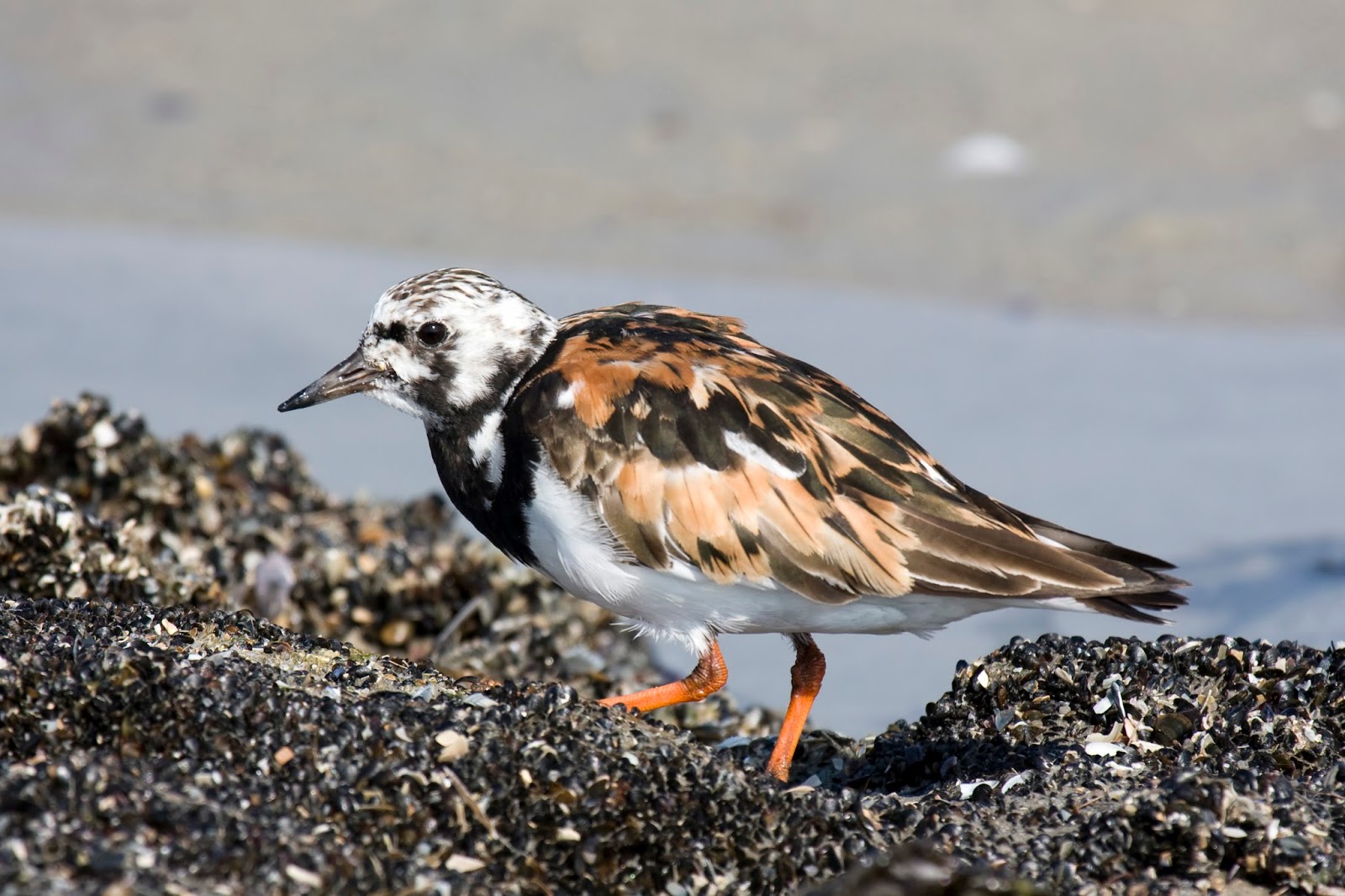
Ruddy Turnstone
In the late 1800s and early 1900s, their stopover was not very satisfying. In those days, as many as 2 million horseshoe crabs were harvested each year and ground up as fertilizer for farms in South Jersey. That usage fell off as better fertilizers were found and was off by the 1960s.

There were a few decades when the main threat was fishermen who used the crabs for bait. In the late 1990s, the demand for them as bait for eel and conch fishermen increased. Those fishermen had been using shellfish bellies discarded by South Jersey processing plants, but when the processing plants started closing and waste disposal laws were made tighter, the supply disappeared.

The horseshoe crabs were also in demand for the biomedical industry. The crabs’ blue blood is used to make a clotting agent that helps detect human pathogens in patients, drugs and intravenous devices. Thankfully, in this process the crabs are returned to the water after blood is extracted, but not all survive the process. More than a half a million crabs were used for biomedical purposes in 2015.

Of course, not only were the crabs affected, but also the numbers of birds who were returning to the beaches.

After a steep population decline, a harvest management plan was put into place for horseshoe crabs in Delaware Bay, Where once 2.5 million crabs were taken annually, now New Jersey, Delaware, Maryland and Virginia harvesters are restricted to 500,000 male crabs and no females.

New Jersey has gone beyond the restrictions and has had a complete ban on horseshoe crab harvesting since 2008.


Horseshoe crabs at Reeds Beach

Hopefully, the Delaware Bay will remain the largest concentration of the prehistoric horseshoe crabs in the world. Red knot numbers have stabilized. Conservationists still work towards those numbers rebounding up. The red knot is considered threatened, and it is listed as endangered by New Jersey.

And after their visit to our state, the birds still have another 3000 miles to go to their breeding grounds in the Arctic. Think about that the next time you're stuck in Parkway traffic on the way to the beach.

Monday, April 20, 2015

Beaches on Delaware Bay Continue to Undergo Restoration


A continuing story in New Jersey since Hurricane Sandy has been the restoration of the beach area on Delaware Bay that are spawning grounds for horseshoe crabs and feeding areas for shorebirds.

It's a story worth retelling as these important populations of shorebirds and horseshoe crabs need the  protection that comes this year with the restoration of more beaches on New Jersey’s side of Delaware Bay.

Thompson’s Beach, on a remote stretch of the Cumberland County shore, will see the removal of  shattered bulkheads and the replacement of 40,000 cubic yards of sand for the spawning of thousands of horseshoe crabs.

Four more beaches and a marsh are due for restoration over the next two years in a federally funded $5.1 million operation on behalf of the American Littoral Society and the Conserve Wildlife Foundation of New Jersey.


A ban on horseshoe-crab harvesting on New Jersey beaches has shown an increase in the bay’s population of red knots. But the crabs are still taken for medical uses and as bait and are harvested on Maryland and Virginia shores even though they are part of the Delaware Bay population.


The red knot migrates from southern Argentina to Arctic Canada via the Delaware Bay beaches each spring and relies on horseshoe crab eggs for food to fuel that journey. The bird population was at its lowest in the early 2000s and has recently stabilized at about 25,000.

That is encouraging, but it is less than a third of the 80,000 birds that biologists consider sustainable, and well below its peak of about 92,000 in the 1980s. The red knot was recently listed as threatened under the federal Endangered Species Act,.

Other shorebirds that use the bay beaches have also suffered a sharp decline and may be more endangered than the red know. For example, the ruddy turnstone's numbers are down to 14,000 from some 150,000 during the 1980s.

Larry Niles, a consulting biologist who designs and manages the beach-restoration program and who previously headed the endangered species program at New Jersey’s Department of Environmental Protection, estimates that some 500,000 male crabs and 150,000 females are harvested each year for their blood, which contains LAL, an extract used to ensure that medical products such as intravenous drugs and vaccines are free of contamination. The crabs are bled and then returned to the ocean in an operation that may kill as many as half of them, he said.
The medical harvest has cut the number of females to about 4 million from about 12 million in the 1990s, he said. “There’s no evidence of recovery in the crab population,” he said. “We’re not going to increase the bird population until the crab numbers start increasing.”