Showing posts with label migratory species. Show all posts

Saturday, November 20, 2021

Bat Migration and Hibernation

When we think of migration flights by some species, birds are probably what we are thinking about. But bats also migrate. During these migrations, they will often rest in odd places - window screens, exterior walls of homes and buildings - and will frighten humans.  


Silver-haired bat found in Newark - Photo: K.Perotta via NJDEP 


They are often alone and may remain for a day or two. They are not harmful or threatening to humans and should be left alone. What you should do is take a photo and send it to  MacKenzie.Hall@dep.nj.gov with information about the location and date. The Endangered and Nongame Species Program (ENSP) is able to catch some of these migrating bats in mist nets and then use nanotags to track them for a few weeks to learn about their patterns. Your photos and information can supplement that data. Even if you don't know what species you have found, take several photos from different angles and send them for identification.


Hoary bat found in Avalon - Photo: M.Wright via NJDEP

New Jersey has had an active bat conservation program for many years that has a focus on protecting winter dens of non-migratory species that gather together for hibernation. These winter colonies often number in the hundreds or thousands. Bats are especially vulnerable to disturbance and vandalism during hibernation. Even unintentional human activity can arouse the bats and cause them to use up their energy reserves too quickly. 

The Hibernia Mine in Rockaway Township, Morris County is our most famous "bat cave" or hibernaculum. The site had been used for mining iron ore from the early 1720s until operations ended around 1913. Bats were first observed in the abandoned mine in the 1930s, and by the 1980s more than 20,000 bats were wintering there each year. But vandalism and trespassing were big problems. When federally endangered Indiana bats were found to be using the mine in 1992, New Jersey acquired the property soon thereafter via the Green Acres Program and it is now part of the Wildcat Ridge Wildlife Management Area.

The hibernating colony climbed to around 30,000 bats in the early 2000s, with Little Brown bats being most numerous but bats of all cave-hibernating species seeking refuge there. Sadly, White-nose Syndrome hit Hibernia in January 2009 and more than 90% of the bats died.


Friday, October 15, 2021

October Hawk Watching

Stairs to the hawk lookout platform

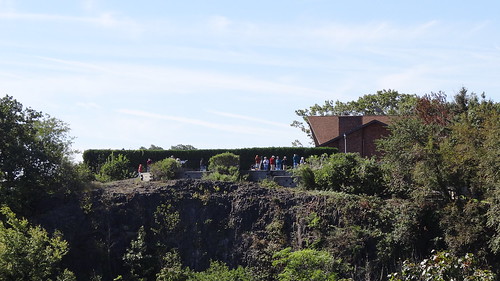
It has become a fall ritual for me to climb up the 500-foot basalt ledge near my home in Cedar Grove to the NJ Audubon Hawk Lookout. 

From this flattened area on First Watchung Mountain, you can see birds following this first ridge west of the lower Hudson River Valley as it runs northeast to southwest. They also follow the coastline when the ridge fades away and it leads them all the way to Cape May at the tip of our state. 

There will be someone from Audobon there from September 1 through November 30 from 9am - 5pm, but early October is the peak time and this month is a great month to take a look. The spring watch is from March 16 to May 15.


For directions to the hawk watch: njaudubon.org/watches/montclair-hawk-watch/
NJ Audobon also has a Cape May hawk watch location. 

Friday, July 19, 2019

Fisheries, Sharks and Migratory Species in New Jersey Waters


Fishing for sharks is regulated by the New Jersey and federal regulations. Cooperative conservation partnerships between NOAA Fisheries and New Jersey was formalized by entering into agreements under section 6 of the Endangered Species Act.

Beyond the threatened and endangered species, federal regulations prohibit targeting any prohibited species. That means that anglers must release any prohibited shark immediately, without removing it from the water and in a manner that maximizes its chances of survival.

For example, Sand Tiger Sharks are a prohibited species, therefore posing for pictures on the beach with this species or any other species on the prohibited list would be a violation of federal regulations.

The New Jersey Department of Environmental Protection, Division of Fish and Wildlife (NJ DEP) signed a Cooperative Agreement in 2004 which was amended November 7, 2012. establishes and maintains an "adequate and active" program for the conservation of endangered and threatened species.
New Jersey's agreement lists the following species:
Endangered
Threatened

Additional information on the regulations regarding these species can be found at fisheries.noaa.gov/topic/atlantic-highly-migratory-species

Saturday, May 25, 2019

Horseshoe Crabs Come Ashore from the Delaware Bay


Each May and June, millions of Atlantic horseshoe crabs come ashore along the East Coast to spawn. The height is usually when there is a full moon or new moon, creating the highest tides of the month. 

The result is those familiar helmet-shaped shells of Limulus polyphemus and trillions of their greenish eggs.

At least 11 different species of shorebird rely on horseshoe crab eggs as their primary food source for about 2-3 weeks during their migration. Migrating to their breeding grounds in the Arctic, some come from as far away as the southern tip of South America. Recent declines in the horseshoe crab population have triggered similar and more drastic declines in shorebird populations.

Red knots feeding near horseshoe crab. Photo by Gregory Breese/USFWS


Horseshoe crabs are often called "living fossils" as they are thought to have changed very little in the last 450 million years. Scientists are still not sure if they were land-based arachnids that moved into the sea or an ancestor that stayed put in the oceans. Recent genetic research favors arachnids, placing them alongside spiders and scorpions.

The horseshoe crabs spawn from Maine to the Yucatan Peninsula, but our own Delaware Bay is the center of activity. The warm water and mild surf with sandy shores must be appealing because some of the crabs have come from more than 60 miles out from the continental shelf off the mouth of the bay.

The blue blood of the Atlantic Horseshoe crab is used in medical testing of equipment and vaccinations to detect bacterial contamination in minute quantities, and the crabs have always been harvested as bait. The Atlantic horseshoe crab is currently considered “Near Threatened” by the IUCN. While not currently listed as a threatened species by the State of New Jersey, there is currently a moratorium on the harvest of horseshoe crabs within the state. With this law, it is illegal to remove a horseshoe crab, dead or alive, from its habitat in the wild.


conservewildlifenj.org/species/fieldguide/view/Limulus-polyphemus/

fws.gov...Modeling-a-Future-for-Horseshoe-Crabs-and-Red-Knots


Wednesday, November 7, 2018

Atlantic Brant Study in NY and NJ

During winter 2018, the NJDEP Division of Fish and Wildlife kicked-off a 5-year collaborative Atlantic brant migration and breeding ecology study with the New York Department of Environmental Conservation and the Canadian Wildlife Service.

Atlantic brant - Photo: Andreas Trepte - Own work, CC BY-SA 2.5

Atlantic brant are a small goose species that breeds in northern Canada and winter in the mid-Atlantic region of the United States. About 90% of the entire population winters along the coast of New Jersey and New York. 

During the next two years, crews will be marking brant with GPS transmitters and tiny geolocators. The geolocators are clear, plastic electronics about the size of a "fat nickel" and are attached to a red and white plastic leg band with a plastic cable lock tie.

This study is using GPS backpack and tarsal geolocators during 2018-19 on both the wintering grounds in New Jersey/New York and breeding grounds in Nunavut, Canada. Marked birds will provide insight into the following Atlantic brant questions:

If you encounter a marked Atlantic brant, check out the information at njfishandwildlife.com on how to help and what to report - especially if you find a bird with tarsal band or backpack transmitter shot or dead.

Monday, September 19, 2016

Observe Migrating Birds at Montclair Hawk Watch


Montclair Hawk Watch in Essex County Mills Reservation is for people of all ages. Join NJ Audubon staff and volunteers for fantastic views of migrating hawks.

Volunteers will be on hand to help people spot and identify hawks as they move through the ridges of the Watchung Mountains. Park along Edgecliff Road and look for the pathway to the stairs into the reservation. The stairway is steep, but worth the effort. Bring a hat, water and a folding chair. This is a free event. Pre-registration is requested. Montclair Hawk Watch will be held as follows:

Date: Thursday, September 22, 2016
Time: 9 a.m. to 12 p.m.
Place: Essex County Mills Reservation, Edgecliff Road, Montclair, NJ
see njaudubon.org/SectionBirdingSites/MontclairHawkWatch.aspx

Thursday, February 11, 2016

Animated Bird Migration Map


This is a nice example of data visualization showing bird migration in motion on a map. The data is from millions of bird observations from participants in eBird and the Great Backyard Bird Count. That count is happening now (February 12-15).

Scientists at the Cornell Lab used that data to generate an animated map showing the annual journeys of 118 bird species.  You can see how the routes change in spring and fall as birds ride seasonal winds to their international destinations.

If you want to know which species is which, you can switch to another version of the map showing species represented by a number. It is fast moving and a bit hard to interpret at a glance but you can start by looking for species like the Black-throated Blue Warbler (#16) passing by New Jersey or look for the Bobolink (#20), Solitary Sandpiper (#88), Prothonotary Warbler (#76), Lazuli Bunting (#55), Purple Sandpiper (#78) and Yellow-bellied Sapsucker (#114) .

Wednesday, September 9, 2015

Raptor Watch New Jersey - Montclair Hawk Watch

Montclair Hawk Watch

Because New Jersey is located along the Atlantic Flyway, we are in a great place to observe hawks heading south to their wintering grounds. This is the time when migrating birds of prey come through NJ in greater concentrations as they follow our ridges and coastline.

Raptors migrate from late summer through early December, but the numbers peak between mid-September and mid-October.I have read that the best days usually occur after a day that featured a cold front with northerly winds, and mornings and early afternoons are better than later in the day.

It is pretty awesome to watch them ride the thermals, wind currents and updrafts along the Hudson River Palisades to the Kittatinny Ridge along the Delaware River and down to Cape May.

You can get more information at the New Jersey Audubon Society and the Hawk Migration Association of North America websites.

This week, I walked up the stairs to the Montclair Hawk Watch (Essex County) a observation platform that is maintained by the NJ Audubon Society. From there, you can watch migrating birds move south along the first ridge of the Watchung Mountains. On a clear day, the Verrazano Narrows Bridge, the New York City skyline and the Statue of Liberty are also in view.

The site is interesting atop a 500-foot basalt ledge on the First Watchung Mountain. There is a stone-filled platform at the top of a long staircase. They have recorded sightings of broad-winged hawks, bald eagles, American kestrels, red-tailed hawks, ospreys, merlins, sharp-shinned hawks, northern harriers, peregrine falcons and Cooper's hawks.

Directions: from the Garden State Parkway in Bloomfield, take exit 151 for Watchung Avenue and head west on Watchung to its end at Upper Mountain Avenue in Montclair, about 2.1 miles. Make a right turn and go north on Upper Mountain 0.7 miles to Bradford Avenue. Make a left turn and go up Bradford 0.1 miles to Edgecliff Road and make a right turn. Go up Edgecliff 0.2 miles and park on the shoulder (to avoid parking problems, please park well off the side of the road). The lookout path is on the south side of the road marked with a sign at the base of the steps.

Other places for watching:
  • Palisades Interstate Park, Bergen County, State Line Lookout - 527 feet above the Palisades.
  • Sunrise Mountain, Sussex County - the pavilion atop the mountain is located in Stokes State Forest in Branchville.
  • Chimney Rock, Somerset County in Washington Valley Park in Martinsville. This is the southern end of the Watchung Ridge that starts at the Montclair platform.
  • Raccoon Ridge in Blairstown is on the Kittatinny Mountains at an elevation of 1,563 feet and Scotts Mountain, also in Warren County at the Merrill Creek Reservoir in Washington.
  • Down at the tip of the state at Cape May Point State Park birds riding air currents from the surrounding Atlantic Ocean and the Delaware Bay head south overhead.


Monday, August 17, 2015

Shorebirds Make Their August Return to New Jersey

Baird's Sandpiper (Calidris bairdii) by Dominic Sherony [CC BY-SA 2.0 via Wikimedia Commons

Via the "Seen in New Jersey" column written by Pete Bacinski (New Jersey birder and retired NJ Audubon All Things Birds program director) comes the reminder that shorebirds are now returning from nesting grounds in the high Arctic to the Jersey shore.

Like many NJ people, these birds have found that the late summer and after Labor Day are very nice times to enjoy our state. People think of migrations as an autumn event, but in this case this part of August is the time for neotropic migrant passerines, or perching birds, to migrate and it is the peak of shorebird migration. Pete says that the second half of August has the highest shorebird diversity of the year.

This is a great time to see birds foraging in mudflats, sandy beaches, sod farms and grassy areas. A choice spot is the Forsythe National Wildlife Refuge. This refuge has 47,000 acres of marshland and forest and the Brigantine Division in Galloway is the place to be for shorebirds at this time of year.

Other locations worth checking:
  • Barnegat Impoundments, in Barnegat Township, also part of Forsythe NWR
  • TNC Meadows in Cape May
  • Stone Harbor
  • Island Beach State Park
  • Sandy Hook (north end)
  • New Jersey Meadowlands, around the DeKorte Environment Center
  • Whitesbog cranberry bogs and mudflats (when drained)
Baird's sandpiper (shown at top) and the buff-breasted sandpiper, as well as the rare American golden plover love sod farms and grassy fields in places like Brigantine.These two sandpipers (AKA grasspipers) don't appear here in spring migration because they take a central flyway when they head north. Upland sandpipers, a New Jersey endangered species, is ending its migration through NJ now.


New Jersey Audubon's All Things Birds will sponsor these birding field trips:

Aug. 23: Forsythe (Brigantine) National Wildlife Refuge
Aug. 30: Forsythe (Brigantine) National Wildlife Refuge
There is a fee for these events: $20 for members and $25 for nonmembers. For more information or to register, call the Scherman-Hoffman Wildlife Sanctuaries at (908) 766-5787.

Friday, November 28, 2014

Red Knot May Get Federal Threatened Status


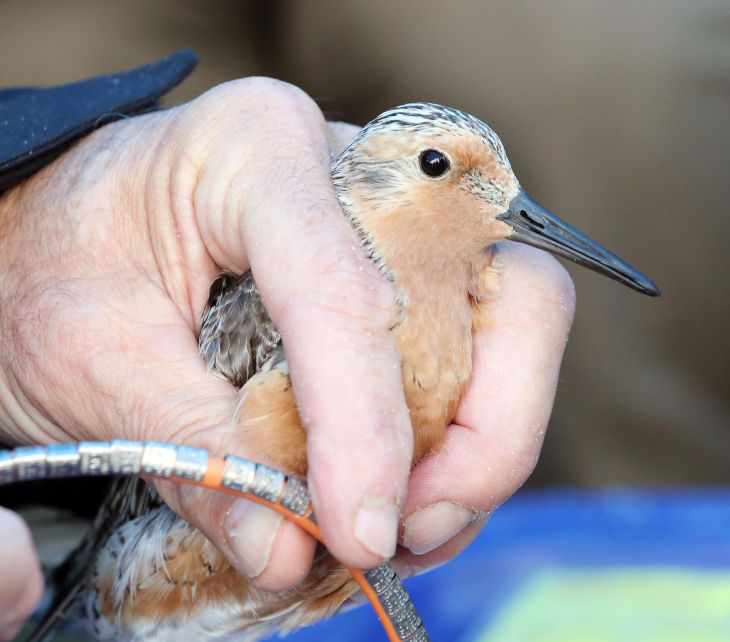
The pressofatlanticcity.com reports that today federal regulators will decide whether to give greater protections to red knots, a shorebird that comes to and depends on South Jersey each spring to fuel its epic migration.

Scientists in New Jersey have been studying the red knot for more than 20 years, following the robin-sized bird from its winter home at the tip of South America to its high-Arctic breeding grounds.

The birds are drawn to South Jersey by the annual spawn of horseshoe crabs, which crawl onto the beaches once a year to lay their eggs in the sand in an annual wildlife spectacle that has taken place since before the age of dinosaurs. Red knots, ruddy turnstones, laughing gulls and other birds converge on Delaware Bay beaches each May to gobble up the tiny, nutritious eggs.

More NJ Info fws.gov/northeast/njfieldoffice/Endangered/redknot.html

Tuesday, September 9, 2014

North American Bird Species Threatened By Climate Change


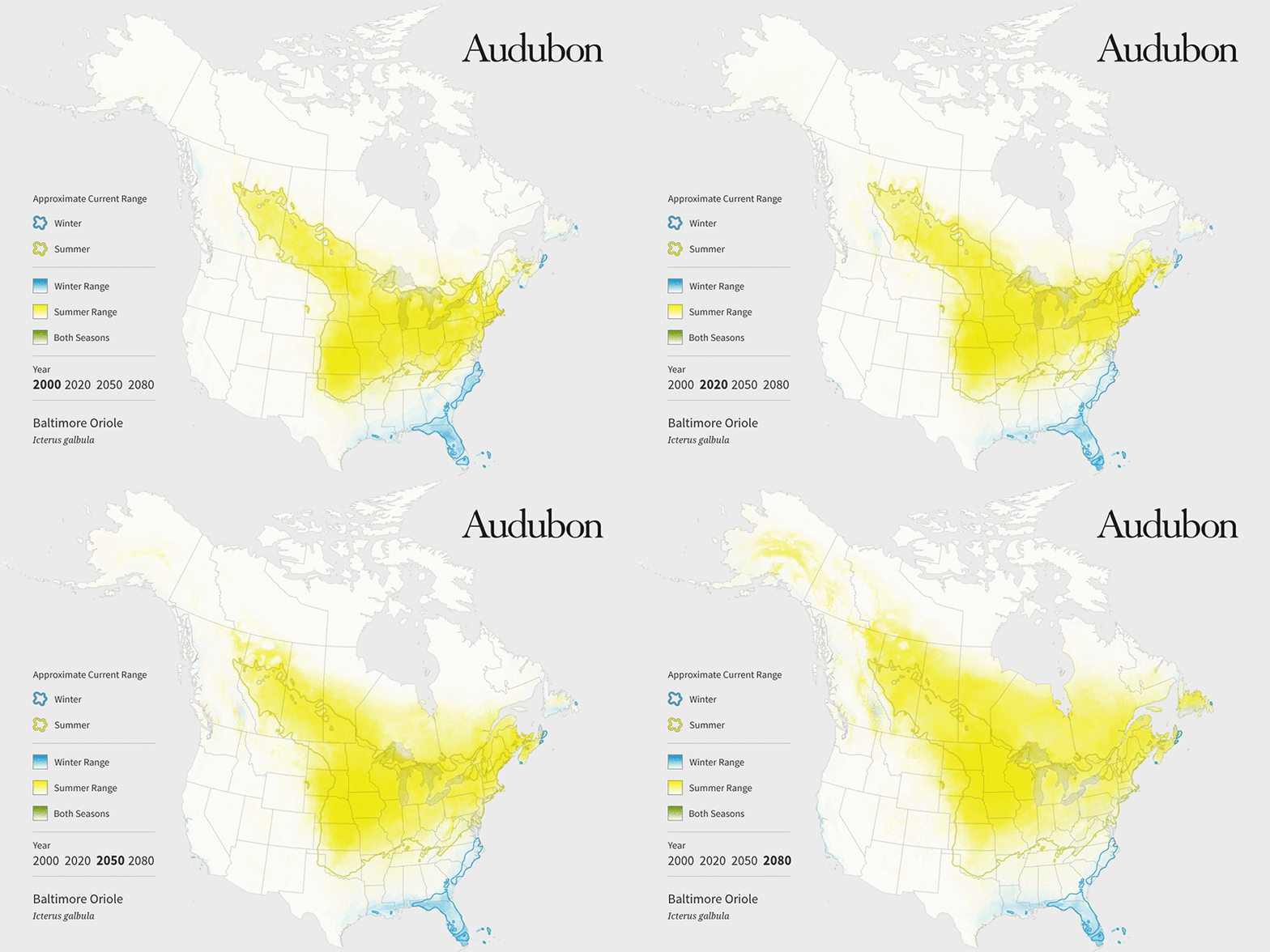
The shift north of species     image credit: National Audubon Society via npr.org

I heard David Yarnold, president and CEO of the National Audubon Society, on NPR talk about a new seven-year study the organization has done that warns that the migratory routes and habitats of more than half of the birds in North America are now or soon will be threatened by climate change.

I still hear arguments against climate change forecasts that are sometimes labeled as "alarmist" but Yarnold says that "... there are forecasts that are far more extreme than this report. If anything, this report is conservative. At every step of the way, we took great care to not overstate data or conclusions. Nothing would make us happier than to be wrong about the fate of many of these birds."

The study, "314 Species on the Brink," look at the entire continent, but you can look close up at New Jersey.  The bald eagle, a species that in New Jersey has finally been brought "back from the brink" of being extirpated and endangered, could see its current range decrease by nearly 75 percent in the next 65 years.

One NJ species is the American kestrel.
Photo: Nathan Rupert/Flickr Creative Common via audubon.org

"This colorful little falcon is in serious trouble in some parts of the continent. Yet populations are stable or increasing elsewhere. With the American Kestrel and so many other geographically widespread species, it is essential to engage management and conservation on a region-by-region basis. The Audubon model forecasts overall winter gains and summer losses for the species, but the bigger story is substantial northward movement of suitable climate space at both times of year. The decline of nesting American Kestrels in the northeastern U.S., well along already, seems likely to proceed, perhaps to the point of regional extirpation in New England and the Mid-Atlantic states."

The common loon, an iconic bird in Minnesota and Maine, may no longer be able to breed in the lower 48 states as soon as 2080, according to the report.

Oriole photo credit: Universal Images Group /Getty Images via npr.org

The story highlighted Baltimore orioles, a species that is so beloved in Maryland that their major league baseball team bears its name. These orioles are migrating birds and by 2080, there may not be any orioles left in Maryland because they could be forced to nest well north of the state.

In talking about the pace at which this change is happening, Yarnold says:
The report looked at North American birds. It's not likely that birds are going to migrate from Central and South America to replace them. But, remember, what we're talking about are changes at a pace and a scale that we've never seen before. These are the kinds of changes to habitat that have taken tens of thousands of years in the past. And what worries me is that these are the kinds of changes that my 9-month-old grandson could see in his lifetime.


Saturday, May 10, 2014

Golden-Winged Warblers and American Woodcocks

In cooperation with the US Fish and Wildlife Service and the Canadian Wildlife Service, the NJ Division of Fish & Wildlife conducts several surveys each year to measure waterfowl population parameters. As a Wildlife Conservation Corps volunteer, I was involved in an American woodcock survey this month.

Known as the timberdoodle, bogsucker, night partridge, brush snipe, and hokumpoke, this unusual bird is known to appear in NJ. They have been spotted in NJ in places like the Tower Hill Reserve in Bethlehem Township (Hunterdon County) and Quakertown Preserve in Franklin Township (owned by Hunterdon Land Trust).


The American Woodcock (Scolopax minor) is a chubby bird about 11 inches long with an interesting pattern that allows it to blend very effectively into vegetation. It is a ground-dwelling bird has a very long beak that might remind you of some shorebirds. It probes the ground to feed on worms and insects. Technically, it is the shorebird family, but it inhabits damp, brushy woods, and when displaying, moves into nearby grassy or brushy fields.

Its range includes the eastern half of the mainland United States including NJ, and areas farther north through southern Canada during the spring and summer breeding season. For the winter, it migrates to southern New Jersey and as far south as the Gulf Coast.

Woodcock are nocturnal, secretive, and generally solitary creatures and can typically only be observed during the few weeks of their mating ritual. Those of us involved this month were assigned to areas across the state. My group was in Norvin Green State Forest (Passaic County).

A warm evening at sunset is the best time to listen for woodcock. Unfortunately, temperatures below 40 degrees and rain usually eliminates the chances of hearing or seeing the mating display. I only heard the mating calls one evening on the nights I was out.

I tried to place myself at the edge of a damp area that faced out into the open. A male on the ground will start making a short vocal call: peent. He will call several times from the ground, and then fly up into the air about 50 to 100 yards.

Woodcocks are not good flyers and in this ritual it will fly down in a fast, spiraling flight with sounds like whistles, chirps, and trills being made not by the bird vocalizing, but by his wings.

Woodcocks are not endangered in NJ. The surveys are part of a larger monitoring of the species throughout North America, and also a way to map where populations do occur in the state. Some of those areas allow hunting and in NJ to hunt woodcock, rail, snipe, coots or moorhens you need an New Jersey hunting license and Harvest Information Program (HIP) certification.

Golden-winged Warbler caught for banding
Photo by Kristin Munafro via nj.com

In the nongame category of birds migrating through our state, we have the Golden-winged Warbler who is a rarity in our state. This month is also a time for warblers to visit our state,

The Golden-winged Warbler was once locally common in northern New Jersey. Now it is a species that is one of the rarest to encounter in the state.

They winter from southern Mexico south through Central America to Venezuela, Colombia, and Ecuador. This New Jersey-listed endangered species has been reduced from approximately 100 pairs in the mid-1990s down to about 25 pairs today.

The few remaining birds do their nesting in the northwest corner of the state.

This ground-nesting warbler is found in brushy overgrowth along forested edges, shrubby fens, and shrub swamps and can be found along power-line cuts and areas where young forests are regenerating. They avoid a closed canopy setting and can be found in the NJ Highlands and Sussex County.


They have a unique "bee buzz buzz buzz" song.

Clearing of eastern forests is not something we want happening, but this species benefits from the regrowth and young forest that many abandoned or conserved farmlands or fields offer.

New Jersey Audubon has been working to create habitat at its Sparta Mountain Sanctuary and is partnering with the NJ Department of Environmental Protection on habitat creation at the Sparta Mountain Wildlife Management Area.