Showing posts with label hibernation. Show all posts

Monday, November 22, 2021

Bears Preparing for Hibernation


The November Full Moon is called by some people the Deer Rutting Moon and you may have seen signs or news stories about being extra careful driving during this time. Though deer are very much a part of rural and suburban life in New Jersey, increasingly so are black bears.

On June 21, 2021, New Jersey's Comprehensive Black Bear Management Policy (CBBMP) expired, and as such, there is no black bear hunt in 2021. In accordance with the Supreme Court ruling on September 27, 2007, no black bear hunt may occur without a properly-promulgated CBBMP proposed by the New Jersey Fish and Game Council and approved by the Commissioner of the New Jersey Department of Environmental Protection.

This time of year is also the time when black bears in our state are feeding at an intense rate in preparation for hibernation. In many areas of our state, food in garbage cans is the easiest source for bears. Intentionally feeding bears is illegal in the state and can result in fines up to $1000. But unintentional feeding by leaving out food waste in containers that bears can easily access can lead to unintended encounters with humans and property damage. 

You should report nuisance or aggressive bears and damage to local police, and the state's Wildlife Control Unit 908-735-8793 or the 24-hour DEP Hotline 1-877-927-6337

Black bears are the largest land mammal in New Jersey. Since the 1980s, our black bear population has been increasing and expanding its range both southward and eastward from the forested areas of northwestern New Jersey. Within the most densely populated state in the nation, black bears are thriving and there are now confirmed bear sightings in all 21 of New Jersey's counties.

The American black bear is native to New Jersey. Prior to European settlement, black bears lived in forested regions throughout the state, but as towns grew, loss of habitat and indiscriminate killing caused the black bear population to sharply decline throughout the 1800s. In 1953, the New Jersey Fish and Game Council classified the black bear as a game animal, affording it protection from indiscriminate killing. 

Today, bear management includes research, monitoring, non-lethal and lethal control of problem bears, public education on how to coexist with bears, enforcement of laws designed to reduce bear-related conflicts, and bear population control.

Attacks on humans by black bears are rare, especially in NJ, but they do occur throughout black bear habitat in North America. In September 2014, a fatal predatory black bear attack occurred in West Milford, Passaic County, resulting in the death of a 22-year old male. It is the first documented bear fatality in New Jersey's history.


Saturday, November 20, 2021

Bat Migration and Hibernation

When we think of migration flights by some species, birds are probably what we are thinking about. But bats also migrate. During these migrations, they will often rest in odd places - window screens, exterior walls of homes and buildings - and will frighten humans.  


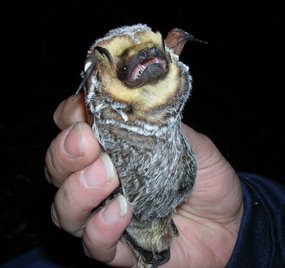
Silver-haired bat found in Newark - Photo: K.Perotta via NJDEP 


They are often alone and may remain for a day or two. They are not harmful or threatening to humans and should be left alone. What you should do is take a photo and send it to  MacKenzie.Hall@dep.nj.gov with information about the location and date. The Endangered and Nongame Species Program (ENSP) is able to catch some of these migrating bats in mist nets and then use nanotags to track them for a few weeks to learn about their patterns. Your photos and information can supplement that data. Even if you don't know what species you have found, take several photos from different angles and send them for identification.


Hoary bat found in Avalon - Photo: M.Wright via NJDEP

New Jersey has had an active bat conservation program for many years that has a focus on protecting winter dens of non-migratory species that gather together for hibernation. These winter colonies often number in the hundreds or thousands. Bats are especially vulnerable to disturbance and vandalism during hibernation. Even unintentional human activity can arouse the bats and cause them to use up their energy reserves too quickly. 

The Hibernia Mine in Rockaway Township, Morris County is our most famous "bat cave" or hibernaculum. The site had been used for mining iron ore from the early 1720s until operations ended around 1913. Bats were first observed in the abandoned mine in the 1930s, and by the 1980s more than 20,000 bats were wintering there each year. But vandalism and trespassing were big problems. When federally endangered Indiana bats were found to be using the mine in 1992, New Jersey acquired the property soon thereafter via the Green Acres Program and it is now part of the Wildcat Ridge Wildlife Management Area.

The hibernating colony climbed to around 30,000 bats in the early 2000s, with Little Brown bats being most numerous but bats of all cave-hibernating species seeking refuge there. Sadly, White-nose Syndrome hit Hibernia in January 2009 and more than 90% of the bats died.


Wednesday, January 24, 2018

A Dangerous Time for Hibernating Bats

You may be spending more time indoors now that it is winter, but New Jersey's non-migrating bats have gone into hibernation. It is a dangerous time for them no, particularly because of white-nose syndrome. This is caused by a fungus that was originally introduced inadvertently by humans exploring caves in New York State.

The disease has decimated many bat species. It scars their wings and disrupts their hibernation patterns. One of its effects is that it causes them to wake and fly around when they should be sleeping, and so their energy reserves deplete and they die from starvation, thirst and exhaustion.

Bats are the single largest consumer of night-flying insects like mosquitoes, beetles and moths. Not only does that help humans be less bothered outdoors in the summer and decrease the spread of mosquito-borne diseases, but it this natural insect control helps our Garden State agriculture.

A little brown bat with white nose syndrome.
The most affected of New Jersey's bats is the little brown bat which was once common but has now become rare. NJ's largest hibernaculum is the old Hibernia Mine in Morris County. Before the syndrome hit our state in 2007, Hibernia was the winter home for 34,000 little brown bats. Now, there are only about 400.

The best we can say currently is that this small population seems to be leveling off.

Big brown bats seem to be unaffected by white-nose syndrome and it may be because they hibernate in different locations than the little brown bat. They prefer cold but dry places, such as attics. (If you discover bats in your attic or home, don't try to remove them on your own. Call a bat removal expert, who can safely remove them.) Caves tend to be warmer and have higher humidity which may increase the fungus spreading. When the big brown bats do use subterranean locations, they stay close to entrances where it is colder. They may, if the weather warms enough, even awaken, seek water and perhaps breed.

Modifications in the Hibernia cave to increase air flow may drop temperatures slightly, inhibiting the growth of white-nose fungus.

Little brown bats, northern long-eared bats, tri-colored bats and eastern small-footed bats are all affected by white-nose syndrome, and have been recommended for inclusion on the state's endangered species list.


More on New Jersey's bats
http://wildlife.rutgers.edu/bats/
http://www.conservewildlifenj.org/protecting/projects/bat/white-nose/
Bat Conservation International www.batcon.org.

Wednesday, May 7, 2014

Frog Awakenings

Photo by William Locascio
Now that spring has truly arrived in New Jersey, all kinds of miraculous rebirths are before us in nature.

My friend Bill's backyard pond in northern NJ has always had a few frog visitors and this week a new one has found the pond.

In early April, that frog would have been still frozen awaiting the spring thaw. If its heart turns on before its brain, the brain would be too cold to get oxygen and the circulatory system would dam up and fail. If the brain turns on before the heart, that brain would be starved for oxygen and die. But somehow, all those organs awaken at the right time and they emerge.

Amazing.

Monday, January 28, 2013

Hibernating Bats

In autumn, bats will find their traditional hibernation locations and often migrate hundreds of miles to the abandoned mines and caves where they will spend the winter months.

Some of our common New Jersey bats congregate in colonies, often in caves, mine or buildings. These "social bats" usually return to the same roost year after year and start maternity colonies in the spring.

Nine species of bats are considered regular residents of New Jersey. These include the little brown bat, big brown bat, northern long-eared bat, small-footed myotis, Eastern pipistrel, Indiana bat (state and federally endangered), hoary bat, red bat and silver-haired bat. The hoary, red and silver-haired bats are part-time residents that are found here from spring through fall. They migrate to southern states for the winter. The other six species remain here throughout the entire year and require special habitats for winter hibernation.

Natural caves once provided hibernating habitat for bats, but today most caves are subject to disturbance by people and thus are not suitable for use by bats. Abandoned mines and tunnels, storm drains and sewers have replaced natural caves as the primary winter habitat for many bats. Since those places are often unsafe to enter or inaccessible to people, they are desirable locations. But bats will sometimes hibernate in homes, garages, sheds and barns if there is access and it appears isolated to them.

New Jersey's largest known bat hibernaculum is the Hibernia Mine in Rockaway Township, Morris County. It was abandoned as a mine in the early 1900s and there are records of bats using the mine going back to the 1930s. After decades of the bats being disturbed, chased or even killed and landowner attempts to seal the mine, it is now a protected location.

Since they are particularly vulnerable to pollution and pesticides, the presence or absence of bats can tell scientists a lot about the overall health of the local environment.


Hibernating hoary bat on garage in Hunterdon County

I recently received via this site an email from someone in Hunterdon County who had discovered a bat hibernating attached to the outside of their garage. They were concerned about its exposure to the weather.

I recommended that they leave it alone and use the contact page at NJbats.org/ifoundabat.html in the hope that they could give them advice or take the bat.

I'm pleased that this bat was picked up by Jackie of NJ Bats and she was very excited that it was a female hoary bat and was most likely pregnant.

Hoary Bat - Photo by Jennifer Linehan - nps.gov 

Hoary bats are the most widespread of all bats in the United States and are thought to occur in all 50 states. They range from the tree limit in Canada down to at least Guatemala in Central America, and throughout South America. They are the only bats found in Hawaii.

They are rarer in most of the eastern United States but have also been found in Michigan, New York and Connecticut during December and in Indiana during January. This suggests that some may winter farther north than was previously expected.

Hoary bats are migratory and move north in spring and south in winter. It tends to be rather solitary and frequents wooded areas where it roosts in the open (not in buildings) by hanging from a branch or twig. It is more easily recognized by its large size and its swift, erratic flight. This bat usually emerges rather late in the evening, but during migration, it is frequently observed in daylight hours

Two kinds of bats in New Jersey are often found roosting in colonies inside buildings: the big brown and little brown bats.

The big brown bat has a wingspread of about 14 inches and is our most common species. Colonies of up to 200 individuals return each spring to locations (including homes and other buildings) in New Jersey.

Although they have relatively long lives, reproduction is slow. Generally, one is born each year. The big brown bat accounts for over 75 percent of the bat contacts with people and pets and is the bat most often tested for rabies.

Little Brown Bat
The little brown bat is also quite common in homes during the spring and summer, and large numbers hibernate in our abandoned iron mines. However, the number of human and animal exposures, and the number of little brown bats found to be rabid, are much less than for the big brown bat.

When bats are hibernating, it is a time that scientists often study them. Much of the research and surveying on White Nose Syndrome is done at this time.

White Nose Syndrome is a "bat plague" that has killed nearly 7 million bats since it first appeared in the US in New York State. The deadly fungal disease has spread to 19 states as far west as Missouri, as far south as Alabama and north into Canada.

The little brown bat (Myotis lucifugus) has been hardest hit by the sickness because it is the most common of our bat species, but there are 22 other species of American bats that also hibernate in caves that are being affected. 

Like a number of other threatened and endangered species, such as snakes, wolves, and wood rats,  there are many myths and misunderstandings about bats. For example, all of the bats found in New Jersey are strictly insect eaters. No vampires in Jersey. Many people fear a bat bite because of rabies. It makes sense not to touch bats that you find, but less than one percent of bats carry rabies, and attacks by bats are extremely rare. They rarely get tangled in people's hair, despite my mother's warnings about that.

They are not blind, but they depend more on their sonar hearing than eyesight to navigate and avoid obstacles - and to capture insects. Because a bat can consume hundreds of insects in an hour, they keep our mosquito population down in areas where they congregate.

Bats are the only truly flying mammals. They belong to the order Chiroptera and are not rodents. They are mammals because they have hair, give birth to live young, and feed their young milk produced by mammary glands.

Most bats produce only one offspring (called a pup) annually and rear their young for the first few weeks of life until they can fly and feed on their own. These reproductive and rearing practices make them the slowest reproducing mammals on earth for their size. Despite their slow reproduction, bats exist in large numbers and encompass one quarter of all mammal species, second in population only to rodents.

Individual bats can live to be 30 years old, and colonies can be present at the same location for over 100 years.

A story last year on the Wild New Jersey site said that while bat populations are on the decline across New Jersey and the United States, in Central New Jersey's Dismal Swamp Conservation Area (DSCA), the Edison Wetlands Association (EWA) and Eagle Scouts have taken action and are doing something about this worldwide bat extinction crisis. Bat populations in Northern Central New Jersey are actually increasing due to conservation activities.

MORE INFORMATION
ABOUT BATS IN NEW JERSEY

Friday, June 12, 2009

NJ Bats Being Affected By Mysterious Disease

Several years ago, researchers began to report on a mysterious illness in the Northeast that is killing thousands of hibernating bats.

Wildlife officials are calling the illness “white nose syndrome” because the most obvious symptom is a white fungus that forms around the noses of some, but not all, of the afflicted bats.

Researchers do not yet know if the fungus actually causes death, but they have observed that bats with white nose syndrome deplete their fat reserves months before they would normally emerge from hibernation, and die as a result.

Experts have also advised the public to avoid entering any caves and mines that might harbor bats until more is known about the problem.

At that time, no evidence of disease was found among New Jersey’s wintering bat populations and it was feared that humans might carry this mysterious illness from one cave to another. Hikers, photographers and spelunkers are among those who frequent abandoned mines, caves and other locations that likely shelter hibernating bats.

Caves near Albany, N.Y., with up to 11,000 bats, proved to have more than 50% of the area’s wintering population. - were found dead, and many showed symptoms of the mysterious disease. The white fungus was found on bats hibernating in New York and southwest Vermont, and because bats migrate hundreds of miles to their summer range, the impact to other areas where hibernating bats could be significant.

The affected species include the Indiana bat, listed as endangered in New Jersey and nationwide. Wildlife experts report that little brown bats are sustaining the largest number of deaths, along with northern long-eared, eastern pipistrelle and other bat species using the same caves.

Now, the "white nose syndrome" has spread to NJ, according the New Jersey Division of Fish and Wildlife. The fungus was found on many of the dead bats found inside and outside three former mines in Rockaway Township and Denville, where the bulk of New Jersey's bat populations are found. This includes our largest bat hibernation spot (hibernaculum) at the Hibernia Mine.

The bats being impacted the most, at this point, appear to be the common little brown bat. Though the endangered Indiana bat has not been found with the disease, it is likely that species also will be impacted.

Bats that have developed the white fungus around their nose and wing membranes will take flight out of their caves when they should be hibernating during the winter months.

Hibernating bats are particularly vulnerable to disease or disturbance because they congregate in large numbers in caves and mines, forming tight clusters of 300 per square foot in some locations. Tens of thousands of bats hibernate in New Jersey in a small number of abandoned mines.