Showing posts with label ENSP. Show all posts

Monday, January 1, 2024

Video: Endangered and Nongame Species Program

Watch how the Endangered and Nongame Species Program ENSP staff, along with the help of dedicated volunteers carry out their missions of protecting these species and their habitats.


2023 marked the 50th anniversary of the New Jersey Endangered and Nongame Species Conservation Act, which established laws to protect and restore endangered and threatened wildlife in New Jersey. As a result, NJDEP Fish & Wildlife established the Endangered and Nongame Species Program to carry out the work necessary to restore and maintain these species. 

Sunday, December 31, 2023

50th anniversary of the New Jersey Endangered and Nongame Species Conservation Act


ENSP biologist Kathy Clark checks bald eagle nest

This year marks the 50th anniversary of the New Jersey Endangered and Nongame Species Conservation Act. This landmark legislation protects hundreds of wildlife species, including raptors such as bald eagles and ospreys, threatened shorebirds such as the piping plover and red knot, rare amphibians and reptiles such as the Eastern tiger salamander and timber rattlesnake, and even butterflies and freshwater mussels.

From the state's press release: “The New Jersey Endangered and Nongame Species Conservation Act was a milestone in the history of environmental protection, coming at a time when the environment was under siege from pollution, wanton use of pesticides and uncontrolled development,” said Commissioner Shawn LaTourette. “Without this law, many of the species that we enjoy today, from bald eagles to bobcats to bog turtles, might no longer be part of New Jersey’s landscape.

Fifty years on, the state encounters new threats including climate change, invasive species, illegal collection and roadway mortalities.

Governor William T. Cahill signed the New Jersey Endangered and Nongame Species Conservation Act into law on Dec. 14, 1973, two weeks before President Richard M. Nixon signed the federal Endangered Species Act. The state law established NJDEP Fish & Wildlife’s Endangered and Nongame Species Program (ENSP), a small, highly dedicated team supported by hundreds of volunteers throughout the state.

ENSP’s mission is to actively conserve New Jersey’s biological diversity by maintaining and enhancing endangered, threatened and nongame wildlife populations within healthy ecosystems. Today, ENSP is responsible for the protection and management of more than 500 wildlife species, including 83 currently listed as threatened or endangered.

The state has many success stories. Probably better known are ones such as the recovery of ospreys to their historic population size, the return of the peregrine falcon statewide; and the remarkable rebound of bald eagles. But there are also many species that get less attention by the public, such as the Eastern Tiger Salamander pictured here.


Eastern Tiger Salamander

Growing up to 8 inches long, the Eastern tiger salamander is the largest salamander in New Jersey, yet it is elusive and rarely seen. Historical distribution was across 10 counties. Today it is only found in parts of extreme southern New Jersey, and it has been lost from surrounding states. Conservation efforts focused on the vernal ponds they need for reproduction have slowed the decline in New Jersey, giving hope for this species.

The bald eagle was nearly extirpated in New Jersey and was down to one active nesting pair in the early 1980s. As a result of a comprehensive restoration program and a ban on the pesticide DDT, they now number more than 250 nesting pairs. This is considered one of New Jersey’s greatest wildlife conservation success stories.

At one time lost from the wild in all states east of the Mississippi River due to the pesticide DDT, the peregrine falcon is still considered endangered or threatened in many eastern states, but it has been restored to many natural cliffs and has adapted to the tallest urban buildings. Through reintroduction and careful management, New Jersey is now home to more than 40 pairs of these impressive birds of prey.

Those magnificent birds get a lot of love from the public, but other species, such as snakes and bats, still have a stigma surrounding them based on folk tales and misinformation.

White-nose syndrome is a fungus that decimated bat populations in eastern North America. In New Jersey, efforts to protect their populations include installing bat-friendly gates to protect hibernating bats from human disturbance during winter months; preserving land to safeguard important bat hibernacula and fall foraging habitat; improving communications with residents and nuisance wildlife control companies about proper handling of bats in buildings and using new techniques to study and monitor bats.


Saturday, November 20, 2021

Bat Migration and Hibernation

When we think of migration flights by some species, birds are probably what we are thinking about. But bats also migrate. During these migrations, they will often rest in odd places - window screens, exterior walls of homes and buildings - and will frighten humans.  


Silver-haired bat found in Newark - Photo: K.Perotta via NJDEP 


They are often alone and may remain for a day or two. They are not harmful or threatening to humans and should be left alone. What you should do is take a photo and send it to  MacKenzie.Hall@dep.nj.gov with information about the location and date. The Endangered and Nongame Species Program (ENSP) is able to catch some of these migrating bats in mist nets and then use nanotags to track them for a few weeks to learn about their patterns. Your photos and information can supplement that data. Even if you don't know what species you have found, take several photos from different angles and send them for identification.


Hoary bat found in Avalon - Photo: M.Wright via NJDEP

New Jersey has had an active bat conservation program for many years that has a focus on protecting winter dens of non-migratory species that gather together for hibernation. These winter colonies often number in the hundreds or thousands. Bats are especially vulnerable to disturbance and vandalism during hibernation. Even unintentional human activity can arouse the bats and cause them to use up their energy reserves too quickly. 

The Hibernia Mine in Rockaway Township, Morris County is our most famous "bat cave" or hibernaculum. The site had been used for mining iron ore from the early 1720s until operations ended around 1913. Bats were first observed in the abandoned mine in the 1930s, and by the 1980s more than 20,000 bats were wintering there each year. But vandalism and trespassing were big problems. When federally endangered Indiana bats were found to be using the mine in 1992, New Jersey acquired the property soon thereafter via the Green Acres Program and it is now part of the Wildcat Ridge Wildlife Management Area.

The hibernating colony climbed to around 30,000 bats in the early 2000s, with Little Brown bats being most numerous but bats of all cave-hibernating species seeking refuge there. Sadly, White-nose Syndrome hit Hibernia in January 2009 and more than 90% of the bats died.


Monday, March 16, 2020

Funding the NJ Endangered and Non-game Species Program


You have seen cars on New Jersey roads with this Conserve Wildlife license plate, but did you know how it was obtained and what it means?

This special plate's purchase dedicates 80 percent of the fees to the NJ Endangered and Non-game Species Program. That is important because - as many people do not know - that program is supported by contributions and not by the state. 

These revenues help the state's Bald Eagle comeback, Peregrine Falcons, Ospreys, Bog Turtles, Barred Owls and many other species to survive in the state.


The other source of revenue is the checkoff on your state tax return on Line 66 on your NJ 1040 income tax return. EVERY dollar you donate goes directly to the state's Endangered and Nongame Species Program, and your contribution is matched with an equal amount of federal funding, further strengthening efforts to protect imperiled species.

The Endangered and Nongame Species Program is responsible for more than 600 species of greatest conservation need across New Jersey, including 86 species currently listed as endangered or threatened.

Tuesday, June 19, 2018

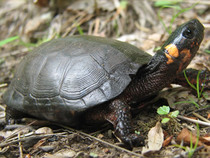
The Bog Turtle Is Now NJ's Official Reptile

The bog turtle is a tiny, dark turtle with a distinct orange patch
 behind the tympanum (ear membrane) on either side of the head.

The bog turtle is now the state’s official reptile following legislation signed by Governor Phil Murphy.

The Endangered and Nongame Species Program estimates that there are fewer than 2,000 of these inhabitants of groundwater-fed freshwater wetlands left in the state.

Once abundant in New Jersey, this secretive, palm-sized turtle today is now endangered and found only in rural areas such as Sussex, Warren, Hunterdon, and Salem counties.

Bog turtles have very specific habitat needs and are very sensitive to changes to its environment. The DEP has been working to protect land around high-priority populations, restoring habitat by eliminating invasive plant species, and identifying critical movement corridors.


Bog Turtle Fact Sheet

Tuesday, July 11, 2017

Have You Sighted a NJ Endangered Species?


You can help the Endangered and Nongame Species Program (ENSP) maintain updated records of rare species within the state. I was reminded of this recently when a commenter on a post here about bobcats mentioned that "local animal control" didn't seem interested in his sighting. That might often be true, but ENSP is interested.

You should check the list of New Jersey's endangered and threatened wildlife species maintained by the Division of Fish and Wildlife's Endangered and Nongame Species Program (ENSP).

If you have information on the location of a rare animal and would like to help build the Natural Heritage inventory, you can submit a report. This data will help develop critical habitat mapping and look at habitat and population trends, and ultimately help develop conservation strategies for endangered and threatened species.

You can fill out the sighting report form available at state.nj.us/dep/fgw/ensp/rprtform.htm (There is also one online for marine wildlife.)

Reporting includes marking the location of the sighting on a map to help biologists determine if suitable habitat is present at the location.

There is also information on submitting your report by mail or email.

Each record will be reviewed by an ENSP biologist.

Sunday, June 11, 2017

Reporting Rare Wildlife Sightings in NJ

I get emails and comments at this blog fairly regularly when people sight what they believe is an endangered, threatened or rare species. Some of those contacts have led to posts, but this is not an official blog, so I can't always get the information to the people at the NJ Division of Fish and Wildlife or the Endangered and Nongame Species Program.

Fisher - via wikipedia commons
Just this week, a commenter reported sighting a fisher. The state agencies are understaffed and really need accurate information, so that conservation action can be focused on NJ's most important natural areas. If you have information on the location of an endangered, threatened or rare animal or plant and would like to help, you can report the sighting. This data will helps develop critical habitat mapping and look at habitat and population trends, and ultimately helps to develop conservation strategies for endangered and threatened species.

TO REPORT A SIGHTING
  • Look at the information at www.state.nj.us/dep/fgw/ensp/rprtform.htm 
  • Complete a sighting report form OR, for marine wildlife, please use the Marine Wildlife Sighting Report Form Complete this form in its entirety - anonymous submissions cannot be incorporated into the database.
  • These reports are for first hand field observations only. DO NOT COMPLETE THIS FORM if the source of your information is a report, news item, email, conversation, or other document. If that is the case, send the documentation instead.
  • Only report one species at each location per form and map.
  • Mark the location of the sighting on a map. When submitting a report, a map is necessary to help our biologists determine if suitable habitat is present at the location. Once the suitability of the area is determined the map provided aids in the delineation of land to be protected.


Mail completed surveys to:
Endangered and Nongame Species Program
NJ Division of Fish and Wildlife
P.O. Box 400
Trenton, NJ 08625-0400
or send it as an e-mail attachment to: Gretchen.Fowles@dep.state.nj.us

In order to maintain the validity and integrity of the database, each record will be reviewed by an ENSP biologist. NOT ALL SUBMISSIONS WILL BE ACCEPTED.

Click these links for a listing of the current New Jersey Endangered and Threatened Species List or Special Species of Concern.

If you have any questions please contact ENSP at 609-292-9400.

Monday, March 13, 2017

A NJ Income Tax Check-off to Help Endangered Species


New Jersey residents can continue to help the recovery of endangered species through a state income-tax check-off. Not the most opportune time to ask someone for a "donation," but taxpayers can give a portion of their state refunds to fund wildlife protection.

Simply look for Line 59 on your NJ 1040 income tax return, and check-off for wildlife. Or remind your tax preparer that you want to make a contribution.

Every dollar you donate goes directly to the DEP's Endangered and Nongame Species Program (ENSP), enabling biologists to continue their work to restore, conserve and enhance New Jersey's populations of rare species. What's more, your contribution is matched with an equal amount of federal funding, further strengthening efforts to protect hundreds of imperiled species.

The funds collected in past years have helped specie such as the bald eagle and osprey populations reach record highs in the state.

It is an understandable misconception that these programs are funded by tax dollars or the purchase of hunting and fishing licenses. They are not.

The Endangered and Nongame Species Program also works closely with local conservation groups. They award Conserve Wildlife Matching Grants —funded by sales of Conserve Wildlife license plates — to fund efforts of nonprofit conservation organizations,


Wednesday, August 10, 2016

On New Jersey's Endangered Species Program

Peregrine falcons

New Jersey Monthly did a nice feature story on New Jersey's endangered species recently. It is a nice overview of the more than 80 species — from birds to bobcats — that are in danger because of loss of habitat and other man-made threats. These species come range from 1.5-inch bronze copper butterfly to the 60,000-pound humpback whale.

Another threat in our state is funding. The ENSP program charged with protecting NJ’s endangered and threatened wildlife has a budget of only $2.5 million to cover its 14-person staff and all its projects. ENSP must protect and manage the state’s nearly 500 wildlife species—including those that are endangered or threatened.

Funds come from federal aid, including State Wildlife Grants and Wildlife and Sport Fish Restoration Program funding, along with state appropriations, a state income tax checkoff and revenue from Conserve Wildlife license plates - not from your taxes.

The article points out that the ENSP would need 10 times its budget to fully implement even 80 percent of the projects in its Wildlife Action Plan, a federally mandated outline of the steps needed to conserve wildlife and habitat.

Monday, January 4, 2016

Assessing NJ's Native Reptiles and Amphibians.

Timber Rattlesnake

The NJDEP Division of Fish and Wildlife's Endangered and Nongame Species Program recently completed an assessment of the conservation status of the state's native reptiles and amphibians. 

ENSP periodically conducts such assessments for groups of nongame wildlife to help determine which species should be listed on the state's Endangered species list or designated as Threatened, Special Concern, Stable-Secure, or Undetermined-Unknown on the list of nongame wildlife.

For information on this process, including the draft reptile/amphibian report, visit http://www.njfishandwildlife.com/ensp/species_assessment.htm on the Division's website.

Review of this report will be a major agenda item at the January 7, 2016, meeting of the Endangered and Nongame Species Advisory Committee.

Monday, March 16, 2015

New Jersey’s Endangered Wildlife Fund Tax Check-Off

Though we hate to remind you that tax day is only a month away, we do really do want to remind you that you can help protect New Jersey's bald eagles and all other rare wildlife by supporting the New Jersey Endangered Wildlife Fund when you file your state income tax this year and every year.

Simply look for Line 59 on your NJ 1040 income tax return, and check-off for wildlife. Or remind your tax preparer that you want to make a contribution.

Every dollar you donate goes directly to the DEP's Endangered and Nongame Species Program (ENSP), enabling biologists to continue their work to restore, conserve and enhance New Jersey's populations of rare species. What's more, your contribution is matched with an equal amount of federal funding, further strengthening efforts to protect hundreds of imperiled species.

The Endangered and Nongame Species Program is responsible for protecting and managing nearly 500 wildlife species, including 73 species currently listed as endangered or threatened. The program is funded almost entirely by the state income tax check-off donations and through sales of the distinctive Conserve Wildlife License Plates.

For more than 35 years, ENSP biologists have been working to bring back from the brink of extinction a variety of rare species such as the bald eagle, the peregrine falcon and the osprey. Your contribution to the Endangered Wildlife Fund makes it possible for these scientists to prevent other birds, reptiles, amphibians, mammals, fish and even butterflies from being added to the state's list of endangered and threatened species.

Whether you receive a tax refund this year or you owe tax this year, you can help keep the wonder of rare wildlife alive for our children - and for theirs - by checking off for wildlife on your NJ 1040 tax return.

Tuesday, March 3, 2015

How Many Salamanders?

Eastern Tiger Salamander (endangered in NJ)

Ecologist Raymond Semlitsch and his doctoral student Katie O’Donnell are researching part of the Mark Twain National Forest in Missouri for salamanders. They crawl along the ground, raking the leaf litter with their hands, looking under rocks and logs, and when they find  salamanders, they lift them gently from the dirt to be weighed and measured.

They are building a model of salamander populations and using the data from the sites they studied, they can estimate salamander populations in other parts of the woods.

How many salamanders are in the woods? The answer, according to the model, is between 1.88 and 2.65 billion salamanders. That’s within a district of the Mark Twain National Forest about 2,800 square kilometers in area, and those numbers 2-4 times higher than estimates made by other scientists in the 1970s.

Those earlier researchers, studying salamanders in the woods of New Hampshire, didn’t account for amphibians hiding underground. And more recent studies of other salamander species have found up to 10 times more salamanders than the 1970s research.

What about here in New Jersey?

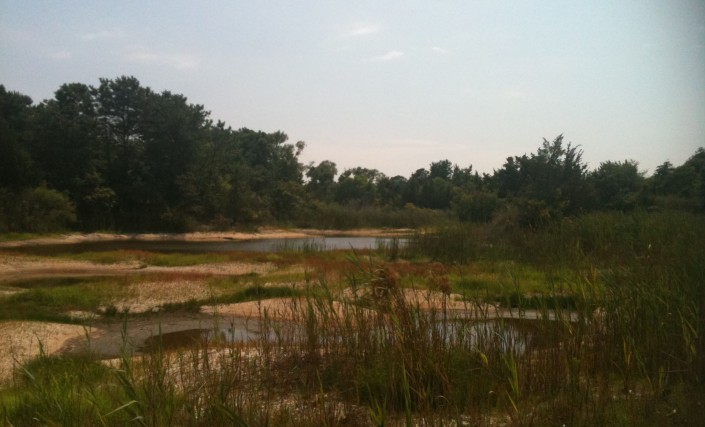
NJDEP, Division of Fish and Wildlife’s Endangered and Nongame Species Program and the Conserve Wildlife Foundation of NJ have enhanced a complex of 12 vernal pools in Cape May County to create habitat for state-endangered eastern tiger salamanders and other vernal pool breeding amphibians. The interconnecting pools allowed eastern tiger salamanders to return to vernal pools to breed in early winter.


In mid-December, eastern tiger salamander egg masses can be found in the pools and egg masses collected from other sites have also been introduced into these pools as supplements.

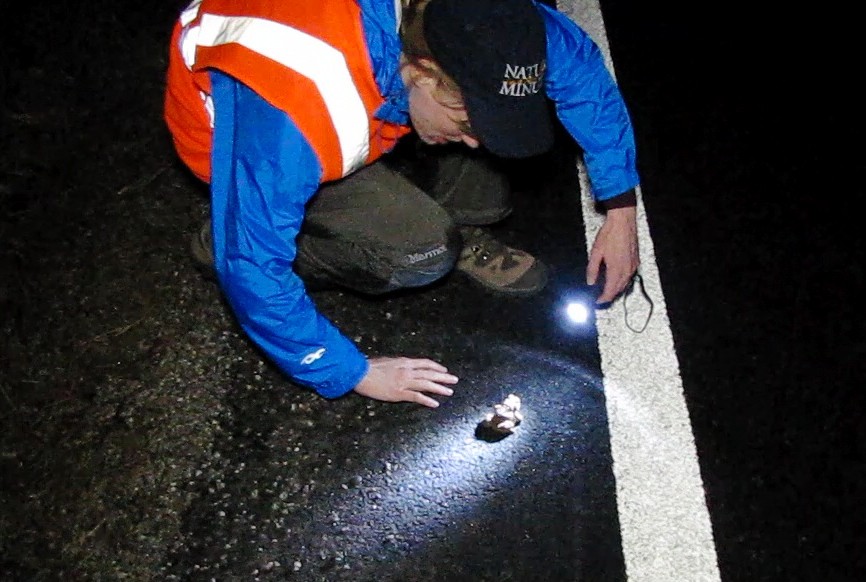
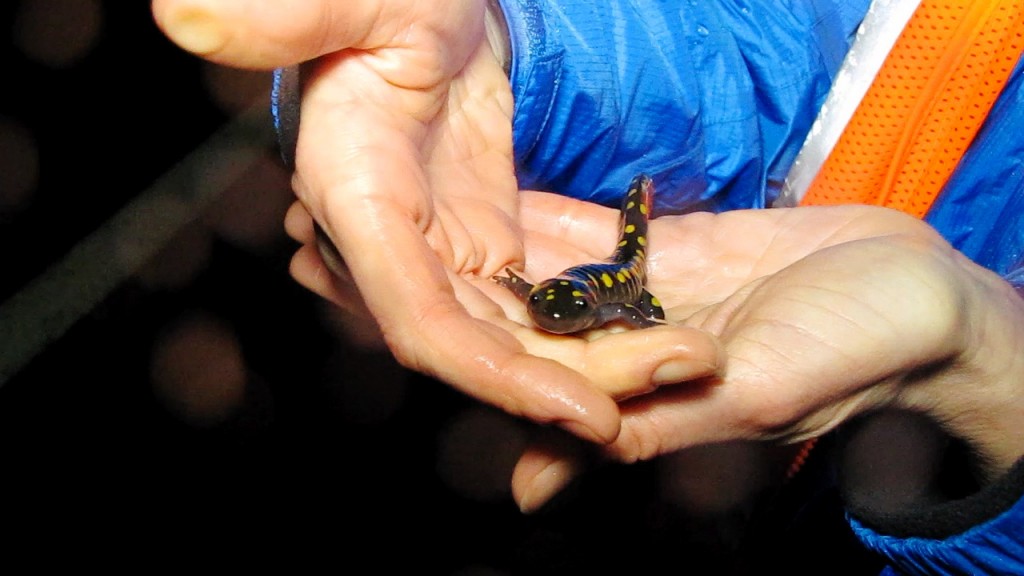
Every year,  volunteers on a wooded road in northwestern New Jersey spend some early spring nights looking for frogs and salamanders to count.

They wait for the amphibians to cross the road on their way from the wooded uplands where they winter to the marshy lowlands and vernal pools where they will do their spring mating

Wood frogs and blue-spotted salamanders are more common amphibians in northern New Jersey and not endangered.

The NJ’s Endangered and Nongame Species Program and Conserve Wildlife, along withe the NJ Audubon Society are partners on the Amphibian Crossing Survey Project. Relying again on volunteers to help monitor sites in Warren and Morris County, they identify additional crossings throughout the northern region of the state. (Due to limited resources, they are currently focusing efforts on northern New Jersey.)


It is estimated that one third of the world’s amphibians are threatened with extinction, according to the International Union for the Conservation of Nature (IUCN).

SOURCES:
A Surfeit of Salamanders
NJ Online Field Guide for Reptiles and Amphibians


Tuesday, December 30, 2014

Reports on 3 New Jersey Raptors

An osprey returns to its nest     Photo by Gary Lehman

Raptors, commonly referred to as "birds of prey," include hawks, owls, eagles, falcons and vultures. Raptors have fascinated people for thousands of years and inspire people even today. Fortunately, after some frightening declines in some of our largest species, raptors represent some of New Jersey's greatest success stories.

The bald eagle, osprey and peregrine falcon have made impressive comebacks from the brink of extinction, in large part thanks to the efforts of division biologists.

Unfortunately, not all species of raptors are thriving - the American kestrel, for instance, has experienced a sharp decline in recent years, and the work of biologists in the Endangered and Nongame Species Program continues.

The 2014 reports on three raptor species managed by the NJDEP Division of Fish and Wildlife have been posted on the Division's web site. The reports detail the management efforts and results of Division staff and dedicated volunteers.

This work would not be possible without public support. Donations to the program can be made on the NJ state income tax return (Line 58 - check-off for wildlife) and through Conserve Wildlife License Plates.


2014 Peregrine Falcon Report (pdf, 130kb)
2014 Osprey Report (pdf, 105kb)
2014 Eagle Report (pdf, 970kb)


Also 
From One to 135 - New Jersey's Bald Eagle Success Story (US FWS site)


Source:  http://www.njfishandwildlife.com/ensp/raptor_info.htm .

Wednesday, December 3, 2014

Newly Identified Species Discovered in New Jersey - Atlantic Coast Leopard Frog


Atlantic Coast Leopard Frog  - NJFWS photo
 
The NJDEP Division of Fish and Wildlife Endangered and Nongame Species Program is currently participating in an ongoing effort to map the potential range of the Atlantic Coast leopard frog. This newly identified species is being found in places as diverse as the Great Swamp National Wildlife Refuge, the Meadowlands, marshlands along the Delaware River and Delaware Bay, Cape May Point State Park, and along stretches of the state's coastline.

For Division of Fish and Wildlife Endangered and Nongame Species Program zoologist Brian Zarate, having a hand in helping to “discover” a new frog species in a state as populated and urbanized as New Jersey is both a “very cool” and “humbling” experience.

“It’s kind of humbling, especially as a biologist, to realize that in a place like New Jersey, there’s an opportunity to learn new things,” Zarate said. “This discovery teaches us not to give up on certain habitats that people might dismiss.”

As part of a Rutgers University research project, the frog, barely the length of one’s thumb, has made national news with the publication of a study confirming its existence on Staten Island not far from the Statue of Liberty – going about its business unnoticed.

But Zarate and Division of Fish and Wildlife have been quietly contributing to the Rutgers Research for several years and, using a federal State Wildlife Grant matched by state funds, the Endangered and Nongame Species Program is currently working on a two-year-project to further refine the species’ habitat range in New Jersey.

“New Jersey has been a leader in protecting valuable wetlands resources,” said David Jenkins, Chief of the Endangered and Nongame Species Program. “These efforts have included wetlands in urban and suburban areas that may not, on first blush, appear to be of great value to wildlife. This discovery of this frog, literally in our backyard shows that New Jersey’s swamps and marshes, even those in urban and suburban landscapes, still have tremendous value for our native wildlife and we shouldn’t discount their value.”

Zarate’s connection to the Atlantic Coast leopard frog actually goes back to 2003, when he and a group of others working with protection of reptiles and amphibians heard an unfamiliar frog call at the Great Swamp National Wildlife Refuge in Morris County. The call is now frequently described as a series of chucks and occasional groans.

At the time, Zarate was a state contract biologist with the Conserve Wildlife Foundation of New Jersey. The group captured the frog and took some photos. It wasn’t the southern leopard frog, a species found widely in the Pine Barrens, so they concluded it was a northern leopard frog that someone, perhaps a high school biology teacher, had released into the wild.

Four years later, the group got the idea to return to Great Swamp to confirm whether the strange frog was still there, and perhaps if it was in other parts of the property. Not only was it where they first found it, but in several other wetlands as well.

A few months later, Zarate took a job with the Endangered and Nongame Species Program. A YouTube video of the frog that Zarate posted in 2007 connected him with Jeremy Feinberg, a doctoral student at the Rutgers University School of Environmental and Biological Sciences, who was working in the New York area to track down other reports of an unfamiliar frog call.

“Our role in the early stages was to help Feinberg’s group and explore what was going on in New Jersey,” Zarate said.

Using the state’s database of frog records and information gleaned from a wide range of professional experts, amateur frog aficionados, museum records, and the Internet, the frog was confirmed to exist in a wide range of habitats, virtually anywhere researchers went to confirm its call, actually the mating song of the male of the species.

Next spring, biologists and volunteers with the Endangered and Nongame Species Program will fan out to wetlands across the state, searching for more evidence of the Atlantic Coast leopard frog and collecting data on its habitat preferences. In addition, museum records indicate that a third leopard frog, the northern leopard frog, did, in fact, naturally occur in the northern part of the state as recent as the 1930s. Surveys will specifically target this frog at its past locations in hopes of finding them still hanging on.

“There’s still a lot we don’t know,” Zarate said. “The Atlantic Coast leopard frog is a really interesting species that somehow manages to hang on even in urban environments. It’s important we learn as much as we can about New Jersey’s wildlife and this discovery highlights the value in protecting our natural resources.”


SOURCE:  http://www.nj.gov/dep/newsrel/2014/14_0126.htm .

Wednesday, June 6, 2012

Amphibian Crossing Project on Video

An American toad gets some crossing protection

This year, the Amphibian Crossing Project again helped migrating amphibians cross busy roads. Among the species identified were Jefferson salamanders, a New Jersey species of special concern.

The Conserve Wildlife Foundation of NJ and their partner in the Amphibian Crossing Project, the NJ Endangered & Nongame Species Program, placed a particular location at the top of their survey list. The project activity was captured for a special episode of Nature in a New York Minute.

“The surveyors were out until 4am this year to collect the data they needed on the amphibian population and traffic rate at the site,” said Kelly Rypkema who filmed the team’s efforts. “Helping amphibians across was icing on the cake. Instead of feeling tired, I felt a real tangible sense of accomplishment which spurred me on.”


This year, the surveyors were challenged by the sporadic nature of the nighttime rain showers during which the amphibians cross. “Most times, the rain hit very late at night or before dawn – a great situation for frogs and salamanders that have to cross otherwise busy roads,” said MacKenzie Hall, the biologist who coordinates the project, “but tough for us to keep tabs on.”


Nature in a New York Minute is a series about nature in urban environments. From communicating with ants to interpreting the secret life of squirrels, biologist and host Kelly Rypkema showcases in each episode ways to be actively involved with the nature of the concrete jungle. You can follow the series on Facebook.

Kelly holding a spotted salamander


Monday, March 5, 2012

Help Fund Endangerd Species in New Jersey


The Endangered and Nongame Species Program is responsible for protecting and managing nearly 500 wildlife species, including 73 species currently listed as endangered or threatened. When I have talked to groups about the program, one thing that always surprises people is that it is funded almost entirely by the state income tax check-off donations and through sales of the distinctive Conserve Wildlife License Plate. Imagine running a program by relying on people to contribute when they are paying their taxes!

You can help protect New Jersey's bald eagles and all other rare wildlife by supporting the New Jersey Endangered Wildlife Fund when you file your state income tax this year. Jusst look for Line 58 on your NJ 1040 income tax return, and check-off for wildlife or remind your tax preparer that you want to make a contribution.

Every dollar you donate goes directly to the DEP's Endangered and Nongame Species Program, enabling biologists to continue their work to restore, conserve and enhance New Jersey's populations of rare species. What's more, your contribution is matched with an equal amount of federal funding, further strengthening efforts to protect hundreds of imperiled species.

The bald eagle used on the images above is the best example of a species on the brink of extinction in NJ. In 1979, there was just a solitary nesting pair. Residues of the pesticide DDT from the 1950s and 1960s were still causing thin, fragile eggshells that crushed under the weight of the adult eagles.
But volunteers and Endangered and Nongame Species biologists, plus a ban on DDT and other pesticides, has allowed the bald eagles to make a steady comeback over the past three decades.

In 2011, there were 113 nesting pairs and 119 fledged chicks and a January 2012 bird count found well over 300 eagles making their homes in New Jersey.

The Delaware Bay region of Cumberland and Salem Counties' expanses of coastal wetlands provide plentiful fishing grounds, and the species is expanding northward. The nesting range now includes 18 of New Jersey's 21 counties.

They are still an ususual sight for most New Jerseyeans. A bald eagle perched in a tree directly above busy Route 202-206 in Bedminster, Somerset County, created a minor traffic jam recently as motorists stopped and pulled out their cameraphones.

And don't forget our secretive bobcats that were reintroduced 30 years ago and are now living in the northern third of the state.

Peregrine falcons - the fastest of the world's birds - disappeared from New Jersey in the 1960s, but a reintroduction project and intensive management have resulted in a stable population of about 20 nesting pairs, including some in major cities.

 
If tax time isn't the right way for you to help out, how about "driving home" the conservation message showing off your commitment by purchasing a $50 Conserve Wildlife license plate? More than 80% of your payment, or $4 out of every $5, goes directly toward preserving our state's endangered wildlife. That's crucial, because the New Jersey's endangered, threatened and nongame wildlife protection program receives no dedicated state funding and must depend completely on contributions from the general public.

For more information on New Jersey's endangered and threatened species, go to www.nj.gov/dep/fgw/ensphome.htm. This webpage includes information on how to help these species through both the tax return check-off and Conserve Wildlife license plates.

Sunday, February 26, 2012

Salamanders At Cape May Vernal Pool

The new vernal pools  Photo: Dave Golden
 As a follow-up to yesterday's post about the spring amphibian crossings now taking place in NJ, here's a link to a post by Karena DiLeo, Wildlife Biologist for Conserve Wildlife Foundation (CWF).

Last fall, NJDEP's ENSP and CWF completed a project to enhance a complex of 12 vernal pools in Cape May County, creating habitat for state-endangered eastern tiger salamanders and other vernal pool breeding amphibians.

The interconnecting pools allowed eastern tiger salamanders to return to vernal pools to breed in early winter.

In mid-December, eastern tiger salamander egg masses were found in the pools. Egg masses collected from other sites have also been introduced into these pools as supplements.

Monday, March 7, 2011

Endangered Species and a Tax Check-Off


Did you know that New Jersey residents can help secure the future of the State's threatened and endangered wildlife by making a dedicated donation when they file their State income tax returns this year?

"Despite being the nation's most densely populated state, New Jersey has an incredible diversity of wildlife, including some of the world's most beautiful and rare animals,'' said NJDEP Commissioner Martin. "These are special creatures that need our protection, and which we'd like to preserve in the Garden State for our children and future generations. We can support this important effort by making a simple check-off for wildlife on our State income-tax returns."

Residents should look for Line 58 -- the New Jersey Endangered Wildlife Fund -- on the NJ 1040 income tax form, or remind their tax preparers they want to make a contribution.

Each donated dollar goes directly to the DEP's Division of Fish and Wildlife, enabling its Endangered and Nongame Species Program biologists to continue their work to restore, conserve and enhance New Jersey's populations of rare species.

Each contribution is matched by an equal amount of federal funding, which further strengthens efforts to protect imperiled species.

The Endangered and Nongame Species Program manages nearly 500 wildlife species, including 73 species of birds, reptiles, amphibians, invertebrates, mammals and fish currently listed as endangered or threatened.

When I have done talks as a volunteer for the ENSP, one thing I have always emphasized is that the program is funded almost entirely by federal grants, which require matching state funds from the state income-tax check-off and sales of New Jersey's distinctive Conserve Wildlife license plate.

No, it's not paid for by your tax dollars. What a way to fund a program!  And what a time to ask for donations - when people are paying their income taxes!

Nevertheless, those two revenue sources, which generated $292,000 in 2010 and $1.8 million over the past five years, help finance efforts by DEP biologists to prevent some rare species from becoming extinct in New Jersey, and to make sure other creatures do not have to be added to the state's list of endangered and threatened species.

What are the "dividends" that your investment makes?

New Jersey biologists restored our bald eagle population from one nest in 1979 to 82 nesting pairs today.

New Jersey biologists have led the international effort to prevent the Western Hemisphere extinction of the red knot, which depends on the eggs of spawning Delaware Bay horseshoe crabs they devour in New Jersey each spring to fuel an epic migration from their South American breeding grounds to Canadian Arctic nesting grounds.

The bobcat was reintroduced in New Jersey 30 years ago, and research and protection efforts since then have allowed this secretive cat to establish a foothold in the northern third of the state.

More than 30 years of intensive management and cooperative efforts with coastal communities have prevented the State extinction of three New Jersey beach nesting birds, the piping plover, least tern and black skimmer.

Peregrine falcons disappeared from New Jersey in the 1960's but through a reintroduction project and intensive management we now have a stable population of 20 nesting pairs statewide.


Learn more about New Jersey's endangered species:
http://www.njfishandwildlife.com/ensphome.htm
http://www.njfishandwildlife.com/tandespp.htm

For information on the Conserve Wildlife license plates:
http://www.nj.gov/dep/fgw/ensp/plates.htm

Thursday, December 30, 2010

Allegheny Woodrats

As I have written here in an earlier post, I don't get much sympathy when I do a speaking engagement on NJ's endangered species and discuss woodrats. Rats, like snakes, are often lumped together by the general public and considered pests.

There are dozens of non-game mammal species found in New Jersey. Of these, there are only three land mammal species listed as "endangered." They are the bobcat, Indiana bat and Allegheny Woodrat.

The state-endangered Eastern woodrats have been declining at an alarming rate throughout the northeastern portion of their range. The decline has been attributed, at least in part, to the parasite, raccoon roundworm. NJ's last remaining eastern woodrat (Neotoma floridana) population is at the Palisades Interstate Park in Bergen County.

The Allegheny woodrat, Neotoma magister, is a species of "pack rat" in the genus Neotoma. Once believed to be a subspecies of the Eastern Woodrat or Florida Woodrat,  extensive DNA analysis has proven it to be a distinct species.

Photo: http://science.nature.nps.gov

The Allegheny Woodrat prefers rocky outcrops associated with mountain ridges such as cliffs, caves, talus slopes, and even mines. This is mostly true for Pennsylvania and Maryland. In Virginia and West Virginia, woodrats are found on ridges but also on side slopes in caves and talus (boulders and breakdown) fields. The surrounding forest is usually deciduous

Distribution mainly occurs along the Appalachian Mountain range. Historically found as far north as Connecticut where it is now extinct, southeastern New York (near extinct), northern New Jersey, and northern Pennsylvania southwestward through western Maryland, Tennessee, Kentucky, West Virginia, northern and western Virginia to northeastern Alabama and northwestern North Carolina with isolated populations north of the Ohio River in southern Ohio and southern Indiana. The Tennessee River is generally accepted as the southern range limit.

Although the Allegheny Woodrat is not federally listed, it is in major decline and is state listed. In parts of their range (New York, New Jersey, and Pennsylvania), the Allegheny Woodrat population has been in decline over the past thirty years. A decline in populations of Allegheny woodrats was first noticed in the 1980s. Since that time, woodrats have become extirpated from at least two states and have declined dramatically in several others. Recent evidence suggests that the decline of this species may be proceeding further south to include states where woodrat populations were previously considered to be stable.

The Allegheny Woodrat prefers rocky outcrops associated with mountain ridges such as cliffs, caves, talus slopes (boulders and breakdown), and even mines.

The Allegheny Woodrat's diet primarily consists of plant materials including buds, leaves, stems, fruits, seeds, acorns and other nuts. They store their food in caches and eat about five percent of their body weight a day.The Allegheny Woodrat: Ecology, Conservation, and Management of a Declining SpeciesNocturnal, the Allegheny Woodrat spends its nights foraging, collecting food and nesting materials, very rarely traveling more than 150 feet from its home range.

They also collect and store various non-food items such as bottle caps, snail shells, coins, gun cartridges, feathers and bones. This trait is responsible for the nickname "trade" or "pack rat".

These rats form small colonies in which their nesting areas consist of a network of underground runways. They also create "latrines" - large fecal piles the rats deposit on protected flat rocks.

Researchers have found dried leaves placed around the nesting area which appear to act as alarms to warn the rats of approaching danger.

Unlike their cousins, the Allegheny Woodrat (Neotoma magister) is not a prolific breeder, averaging only one to three young per litter. In the wild, the Allegheny Woodrat has been known to live up to three years.

Predators include owls, skunks, weasels, foxes, raccoons, bobcats, large snakes and, of course, humans. At one point, the Allegheny rat was hunted for food and also killed due to false identification based on its resemblance of more problematic European rats. The Allegheny woodrat is most easily distinguished from the Norway rat by its larger, naked ears and its hairy, bicolor tail that is dark gray above and white below.

The NJ ENSP conducts annual monitoring of the Palisade population via live-trapping during the early fall. Trapping results indicate that this population has remained stable. Annual monitoring of this population has become a priority due to the rapid decline and extirpation of the species from their former range in New York and portions of eastern Pennsylvania.

More Information

On New Jersey's only remaining Allegheny woodrat population at the Hudson River Palisades NJ's Allegheny Woodrat Fact Sheet (pdf, 59kb)

The Allegheny Woodrat: Ecology, Conservation, and Management of a Declining Species

http://www.iucnredlist.org/apps/redlist/details/14581/0 

Thursday, March 25, 2010

Spring Amphibian Migrations

Why did the wood frog cross the road?

NJ Audubon, partners with the NJ Fish and Wildlife Endangered and Non-game Species Program (ENSP)
and Conserve Wildlife Foundation of NJ, to study migratory movements of amphibian populations in the state

There are widespread declines in amphibian populations globally. Studying local populations can help us more effectively protect their habitats.

Amphibians often play important and keystone roles in the natural world as indicators of functioning healthy ecosystems and as part of the predator - prey relationship. Like birds, they often signify a "canary in the coal mine" because widespread declines may indicate far reaching problems in the ecosystem. Herpetologists around the world have initiated research and conservation efforts to identify problems associated with these declines and come up with solutions to counteract them. The incredibly high extinction rate of some species can be attributed to:

* Human disturbance
* Habitat destruction
* Encroachment
* Pollution
* Introduced predators

Why did that frog, toad, or salamander cross the road?  Amphibian populations require habitat with abundant food supplies, breeding areas, and hibernation sites - and they need a safe travel path between these sites.

The always increasing development here in NJ and the entire northeast continues continues to separate hibernation sites from breeding pools with road crossings that amphibians must travel.

There are some amphibians (vernal pond obligates VPOs) that can only reproduce successfully in vernal ponds. Why vernal (spring) pools?  These pools only hold water for several months in the spring, so they are not places for amphibians to "live" but their short existence also ensures that fish can not live there and so will not eat the amphibian's eggs or young.

Most of these species are moving from safer upland forests on the first warm rainy nights to these vernal ponds. There, it is amphibian dating time. They search for mates, breed and lay their eggs for the next generation.


Spring Amphibian Migration 2010 video shows volunteer training and two crossings.

These amphibians might be living in your backyard or a small woodlot near you. You probably wouldn't even notice any "road kill" as nocturnal scavengers do a good job of cleaning up the evidence by morning.

Volunteers learn how to identify amphibian crossing sites (generally historic migratory routes from past years) and conduct night surveys on suitable weather nights to look for frogs and salamanders crossing roads.

They collect amphibian mortality data for the NJ Endangered Species Program. They also act as "crossing guards" to help amphibians negotiate dangerous road crossings during the most stressful time of their life cycle.

Of course, all volunteers also act as ambassadors for the project by educating other people about what they do.

Fowler's toad

To become a volunteer, visit the ENSP website at http://www.nj.gov/dep/fgw/wcchome.htm

For more information on this effort, see http://www.njaudubon.org/SectionEducation/Amphibians.aspx

FURTHER READING
On NJ Vernal Pools
Aquatic Turtles: Sliders, Cooters, Painted, and Map Turtles
NJ Wildlife: An Introduction to Familiar Species of Birds, Mammals, Reptiles, Amphibians, Fish and Butterflies


Obligate Vernal Pool Breeding Amphibians:
Eastern tiger salamander (Ambystoma t. tigrinum) Endangered
Marbled salamander (A. opacum) Special Concern
Spotted salamander (A. maculatum)
Jefferson salamander (A. jeffersonianum) Special Concern
Blue-spotted salamander (A. laterale) Endangered
Wood frog (Rana sylvatica)
Eastern spadefoot toad (Scaphiopus holbrookii)

Facultative Vernal Pool Breeding Amphibians:
Green frog (Rana clamitans melanota)
Bullfrog (R. catesbiana)
Pickerel frog (R. palustris)
Southern leopard frog (R. utricularia)
Carpenter frog (R.virgatipes) Special Concern
Northern cricket frog (Acris crepitans)
Northern spring peeper (Psuedacris crucifer)
New Jersey chorus frog (P. triseriata kalmii)
Upland chorus frog (P. triseriata ferarium)
Northern gray treefrog (Hyla versicolor)
Southern gray treefrog (H. chrysocelis) Endangered
Pine Barrens treefrog (H. andersonii) Threatened
Four-toed salamander (Hemidactylium scutatum)
Long-tailed salamander (Eurycea l. longicauda) Threatened
American toad (Bufo americanus)
Fowler's Toad (B. fowlerii) Special Concern

In addition to amphibians, there are several reptiles that inhabit vernal pools on a seasonal basis, primarily to eat the eggs and larvae of amphibians:
Wood turtle (Glyptemys insculpta) Threatened
Spotted turtle (Clemmys guttata) Special Concern
Mud turtle (Kinosternon subrubrum)
Eastern painted turtle (Chrysemys picta picta)
Common snapping turtle (Chelydra serpentina serpentina)