Showing posts with label raptors. Show all posts

Thursday, February 17, 2022

Bald Eagles in New Jersey 2021


What was the nest of the last breeding pair of bald eagles in NJ in 1976

Raptors, commonly referred to as "birds of prey," include hawks, owls, eagles, falcons, and vultures. Fortunately, after some frightening declines in some of our largest species, raptors represent some of New Jersey's greatest success stories.

The bald eagle, osprey, and peregrine falcon have made impressive comebacks from the brink of extinction, in large part thanks to the efforts of state biologists. 

Unfortunately, not all species of raptors are thriving - the American kestrel, for instance, has experienced a sharp decline in recent years, and the work of biologists in the Endangered and Nongame Species Program continues.

The Delaware Bay region of the state remained the state’s eagle stronghold with about 50% of all nests located in Cumberland, Salem, and Cape May counties. 

Last year there were 247 Monitored Eagle Nests and 222 were active (with eggs). 27 new eagle pairs found and 296 young eagles fledged.

The 2021 Bald Eagle Management and Research report is now available online and all raptor reports can be viewed online.


Tuesday, January 19, 2021

Winter Owl Spotting

Can you identify this well-camouflaged owl?
Image by Kevinsphotos from Pixabay

Though most of us prefer to be out in nature in spring through autumn, winter is actually a great time for spotting and listening for owls. Bare trees make it easier to see at dawn and dusk when many owls are active.

New Jersey’s year-round owls include great horned, Eastern screech, barred and, less common, short-eared, long-eared, barn and saw-whet owls. 

In winter, you can also see snowy owls and short-eared, long-eared, and saw-whet owls from the north that migrate to our warmer climate in search of a steadier food supply. Barn owls usually migrate further south from New Jersey in winter, but there may be a few that stay.

Giselle Chazot Smisko, director of the Avian Wildlife Center in Wantage advises looking carefully in those bare branches at dawn and dusk as owls may nap in tree branches during daylight hours. Owls can camouflage themselves very well.

Of course, you can also listen for their distinctive calls. It is also possible to find signs of an owl's roosting place by finding chalky white droppings and grey owl pellets of indigestible bones and fur in the area below a tree. (They are not "owl poop" but rather regurgitated parts and they are frequently opened up in science lessons to show what the owl had eaten.)

If you want a guaranteed owl spotting (especially with children), visit the Raptor Trust or the Woodford Cedar Run Wildlife Refuge. Both have resident owls that have been injured and cannot survive in the wild. The Avian Wildlife Center, Raptor Trust, and Woodford Cedar Run Wildlife Refuge also provide public education programs at various locations using “ambassador” owls.

MORE

Cornell Ornithology Lab’s “All About Birds” website 

National Audubon Society’s guide to North American birds

New Jersey Conservation Foundation and njconservation.org/owl-spotting-in-winter/

Wednesday, August 1, 2018

The American Kestrel and Raptors in New Jersey

American Kestrel - male

The Bald EaglePeregrine FalconOsprey, and the American Kestrel are some of New Jersey's raptors. Commonly referred to as "birds of prey," this group includes hawks, owls, eagles, falcons and vultures.

Raptors have fascinated people for thousands of years and were once the birds kept by British royalty and used i both ceremonies and for hunting.

After some frightening declines in some of our largest species, raptors represent some of New Jersey's greatest wildlife success stories. The bald eagle, osprey and peregrine falcon have made impressive comebacks from the brink of extinction, in large part thanks to the efforts of division biologists.

Unfortunately, not all species of raptors are thriving - the American kestrel, for instance, has experienced a sharp decline in recent years, and the work of biologists in the Endangered and Nongame Species Program continues.


American Kestrel - female
This once-common inhabitant of fallow fields and pastures has declined in recent years, and the reasons are largely unknown. In February, 2012, the American kestrel became listed as a State Threatened species. 

MORE

Wednesday, September 9, 2015

Raptor Watch New Jersey - Montclair Hawk Watch

Montclair Hawk Watch

Because New Jersey is located along the Atlantic Flyway, we are in a great place to observe hawks heading south to their wintering grounds. This is the time when migrating birds of prey come through NJ in greater concentrations as they follow our ridges and coastline.

Raptors migrate from late summer through early December, but the numbers peak between mid-September and mid-October.I have read that the best days usually occur after a day that featured a cold front with northerly winds, and mornings and early afternoons are better than later in the day.

It is pretty awesome to watch them ride the thermals, wind currents and updrafts along the Hudson River Palisades to the Kittatinny Ridge along the Delaware River and down to Cape May.

You can get more information at the New Jersey Audubon Society and the Hawk Migration Association of North America websites.

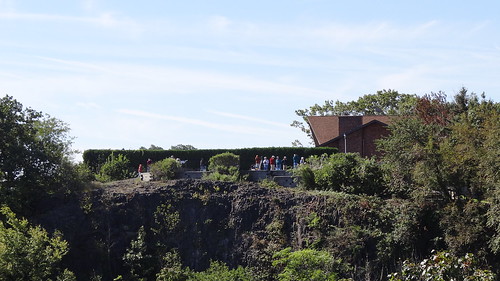
This week, I walked up the stairs to the Montclair Hawk Watch (Essex County) a observation platform that is maintained by the NJ Audubon Society. From there, you can watch migrating birds move south along the first ridge of the Watchung Mountains. On a clear day, the Verrazano Narrows Bridge, the New York City skyline and the Statue of Liberty are also in view.

The site is interesting atop a 500-foot basalt ledge on the First Watchung Mountain. There is a stone-filled platform at the top of a long staircase. They have recorded sightings of broad-winged hawks, bald eagles, American kestrels, red-tailed hawks, ospreys, merlins, sharp-shinned hawks, northern harriers, peregrine falcons and Cooper's hawks.

Directions: from the Garden State Parkway in Bloomfield, take exit 151 for Watchung Avenue and head west on Watchung to its end at Upper Mountain Avenue in Montclair, about 2.1 miles. Make a right turn and go north on Upper Mountain 0.7 miles to Bradford Avenue. Make a left turn and go up Bradford 0.1 miles to Edgecliff Road and make a right turn. Go up Edgecliff 0.2 miles and park on the shoulder (to avoid parking problems, please park well off the side of the road). The lookout path is on the south side of the road marked with a sign at the base of the steps.

Other places for watching:
  • Palisades Interstate Park, Bergen County, State Line Lookout - 527 feet above the Palisades.
  • Sunrise Mountain, Sussex County - the pavilion atop the mountain is located in Stokes State Forest in Branchville.
  • Chimney Rock, Somerset County in Washington Valley Park in Martinsville. This is the southern end of the Watchung Ridge that starts at the Montclair platform.
  • Raccoon Ridge in Blairstown is on the Kittatinny Mountains at an elevation of 1,563 feet and Scotts Mountain, also in Warren County at the Merrill Creek Reservoir in Washington.
  • Down at the tip of the state at Cape May Point State Park birds riding air currents from the surrounding Atlantic Ocean and the Delaware Bay head south overhead.


Tuesday, December 30, 2014

Reports on 3 New Jersey Raptors

An osprey returns to its nest     Photo by Gary Lehman

Raptors, commonly referred to as "birds of prey," include hawks, owls, eagles, falcons and vultures. Raptors have fascinated people for thousands of years and inspire people even today. Fortunately, after some frightening declines in some of our largest species, raptors represent some of New Jersey's greatest success stories.

The bald eagle, osprey and peregrine falcon have made impressive comebacks from the brink of extinction, in large part thanks to the efforts of division biologists.

Unfortunately, not all species of raptors are thriving - the American kestrel, for instance, has experienced a sharp decline in recent years, and the work of biologists in the Endangered and Nongame Species Program continues.

The 2014 reports on three raptor species managed by the NJDEP Division of Fish and Wildlife have been posted on the Division's web site. The reports detail the management efforts and results of Division staff and dedicated volunteers.

This work would not be possible without public support. Donations to the program can be made on the NJ state income tax return (Line 58 - check-off for wildlife) and through Conserve Wildlife License Plates.


2014 Peregrine Falcon Report (pdf, 130kb)
2014 Osprey Report (pdf, 105kb)
2014 Eagle Report (pdf, 970kb)


Also 
From One to 135 - New Jersey's Bald Eagle Success Story (US FWS site)


Source:  http://www.njfishandwildlife.com/ensp/raptor_info.htm .

Tuesday, May 3, 2011

Jersey City Peregrine Falcon Webcam - Hatching Near

Male peregrine guarding the nest. Note banding.
The Jersey City Peregrine Webcam streams live video from a nestbox atop 101 Hudson Street between April and July each year. Follow the season on screen during that period. Clicking on the still image will open a new window containing the live video feed when active.

They are projecting hatching to occur around May 5-6, so this is a great time to tune in.

Viewers get a glimpse of the four eggs only when the adults get up to exchange duties or to stretch, but these peregrines are the essence of diligence during the 32-33 days of required incubation, very focused on their duties.

The ENSP staff and volunteers are monitoring peregrine nesting at about 20 other sites around the state. The recent rain and wind storms may have caused problems at some sites that are more vulnerable to easterly winds. In many cases all we can do is document the outcome of those nests. (See the annual reports at www.njfishandwildlife.com/ensp/ for details.)

The Jersey City peregrines have been very successful over the years. During a nest check visit in March, it was determined that adults are the same birds that have nested here since at least 2005 (the female) and 2006 (the male). The female has not been identified except that she wears a silver federal band and no color band. The male was banded in 2003 at Riverside Church in NY, making him 8 years old this year. Both are fiercely defensive of their nest and have been good parents over the years.

Keep watching this great natural show!


NJDEP Division of Fish & Wildlife - Peregrine Falcon Webcam

Thursday, January 13, 2011

American Kestrels in NJ

American Kestrel eating a cricket "on the wing" 
photo via http://birdcapemay.org

The American Kestrel was a once-common inhabitant of fallow fields and pastures has declined in recent years, and the reasons are largely unknown. The Endangered and Nongame Species Program embarked on a survey campaign in 2004, and the findings were alarming. More detailed surveys and habitat evaluations were conducted in 2005, along with building a predictive habitat model.

Experiments with nest boxes are planned for 2006 to see if breeding success can be improved for this now scarce bird. 200 nest boxes will be constructed and installed throughout New Jersey. These boxes will be monitored during the breeding season by ENSP staff and/or volunteers.

Please report your sightings of this bird, especially in the breeding season (April – July) using the Sighting Report Form http://www.njfishandwildlife.com/ensp/rprtform.htm

Wednesday, January 12, 2011

2010 Osprey Information for NJ

Ospreys are well-loved birds of our coastal bays and marshes. Formerly known as the fish hawk, ospreys rely almost exclusively on fish for their diet. They have taken well to human structures, such as duck blinds and channel markers, for nest structures. They, like eagles and falcons, succumbed to the effects of DDT and their population dropped to about 60 pairs by the early 1970s.

With the help of biologists and, more recently, volunteers who put up nest structures, they have recovered to more than 360 nesting pairs. The Endangered and Nongame Species Program monitors their health as an indicator of many coastal species, as they are sensitive to contaminants and the viability of the aquatic food chain.

2010 Osprey Report (pdf, 179kb)

Tuesday, January 11, 2011

NJ Peregrine Falcon Information for 2010

Peregrine falcons, as the fastest bird in the skies, have fascinated people for centuries. Peregrine numbers fell due to the effects of DDT which caused their eggs to fail, and they became extinct east of the Mississippi by 1964. They were one of the first birds to be the focus of conservation, however, and through an intensive reintroduction program, returned to the skies in New Jersey and other eastern states in the 1980s.

The population in New Jersey has been about 15-20 pairs annually since 1998. In 2003, on the 30th anniversary of New Jersey’s Endangered and Nongame Species Conservation Act, peregrine falcons returned to their historic cliff nesting habitat on the Hudson River Palisades – a huge milestone in the peregrine's recovery in the state and the region.

2010 Peregrine Falcon Report (pdf, 255kb)

Friday, January 7, 2011

NJ Raptor Reports for 2010 Now Online

Peregrine on prey
Raptors, commonly referred to as "birds of prey," include hawks, owls, eagles, falcons and vultures. Raptors have fascinated people for thousands of years and inspire people even today. Fortunately, after some frightening declines in some of our largest species, raptors represent some of New Jersey's greatest success stories.

The bald eagle, osprey and peregrine falcon have made impressive comebacks from the brink of extinction, in large part thanks to the efforts of division biologists. Unfortunately, not all species of raptors are thriving - the American kestrel, for instance, has experienced a sharp decline in recent years, and the work of biologists in the Endangered and Nongame Species Program continues

The NJDEP Division of Fish and Wildlife has posted the 2010 annual reports for Bald Eagle, Osprey and Peregrine Falcon on its website.  The reports summarize management and research activities, nest productivity and related information on these state endangered species.  Thanks to the efforts of the division's Endangered and Nongame Species Program and others, all three species have staged remarkable comebacks in the state.

To view the reports, as well as other information about these species, visit http://www.njfishandwildlife.com/ensp/raptor_info.htm .

Thursday, December 24, 2009

Bald Eagle Rescued in Essex County

According to nj.com, a juvenile bald eagle was discovered trapped in a tall grass embankment at a Short Hills reservoir on the property of New Jersey American Water.

The eagle had entered the ice-cold water in a marshy area nearby and was unable to fly out because of heavy winds and apparent neurological damage from lead it had consumed.

The Raptor Trust, a Millington-based bird sanctuary, was brought in to rescue and rehabilitate the bird. Eagles sometimes contract lead poisoning from eating deer carcasses that contain buckshot. This was the Raptor Trust’s first Essex County eagle rescue.

The reservoir property is a habitat for migratory water fowl and eagle sightings have become more numerous in recent years.

After treatment at the Raptor Trust, the eagle will hopefully be returned to the reservoir and released.

Wednesday, December 23, 2009

2009 NJ Raptor Reports Available


The 2009 reports for three raptor species actively managed by the NJ DEP Division of Fish and Wildlife's Endangered and Nongame Species Program are now available online. The reports for Bald Eagle, Peregrine Falcon and Osprey summarize management efforts, species status and results of this year's nesting season.

This year, there was a record number of 84 Bald Eagle pairs, which resulted in 69 active nests producing 99 eagle fledglings.

The number of Osprey nesting pairs recorded was 485; a 14% increase since the 2006 survey.

Peregrine Falcons increased also to 24 nesting pairs in 2009.

Visit http://www.njfishandwildlife.com/ensp/raptor_info.htm on the division's website for more information on these species and to view the 2009 reports .

Saturday, July 4, 2009

Successful Comeback for Bald Eagle in New Jersey

Most experts expected the bald eagle to become extinct during the 20th century.

This American symbol has since reversed its decline and begun to recover.

The bald eagle was found to be endangered in 1940 and a law was passed, the Bald and Golden Eagle Protection Act, to protect it from hunting.

DDT offered another threat to the survival of the bald eagle, and continued to feed the decline in numbers after the birds were no longer hunted. When the number reached just 417 breeding pairs in 1963, action was called for and in 1973 the species was put on the newly created Endangered Species List.

The bald eagle is making a strong comeback in the state of New Jersey. Zoologists from the Endangered and Nongame Species Programs (ENSP) locate and monitor eagle nests and territories to determine the species health and population.

Bald eagle numbers in New Jersey are increasing due to the efforts of volunteers who monitor bald eagle nests and report critical data concerning incubation, hatching and fledging dates to DEP wildlife biologists. Along with monitoring the nests, volunteers report new eagle sightings that often lead to the discovery of additional nests.

Despite its continued endangered status, the bald eagle is one of New Jersey's great success stories in endangered species protection and management.

The rising trend in eagle numbers began in the early 1980s. Eagle numbers have not only been increasing in New Jersey, but throughout the Northeast and lower 48 states. Fewer than 10 bald eagles were observed in the state's initial annual survey in 1978 as extensive pesticide use in the mid-1900's decimated the eagle population.

Beginning in 1982, the Department's Division of Fish and Wildlife engaged in a comprehensive strategy to address the situation by acquiring 60 bald eagles from Canada to form the nucleus of a new breeding population.

There are approximately 40 volunteers who assist DEP wildlife biologists by monitoring bald eagle nests from the beginning of the nesting season in December until the young birds take their first flight in late summer. Volunteers provide further protection to the bald eagle by alerting the Department when they witness snowmobiles, ATV's or people walking too close to a bald eagle nesting location. Often volunteers act as educators, informing the public that walking too close to a nesting eagle pair can cause the birds to abandon their nest.


A new record high of 69 eagle pairs was monitored during the 2008 nesting season. 63 of those were active (with eggs) and one was housekeeping. Five other pairs were seen in and around previous nest territories, but it was unknown if and where they nested.

New Jersey’s Delaware Bay region remained the state’s eagle stronghold, with 46 percent of all nests located in Cumberland and Salem counties. Seven new nests were found this season, three in the south, two in central and two in northern NJ. Fifty nests were successful in producing 85 young, for a productivity rate of 1.35 young per active nest.

In January’s Midwinter Eagle Survey, ENSP staff, regional coordinators and
volunteers reported a total of 264 bald eagles, a new record high count. Forty-three eagles were recorded in northern NJ and 221 in the south.