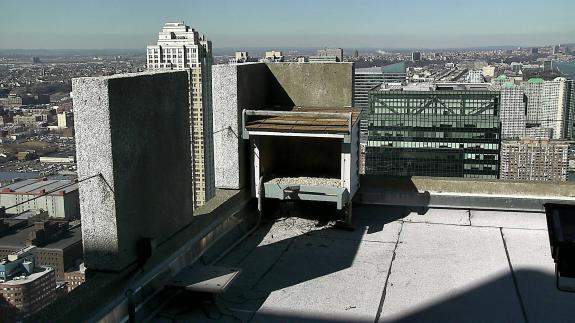
Conserve Wildlife Foundation of NJ has partnered with Union County to live stream the view of a peregrine falcon nest located on the roof of the County Courthouse in Elizabeth, NJ.
A first egg was laid on March 18 and a second on March 21.
A new partnership between the Union County Freeholder Board and the nonprofit Conserve Wildlife Foundation of New Jersey is providing students, scientists and other wildlife enthusiasts all over the world the chance to study a pair of rare peregrine falcons. The birds, endangered in our state, have made their nest on the roof of the historic 17-story Union County Courthouse Tower, located in the bustling center of midtown Elizabeth.
Peregrine falcons have been nesting on the Courthouse Tower every year since 2006. In 2016, Union County began offering a free livestream “Falcon Cam” after installing two cameras inside and outside of the nest. This winter a third camera has been added to provide a scenic view, and audio will be available later this year.
“This year our Falcon Cam will become a new collaborative effort between the County and Conserve Wildlife Foundation, with assistance from the New Jersey Department of Environmental Protection,” said Freeholder Chairman Bruce H. Bergen. “This partnership makes Union County a premier site for falcon observation and research in New Jersey. The result is a truly enriching experience that brings the message of environmental stewardship throughout Union County and beyond.”
Peregrine falcon and young - USFWS photo
The peregrine falcon, also known as the duck hawk, is the largest falcon in New Jersey, and the world’s fastest animal, capable of flying at speeds over 200 miles an hour.
The two current occupants of the nest have spent the winter “pair bonding.” Bird watchers who visit the Falcon Cam at the right time can catch sight of the two falcons meeting at the nest, bowing to each other and communicating with gentle sounds called “ee-chupping.”
“While peregrine falcons were completely gone east of the Mississippi River just a few decades ago, this magnificent bird – the fastest animal in the world – has recovered dramatically in recent years,” said Conserve Wildlife Foundation executive director David Wheeler. “Thanks to Union County, students and New Jerseyans of all ages can enjoy a behind-the-scenes look at this rare wildlife reality show unfolding near tens of thousands of people in downtown Elizabeth.”
In winter the prime time for viewing is early morning. Activity also tends to occur mid-afternoon. If the pair breeds, the nest will be occupied almost constantly until the chicks fledge.
The Courthouse Tower hosts one of only two falcon cams in New Jersey. The other falcon cam is in Jersey City.
In addition to providing a unique learning opportunity for students of all ages, the Union County Falcon Cam provides essential information that helps promote the continued recovery of peregrine falcons in the eastern U.S.
The cameras help biologists determine when the chicks are old enough to be banded and enable observers to identify the falcons based on bands placed on their legs at birth. The bands indicate the age of each falcon and where they were born. That information can help scientists detect trends in range of habitat and choice of nesting locations.
The leg bands helped biologists to take note of some recent changes in the population of the Union County nest.
The first female to occupy the nest was from Jersey City. She remained there until last year, when a new and younger female from New York City gained possession of the coveted spot. Her leg band indicated that she was born at the Throgs Neck Bridge in 2010.
“Peregrine falcons prefer to nest in a high spot on the face of a cliff where they can forage for prey, and apparently the Courthouse Tower fits the bill,” Bergen explained. “It is the tallest building in Union County.”
Early this year, a third female replaced the New York City female. This new occupant does not have a leg band. The first male to occupy the nest was banded and came to Union County from Connecticut. The current male is unbanded.
The free Falcon Cam livestream is available on the Union County website at ucnj.org/falcon.
Union County has also provided a link to the Falcon Cam on the Conserve Wildlife Foundation website, ConserveWildlifeNJ.org. Conserve Wildlife Foundation will use the Falcon Cam in its STEM (science, technology, engineering and mathematics) programs in local schools, and for programming at the County’s Trailside Nature and Science Center in Mountainside.
A new adult peregrine falcon up close checking out the igloo nest atop the Union County Courthouse in Elizabeth, NJ - January 2017
Conserve Wildlife Foundation is also offering individual and corporate sponsorships of public outreach and environmental education in Union County centered on the Falcon Cam. CWF seeks to provide educational programs, lesson plans, curriculum development, and educational field trips for schools within Union County.
For more information about Conserve Wildlife Foundation's individual and corporate sponsorships, call 609-984-6012 or use the online form at ConserveWildlifeNJ.org. High resolution photos available upon request.
For quick links to all Union County programs related to conservation and sustainability, visit ucnj.org/green-connection
I occasionally get email or comment to the blog asking about how to report a sighting of a rare species and questions about identifying a species seen. Although I have been a volunteer with the Endangered and Nongame Species program for quite awhile, I'm no expert on all the flora and fauna of the state.
And this month I also got an inquiry from someone in Hillsborough who sees a peregrine falcon in a nearby woods regularly. "Anonymous" wondered if that might help prevent development of those woods.
I replied that the appearance of an endangered species doesn't immediately qualify an area for protection, though nesting might. I suggested looking at http://www.conservewildlifenj.org/protecting/projects/peregrine/ and trying to use the contact listed there.
And if you have suggestions about that frog or the peregrine situation, or other people and places to contact about endangered and threatened species, please leave a comment.
An osprey returns to its nest Photo by Gary Lehman
Raptors, commonly referred to as "birds of prey," include hawks, owls, eagles, falcons and vultures. Raptors have fascinated people for thousands of years and inspire people even today. Fortunately, after some frightening declines in some of our largest species, raptors represent some of New Jersey's greatest success stories.
The bald eagle, osprey and peregrine falcon have made impressive comebacks from the brink of extinction, in large part thanks to the efforts of division biologists.
Unfortunately, not all species of raptors are thriving - the American kestrel, for instance, has experienced a sharp decline in recent years, and the work of biologists in the Endangered and Nongame Species Program continues.
The 2014 reports on three raptor species managed by the NJDEP Division of Fish and Wildlife have been posted on the Division's web site. The reports detail the management efforts and results of Division staff and dedicated volunteers.
This work would not be possible without public support. Donations to the program can be made on the NJ state income tax return (Line 58 - check-off for wildlife) and through Conserve Wildlife License Plates.
The Jersey City FalconCam – a popular webcam that captures the breeding, nesting, feeding and flight of a family of endangered Peregrine Falcons living on a Jersey City skyscraper – goes live this week for its 14th season of daily live webfeeds. For the first time, the FalconCam will be operated by the nonprofit Conserve Wildlife Foundation of New Jersey (CWF) rather than the New Jersey State Division of Fish and Wildlife.
“We are so excited to relaunch this unique and inspirational FalconCam, especially for the thousands of devoted falcon lovers who thrill to their every move on this real New Jersey ‘reality show,’” said David Wheeler, CWF Executive Director. “For New Jerseyans to be able to experience the fastest animal on earth from their own computer screens is so rewarding because it connects us with the nature all around us, even in our most densely populated cities.”
After state funding could no longer cover the webcam, CWF assumed the responsibility for managing the FalconCam. CWF is relying on corporate and individual donations to fund the new camera, related equipment, and other costs, which combine to total $10,000 in expenses.
CWF biologist Ben Wurst installed the new equipment last week, adding new components that will give the viewer an even more “inside look at the falcons’ daily lives.
The FalconCam viewer experience will now utilize:
• a digital outdoor high resolution PTZ (pan-tilt-zoom) camera that offers a scenic view of the nestbox, roof, and the New York City skyline
• a small “pinhole” camera was installed inside the nestbox that offers an eye level perspective of the falcons
• and a microphone inside the nestbox that will broadcast the sounds of the falcons and their high-rise city environment.
“In this digital age, the use of a webcam is a key component in engaging the public in wildlife conservation,” said Wurst. “To be able to share this with thousands of viewers is a truly magnificent thing, and I am very grateful for all of the contributions that have been made to support this program!”
In January, CWF ran a series of educational blog posts to help raise awareness for the state endangered peregrine falcons, and to raise funding for the new Falcon Cam. CWF also offers viewers the chance to join our free High Fliers Club, which offers members a chance to attend a falcon banding with biologists at this nest site in the summer of 2014.
Since 2000, a pair of peregrine falcons has nested on the roof of 101 Hudson Street in Jersey City. A webcam was installed inside the nestbox on the roof in 2001 to share the falcons’ annual life cycle with countless wildlife enthusiasts. Over the years the cam showed the ups and downs of the nesting pair during their nesting season from April to July. CWF also developed an educational curriculum, “Days of the Peregrine,” to help educate future generations about conserving endangered species, like the peregrine falcon.
Conserve Wildlife Foundation of New Jersey (CWF) has worked to protect at-risk species of wildlife in New Jersey and beyond for two decades. CWF utilizes science, technology, habitat restoration, education, communications, and volunteer stewardship to save imperiled wildlife from our state before they disappear forever.
The NJDEP Division of Fish and Wildlife Peregrine Webcam has been streaming live video from the rooftop nestbox at 101 Hudson Street in Jersey City for a number of years.
Even webcams can become endangered. Unfortunately, there is no longer funding available for the NJDEP Division of Fish & Wildlife to manage and host the Jersey City Peregrine Webcam.
The Conserve Wildlife Foundation of NJ (CWF) hopes to replace the old analog system with a new digital high-definition camera and host the webcam. This will allow them to provide streaming video of the nestbox this coming season, but your support is needed to make this happen.
Since 2001, Nestbox News has chronicled the nesting activity, providing detailed information about each year's activity.
The Peregrine Project has always relied on public support. Much of that support is from The Conserve Wildlife Foundation of NJ, a non-profit organization which works closely with the division's Endangered and Nongame Species Program.
The NJDEP Division of Fish and Wildlife is excited to inform the public
that the first of four eggs being incubated in the Nestbox atop 101
Hudson Street in Jersey City has hatched. Staff is monitoring the live
feed and still images from two webcams - hopefully we'll soon observe
the hatching of the three remaining eggs.
Nestbox News chronicles the nestbox activity, providing detailed
information and photos of each year's activity. For this year's edition
visit http://www.njfishandwildlife.com/peregrinecam/jcp-2013nestnews.htm - there are links to the live video as well as current still images from that page.
The NJDEP Division of Fish and Wildlife is happy to announce that the Peregrine Webcam is once again streaming live video from the rooftop nestbox at 101 Hudson Street in Jersey City. Technical problems had prevented the live stream from being accessible to the public, but still images have been available for several weeks. The birds have been incubating four eggs since mid-April and hatching is expected around May 13th-14th.
Since 2001, Nestbox News has chronicled the nesting activity, providing detailed information about each year's activity. (See Nestbox News at http://www.njfishandwildlife.com/peregrinecam/jcp-2013nestnews.htm for this year's and previous years' accounts). There are links to the live video as well as current still images from that page.
The Peregrine Project relies on public support. Much of that support is from The Conserve Wildlife Foundation of NJ, a non-profit organization which works closely with the division's Endangered and Nongame Species Program. Due to the technical issues we experienced this year, and with the advent of new technology, the foundation will be raising funds for a new webcam configuration in addition to its continued support of this and other activities of the division's Endangered and Nongame Species Program. To make a donation, go directly to their Donate Now website .
The webcam broadcasts from atop 101 Hudson St. in Jersey City. Since 2001, Nestbox News has chronicled the nesting activity, providing detailed information about each year's activity. (See Nestbox News at http://www.njfishandwildlife.com/peregrinecam/jcp-2012nestnews.htm for this year's and previous years' accounts). There are links to the live video as well as current still images from that page.
The Peregrine Project relies on public support. Much of that support is from The Conserve Wildlife Foundation of NJ, a non-profit organization which works closely with the division's Endangered and Nongame Species Program. To make a donation, go directly to their Donate Now Web site at partners.guidestar.org .
The NJDEP Division of Fish and Wildlife's Peregrine Webcam has been
activated for the 2012 nesting season.
Broadcasting from atop 101
Hudson St. in Jersey City since 2001, the webcam has chronicled the
nesting activity of peregrine falcons in a nestbox installed the
previous year.
Read the Nestbox News for this year's and previous years' accounts.
As of March 28th, four eggs have been laid and incubation is beginning.
The Peregrine Project relies on public support. The Conserve Wildlife
Foundation of NJ is a non-profit organization which supports the work of
the division's Endangered and Nongame Species Program. To make a
donation, go directly to their Donate Now Web site.
The Jersey City Peregrine Webcam streams live video from a nestbox atop 101 Hudson Street between April and July each year. Follow the season on screen during that period. Clicking on the still image will open a new window containing the live video feed when active.
They are projecting hatching to occur around May 5-6, so this is a great time to tune in.
Viewers get a glimpse of the four eggs only when the adults get up to exchange duties or to stretch, but these peregrines are the essence of diligence during the 32-33 days of required incubation, very focused on their duties.
The ENSP staff and volunteers are monitoring peregrine nesting at about 20 other sites around the state. The recent rain and wind storms may have caused problems at some sites that are more vulnerable to easterly winds. In many cases all we can do is document the outcome of those nests. (See the annual reports at www.njfishandwildlife.com/ensp/ for details.)
The Jersey City peregrines have been very successful over the years. During a nest check visit in March, it was determined that adults are the same birds that have nested here since at least 2005 (the female) and 2006 (the male). The female has not been identified except that she wears a silver federal band and no color band. The male was banded in 2003 at Riverside Church in NY, making him 8 years old this year. Both are fiercely defensive of their nest and have been good parents over the years.
Peregrine falcons, as the fastest bird in the skies, have fascinated people for centuries. Peregrine numbers fell due to the effects of DDT which caused their eggs to fail, and they became extinct east of the Mississippi by 1964. They were one of the first birds to be the focus of conservation, however, and through an intensive reintroduction program, returned to the skies in New Jersey and other eastern states in the 1980s.
The population in New Jersey has been about 15-20 pairs annually since 1998. In 2003, on the 30th anniversary of New Jersey’s Endangered and Nongame Species Conservation Act, peregrine falcons returned to their historic cliff nesting habitat on the Hudson River Palisades – a huge milestone in the peregrine's recovery in the state and the region.
Visitors to the NJ DEP Division of Fish and Wildlife web site are probably familiar with the Peregrine Webcam. You can view the Jersey City nestbox at http://www.njfishandwildlife.com/peregrinecam.
But there are about 20 peregrine nests found throughout the state, from river bridges to coastal nesting platforms to the Palisades and beyond.
A Star-Ledger videographer, Andre Malok, went along with NJDEP biologist Kathy Clark on banding day in Atlantic City. Peregrines have been nesting on a ledge outside a Hilton Casino penthouse suite for about 20 years and his video gives you a view of the nest area, biologists at work, and the reactions of hotel staff.
Peregrine falcons nesting on top of Atlantic City casino hotel
State-endangered peregrine falcons have adapted to their urban surroundings.
Many visitors to the NJ DEP Division of Fish and Wildlife web site are familiar with the Peregrine Webcam which streams video from Jersey City. Fortunately there are another estimated 20 nests found throughout the state, from river bridges to coastal nesting platforms to the Palisades and beyond.
Star-Ledger videographer Andre Malok recently accompanied biologist Kathy Clark on banding day in Atlantic City. There, for the past 20 years, peregrines have been nesting on a ledge outside a Hilton Casino penthouse suite. His video provides a "bird's eye view" of the nest area, biologists at work, and the reactions of hotel staff.
"An egg has been laid! When we first tuned in today the webcam image revealed an egg that had been laid sometime between yesterday afternoon and 7:30 a.m. this morning. The timing is about average - egg laying varies year to year, with last year being one of the latest with the first egg not laid until April 13; in 2008 the first egg was laid around March 21.
Hopefully a new egg will be laid every two days or so until there is a full clutch of three or four (rarely, five). Once the female has finished laying her eggs incubation will begin, and about 32 to 33 days later hatching should occur. We appreciate the support of all our viewers as we begin another season in earnest now that laying has begun. Please remember our work and Check-off for Wildlife when you complete your NJ tax form this year."
The Jersey City Peregrine Webcam streams live video from a nestbox atop 101 Hudson Street between March and July each year. Follow the season on screen. Clicking on the still image will open a new window containing the live video feed when active. The video feed is in Windows Media format.
Albany Street Bridge over the Raritan in New Brunswick
Having spent four years at Rutgers College, I heard and sang the alma mater plenty of times at events. "On the Banks of Old Raritan" (listen to it too)was more than a song in those years, because I spent a lot of time on the actual banks of the river and staring at it from my river dorm window (and flying some masterfully made paper planes over it to Johnson Park).
And so I settled down,
In that noisy college town,
On the banks of the old Raritan.
The River Dorms
The Raritan River is New Jersey's largest river that is entirely contained in the state.
Its watershed drains much of the mountainous area of the central part of the state, emptying into the Raritan Bay on the Atlantic Ocean. There are 1,100 square-miles of rivulets and streams that spill into the Raritan. The river's source is Budd Lake in the more rural northwestern part of the state. Its path through the state takes it through 100 municipalities and seven counties to an industrial end in Middlesex County.
The Raritan River forms at the confluence of the North and South Branches just west of Somerville. It flows 16 miles before slowing in tidewater at New Brunswick. Its estuary extends 14 miles more until the Raritan Bay at South Amboy.
So, naturally, there would be some further Raritan and Rutgers connections. The Sustainable Raritan River Initiative is one where Rutgers and the over thirty partner organizations and businesses are collaborating to restore and revitalize the Raritan River.
The threats facing the Raritan include over 150 significantly contaminated sites, the legacy of its industrial heritage, and stormwater runoff that erodes riverbanks and brings trash and pollutants into the waterway, the legacy of antiquated infrastructure in a highly urbanized region.
The lower watershed, cited as 14th among US rivers polluted by direct and sewer discharges of toxic chemicals (from 1990-1994), has been heavily impacted by intense industrial and storm runoff pollution and heavy flooding due to extensive urban impervious surfaces and climate change.
But the Raritan River basin also has spectacular natural areas, wildlife habitat, trails and recreational boating areas. It also has scenic waterfront redevelopment opportunities that create the potential for long-term balance and sustainability for the River and the towns that border it.
Some History
The Raritan River was an important water transportation route for the Native Americans. The “Raritan” was an Algonquin word meaning “stream overflows.” The Raritan people were also an Algonquin tribe.
In colonial days, early industry around developed along the Raritan around New Brunswick. During the Revolutionary War, the river provided a means for troop conveyance.
However, before the American Revolution, early Dutch settlers built grist mills on the Raritan, called the “Forked River” by Native Americans.
In the 1830s the Raritan-Delaware Canal provided a waterway connecting Philadelphia and Pennsylvania’s coal fields to New York.
The Lower Raritan Watershed’s environmental health has rebounded over the past decade, but there is a long way to go. Bald eagles, peregrine falcons, and osprey again soar the Raritan skies, and a thriving fish population has helped seals, otters, and marine life recover here.
The Edison Wetlands Association (EWA) Raritan River Project has fought since 1989 for the cleanup and restoration of the hazardous waste sites posing the greatest threats to human health and environment.
The Lower Raritan Watershed has a disproportionate amount of the NJ 25,000 toxic waste sites draining into its watershed. Most of these are not remediated to levels that are protective of human health or the environment. Federal and State regulatory agencies responsible for cleaning up these sites have abdicated their responsibilities and the pollution remains unchecked. Over-development threatens the remaining natural areas along the Raritan and her tributaries.
To end on a positive note, the relatively pristine Upper Raritan is a habitat for endangered ancient wild brook trout. It is challenged by an excessive deer population that is seriously reducing vegetative and forest renewal and by the need to preserve its farms and open space.
“Ode to the Raritan, Queen of Rivers”
by John Davis, 1806
All thy wat’ry face
Reflected with a purer grace
Thy many turnings through the trees,
Thy bitter journey to the seas,
Thou Queen of Rivers, Raritan!
Flying with the fastest birds on the planet: Peregrine Falcon & Gos Hawk - Animal Camera - BBC
Tiny spy cameras allow you to see some of the world's most magnificent birds in flight. Watch this video to learn how the fastest bird on the planet, the peregrine falcon, keeps control at mind-numbing speeds, and take a flight with the master of manoeuvrability, the Gos Hawk, as it flies through dense woodland.
Great animal video from BBC wildlife show Animal Camera.
The 2009 reports for three raptor species actively managed by the NJ DEP Division of Fish and Wildlife's Endangered and Nongame Species Program are now available online. The reports for Bald Eagle, Peregrine Falcon and Osprey summarize management efforts, species status and results of this year's nesting season.
This year, there was a record number of 84 Bald Eagle pairs, which resulted in 69 active nests producing 99 eagle fledglings.
The number of Osprey nesting pairs recorded was 485; a 14% increase since the 2006 survey.
Peregrine Falcons increased also to 24 nesting pairs in 2009.
The Peregrine Project is a hands-on, multi-disciplinary project using the peregrine falcon as its focus to teach reading, writing, science, geography, technology, and art.
Teachers can use the peregrine webcam as an exciting resource in the classroom. The Jersey City Peregrine webcam streams live video from a nestbox atop 101 Hudson Street between March or April and July each year.
You can start the year with activities and resources to prepare students for the nesting activity in the spring.
By engaging students in the wonders of our natural world, it encourages respect for all living things and helps promote stewardship for rare wildlife.
In the winter of 2004, the Conserve Wildlife Foundation of NJ (CWF) partnered with the Cornelia F. Bradford School in Jersey City on The Peregrine Project, created to raise awareness about one of the New Jersey’s endangered and threatened species, the peregrine falcon. One product of the effort is The Peregrine Project Curriculum. The Verizon Foundation generously provided funding for this project.
The Peregrine Project is a hands-on, multi-disciplinary project using the peregrine falcon as its focus to teach reading, writing, science, geography, technology, and art. The Cornelia F. Bradford School is located around the corner from 101 Hudson Street, where in 2001, the NJ Division of Fish and Wildlife installed a Web cam on a nesting pair of peregrine falcons.
Second graders at Cornelia F. Bradford School, learned about this endangered species through reading, writing, and art, using the Internet and library for their research. Using classroom computers, the children were able to observe the peregrines and their behavior as the birds cared for their newly hatched chicks. The second graders kept a journal about the peregrine falcon family as well as observations of all urban wildlife that they encountered on a daily basis. The hallways of the school were lined with pictures, articles, and artwork about birds of prey and peregrine falcons. Encouraged by their teachers, students “thought like birds” for a weekend and then constructed bird nests that were displayed throughout the school.
The Peregrine Project and Curriculum - The lesson plans and activities contained in the curriculum, entitled "Peregrine Falcons, Raptors, and Other Urban Wildlife," details the lessons and activities they used to teach about the peregrine falcon in the classroom. Using the New Jersey Core Curriculum Content Standards, the 23 lessons are multi-disciplinary, incorporating reading, writing, science, art, and technology. The lessons build off one another, first discussing birds in general and then focusing on birds of prey and finally onto peregrine falcons.