Showing posts with label frogs. Show all posts

Monday, February 16, 2026

Frogs in Winter

This is another look at how some species survive through the winter. Previously, we looked at birds, moths, and bear cubs. Today, we're thinking about how frogs make it through winters in NJ when their watery habitats are frozen.

Many frogs spend their entire winter under ice, essentially looking like living "underwater rocks."  Some species of frogs are at the bottom of frozen ponds and slow-moving rivers. However, they don’t all use the same survival strategy.

Here are three survival strategies.

Since the surface is capped with ice, frogs can't exactly pop up for a gulp of air. Instead, they rely on cutaneous respiration. They absorb the limited oxygen dissolved in the pond water directly through their skin. To make this work, they have to stay very still to keep their oxygen demand to a bare minimum.

For most aquatic frogs—like Bullfrogs and Northern Leopard Frogs—the goal is to stay cold but not frozen. They sink to the bottom of the pond. They don't burrow deep into the mud (like turtles do) because they need to stay in contact with the oxygenated water. They spend the winter in a state called brumation, where their heart rate slows to a crawl, and their metabolism almost stops.

If you see a frog near the surface or under some leaf litter, that’s likely a Wood Frog. These frogs are the overachievers of the winter world. They don't usually stay underwater; they stay on land under leaves. They actually freeze solid. Their heart stops, and their breathing ceases. They use a natural "antifreeze" (glucose/sugar) to keep their cells from bursting. When spring hits, they "thaw" out and hop away like nothing happened.

The biggest threat to a frog under the ice isn't the cold—it's the oxygen. If a pond is shallow and covered in thick snow, sunlight can't reach the plants to produce oxygen. If the oxygen in the water runs out before the thaw, the frogs (and the fish) won't make it.

Monday, November 10, 2025

Hibernating Time

This month as the polar vortex dips into New Jersey and we say goodbye to warm days, animals may not be the only ones in our state thinking about migrating south or about some winter hibernation.

The popular idea of hibernation is probably closer to a storybook version of fattened bears curled up in a cave than the ways that New Jersey's creatures are preparing to hibernate using a variety of physiological strategies.

After an animal finds or makes a living space (hibernaculum) that protects it from winter weather and predators, the animal's metabolism slows dramatically.

Little brown bats with white nose syndrome - Al Hicks, NYSDEC, Bugwood.org

Our over-wintering bats, including the federally endangered Indiana bats, are true hibernating mammals who regulate their metabolism to create a torpid, cold, inactive state. That's why White Nose Syndrome is a serious threat to them. The fungus disrupts their sleep, causes them to fly, and exhausts their fat reserves even if they only wake up in mid-winter for brief periods.

Also in that hibernation category are some rodents like woodchucks and chipmunks. They can maintain a constant body temperature of 38 degrees. But woodchucks, also known as groundhogs, will not be coming out of hibernation naturally as early as February 2 to satisfy some news crew's need for a Groundhog Day story.


For chipmunks, their den temperatures remain mostly above freezing because burrow entrances are plugged and their burrow system extends below the frost line. Their body temperature drops to within a few degrees of the burrow temperature and is often around 40°F. Every few days, chipmunks elevate their body temperature to over 94°F.


Timber rattlesnake - photo by Kris Schantz via state.nj.us/dep/

Our timber rattlesnakes in the Ridge and Valley and Highlands regions will hibernate in deep, rocky mountain crevices with a southern exposure.

In the Pinelands, lacking those rocky crevices, the rattlesnakes will hibernate in the springs and roots of cedar swamps where the water movement means it probably will never freeze.

The Northern pine snake, which also inhabits the Pinelands, will first fully digest their last autumn meal before hibernating. (Undigested food in a reptile can lead to bacterial infection and death.) Then, they will burrow into upland sands about four feet below the surface to hibernate.


Fish and many reptiles and amphibians don't go into a true hibernation but rather into dormancy. That is a period in an organism's life cycle when growth, development, and physical activity are temporarily stopped. This minimizes metabolic activity and therefore helps an organism to conserve energy. This allows some species to survive extremely low oxygen conditions in the mud and deep water of ponds.


Aquatic frogs such as the American bullfrog typically hibernate underwater. They do not spend the winter like aquatic turtles which dig into the mud at the bottom of a pond or stream. If hibernating frogs did that, they would suffocate. Hibernating aquatic frogs require oxygen-rich water and spend a good portion of the winter just lying on top of the mud or only partially buried, and may even slowly swim around from time to time.

A hibernating turtle's metabolism slows down so drastically that it can get by on the mud's poor oxygen supply.

Of course, we also have terrestrial frogs that normally hibernate on land. American toads and other frogs will burrow deep into the soil, safely below the frost line. Not all frogs are diggers. The wood frog and the spring peeper will find deep cracks and crevices in logs or rocks, or, not as safely, just burrow down as far as they can in the leaf litter. Be careful raking or kicking those leaf litter piles!


Is this bear hibernation or just sleeping?

Black bears are still our number one popular poster species for hibernation, but they are not true hibernators and in New Jersey may be active all year long.

Black bears begin entering their winter dens in the fall to avoid periods of food shortage and severe weather. Impregnated females typically enter dens first, during the last week in October. Males may not enter dens until December.

Unlike smaller mammals that hibernate, black bears do not drop their body temperature appreciably. They enter a state of torpor (low metabolic activity). The small amount of urine that is produced is reabsorbed by their kidneys, and they don't have to wake up to urinate or defecate.

Bears are too big to allow their bodies to get really cold, and they need to be able to wake up quickly in an emergency. Den sites generally include ground nests, excavation sites, brush piles, hollow trees, rock cavities, and, more rarely, caves (which are not very plentiful in NJ). Sometimes they might even be found beneath houses and other buildings. The den sites are typically small in size to retain body heat and ensure that black bears stay well insulated.

They live off of their body fat, which is metabolized to produce the calories and water that they need to survive. That is why autumn is such a critical and active feeding time for them. They generally lose between 18-20% of their body fat while in their dens, and they can maintain their bone and muscle mass. While in torpor, black bears are capable of being easily awakened if disturbed, and they may leave their dens on mild winter days in search of food.


Tuesday, August 20, 2024

Frog and Toad


Frog or toad?

You have probably encountered a frog or toad if you spend any time out in nature. You may have read a famous children's book, Frog and Toad by Arnold Lobelwhen you were young or have read it to your own young ones.

But do you know how to tell the difference between a frog and a toad if you see one in the wild?

A toad has a wide body, and short hind legs for low to the ground hopping. It has bumpy dry skin and lives on land.


American toad

A frog has a narrow body and long hind legs for long leaps and swimming.  Frogs have smooth, slimy skin and live near and in water. 

Green frog 

"The Celebrated Jumping Frog of Calaveras County,” is another famous story - though not a children's story - by Mark Twain. It is a tall tale with a surprise ending about a man who bets on anything and wagers that his frog can out-jump a stranger’s frog. Don't place any bets on toads jumping very far.


From writing letters, to going swimming, telling stories, to finding lost buttons, Frog and Toad are always there for each other—just as best friends should be. The classic Frog and Toad stories by Arnold Lobel have won numerous awards and honors, including a Newbery Honor (Frog and Toad Together), a Caldecott Honor (Frog and Toad Are Friends), ALA Notable Children’s Book, Fanfare Honor List, School Library Journal Best Children’s Book, and Library of Congress Children’s Book. The books are geared for kids who read on their own but still need a little help. 

If you are reading the book to a little one, be sure to point out the differences between the often misidentified frogs and toads.

New York magazine's The Strategist chose Frog and Toad Are Friends as one of the "Best (Nonobvious) Baby Books to Bring to a Shower." As The Strategist stated: "The stories are just so hilarious and entertaining (and moving) that they really hold the imagination of a tiny tot. The illustrations are incredible, too."

The photo at the top is a Fowlers toad photographed at Cape May, NJ.


Friday, May 7, 2021

Amphibian Antifreeze Blood


Wood Frogs are adapted to survive cold winters by being freeze-tolerant. As temperatures drop, glucose moves throughout the animal’s body and acts as a cryoprotectant - an "antifreeze" - allowing the frog to survive in the frozen ground. Gray Treefrogs and Spring Peepers can also do this.

Thursday, April 1, 2021

Amphibian Spring Crossings

Salamander crossing road - by inkoalseibua from Pixabay

Spring has arrived in New Jersey despite this week being quite chilly, windy. Our hibernating amphibians – the frogs, salamanders, and toads – are waiting for the warmer days and spring rains that signal to them to leave winter homes, come out and start mating.

Part of that spring ritual often includes crossing roadways and that is dangerous. It's not always a long journey. It might be a hundred yards. It might be further but crossing a busy roadway even a short distance might be life-threatening. It doesn't help that they are also not at full strength. Rainy, foggy nights and the darkness also help keep them hidden from predators like owls and raccoons.

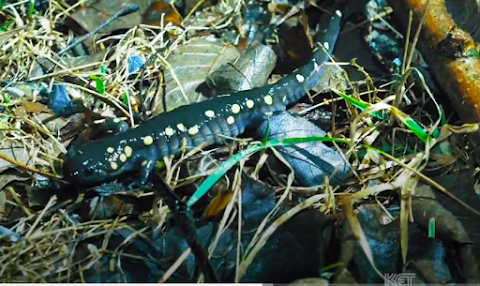
On the first warm, rainy nights of spring amphibians start to move. From below ground come spotted salamanders, Jefferson salamanders, wood frogs and spring peepers. Where are they headed? To vernal pools.  

See a list of New Jersey’s amphibian species and
listen to recorded frog and toad calls state.nj.us/dep/fgw/ensp/fieldguide_herps.htm

This movement can happen as early as February if we have a mild winter and some warm, rainy days and nights, but it can also be as late as April if the ground is still partly frozen or covered with snow. 

Volunteers and the staff from Conserve Wildlife Foundation have been acting as “amphibian crossing guards” at locations in Warren and Sussex counties. 

To learn more about the Conserve Wildlife Foundation’s
amphibian crossing program, go to
conservewildlifenj.org/protecting/projects/amphibian_crossing/


Searching for amphibians crossing with kids and rescuing them from harm is a great activity and a chance to be a wildlife superhero. Here are a few guidebooks. Check in your local library too.


Tuesday, April 14, 2020

Providing Wild Crossings for Endangered Species

Turtle using a tunnel under a roadway

CHANJ is Connecting Habitat Across New Jersey, an effort to make New Jersey's landscape and roadways more permeable for terrestrial wildlife. By identifying key areas and actions needed to achieve habitat connectivity across the state, CHANJ offers statewide mapping and a Guidance Document to help prioritize land protection, inform habitat restoration and management, and guide mitigation of road barrier effects on wildlife and their habitats.

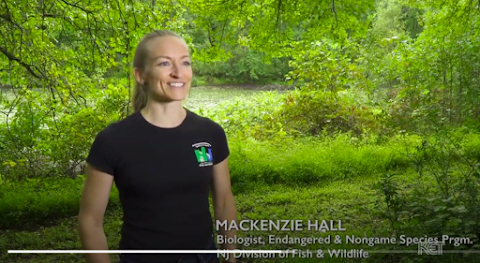
Mackenzie Hall
Mackenzie Hall, ENSP biologist


CHANJ is featured in a new episode of the PBS show, EcoSense for Living.  In this episode, "Wild Crossings," NJ is one of three major habitat connectivity projects, from North Carolina to New Jersey, that are helping wildlife navigate our increasingly developed world.  

In this program, CHANJ comes in at the 14-minute mark but I recommend watching the entire 26-minute episode. The CHANJ portion is 12 minutes and covers salamander migrations, turtle tunnels, timber rattlesnakes, and various connectivity projects of the NJ Division of Fish and Wildlife. You will even meet the Division's bobcat scat-sniffing dog, Fly.


In finding food and finding mates and adapting to climate change, these creatures must overcome all the obstacles humans and nature have put in their way. This project, which once relied solely on volunteers physically moving the smaller amphibians, is using more sustainable methods to help animals find safe passage in our increasingly developed state.

This time of year is especially important for amphibians who are coming out of hibernation and moving to area with water and vernal pools for their short breeding season.

Volunteer transferring a frog across a roadway on a spring night

Spotted salamander entering a tunnel

Despite our well-known population density, we are fortunate that NJ is also a recognized leader in preserving open spaces for recreation, agriculture, and nature. Nearly one-third of the state’s landmass is now in permanent preservation. NJ boasts a higher percentage of publicly-owned forest land than any other state east of the Mississippi (Widmann 2004). Healthy, connected ecosystems are an important part of that.

bobcat
Bobcat in the northern NJ "Bobcat Corridor"

Bobcat using a dry terrestrial pathway under a road

All images via pbs.org video

Monday, June 10, 2019

Snakes in New Jersey

Common and non-venomous eastern garter snake (Thamnophis sirtalis sirtalis)
Photo: Wilson44691 - Own work, Public Domain   

New Jersey is home to 71 species of reptiles and amphibians. The Division of Fish and Wildlife's "Field Guide to Reptiles and Amphibians of New Jersey" lists reptiles and amphibians and links to fact sheets excerpted from the Field Guide to Reptiles and Amphibians of NJ. The frogs and toads also have a link to each species' calls which are shortened versions of those found on the vocalization CD. This online field guide is intended to provide instant access to pictures, maps, calls and descriptions for New Jersey’s reptiles and amphibians.

In this post, we are focusing on New Jersey's snakes. People more often than not have a fear of snakes. Much of that fear comes from a lack of ability to distinguish species and a fear that a snake id dangerous/venomous.

On this site, we often get comments about snakes that are almost always misidentifications. The most common misidentifications are about venomous snake sighting. We only have two venomous snakes in the state - the Northern Copperhead (more common to the northern part of the state) and the Eastern Timber Rattlesnake (more common in the south).

Northern Watersnake, Nerodia sipedon, non-venomous and found in NJ

Water moccasin or cottonmouth, not present in NJ,
venomous and sometimes misidentified for a water snake
Photo by Ltshears - Own work, CC BY-SA 3.0

  1. Black Rat Snake    Elaphe o. obsoleta
  2. Corn Snake (E)    Elaphe g. guttata
  3. "Coastal Plain" Milk Snake    L. t. triangulum X L. t. elapsoides
  4. Eastern Garter Snake    Thamnophis s. sirtalis
  5. Eastern Hognose Snake    Heterodon platyrhinos
  6. Eastern Kingsnake    Lampropeltis g. getula
  7. Eastern Milk Snake    Lampropeltis t. triangulum
  8. Eastern Ribbon Snake    Thamnophis s. sauritus
  9. Eastern Smooth Earth Snake    Virginia v. valeriae
  10. Eastern Worm Snake    Carphophis a. amoenus
  11. Northern Black Racer    Coluber c. constrictor
  12. Northern Brown Snake    Storeria d. dekayi
  13. Northern Pine Snake (T)    Pituophis m. melanoleucus
  14. Northern Redbelly Snake    Storeria o. occipitomaculata
  15. Northern Ringneck Snake    Diadophis punctatus edwardsii
  16. Northern Scarlet Snake    Cemophora coccinea copei
  17. Northern Water Snake    Nerodia s. sipedon
  18. Queen Snake (E)    Regina septemvittata
  19. Rough Green Snake    Opheodrys aestivus
  20. Smooth Green Snake    Opheodrys vernalis
  21. Southern Ringneck Snake    Diadophis p. punctatus
  22. Northern Copperhead    Agkistrodon contortrix mokasen
  23. Timber Rattlesnake (E)    Crotalus horridus


Wikipedia also has a useful list of snakes in New Jersey with links to individual articles about each species with photos. See wikipedia.org/wiki/List_of_snakes_of_New_Jersey

Timber rattlesnake Photo by Kris Schantz via state.nj.us/dep/

Northern copperhead Agkistrodon contortrix mokasen, one of two venomous snakes found in New Jersey
Photo: Public Domain

Friday, November 3, 2017

A "New" Frog Species to NJ


Atlantic-coast-leopard-frog.png
Male Atlantic Coast Leopard Frog - Photo by Brian R. Curry CC BY 4.0, Wikimedia


The Atlantic Coast leopard frog, Rana kauffeldi, is a "new" species to our state, though it has probably been in New Jersey all along.

The Atlantic Coast leopard frog is one of several species of leopard frogs. Its species name, kauffeldi, honors the herpetologist Carl Frederick Kauffeld who in 1936 proposed that there could be a third species of leopard frog inhabiting the New York Tri-State Area. The author team that described the species in 2014 christened it after Kauffeld.

Classified as a true frog, it has smooth skin and a narrow waist. Its range stretches along the northern part of Eastern Seaboard, from Connecticut to North Carolina.

The species takes its common name from the speckles on its legs and back reminiscent of a leopard pattern.

The Atlantic Coast leopard frog tends to inhabit large wetland areas, such as marshes, wet meadows, or slow-flowing water. Its habitat usually includes clear, shallow water and it lives in or around open, vegetated spaces as well, with such plants as cattails, reeds, or river shrubs.

Species Profile  state.nj.us/dep/fgw/ensp/pdf/chanj_atlcst_leopardfrog.pdf

The Atlantic Coast leopard frog is a featured species for Connecting Habitat Across New Jersey (CHANJ) state.nj.us/dep/fgw/ensp/chanj_featspecies.htm


Atlantic Coast Leopard Frog distribution simplified.png

By Feinberg JA, Newman CE, Watkins-Colwell GJ, Schlesinger MD, Zarate B, et al. - Feinberg JA, Newman CE, Watkins-Colwell GJ, Schlesinger MD, Zarate B, et al. (2014) Cryptic Diversity in Metropolis: Confirmation of a New Leopard Frog Species (Anura: Ranidae) from New York City and Surrounding Atlantic Coast Regions. PLoS ONE 9(10): e108213. doi:10.1371/journal.pone.0108213, CC BY 4.0, Link

Tuesday, November 1, 2016

Questions on Endangered Species

I occasionally get email or comment to the blog asking about how to report a sighting of a rare species and questions about identifying a species seen. Although I have been a volunteer with the Endangered and Nongame Species program for quite awhile, I'm no expert on all the flora and fauna of the state.

Recently you might have seen a post I put up about a frog species that a reader wanted to identify. I was hoping the "wisdom of the crowd" might identify it.

And this month I also got an inquiry from someone in Hillsborough who sees a peregrine falcon in a nearby woods regularly. "Anonymous" wondered if that might help prevent development of those woods.

I replied that the appearance of an endangered species doesn't immediately qualify an area for protection, though nesting might. I suggested looking at http://www.conservewildlifenj.org/protecting/projects/peregrine/ and trying to use the contact listed there.

Also, there is information from the state about reporting a rare species at http://www.state.nj.us/dep/fgw/ensp/rprtform.htm

And if you have suggestions about that frog or the peregrine situation, or other people and places to contact about endangered and threatened species, please leave a comment.

Thursday, September 1, 2016

Can you identify this New Jersey frog species?


Jan writes and asks:

Today while picking raspberries i came across two tiny frogs. This one is about 1 inch, the other was a little smaller. It was at a farm in Flemington. I tried to identify it by your web page but could not. It sort of looks like a pine barrens tree frog except it is out of the range. Do you know what kind of frog this little one is?

Not being an expert on frogs, I will ask our readers to help identify - post your answers as a comment here, perhaps with a link to more information.

Some good sources (that unfortunately don't show any frog exactly like the photo) for frogs in NJ:


Wednesday, May 7, 2014

Frog Awakenings

Photo by William Locascio
Now that spring has truly arrived in New Jersey, all kinds of miraculous rebirths are before us in nature.

My friend Bill's backyard pond in northern NJ has always had a few frog visitors and this week a new one has found the pond.

In early April, that frog would have been still frozen awaiting the spring thaw. If its heart turns on before its brain, the brain would be too cold to get oxygen and the circulatory system would dam up and fail. If the brain turns on before the heart, that brain would be starved for oxygen and die. But somehow, all those organs awaken at the right time and they emerge.

Amazing.

Friday, March 12, 2010

Pregnant Males

Strange and disturbing news from National Geographic News this month that a new study shows that one of the most common weed killers in the United States can make male frogs lay eggs.

Atrazine, a widely-used pesticide used croplands in the U.S., is an endocrine disruptor. That means that it is a substance that interferes with animals' reproductive systems.

Previous research had shown that atrazine could give male amphibians female characteristics. New research has discovered that the chemical transforms male frogs into fully functioning females.

Atrazine "Keeps Coming Back"

Of 40 genetically male African clawed frogs used in the experiment, 4 of the adult frogs—or ten percent—developed into what looked like perfectly normal females.

As always with this type of discovery, if you're not concerned with the impact on wildlife, consider the human implications. Though there haven't been many studies on the chemicals' impacts on people, some recent research has linked atrazine exposure to breast cancer.
The U.S. Environmental Protection Agency recently announced it's reevaluating atrazine. The chemical has been banned in the European Union since 2004.

Thursday, September 3, 2009

Teaching NJ's Herptile Wildlife Species


Southern leopard frog
seen in Double Trouble State Park,
Lacey & Berkeley Townships, NJ.
Originally uploaded by Brett NJ


The Division of Fish and Wildlife has a educational materials focusing on the state's amphibian and reptile (herptile) wildlife species.

The Conserve Wildlife Foundation of New Jersey has assembled a resource package to help teachers educate students about New Jersey's reptiles and amphibians.

The package includes the Field Guide to Reptiles and Amphibians of NJ and Calls of NJ Frogs and Toads CD, the Field Guide to Salamanders, Frogs and Toads of New Jersey's Vernal Pools and a teacher's guide full of activities and lesson plans for grades 5-9.

The activities are correlated to the state's Core Curriculum Content Standards.

Resource Package Flyer and Order Form (pdf, 50kb)

Below are links to pages concerning New Jersey's herp populations.

Field Guide to Reptiles and Amphibians of NJ and related CD
Field Guide to Reptiles and Amphibians of NJ and Related CD Order Form
Herp Atlas Project

Monday, July 6, 2009

Operation Frog Pond and Frogwatch

Amphibians are currently in crisis in NJ, across the United States and beyond our borders. Habitat loss is obviously a problem, but so is climate change and disease.

About 46% of the 277 species of amphibians in the United States are at risk, according to Tree Walkers International, an organization that encourages private individuals to get involved in amphibian conservation.

Operation Frog Pond from treewalkers.org has information if you are building a pond or if you have one, so that you can make it more amphibian-friendly.

Small ponds - about half the size of a bathtub - usually cost less than $100 and can provide habitat.


What makes your pond amphibian friendly?
  • Gently sloping sides
  • Fairly shallow water - most amphibians breed in shallow water - give them different depths
  • Plants growing in the water at the edges of the pond are needed for laying eggs - vegetative variety surrounding the pond provides hiding places.
  • No fish. Those large ornamental fish, such as koi and goldfish, feed on eggs, tadpoles and larvae.
  • Keep pets away from the pond - don't add to predator problems.
Never introduce amphibians to a frog pond without the permission of state and local authorities. The goal of Operation Frog Pond is to enhance habitat for wild, native amphibians. Relocating amphibians to new locations can severely alter the local genetics of wild populations and spread disease. Introducing exotic species such as bullfrogs and African clawed frogs cause serious loss of native amphibians. Non-native species and animals purchased at pet shops or bait stores should never be released into the wild.

Don't have a backyard pond? Your yard can provide habitat for adult amphibians, many of which are less dependent on bodies of water outside breeding season.

Perhaps the most important step is to minimize your use of pesticides and other chemicals, which not only affect amphibians directly -- they absorb toxins through their delicate skin -- but kill off the insects that they need for food. In fact, helping amphibians might just mean less yard work. Minimize that chemical-laden lawn and instead plant native vegetation, and don't work so hard at cleanup because a pile of fallen woody debris is just the sort of place where you'd find amphibians in the wild.

Another way to help is to volunteer with Frogwatch USA. Participants go out after sunset to listen for frog calls, reporting data on weather and species of frogs heard. It's not that hard for the average person to learn to tell frog calls apart because you'll only be dealing with a handful of species at any given time.

Frogwatch volunteers don't have to live near pristine wilderness, or even a permanent body of water. Many amphibians reproduce in temporary ponds called vernal pools that dry up after the breeding season. The data collected can help scientists track changes in frog populations, which is crucial at a time when so many species are disappearing.

These sites also provide information for identifying amphibians and their calls.

Monday, May 18, 2009

The Greatest Mass Extinction Since the Dinosaurs

What is the greatest mass extinction since the dinosaurs?

Population by population, species by species, amphibians are vanishing off the face of the Earth. Despite international alarm and a decade and a half of scientists scrambling for answers, the steady disappearance of amphibians continues.

Large scale die-offs of frogs around the world have prompted scientists to take desperate measures to try to save those frogs they can, even bathing frogs in Clorox solutions and keeping them in Tupperware boxes under carefully controlled conditions to prevent the spread of a deadly fungus.

Will it ever be safe to return the frogs back to the ecosystem from which they were taken?

One example here in New Jersey is the southern gray treefrog. This arboreal amphibian is equipped with large toe pads that enable it to cling to trees. These treefrogs can alter their coloration based on their activities or environmental conditions.

Because of its limited distribution in the state and the destruction of its habitat, the
southern gray treefrog was listed as an endangered species in New Jersey in 1979.

Since then, biologists have conducted research to determine the distribution, habitat use, and breeding ecology of the southern gray treefrog in New Jersey. Currently, efforts are being made to protect treefrog habitats on a comprehensive landscape level as well as on an individual wetland basis. Documented breeding ponds, as well as surrounding buffers of 150 to 300 feet, are protected under New Jersey land use regulations, including the Freshwater Wetlands Act and the Coastal Area Facilities Review.

Frogs: The Thin Green Line is one of many PBS videos from the series Nature that are now available online. Many also have Web-exclusive videos. In this program, you can see the effects of the chytrid fungus that may be the key to why one-third of amphibian species are threatened with extinction.

Watch the full Nature episode

Sunday, April 12, 2009

Listen to Some NJ Frogs and Toads

New Jersey is home to 71 species of reptiles and amphibians. In an effort help residents and visitors of the state accurately identify these species, the Division of Fish and Wildlife has created a "Field to Reptiles and Amphibians of New Jersey" with a companion audio CD.

The CD, "Calls of New Jersey Frogs and Toads", was created to help with the identification of the 16 species of calling amphibians found in the state.

The links below will take you to fact sheets about each species (pdf) and 16 of those audio files that are available online.

  1. American Toad Bufo americanus call
  2. Bullfrog Rana catesbeiana call
  3. Carpenter Frog Rana virgatipes call
  4. Eastern Spadefoot (toad) Scaphiopus h. holbrookii call
  5. Fowler’s Toad Bufo woodhousii fowleri call
  6. Green Frog Rana clamitans melanota call
  7. New Jersey Chorus Frog Pseudacris triseriata kalmi call
  8. Northern Cricket Frog Acris c. crepitans call
  9. Northern Gray Treefrog Hyla versicolor call
  10. Northern Spring Peeper Pseudacris c. crucifer call
  11. Pickerel Frog Rana palustris call
  12. Pine Barrens Treefrog (T) Hyla andersonii call
  13. Southern Gray Treefrog (E) Hyla chrysoscelis call
  14. Southern Leopard Frog Rana utricularia call
  15. Upland Chorus Frog Pseudacris triseriata feriarum call
  16. Wood Frog Rana sylvatica call


Pine Barrens Treefrog photo by Breck Kent