Showing posts with label White Nose Syndrome. Show all posts

Monday, November 10, 2025

Hibernating Time

This month as the polar vortex dips into New Jersey and we say goodbye to warm days, animals may not be the only ones in our state thinking about migrating south or about some winter hibernation.

The popular idea of hibernation is probably closer to a storybook version of fattened bears curled up in a cave than the ways that New Jersey's creatures are preparing to hibernate using a variety of physiological strategies.

After an animal finds or makes a living space (hibernaculum) that protects it from winter weather and predators, the animal's metabolism slows dramatically.

Little brown bats with white nose syndrome - Al Hicks, NYSDEC, Bugwood.org

Our over-wintering bats, including the federally endangered Indiana bats, are true hibernating mammals who regulate their metabolism to create a torpid, cold, inactive state. That's why White Nose Syndrome is a serious threat to them. The fungus disrupts their sleep, causes them to fly, and exhausts their fat reserves even if they only wake up in mid-winter for brief periods.

Also in that hibernation category are some rodents like woodchucks and chipmunks. They can maintain a constant body temperature of 38 degrees. But woodchucks, also known as groundhogs, will not be coming out of hibernation naturally as early as February 2 to satisfy some news crew's need for a Groundhog Day story.


For chipmunks, their den temperatures remain mostly above freezing because burrow entrances are plugged and their burrow system extends below the frost line. Their body temperature drops to within a few degrees of the burrow temperature and is often around 40°F. Every few days, chipmunks elevate their body temperature to over 94°F.


Timber rattlesnake - photo by Kris Schantz via state.nj.us/dep/

Our timber rattlesnakes in the Ridge and Valley and Highlands regions will hibernate in deep, rocky mountain crevices with a southern exposure.

In the Pinelands, lacking those rocky crevices, the rattlesnakes will hibernate in the springs and roots of cedar swamps where the water movement means it probably will never freeze.

The Northern pine snake, which also inhabits the Pinelands, will first fully digest their last autumn meal before hibernating. (Undigested food in a reptile can lead to bacterial infection and death.) Then, they will burrow into upland sands about four feet below the surface to hibernate.


Fish and many reptiles and amphibians don't go into a true hibernation but rather into dormancy. That is a period in an organism's life cycle when growth, development, and physical activity are temporarily stopped. This minimizes metabolic activity and therefore helps an organism to conserve energy. This allows some species to survive extremely low oxygen conditions in the mud and deep water of ponds.


Aquatic frogs such as the American bullfrog typically hibernate underwater. They do not spend the winter like aquatic turtles which dig into the mud at the bottom of a pond or stream. If hibernating frogs did that, they would suffocate. Hibernating aquatic frogs require oxygen-rich water and spend a good portion of the winter just lying on top of the mud or only partially buried, and may even slowly swim around from time to time.

A hibernating turtle's metabolism slows down so drastically that it can get by on the mud's poor oxygen supply.

Of course, we also have terrestrial frogs that normally hibernate on land. American toads and other frogs will burrow deep into the soil, safely below the frost line. Not all frogs are diggers. The wood frog and the spring peeper will find deep cracks and crevices in logs or rocks, or, not as safely, just burrow down as far as they can in the leaf litter. Be careful raking or kicking those leaf litter piles!


Is this bear hibernation or just sleeping?

Black bears are still our number one popular poster species for hibernation, but they are not true hibernators and in New Jersey may be active all year long.

Black bears begin entering their winter dens in the fall to avoid periods of food shortage and severe weather. Impregnated females typically enter dens first, during the last week in October. Males may not enter dens until December.

Unlike smaller mammals that hibernate, black bears do not drop their body temperature appreciably. They enter a state of torpor (low metabolic activity). The small amount of urine that is produced is reabsorbed by their kidneys, and they don't have to wake up to urinate or defecate.

Bears are too big to allow their bodies to get really cold, and they need to be able to wake up quickly in an emergency. Den sites generally include ground nests, excavation sites, brush piles, hollow trees, rock cavities, and, more rarely, caves (which are not very plentiful in NJ). Sometimes they might even be found beneath houses and other buildings. The den sites are typically small in size to retain body heat and ensure that black bears stay well insulated.

They live off of their body fat, which is metabolized to produce the calories and water that they need to survive. That is why autumn is such a critical and active feeding time for them. They generally lose between 18-20% of their body fat while in their dens, and they can maintain their bone and muscle mass. While in torpor, black bears are capable of being easily awakened if disturbed, and they may leave their dens on mild winter days in search of food.


Wednesday, January 24, 2018

A Dangerous Time for Hibernating Bats

You may be spending more time indoors now that it is winter, but New Jersey's non-migrating bats have gone into hibernation. It is a dangerous time for them no, particularly because of white-nose syndrome. This is caused by a fungus that was originally introduced inadvertently by humans exploring caves in New York State.

The disease has decimated many bat species. It scars their wings and disrupts their hibernation patterns. One of its effects is that it causes them to wake and fly around when they should be sleeping, and so their energy reserves deplete and they die from starvation, thirst and exhaustion.

Bats are the single largest consumer of night-flying insects like mosquitoes, beetles and moths. Not only does that help humans be less bothered outdoors in the summer and decrease the spread of mosquito-borne diseases, but it this natural insect control helps our Garden State agriculture.

A little brown bat with white nose syndrome.
The most affected of New Jersey's bats is the little brown bat which was once common but has now become rare. NJ's largest hibernaculum is the old Hibernia Mine in Morris County. Before the syndrome hit our state in 2007, Hibernia was the winter home for 34,000 little brown bats. Now, there are only about 400.

The best we can say currently is that this small population seems to be leveling off.

Big brown bats seem to be unaffected by white-nose syndrome and it may be because they hibernate in different locations than the little brown bat. They prefer cold but dry places, such as attics. (If you discover bats in your attic or home, don't try to remove them on your own. Call a bat removal expert, who can safely remove them.) Caves tend to be warmer and have higher humidity which may increase the fungus spreading. When the big brown bats do use subterranean locations, they stay close to entrances where it is colder. They may, if the weather warms enough, even awaken, seek water and perhaps breed.

Modifications in the Hibernia cave to increase air flow may drop temperatures slightly, inhibiting the growth of white-nose fungus.

Little brown bats, northern long-eared bats, tri-colored bats and eastern small-footed bats are all affected by white-nose syndrome, and have been recommended for inclusion on the state's endangered species list.


More on New Jersey's bats
http://wildlife.rutgers.edu/bats/
http://www.conservewildlifenj.org/protecting/projects/bat/white-nose/
Bat Conservation International www.batcon.org.

Monday, January 28, 2013

Hibernating Bats

In autumn, bats will find their traditional hibernation locations and often migrate hundreds of miles to the abandoned mines and caves where they will spend the winter months.

Some of our common New Jersey bats congregate in colonies, often in caves, mine or buildings. These "social bats" usually return to the same roost year after year and start maternity colonies in the spring.

Nine species of bats are considered regular residents of New Jersey. These include the little brown bat, big brown bat, northern long-eared bat, small-footed myotis, Eastern pipistrel, Indiana bat (state and federally endangered), hoary bat, red bat and silver-haired bat. The hoary, red and silver-haired bats are part-time residents that are found here from spring through fall. They migrate to southern states for the winter. The other six species remain here throughout the entire year and require special habitats for winter hibernation.

Natural caves once provided hibernating habitat for bats, but today most caves are subject to disturbance by people and thus are not suitable for use by bats. Abandoned mines and tunnels, storm drains and sewers have replaced natural caves as the primary winter habitat for many bats. Since those places are often unsafe to enter or inaccessible to people, they are desirable locations. But bats will sometimes hibernate in homes, garages, sheds and barns if there is access and it appears isolated to them.

New Jersey's largest known bat hibernaculum is the Hibernia Mine in Rockaway Township, Morris County. It was abandoned as a mine in the early 1900s and there are records of bats using the mine going back to the 1930s. After decades of the bats being disturbed, chased or even killed and landowner attempts to seal the mine, it is now a protected location.

Since they are particularly vulnerable to pollution and pesticides, the presence or absence of bats can tell scientists a lot about the overall health of the local environment.


Hibernating hoary bat on garage in Hunterdon County

I recently received via this site an email from someone in Hunterdon County who had discovered a bat hibernating attached to the outside of their garage. They were concerned about its exposure to the weather.

I recommended that they leave it alone and use the contact page at NJbats.org/ifoundabat.html in the hope that they could give them advice or take the bat.

I'm pleased that this bat was picked up by Jackie of NJ Bats and she was very excited that it was a female hoary bat and was most likely pregnant.

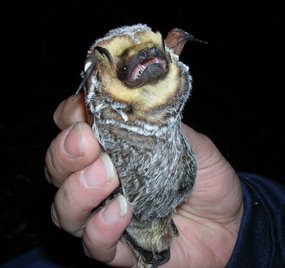
Hoary Bat - Photo by Jennifer Linehan - nps.gov 

Hoary bats are the most widespread of all bats in the United States and are thought to occur in all 50 states. They range from the tree limit in Canada down to at least Guatemala in Central America, and throughout South America. They are the only bats found in Hawaii.

They are rarer in most of the eastern United States but have also been found in Michigan, New York and Connecticut during December and in Indiana during January. This suggests that some may winter farther north than was previously expected.

Hoary bats are migratory and move north in spring and south in winter. It tends to be rather solitary and frequents wooded areas where it roosts in the open (not in buildings) by hanging from a branch or twig. It is more easily recognized by its large size and its swift, erratic flight. This bat usually emerges rather late in the evening, but during migration, it is frequently observed in daylight hours

Two kinds of bats in New Jersey are often found roosting in colonies inside buildings: the big brown and little brown bats.

The big brown bat has a wingspread of about 14 inches and is our most common species. Colonies of up to 200 individuals return each spring to locations (including homes and other buildings) in New Jersey.

Although they have relatively long lives, reproduction is slow. Generally, one is born each year. The big brown bat accounts for over 75 percent of the bat contacts with people and pets and is the bat most often tested for rabies.

Little Brown Bat
The little brown bat is also quite common in homes during the spring and summer, and large numbers hibernate in our abandoned iron mines. However, the number of human and animal exposures, and the number of little brown bats found to be rabid, are much less than for the big brown bat.

When bats are hibernating, it is a time that scientists often study them. Much of the research and surveying on White Nose Syndrome is done at this time.

White Nose Syndrome is a "bat plague" that has killed nearly 7 million bats since it first appeared in the US in New York State. The deadly fungal disease has spread to 19 states as far west as Missouri, as far south as Alabama and north into Canada.

The little brown bat (Myotis lucifugus) has been hardest hit by the sickness because it is the most common of our bat species, but there are 22 other species of American bats that also hibernate in caves that are being affected. 

Like a number of other threatened and endangered species, such as snakes, wolves, and wood rats,  there are many myths and misunderstandings about bats. For example, all of the bats found in New Jersey are strictly insect eaters. No vampires in Jersey. Many people fear a bat bite because of rabies. It makes sense not to touch bats that you find, but less than one percent of bats carry rabies, and attacks by bats are extremely rare. They rarely get tangled in people's hair, despite my mother's warnings about that.

They are not blind, but they depend more on their sonar hearing than eyesight to navigate and avoid obstacles - and to capture insects. Because a bat can consume hundreds of insects in an hour, they keep our mosquito population down in areas where they congregate.

Bats are the only truly flying mammals. They belong to the order Chiroptera and are not rodents. They are mammals because they have hair, give birth to live young, and feed their young milk produced by mammary glands.

Most bats produce only one offspring (called a pup) annually and rear their young for the first few weeks of life until they can fly and feed on their own. These reproductive and rearing practices make them the slowest reproducing mammals on earth for their size. Despite their slow reproduction, bats exist in large numbers and encompass one quarter of all mammal species, second in population only to rodents.

Individual bats can live to be 30 years old, and colonies can be present at the same location for over 100 years.

A story last year on the Wild New Jersey site said that while bat populations are on the decline across New Jersey and the United States, in Central New Jersey's Dismal Swamp Conservation Area (DSCA), the Edison Wetlands Association (EWA) and Eagle Scouts have taken action and are doing something about this worldwide bat extinction crisis. Bat populations in Northern Central New Jersey are actually increasing due to conservation activities.

MORE INFORMATION
ABOUT BATS IN NEW JERSEY

Tuesday, March 29, 2011

White-Nose Disease Has Killed A Million Bats So Far

"White-nose disease was first discovered in a single bat cave in upstate New York in 2006. Since then, the fatal fungal illness, which shows up as white patches on the faces and wings of hibernating bats, has spread to 16 states and crossed the Canadian border. The fungus, Geomyces destrucans, is now killing bats in caves, mine shafts, and abandoned buildings as far south as North Carolina, and as far west as Oklahoma. Biologists say that a million bats have died so far, and they add that, unless a way is found to stop the disease, within two decades bats may be entirely extirpated from some regions of the country.

The little brown bat (Myotis lucifugus) has been hardest hit by the sickness—but that’s only because the little brown is the most common of our bat species. There are 22 other species of American bats that also hibernate in caves, and many of those bats are being affected as well...

Bats apparently spread the disease to one another when they gather in groups to hibernate. Biologists note that damp, cool caves are ideal places for a fungus to grow. According to scientists, people may also unwittingly be spreading the disease on their shoes and clothing when they travel from one cave to another. As a result, wildlife biologists recommend that people stay out of caves where bats are hibernating.

Another way people can help bats is by using as few pesticides as possible. Each night, bats eat up to two-thirds of their body weight in insects, and when the insects they eat have been exposed to insecticides, the poisonous chemicals can quickly build up to levels that cause reproductive problems, or even death, in the bats."


White-Nose Disease Has Killed A Million Bats So Far: — And There’s No Cure On The Horizon

Friday, December 3, 2010

NJ Bat Population Continues To Collapse

Little Brown Bat
Last spring, in studies about White-Nose Syndrome in New Jersey, it was reported that the fungus has killed off about 90 percent of the state's bat population.

The devastation hit the largest hibernation spot for bats in New Jersey which is Morris County's Hibernia Mine.

Normally, as many as 30,000 bats would winter there, but the 2010 count found only about 1,700 alive. To make matters worse, many of those showed signs of infection, according to the state's Endangered and Non-game Species Program.

Despite their undeserved bad reputation, bats are crucial to ecosystems. They have a positive effect - especially for humans - through devouring insects, dispersing seeds, and pollinating flowers. The widespread loss of bats has potential ramifications for human health since the huge quantities of bugs hey consume includes ones that not only damage crops but also carry West Nile and other potentially fatal diseases.

Some scientists think humans who visit caves may inadvertently spread the fungus from cave to cave. To try and halt the spread, government agencies across the country have been closing access to caves and abandoned mines.

But there are massive die-offs in the U.S. due to the fungus that is commonly called "white-nose syndrome" because of the whitish powder that appears on the nose, ears and wing membrane of infected bats.

Geomyces destructans is a filamentous fungus of unknown origin and seems to be new to North America.

It was documented but not yet recognized as Geomyces destructans in 2006 at Howes Cave, New York. In 2007, people began to report that little brown bats were flying outside nearby caves during daylight in the midst of winter - something that should not be happening.

Little brown bats are smaller than a human thumb, and dependent on its two grams of stored fat to keep it alive through the cold season. Without hibernation, it will not survive and it being awakened even once can cost it a month's worth of fat. That is why NJ's bat hibernation locations are protected.

The little brown bat population is continuing to decline, with the numbers down 50% from last summer and 80% from 2008, according to the results of New Jersey's annual summer bat count.

Six species have the disease, one of which had been declared endangered long before white-nose syndrome. That is the Indiana bat (Myotis sodalis). Three others are at very high risk.

In New Jersey, the Conserve Wildlife Foundation has teamed with owners of 15 forest areas in the northwestern part of the state to create more habitat for bats.

The endangered Indiana bat roosts in summer under the loose bark of dead trees and switches those roosts every few days. Since dead and dying trees are often cut down, CWF works with landowners to girdle some trees to kill them so they provide more roost sites, or even to attach cedar shakes and other items to tree trunks to create roost spots.

Endangered Indiana Bat

Wednesday, November 4, 2009

Funding for White Nose Syndrome Research

Sen. Frank R. Lautenberg (D-NJ) has announced that funding to protect bat populations in New Jersey and throughout the region has been increased from $500,000 to $1.9 million for FY 2010. The senator successfully fought to increase the funding for research into a mysterious and deadly illness called White Nose Syndrome (WNS) that is destroying bat populations in New Jersey and the Northeast Region. The legislation will now head to the White House where it is expected to be signed into law.

WNS is named for white fungal growth around the noses and on the bodies of affected animals. It first appeared in caves near Albany, New York in February 2006 and was confirmed in New Jersey in 2009. Over the last two winters, more than one million hibernating bats have died.

Map illustrating the ranges of endangered species of hibernating bats in the U.S.
and the spreading distribution of White-nose syndrome. www.fort.usgs.gov

On July 8, Lautenberg, a member of the Senate Environment and Public Works Water and Wildlife Subcommittee, highlighted the threat of WNS to bat populations during a Senate hearing that he called for to examine threats to native wildlife species.

Bats play a critical role in North American ecosystems. They prey almost exclusively on insects such as mosquitoes, which spread disease, and moths and beetles, which damage crops. A single bat can easily eat more than 3,000 insects a night, and an entire colony will consume hundreds of millions. Bats reduce the need for pesticides, which cost farmers billions of dollars every year and can be harmful to human health.

Friday, June 12, 2009

NJ Bats Being Affected By Mysterious Disease

Several years ago, researchers began to report on a mysterious illness in the Northeast that is killing thousands of hibernating bats.

Wildlife officials are calling the illness “white nose syndrome” because the most obvious symptom is a white fungus that forms around the noses of some, but not all, of the afflicted bats.

Researchers do not yet know if the fungus actually causes death, but they have observed that bats with white nose syndrome deplete their fat reserves months before they would normally emerge from hibernation, and die as a result.

Experts have also advised the public to avoid entering any caves and mines that might harbor bats until more is known about the problem.

At that time, no evidence of disease was found among New Jersey’s wintering bat populations and it was feared that humans might carry this mysterious illness from one cave to another. Hikers, photographers and spelunkers are among those who frequent abandoned mines, caves and other locations that likely shelter hibernating bats.

Caves near Albany, N.Y., with up to 11,000 bats, proved to have more than 50% of the area’s wintering population. - were found dead, and many showed symptoms of the mysterious disease. The white fungus was found on bats hibernating in New York and southwest Vermont, and because bats migrate hundreds of miles to their summer range, the impact to other areas where hibernating bats could be significant.

The affected species include the Indiana bat, listed as endangered in New Jersey and nationwide. Wildlife experts report that little brown bats are sustaining the largest number of deaths, along with northern long-eared, eastern pipistrelle and other bat species using the same caves.

Now, the "white nose syndrome" has spread to NJ, according the New Jersey Division of Fish and Wildlife. The fungus was found on many of the dead bats found inside and outside three former mines in Rockaway Township and Denville, where the bulk of New Jersey's bat populations are found. This includes our largest bat hibernation spot (hibernaculum) at the Hibernia Mine.

The bats being impacted the most, at this point, appear to be the common little brown bat. Though the endangered Indiana bat has not been found with the disease, it is likely that species also will be impacted.

Bats that have developed the white fungus around their nose and wing membranes will take flight out of their caves when they should be hibernating during the winter months.

Hibernating bats are particularly vulnerable to disease or disturbance because they congregate in large numbers in caves and mines, forming tight clusters of 300 per square foot in some locations. Tens of thousands of bats hibernate in New Jersey in a small number of abandoned mines.