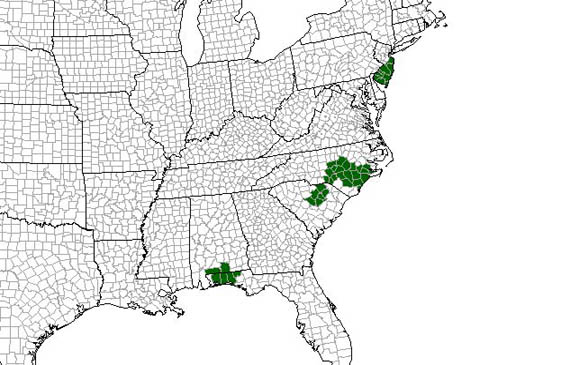
Showing posts with label northern pine snake. Show all posts

Monday, November 10, 2025

Hibernating Time

This month as the polar vortex dips into New Jersey and we say goodbye to warm days, animals may not be the only ones in our state thinking about migrating south or about some winter hibernation.

The popular idea of hibernation is probably closer to a storybook version of fattened bears curled up in a cave than the ways that New Jersey's creatures are preparing to hibernate using a variety of physiological strategies.

After an animal finds or makes a living space (hibernaculum) that protects it from winter weather and predators, the animal's metabolism slows dramatically.

Little brown bats with white nose syndrome - Al Hicks, NYSDEC, Bugwood.org

Our over-wintering bats, including the federally endangered Indiana bats, are true hibernating mammals who regulate their metabolism to create a torpid, cold, inactive state. That's why White Nose Syndrome is a serious threat to them. The fungus disrupts their sleep, causes them to fly, and exhausts their fat reserves even if they only wake up in mid-winter for brief periods.

Also in that hibernation category are some rodents like woodchucks and chipmunks. They can maintain a constant body temperature of 38 degrees. But woodchucks, also known as groundhogs, will not be coming out of hibernation naturally as early as February 2 to satisfy some news crew's need for a Groundhog Day story.


For chipmunks, their den temperatures remain mostly above freezing because burrow entrances are plugged and their burrow system extends below the frost line. Their body temperature drops to within a few degrees of the burrow temperature and is often around 40°F. Every few days, chipmunks elevate their body temperature to over 94°F.


Timber rattlesnake - photo by Kris Schantz via state.nj.us/dep/

Our timber rattlesnakes in the Ridge and Valley and Highlands regions will hibernate in deep, rocky mountain crevices with a southern exposure.

In the Pinelands, lacking those rocky crevices, the rattlesnakes will hibernate in the springs and roots of cedar swamps where the water movement means it probably will never freeze.

The Northern pine snake, which also inhabits the Pinelands, will first fully digest their last autumn meal before hibernating. (Undigested food in a reptile can lead to bacterial infection and death.) Then, they will burrow into upland sands about four feet below the surface to hibernate.


Fish and many reptiles and amphibians don't go into a true hibernation but rather into dormancy. That is a period in an organism's life cycle when growth, development, and physical activity are temporarily stopped. This minimizes metabolic activity and therefore helps an organism to conserve energy. This allows some species to survive extremely low oxygen conditions in the mud and deep water of ponds.


Aquatic frogs such as the American bullfrog typically hibernate underwater. They do not spend the winter like aquatic turtles which dig into the mud at the bottom of a pond or stream. If hibernating frogs did that, they would suffocate. Hibernating aquatic frogs require oxygen-rich water and spend a good portion of the winter just lying on top of the mud or only partially buried, and may even slowly swim around from time to time.

A hibernating turtle's metabolism slows down so drastically that it can get by on the mud's poor oxygen supply.

Of course, we also have terrestrial frogs that normally hibernate on land. American toads and other frogs will burrow deep into the soil, safely below the frost line. Not all frogs are diggers. The wood frog and the spring peeper will find deep cracks and crevices in logs or rocks, or, not as safely, just burrow down as far as they can in the leaf litter. Be careful raking or kicking those leaf litter piles!


Is this bear hibernation or just sleeping?

Black bears are still our number one popular poster species for hibernation, but they are not true hibernators and in New Jersey may be active all year long.

Black bears begin entering their winter dens in the fall to avoid periods of food shortage and severe weather. Impregnated females typically enter dens first, during the last week in October. Males may not enter dens until December.

Unlike smaller mammals that hibernate, black bears do not drop their body temperature appreciably. They enter a state of torpor (low metabolic activity). The small amount of urine that is produced is reabsorbed by their kidneys, and they don't have to wake up to urinate or defecate.

Bears are too big to allow their bodies to get really cold, and they need to be able to wake up quickly in an emergency. Den sites generally include ground nests, excavation sites, brush piles, hollow trees, rock cavities, and, more rarely, caves (which are not very plentiful in NJ). Sometimes they might even be found beneath houses and other buildings. The den sites are typically small in size to retain body heat and ensure that black bears stay well insulated.

They live off of their body fat, which is metabolized to produce the calories and water that they need to survive. That is why autumn is such a critical and active feeding time for them. They generally lose between 18-20% of their body fat while in their dens, and they can maintain their bone and muscle mass. While in torpor, black bears are capable of being easily awakened if disturbed, and they may leave their dens on mild winter days in search of food.


Saturday, September 2, 2017

The Heart of the Pinelands


Here is a video from the New Jersey Conservation Foundation on New Jersey's Pine Barrens. NJCF has preserved thousands of acres of land in this home to many rare and plants and animals.

Of particular focus in this video is the harmless and threatened Northern Pine Snake.


According to NJCF:

"Northern pine snakes face a variety of threats in New Jersey. Habitat loss and alteration are the greatest threats to this in New Jersey. However, illegal collecting and off-road recreational vehicle use also have harmful effects on pine snakes.
The development of Pinelands habitats leads to a loss of pine-oak forest habitat and an increase in human encounters with pine snakes. Too often, such encounters prove fatal to these snakes, and reports of pine snake road kills are common. Some forestry practices may also have negative impacts on pine snakes. For example, forestry practices that favor oak-dominated systems with closed canopies or dense shrub layers probably decrease the amount of suitable pine snake habitat in an area."

More on the pine snake at conservewildlifenj.org

Wednesday, June 22, 2016

The Burrowing Pine Snake

Northern pine snake
Northern pine snake - Pituophis melanoleucus - State Threatened Species - Photo via Zack Bittner, Flickr

Some snakes are tree snakes, some make nests, but the Northern Pine Snake is one of the only burrowing snakes in New Jersey. They make dens and have a nose designed for digging.

They are also currently listed on the Threatened and Endangered species list of New Jersey along with three other snakes.

Most of our pine snake populations are found in the southern part of the state, as they like sandy soils to burrow like those found in the Pine Barrens.

Pine snakes can be hit by cars when trying to move across roads, and are threatened by natural occurrences such as fires. Habitat loss from human development is a factor, as it is for many species in our state. And, unfortunately, a lack of knowledge about snakes in general cause people to fear all snakes, poisonous or not, and people often kill them.

Source: Pine Snake Still Capturing Interest

Tuesday, April 26, 2016

Before They Are Endangered

A recent article from the Press of Atlantic City, reminds us that protecting New Jersey's snakes, birds, frogs and other animals and plants BEFORE they are endangered is really the goal of conservationists.

In that article, the focus is on effort in the far-from-barren NJ Pinelands. The post online includes a video and follows Emile DeVito, an expert on endangered species in the 1.1-million-acre Pinelands National Reserve, who studies the rarest plants and animals.


Those species include the Pickering’s morning glory and the iconic Pine Barrens tree frog.

The Pickering's morning glory is not currently listed in NJ and so its rarity makes it the kind of species that needs attention (and will not get as much federal or state funding support) so that it is not overlooked and it moves to a threatened or endangered status.

Current limited range for the Pine Barrens treefrog


The Pine Barrens treefrog is another kind of species case study. In 1979, iy was listed as an endangered species in New Jersey due to its restricted range, declining population, habitat loss, and pollution of breeding ponds. But conservation efforts moved the treefrog population to a point that it is currently considered stable.

New Jersey serves as a stronghold for this species throughout its entire range. In areas of suitable habitat, they may seem abundant. However, protection of this species is warranted, as quality habitat is limited to specialized Pine Barrens ecosystems patchily distributed throughout its range.

 Flower of Stylisma pickeringii Pickering's Dawnflower or Pickering's Morning Glory, near Batsto, New Jersey.
via Wikimedia
Conservationists have long known that addressing species in decline before they reach the the stages of being threatened or endangered is the real goal.

As members of the New Jersey Conservation Foundation, New Jersey Audubon and the NJDEP track species, they can identify important habitat for that species.

For example, the docile pine snake can be tracked using implanted transmitters that allow us to discover winter dens and nesting sites.

Pine snake moving across sandy soil

We have more than 80 species of wildlife from mammals to birds to insects in New Jersey that are considered endangered or threatened. (See list at www.state.nj.us) There are also dozens of plants that are in danger that probably get less attention than the "sexier" wildlifr.

Some habitats that need protectionare less than intuitive spaces. For example, Ryan Rebozo, director of conservation science at the Pinelands Preservation Alliance, says that the edges of roads in the Pinelands could replace some lost open areas, such as those lost by dousing fires that naturally create suitable habitat. But too often road departments are mowing these areas at inopportune times when some rare plants are flowering. He estimates that 11,000 acres of road edges could be suitable habitat for some of our rare plants, such as the the Pine Barrens gentian, which needs direct sunlight and flowers later in the fall when mowing is common.

As important as education and information, such as this post, can be, it alone isn’t going to save species. People, especially volunteers and the general public, need to take action.

Friday, May 20, 2011

Fire breaks in N.J. Pinelands

via http://www.nrs.fs.fed.us

NJ.com : Fire breaks are set up in N.J. Pinelands to help battle blazes

"As a result of a forest fire in 2007 that rampaged across southern Ocean County and sent thousands fleeing from their homes, strategic fire breaks are being created in the Pinelands forest, and local communities have stepped up their own emergency planning for a population living amid one of the most easily combustible terrains in the country."

Friday, January 14, 2011

N.J. DEP tentatively agrees to allow Walmart store in Pine snake neighborhood

Science update from NewJerseyNewsroom.com

The state has reached a tentative agreement with a developer that would allow the construction of a Walmart store on 21 acres of Pinelands off Route 37 on the Toms River and Manchester border.

The Department of Environmental Protection Thursday said the agreement calls for the permanent preservation of 212 acres of forest near the store site an attempt to enhance pine snake habitat that would be adjacent to the property.

Large-scale development of the 212 acres is already constrained by Pinelands and endangered species regulations and the proposed agreement would preserve the land as undeveloped forest.

Under the agreement, Jaylin Holdings would construct five hibernacula, or den areas, thin sections of forest canopy to create sunny areas snakes need for basking, create upland forest clearings for nesting, and block access to limit human activity that may stress snakes.

N.J. DEP tentatively agrees to allow Walmart store in Pine snake neighborhood

Thursday, January 21, 2010

Threatened Northern Pine Snakes

Northern pine snake on sand

The northern pine snake is a relatively large (5-7 feet or 122-172 cm) black and dull white to yellowish or light gray snake. These snakes have blotches that are dark towards the front of the body but may fade to brown near and on the tail.

Known for their noisy hiss, pine snakes are typically ground dwellers and rarely climb vegetation. Since this species is both secretive and fossorial (it burrows underground), it can easily go undetected even in locations where it is known to be common

Let's start out by saying that the pine snake is a nonvenomous constrictor. It kills its prey by coiling itself around it in order to suffocate the animal. Pine snakes are known to eat mammals as large as rabbits, as well as small rodents and birds. They are usually most active in early morning or late afternoon when they leave their burrows to hunt.

The Northern pine snake (Pituophis melanoleucus melanoleucus) is a threatened species in New Jersey and was the September Species of the Month. The designation was part of a yearlong program to commemorate the 30th Anniversary of the New Jersey Endangered Species Conservation Act and the formation of DEP's Endangered and Nongame Species Program (ENSP).

Pine snakes are egg-layers and typically lay their eggs in underground nests that they excavate in open sandy areas. Eggs are usually laid in mid-summer, and adult females have the tendency to re-use their nest sites year after year.

Pine snakes in New Jersey require dry pine-oak forest types growing on very infertile sandy soils such as Lakehurst or Lakewood sands (Burger and Zappalorti 1988, 1989). Both human-caused and natural disturbances (e.g. agriculture, forestry, and fire) are probably involved in creating the types of openings important for nesting and basking. Sandy infertile soil not only provides for persistent openings in disturbed sites, but may also be important because pine snakes are the only snakes known to dig hibernacula and summer dens.

The secretive nature of this snake has lead to some degree of uncertainty about its overall status in the northeastern United States. All indications seem to suggest that pine snake abundance has decreased throughout its northeastern range, however. It is also believed that pine snakes have been extirpated from West Virginia and Maryland. The
New Jersey Pinelands may hold some of the largest populations of pine snakes in the Northeast, but even in the Pinelands this species is at risk.

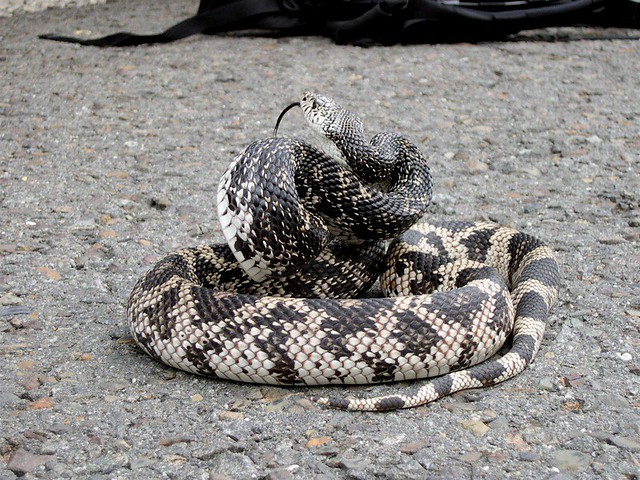
If unexpectedly encountered on the trail or in the woods, this large, white-and-black patterned snake would most likely vibrate its tail, hiss loudly, and then try to escape. Though its bold appearance and actions may fool or scare some people, this particular species of snake is not venomous. In fact, it is harmless to people and is a beneficial predator in nature.

There are four types of pine snakes that can be found in the United States. The northern pine snake is found in the Northern and Eastern-Central regions of the country, in areas with sandy soils and dry upland forests. The population distribution of this pine snake is spotty and all indications suggest that pine snake abundance is decreasing throughout the Northeastern region.

Coiled Northern pine snake

The northern pine snake populations in New Jersey have been affected by a loss of habitat due to development, illegal collecting (due to its popularity as a pet), and other more individualized behavior such as the thoughtless killing of snakes by hikers, automobile drivers and users of off-road vehicles. Never kill a snake if encountering one in a natural area, either when you are traveling on foot or in a vehicle. Back away slowly and do not disturb it.

Anyone who is interested in reptiles and amphibians and enjoys being outdoors can become a volunteer with the Herp Atlas Project. Department staff and volunteers are collecting data on the locations and abundance of all reptile and amphibian species throughout the state. This data will be used to map the critical habitat and distribution of these species, which will allow the agency to better plan for the state's wildlife conservation efforts. Department staff would like to learn about your sightings of an endangered, threatened or rare species in New Jersey. To file a report of a sighting, download and complete the Threatened and Endangered Species Report Form. This data helps biologists and wildlife managers to look at habitat and population trends and then develop appropriate conservation strategies.

Monday, December 14, 2009

Continued Pine Snake Protection Recommended


In another clash of man and wildlife, the Endangered and Non-game Species Advisory Committee has recommended that NJ maintain the threatened status for the pine snake.

The New Jersey Builders Association had filed a petition contending that the pine snake is actually abundant. The species causes problems for builders, particularly in South Jersey, where their protection can limit construction.

Data from state biologists is still being compiled for the NJ Department of Environmental Protection who will decide whether the snake gets continued protection. A final decision has not been made yet, but is expected this month.

The Northern pine snake (Pituophis melanoleucus) likes flat, dry, sandy areas. It is one of the few snakes that burrow in open sandy fields. Most adults are 4-6 in length. It is most likely to be seen in June and July in the afternoon. It feeds on rabbits, rodents, birds, and their eggs.

This snake uses constriction to overpower its prey. When approached it will loudly hiss and vibrate its tail causing most people to think it is a rattlesnake. Though this may work to its advantage is scaring humans, it also causes some people to think it is poisonous and they will try to kill it. A constrictor squeezes its prey and will not strike - in fact, it is fangless.

They are found in Atlantic, Burlington, Camden, Cape May, Cumberland, Gloucester, Monmouth, and Ocean counties.

New Jersey may have the largest single population of northern pine snakes.

It is a rather secretive species that spends most of its time underground, particularly in the sandy soils of South Jersey. The species is found exclusively within the southern half of the state in the Pine Barrens of the outer coastal plain.

Because they eat rodents, in some areas the removal of snakes from an area can cause an increase in the population of mice which in turn may increase Lyme disease. (Mice are the common carriers during the tick's first larvae stage with deer being the frequent carrier in the adult stage.)

Threats to the pine snake include an increase in natural predators, which includes coyotes and raptors. Of course, many of these raptors are themselves threatened or endangered, so this increase is actually a good thing overall.

Pine snakes are also threatened by increased vehicle traffic on the roads through the Pinelands National Reserve which encompasses 1.1 million acres of pine snake habitat. Reptiles need to move into the sun for warmth and will often use roadways which leave them open to traffic and raptors.

The petition by the builders to delist the snake is the first "formal" to question the protected status of a NJ species in the 35 years since the state passed endangered species legislation.

Friday, October 23, 2009

Greenwood Forest and Pasadena Wildlife Management Area

In our continuing series on Wildlife Management Areas and Wildlife Viewing Areas in NJ, today we look at The Greenwood Forest/Pasadena Wildlife Management Area.

This WMA is in Burlington and Ocean Counties in Lacey, Barnegat, Manchester, Berkeley & Woodland Townships. At 95,923 acres it is the largest tract of land preserved by the New Jersey Division of Fish and Wildlife's Bureau of Land Management.

Together with Brendan T. Byrne State Forest, this area constitutes most of the Western Pinelands, the smallest of four conservation zones identified in the Pinelands by NJ Wildlife Action Plan.

This habitat is made up of mixed pine and riparian forests with patches of fields and shrub-scrub. Most of the area is upland pine-oak and scrub-shrub forests with the remaining area being upland habitats including fields.

The lowlands contain pitch-pine forest and Atlantic white cedar bogs.

The headwaters of Cedar Creek are also found here and it connects Greenwood Forest / Pasadena WMA to Lebanon State Forest.

This forest habitat supports breeding species including an estimated 100 Eastern Towhees, 100 Pine Warblers and 60 Prairie Warblers. Barred Owls, favoring swamps and deep forests, particularly those bordering lakes, streams or marshes, are permanent residents in this IBA. Sporadic populations of Red-headed Woodpeckers also inhabit the site’s low-density forest stands.

Some species found here include: the state-threatened Barred Owl, Blue-winged Warbler, Brown Thrasher, Eastern Towhee, Eastern Wood-Pewee, Field Sparrow, Northern Bobwhite, Pine Warbler, Prairie Warbler, Whip-poor-will, Baltimore Oriole, Black-and-white Warbler, Black-billed Cuckoo, Blue Jay, Common Grackle, Eastern Wood-Pewee, Gray Catbird, Tufted Titmouse, and Yellow-billed Cuckoo. See http://www.njaudubon.org for more information.

Northern Pine Snake - NJDEP photo

Currently, the Endangered and Nongame Species Program is working with the Division's Bureau of Land Management to enhance pine snake habitat in a portion of Greenwood Forest Wildlife Management Area.

The primary threats to this site include over-abundant deer and loss of natural ecological forces such as fire and disturbance.

Approximately 1000 acres of the Greenwood Forest/Pasadena WMA are managed as quail habitat and offers hunting and wildlife viewing opportunities.

There are also several hiking and wildlife-watching opportunities throughout the site.

More information: (PDF documents)