Showing posts with label snakes. Show all posts

Monday, April 27, 2026

New Jersey's One Rattlesnake

With warmer weather, many of us are more likely to be out walking in rural and forested areas of our state. Like many people, I'm a bit wary of snakes, but I know about their importance in the ecosystem. That fear is almost always tied to a lack of knowledge about them and an inability to differentiate between the poisonous ones and the non-poisonous ones. So, it troubles me to see headlines like 4 Rattlesnake Hotspots In New Jersey "Hotspot" hints at a place where they are slithering all around, and that is not reality.  

There are 23 snakes that have made New Jersey their home. New Jersey has only two venomous snakes - the Northern Copperhead and the Timber Rattlesnake. 

The Timber Rattlesnake, also called the Canebrake Rattlesnake, can reach 60 inches (152 cm) in length and weigh up to 1,500 grams. They have keeled scales with dark brown to black crossbands on a yellow-brown to gray background and a characteristic rattle on the tail. A Timber rattlesnake's color varies and can be characterized by either a yellow or black phase of keeled scales.

Timber rattlesnake Photo by Kris Schantz via state.nj.us/dep/

The yellow phase coloring means the ground color is yellow to brown, featuring dark brown or black jagged “V-shape” blotches and bands towards the snake's head. The black phase coloring features a similar pattern to the yellow phase; however, the dark brown to black color obscures most of the snake's pattern. In both instances, the snake's head remains unmarked, and the last few inches of the tail are dark brown or solid black in adults. Additionally, sometimes Timber rattlesnakes may be completely black.

While potentially the most dangerous snake in New Jersey due to size and venom yield, they are generally mild-mannered and give warning signals before striking. There have been no reported instances of bites other than by those handling the snakes (which is not recommended unless you're a trained snake handler). However, that doesn’t mean these snakes aren’t dangerous. If threatened, they will defend themselves, so always keep a safe distance.

Timber Rattlesnakes are ambush predators, feeding on small mammals, frogs, birds, and other snakes. They are found in lowland thickets, river floodplains, agricultural areas, and deciduous or coniferous forests. 

This snake is a state-endangered species, with only three timber rattlesnake (Crotalus horridus) populations remaining. These remaining populations include New Jersey's northern region along the Kittatinny Ridge, southern New Jersey within the Pine Barrens, and the Highlands region.

Download an illustrated Snakes of New Jersey brochure


sample page from brochure


Friday, May 3, 2024

The Queen Snake Has Reappeared in New Jersey


young Queen snake

They haven't been seen in New Jersey for almost 50 years, but Queen Snakes, and are making their way back into NJ. Right off, Queen snakes are not venomous. They're also not aggressive but they will bite if provoked.

They've now been classified as "rediscovered" in New Jersey. To give their population a chance to come back, the New Jersey Pinelands Commission will not disclose exactly where a Queen snake was found in order to keep them safe from illegal snake hunters.

This rare discovery was made outside of the Pinelands by Jeff Dragon, a Pinelands Commission Research Scientist, in April 2024. The last recorded sighting in NJ was in 1977. 

Queen snakes (Regina septemvittata) are slender, aquatic snakes that are tan to dark brown in color, with a yellow stripe along its lower side. It has a yellow belly with four brown stripes that run the length of its body. They grow to be about 24 inches in length. The queen snake is similar in appearance to a garter snake, genus Thamnophis, so is often confused with that group.

The New Jersey Department of Environmental Protection theorizes that the queen snake population in New Jersey decreased over time because of to stream channelization, water pollution, and stream bank erosion, all of which crashed the population of their main food source - crayfish. The species had been listed as extirpated in the state. It is listed as endangered by the state 

Historically, they were uncommon among the roughly 23 species of snake known to be present in New Jersey and were seen along a narrow section beside the Delaware River, from Trenton to Gloucester County.

R. septemvittata is known by many common names, including the following: banded water snake, brown queen snake, diamond-back water snake, leather snake, moon snake, North American seven-banded snake, olive water snake, pale snake, queen water snake, seven-striped water snake, striped water snake, three-striped water snake, willow snake, and yellow-bellied snake.

MORE INFO

dep.nj.gov/wp-content/uploads/njfw/queensnk.pdf 

dep.nj.gov/wp-content/uploads/njfw/queen_snake.pdf

herpsofnc.org/queen-snake/ 

nytimes.com/2024/04/30/nyregion/queen-snakes-new-jersey.html

Thursday, February 23, 2023

New Jersey's Two Venomous Snakes

We have only two venomous snakes in New Jersey, but there are four snakes on our endangered or threatened species list.

Of 22 species found in New Jersey, only the timber rattlesnake and the northern copperhead are venomous. Both the copperhead and rattlesnake are reclusive and shy, but each will defend itself if threatened. In reality, though, you have a greater chance of being struck by lightning than of ever being bitten by one of these snakes.

Because snakes had a bad reputation and are so easily misunderstood by the public, it's a good idea to familiarize yourself with the ones that can be dangerous and the ones that are not and are an important part of the ecosystem. This site at usasnakes.com/snakes-in-new-jersey/ has photos of both types.


NJ REPTILES
Endangered Threatened
Rattlesnake, timber Crotalus h. horridus Snake, northern pine Pituophis m. melanoleucus
Snake, corn Elaphe g. guttata

Snake, queen Regina septemvittata


Northern copperhead     Photo: Mike Muller via state.nj.us/dep/

Copperheads are social snakes and often hibernate in communal dens with other copperheads or other species of snakes, including timber rattlesnakes and black rat snakes.

Adult copperheads eat mostly mice but will also eat small birds, lizards, small snakes, amphibians and insects, especially cicadas.

Copperheads have fangs that inject prey with a hemolytic venom that subdues its prey by causing the breakdown of red blood cells, making it easy for the snake to swallow. The copperhead seeks out its prey using its heat-sensitive pits to detect objects that are warmer than its environment. This also enables them to find nocturnal mammalian prey.

A copperhead, one of New Jersey’s least common snakes, is frequently confused with the northern water snake and the eastern milk snake, among the state's most common species. Copperheads have a dark-colored pattern that forms hourglass-shaped bands from side to side, but coloration is highly variable among individuals and changes according to seasonal shedding periods.

You should never approach this snake, or try to handle it, or disturb it. Copperheads and other snakes help to control rodent populations in their environment."

Timber rattlesnake Photo by Kris Schantz via state.nj.us/dep/


The timber rattlesnake inhabits three distinct areas – the Kittatinny Ridge and the northernmost portion of the Highlands as well as the sprawling Pine Barrens of southern New Jersey. The copperhead is limited to hilly, forested regions in portions of northern New Jersey and a few isolated, hilly areas of Hunterdon and Somerset counties.

While the rattlesnake has its rattle to distinguish it from other snakes, many other snakes mimic the rattlesnake by shaking their tails on leaves, twigs and other objects. A rattlesnake has jagged and dark bands extending from side to side around the center and back end of the snake.


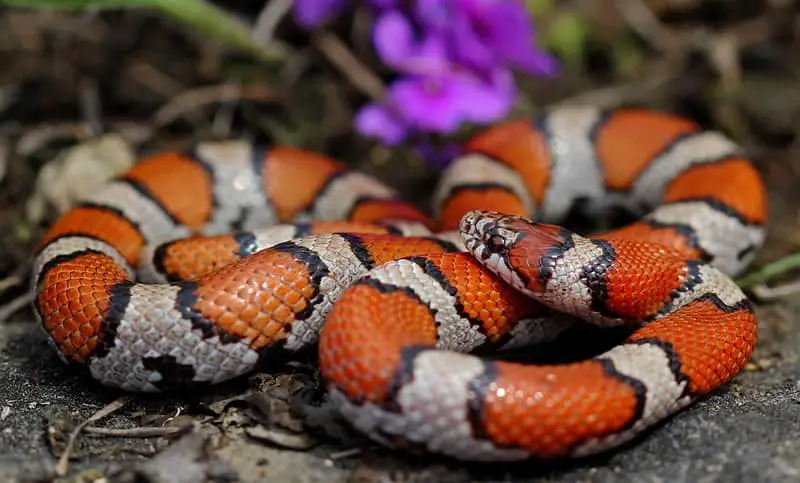
The snake below may look dangerous but it is a non-venomous milk snake Lampropeltis Triangulum. Because it has color variations, it can be confused with some venomous snakes.
Know your Jersey snakes! 
For more information, see  state.nj.us/dep/daw/snakes/


Monday, June 10, 2019

Snakes in New Jersey

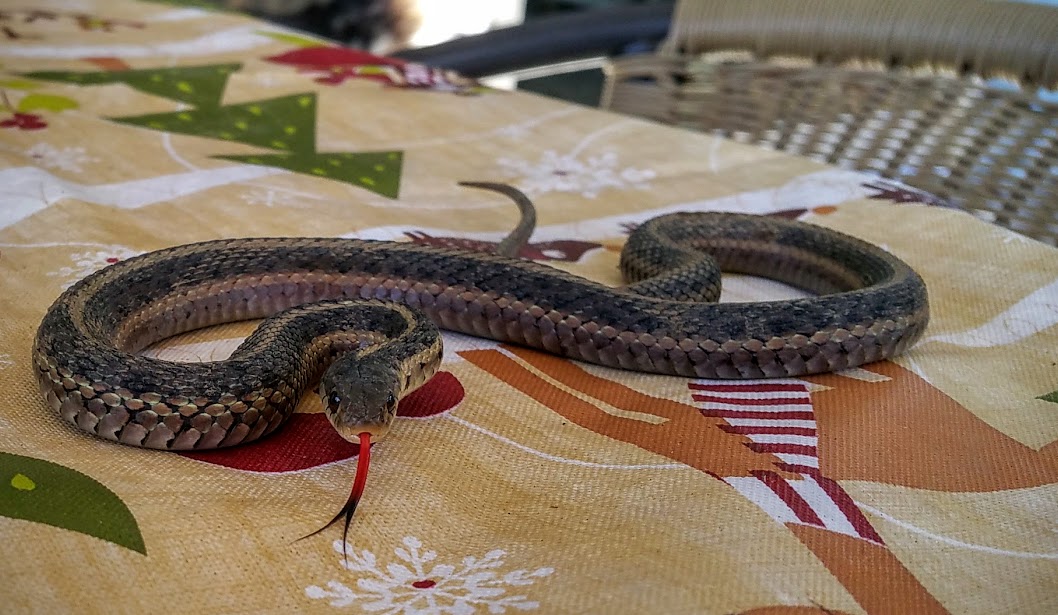
Common and non-venomous eastern garter snake (Thamnophis sirtalis sirtalis)
Photo: Wilson44691 - Own work, Public Domain   

New Jersey is home to 71 species of reptiles and amphibians. The Division of Fish and Wildlife's "Field Guide to Reptiles and Amphibians of New Jersey" lists reptiles and amphibians and links to fact sheets excerpted from the Field Guide to Reptiles and Amphibians of NJ. The frogs and toads also have a link to each species' calls which are shortened versions of those found on the vocalization CD. This online field guide is intended to provide instant access to pictures, maps, calls and descriptions for New Jersey’s reptiles and amphibians.

In this post, we are focusing on New Jersey's snakes. People more often than not have a fear of snakes. Much of that fear comes from a lack of ability to distinguish species and a fear that a snake id dangerous/venomous.

On this site, we often get comments about snakes that are almost always misidentifications. The most common misidentifications are about venomous snake sighting. We only have two venomous snakes in the state - the Northern Copperhead (more common to the northern part of the state) and the Eastern Timber Rattlesnake (more common in the south).

Northern Watersnake, Nerodia sipedon, non-venomous and found in NJ

Water moccasin or cottonmouth, not present in NJ,
venomous and sometimes misidentified for a water snake
Photo by Ltshears - Own work, CC BY-SA 3.0

  1. Black Rat Snake    Elaphe o. obsoleta
  2. Corn Snake (E)    Elaphe g. guttata
  3. "Coastal Plain" Milk Snake    L. t. triangulum X L. t. elapsoides
  4. Eastern Garter Snake    Thamnophis s. sirtalis
  5. Eastern Hognose Snake    Heterodon platyrhinos
  6. Eastern Kingsnake    Lampropeltis g. getula
  7. Eastern Milk Snake    Lampropeltis t. triangulum
  8. Eastern Ribbon Snake    Thamnophis s. sauritus
  9. Eastern Smooth Earth Snake    Virginia v. valeriae
  10. Eastern Worm Snake    Carphophis a. amoenus
  11. Northern Black Racer    Coluber c. constrictor
  12. Northern Brown Snake    Storeria d. dekayi
  13. Northern Pine Snake (T)    Pituophis m. melanoleucus
  14. Northern Redbelly Snake    Storeria o. occipitomaculata
  15. Northern Ringneck Snake    Diadophis punctatus edwardsii
  16. Northern Scarlet Snake    Cemophora coccinea copei
  17. Northern Water Snake    Nerodia s. sipedon
  18. Queen Snake (E)    Regina septemvittata
  19. Rough Green Snake    Opheodrys aestivus
  20. Smooth Green Snake    Opheodrys vernalis
  21. Southern Ringneck Snake    Diadophis p. punctatus
  22. Northern Copperhead    Agkistrodon contortrix mokasen
  23. Timber Rattlesnake (E)    Crotalus horridus


Wikipedia also has a useful list of snakes in New Jersey with links to individual articles about each species with photos. See wikipedia.org/wiki/List_of_snakes_of_New_Jersey

Timber rattlesnake Photo by Kris Schantz via state.nj.us/dep/

Northern copperhead Agkistrodon contortrix mokasen, one of two venomous snakes found in New Jersey
Photo: Public Domain

Wednesday, September 21, 2016

Snakes On the Move

Timber rattlesnake Photo by Kris Schantz
Snakes in New Jersey are at the end of their mating seasons and on the move within their territories. That means you are more likely to see one.

Snakes are quite misunderstood, largely because the majority of people are not able to identify species and don't know which ones are dangerous and which are harmless to humans and beneficial to the ecosystem.

As I have written before, New Jersey only has two venomous snakes: the Eastern timber rattlesnake and the Northern copperhead.

Firefighters in Knowlton (northwest NJ) posted on Facebook about one timber rattlesnake that was probably moving down from the mountains near the Delaware Water Gap to lower areas and was found in a backyard garden compost pile. (It has been relocated.)

Timber rattlesnakes are found in New Jersey typically around the Kittatinny Ridge north of the Water Gap, the northern Highlands area and in the Pine Barrens and typically found in densely wooded and rocky forests.

Timber rattlesnakes (Crotalus horridus) are an endangered species in New Jersey and it is illegal to kill them. If you encounter one on your property, you can call the NJ Division of Fish and Wildlife. In New Jersey, call the Department of Environmental Protection at 877-WARN DEP (877-927-6337). They have a specialized team of experts and trained volunteers who will relocate the snake.

Timber rattlesnake rely on its camouflage to stay out of sight, and generally will not attack. But, as with many animals, if provoked - and that may be unintentional, such as stepping unaware on or near one - they can strike. Stay 10 feet away from the snake.


In comparison, a Northern copperhead Photo by Mike Muller  
Pennsylvania has a third poisonous snake, the endangered Eastern massasauga, which only lives in the northwestern part of the state. The timber rattlesnake is not protected in Pennsylvania.

More information about snakes in NJ
printable brochure www.njfishandwildlife.com/ensp/pdf/snake_broch14.pdf

http://www.state.nj.us/dep/daw/snakes/ 


Wednesday, July 27, 2016

There's a Rattlesnake in the Neighborhood

A timber rattlesnake found in Manchester, NJ
(Credit: Manchester Police)
There is something about seeing certain species that automatically put the average citizen into panic mode. This is true with sharks, bats, some insects and snakes. For all of those examples, there are different species within our state of shoreline and some are potentially dangerous while others are not at all.

The danger for these species is that many people react in the same way to all of them - kill them.

The summer always brings media reports of sharks offshore and sometimes of snakes.

New Jersey has a good number of snake species (22), but only two are venomous - the timber rattlesnake and the copperhead. I have written often here about snakes, particularly because four are endangered or threatened.

One of the endangered snakes is the timber rattlesnake and this month a sighting in a New Jersey neighborhood made its way onto the NY TV news.

A CBS News report said that rattlesnakes have been spotted "slithering" around Manchester Township, in Ocean County.

The timber rattlesnake inhabits three areas of NJ – the Kittatinny Ridge and the northernmost portion of the Highlands as well as the sprawling Pine Barrens of southern New Jersey.

The copperhead is limited to hilly, forested regions in portions of northern New Jersey and a few isolated, hilly areas of Hunterdon and Somerset counties.

Everyone knows that the rattlesnake has its rattle to distinguish it from other snakes, but many other snakes mimic the rattlesnake by shaking their tails on leaves, twigs and other objects.

A rattlesnake has jagged and dark bands extending from side to side around the center and back end of the snake.

They are a rare sighting, but, yes, being bitten by one can cause death. Police in Manchester posted photos on Facebook, warning residents of confirmed sightings of a venomous snake of about five feet in length near Pershing Avenue in the Whiting section of the township.

Timber rattlesnakes like to bask in the sun when they come out of their dens in May, but are passive unless they are threatened or provoked - whether that is intentional or accidental. Now is the mating season, and male timber rattlesnakes are out seeking out females.

Of course, you should not approach or try to handle them or remain in the area. You should not try to kill them. In New Jersey, they are on the endangered species list and intentionally killing one is illegal.

If you see a timber rattlesnake, you should note the time and place and call the New Jersey Endangered and Non-Game Species Program at (609) 628-2103 for southern New Jersey, (908) 735-8975 or (908) 735-9281 for northern New Jersey, or (877) WARN-DEP on weeknights or weekends.


Wednesday, June 22, 2016

The Burrowing Pine Snake

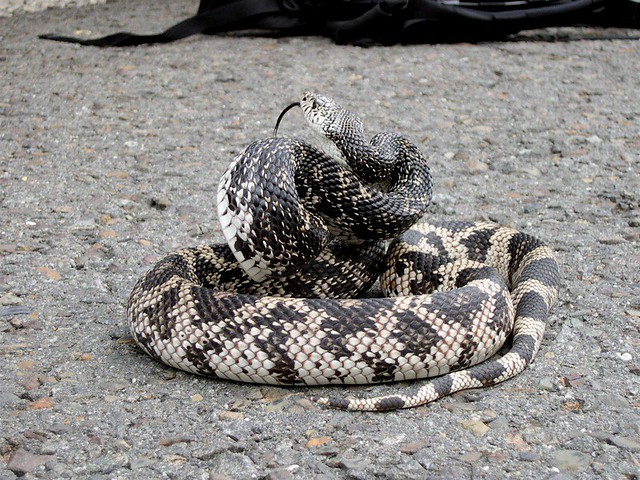
Northern pine snake
Northern pine snake - Pituophis melanoleucus - State Threatened Species - Photo via Zack Bittner, Flickr

Some snakes are tree snakes, some make nests, but the Northern Pine Snake is one of the only burrowing snakes in New Jersey. They make dens and have a nose designed for digging.

They are also currently listed on the Threatened and Endangered species list of New Jersey along with three other snakes.

Most of our pine snake populations are found in the southern part of the state, as they like sandy soils to burrow like those found in the Pine Barrens.

Pine snakes can be hit by cars when trying to move across roads, and are threatened by natural occurrences such as fires. Habitat loss from human development is a factor, as it is for many species in our state. And, unfortunately, a lack of knowledge about snakes in general cause people to fear all snakes, poisonous or not, and people often kill them.

Source: Pine Snake Still Capturing Interest

Wednesday, August 27, 2014

The Eastern Garter Snake

Thamnophis sirtalis sirtalis Wooster.jpg
"Thamnophis sirtalis sirtalis Wooster" Eastern Garter Snake
Wilson44691     Public domain via Wikimedia Commons.
The Eastern Garter snake is not endangered but, like most snakes, it is misunderstood and often misidentified. It is commonly seen throughout New Jersey and can be mistaken for the Eastern Ribbon snake.

You are likely to encounter this snake inside or underneath logs, wood piles and mulch piles, although they may also be found on a lawn, hunting or basking themselves in the sun.

The Garter snake is quite harmless and there is no reason to remove or harm them. If the snake feels threatened, it will emit an unpleasant odor in hopes that the predator moves away.

If a predator grabs its tail, the tail will break off and the broken portion will continue to move around as the snake escapes from the predator. The tail section can grow back.

Garter snakes eat insects, salamanders, small frogs, earthworms and will hunt day and night.

Though most snake species lay eggs, the Garter snake will give birth to 30-50 live young.

Photo by Vincent Costa - Washington Twp. Warren County.


Monday, August 9, 2010

Responding to New Jersey's Snakes

Timber rattlesnake Photo by Kris Schantz


The NJ DEP's Snake Response Team, coordinated by the Division of Fish and Wildlife's Endangered and Nongame Species Program, helps people when venomous snakes get a little too close for comfort. It also works to dispel fears about the reptiles, using facts, tact and understanding.

Of 22 species found in New Jersey, only the timber rattlesnake and the northern copperhead are venomous – and each of these species is generally shy.

Under the state's Endangered and Nongame Species Conservation Act, it is illegal to kill, harm, harass or collect them or any native, non-game wildlife.

On the NJ Endangered and Threatened list are 4 snakes: the timber rattlesnake, Crotalus h. horridus, the northern pine snake Pituophis m. melanoleucus and the corn snake Elaphe g. guttata and the queen snake Regina septemvittata.

In relocating a venomous snake, the Response Team will look for suitable habitat in the same general area that won't harm the snake or create a conflict with another property owner.

Snakes see us as the predator,and their first choice is to try to lay still and blend in with their surroundings or, if feeling threatened, to try to get away.

Snakes fill an important ecological role, controlling rodents and insects and serving as a food source for raccoons, bobcats, hawks, owls and other animals. In short, snakes are indicators of a healthy, vibrant ecosystem.

Yet each year many are intentionally killed by people who don’t understand them.


Northern copperhead Photo by Mike Muller

The copperhead, one of New Jersey’s least common snakes, is frequently confused with the northern water snake and the eastern milk snake, among the most common species.

Copperheads have a dark-colored pattern that forms hourglass-shaped bands from side to side, but coloration is highly variable among individuals and changes according to seasonal shedding periods.

More Information at  http://www.state.nj.us/dep/daw/snakes/

Timber Rattlesnake, Crotalus Horridus Photographic Poster Print by Larry F. Jernigan, 18x24

Timber Rattlesnakes in Vermont & New York: Biology, History, and the Fate of an Endangered Species

Monday, December 14, 2009

Continued Pine Snake Protection Recommended


In another clash of man and wildlife, the Endangered and Non-game Species Advisory Committee has recommended that NJ maintain the threatened status for the pine snake.

The New Jersey Builders Association had filed a petition contending that the pine snake is actually abundant. The species causes problems for builders, particularly in South Jersey, where their protection can limit construction.

Data from state biologists is still being compiled for the NJ Department of Environmental Protection who will decide whether the snake gets continued protection. A final decision has not been made yet, but is expected this month.

The Northern pine snake (Pituophis melanoleucus) likes flat, dry, sandy areas. It is one of the few snakes that burrow in open sandy fields. Most adults are 4-6 in length. It is most likely to be seen in June and July in the afternoon. It feeds on rabbits, rodents, birds, and their eggs.

This snake uses constriction to overpower its prey. When approached it will loudly hiss and vibrate its tail causing most people to think it is a rattlesnake. Though this may work to its advantage is scaring humans, it also causes some people to think it is poisonous and they will try to kill it. A constrictor squeezes its prey and will not strike - in fact, it is fangless.

They are found in Atlantic, Burlington, Camden, Cape May, Cumberland, Gloucester, Monmouth, and Ocean counties.

New Jersey may have the largest single population of northern pine snakes.

It is a rather secretive species that spends most of its time underground, particularly in the sandy soils of South Jersey. The species is found exclusively within the southern half of the state in the Pine Barrens of the outer coastal plain.

Because they eat rodents, in some areas the removal of snakes from an area can cause an increase in the population of mice which in turn may increase Lyme disease. (Mice are the common carriers during the tick's first larvae stage with deer being the frequent carrier in the adult stage.)

Threats to the pine snake include an increase in natural predators, which includes coyotes and raptors. Of course, many of these raptors are themselves threatened or endangered, so this increase is actually a good thing overall.

Pine snakes are also threatened by increased vehicle traffic on the roads through the Pinelands National Reserve which encompasses 1.1 million acres of pine snake habitat. Reptiles need to move into the sun for warmth and will often use roadways which leave them open to traffic and raptors.

The petition by the builders to delist the snake is the first "formal" to question the protected status of a NJ species in the 35 years since the state passed endangered species legislation.