![]() |
| Vernal pool by Assenmacher, CC BY-SA 4.0, Wikimedia |
![]() |
| Blue-spotted salamander by GRMule, Public Domain, Link |
![]() |
| Vernal pool by Assenmacher, CC BY-SA 4.0, Wikimedia |
![]() |
| Blue-spotted salamander by GRMule, Public Domain, Link |
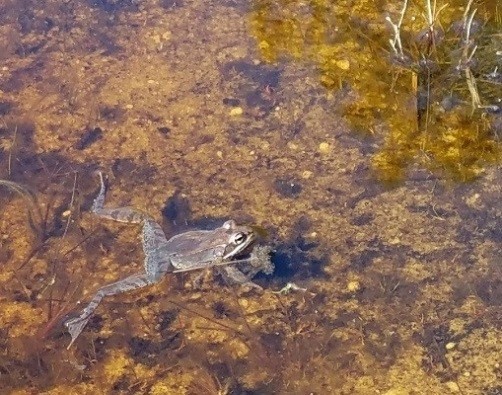
Wood Frogs are adapted to survive cold winters by being freeze-tolerant. As temperatures drop, glucose moves throughout the animal’s body and acts as a cryoprotectant - an "antifreeze" - allowing the frog to survive in the frozen ground. Gray Treefrogs and Spring Peepers can also do this.
Amphibians are tiny powerhouses for the ecosystem and the soundtrack to many of our spring nights, yet they're one of the most at-risk wildlife groups on the planet.
The NJ Division of Fish and Wildlife is celebrating these valuable, vulnerable, cool (blooded) friends with daily social media posts all week, so follow @newjerseyfishandwildlife on Instagram and on Facebook.
Connecting Habitat Across New Jersey (CHANJ) is making progress on their first amphibian tunnel project, at a landmark frog and salamander road-crossing location in Sussex County. This project tackles one of the leading threats to amphibians here and across the globe: habitat fragmentation. The project is currently in the design development stage and will hopefully break ground around Amphibian Week 2022.
![]() |
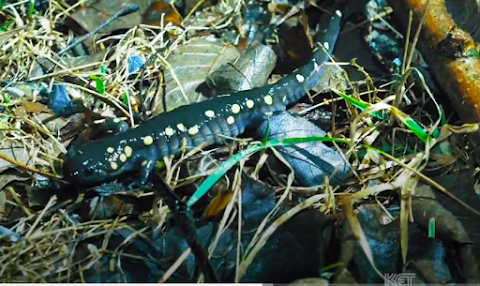
| Spotted salamander Image: Peter Paplanus/Creative Commons |
These pools are created by snowmelt, spring rain and rising groundwater. It is estimated that New Jersey has 3,000 to 5,000 vernal pools. NJ had more snow this winter than last, so that should benefit amphibians.
There are several near me in woods that I often walk and so I will go out some warm spring evening after rain and listen for some frog chorus singers. I might see some amphibians crossing a road. This always makes me think "Why don't they just live in the woods and avoid the dangerous spring commute?"
Luckily, my local pools are in places that will not be developed. But many vernal pools get filled in, level, and built on or near as homes and businesses move in. The amphibians won't know that until the next spring when they make that journey and can't find the pool they expected. The mating still occurs and the eggs will still be laid but the location will be less hospitable to the offspring.
![]() |
| Salamander crossing road - by inkoalseibua from Pixabay |
Spring has arrived in New Jersey despite this week being quite chilly, windy. Our hibernating amphibians – the frogs, salamanders, and toads – are waiting for the warmer days and spring rains that signal to them to leave winter homes, come out and start mating.
Part of that spring ritual often includes crossing roadways and that is dangerous. It's not always a long journey. It might be a hundred yards. It might be further but crossing a busy roadway even a short distance might be life-threatening. It doesn't help that they are also not at full strength. Rainy, foggy nights and the darkness also help keep them hidden from predators like owls and raccoons.
On the first warm, rainy nights of spring amphibians start to move. From below ground come spotted salamanders, Jefferson salamanders, wood frogs and spring peepers. Where are they headed? To vernal pools.
See a list of New Jersey’s amphibian species and
listen to recorded frog and toad calls state.nj.us/dep/fgw/ensp/fieldguide_herps.htm
This movement can happen as early as February if we have a mild winter and some warm, rainy days and nights, but it can also be as late as April if the ground is still partly frozen or covered with snow.
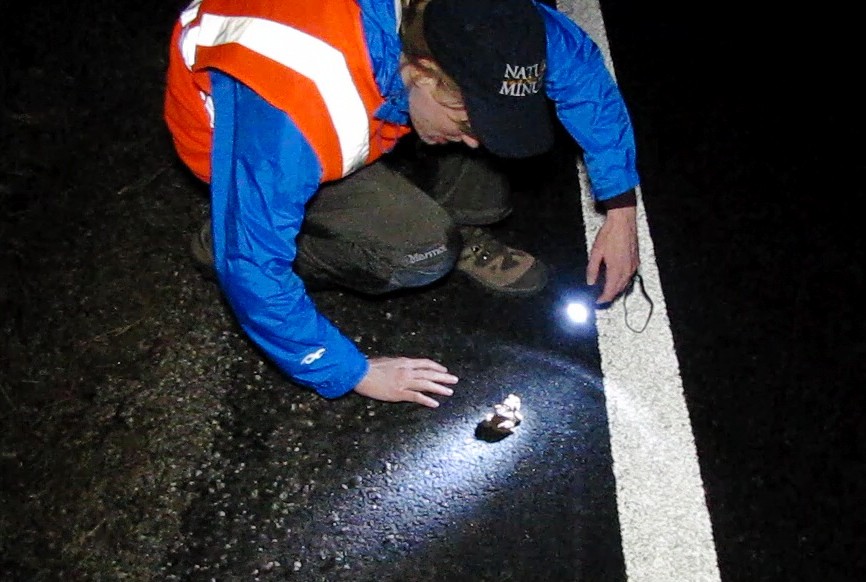
Volunteers and the staff from Conserve Wildlife Foundation have been acting as “amphibian crossing guards” at locations in Warren and Sussex counties.
To learn more about the Conserve Wildlife Foundation’s
amphibian crossing program, go to
conservewildlifenj.org/protecting/projects/amphibian_crossing/
Searching for amphibians crossing with kids and rescuing them from harm is a great activity and a chance to be a wildlife superhero. Here are a few guidebooks. Check in your local library too.
| Turtle using a tunnel under a roadway |
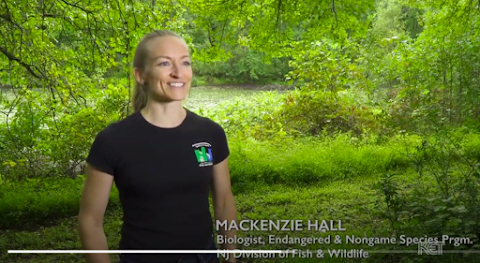
| Mackenzie Hall, ENSP biologist |
| Volunteer transferring a frog across a roadway on a spring night |
| Spotted salamander entering a tunnel |
| Bobcat in the northern NJ "Bobcat Corridor" |
| Bobcat using a dry terrestrial pathway under a road |
![]() |
| Common and non-venomous eastern garter snake (Thamnophis sirtalis sirtalis) Photo: Wilson44691 - Own work, Public Domain |
![]() |
| Northern Watersnake, Nerodia sipedon, non-venomous and found in NJ |
![]() |
| Water moccasin or cottonmouth, not present in NJ, venomous and sometimes misidentified for a water snake Photo by Ltshears - Own work, CC BY-SA 3.0 |
![]() |
| Timber rattlesnake Photo by Kris Schantz via state.nj.us/dep/ |
![]() |
| Northern copperhead Agkistrodon contortrix mokasen, one of two venomous snakes found in New Jersey Photo: Public Domain |
At Waterloo Road in Byram, more than 300 salamanders and frogs per hour have been tallied crossing a quarter-mile stretch on peak migration nights. Their goal is to reach the vernal pool on the other side, lay eggs, and journey back to the forest again. The tiny migrants are up against about 50 vehicles per hour or more - grim odds given that just 15 cars per hour can kill more than 50% of all amphibians trying to cross a road. Even with rescue teams patrolling Waterloo on foot, roadkill rates are always over 10% (Hall and Triece 2012-2017). For Spotted Salamanders, annual road mortality of more than 10% can lead to local extirpation (Gibbs and Shriver 2005).
![]() |
| Eastern Tiger Salamander Photo by Caitlin Smith/USFWS. |
![]() |
| Spotted Salamander |
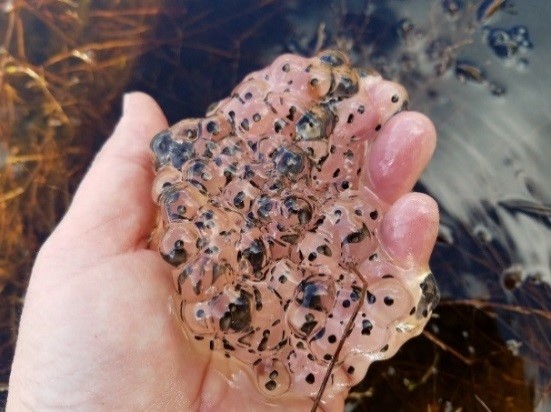
| Eggs |
An Eastern elliptio freshwater mussel
Westcott Phillip/U.S. Fish and Wildlife Service |
The Delaware River once had roughly a dozen native freshwater mussel species. While several still survive in isolated populations, the majority of the river’s mussels—and the species Kreeger’s Freshwater Mussel Recovery Program has, since 2007, focused on — is the Eastern elliptio, a dark shelled mussel up to five inches long with a pearly pink interior. While rare in the tidal estuary, elliptio is common in the river above the reach of the tides at Trenton, New Jersey.
William Lellis of the U.S. Geological Survey (USGS), who surveyed the upper Delaware mussels, estimates there might be as many as two million per river mile. With no dam along the Delaware’s main stem, the American eel, which hosts the mussel’s developing larvae on its gills, can repopulate mussels into beds far upriver, where, as a Wild and Scenic River, the runoff is freer of silt and nutrients than in the highly developed and industrialized estuary. There, the nutrient loads can be very high. The U.S. Environmental Protection Agency’s last National Coastal Condition Report found that the Delaware estuary had more high-nitrogen sites than any other Northeast coastal estuary. Surveys have shown that of 70 Pennsylvania streams, for instance, only four contained any freshwater mussels.
Kreeger realizes it’s critical to find out where and how many mussel beds remain in the estuary, determine where they might still survive if given the chance, and then try to restore those streams to the point where their mussel populations could be rebuilt. (To reach more streams and involve the public in the project, Kreeger has enlisted and trained volunteers to survey mussels in their local streams.) In 2011 and 2012, Kreeger reintroduced mussels into three southeastern Pennsylvania streams and, despite severe flooding, most of the animals survived. The idea, of course, is that, once established, mussels will begin to clean both the water and sediments in their new habitat. Can they do it?
![]() |
| Photo by William Locascio |
| Spotted salamander halfway across a road (conservewildlifenj.org) |
| An American toad gets some crossing protection |
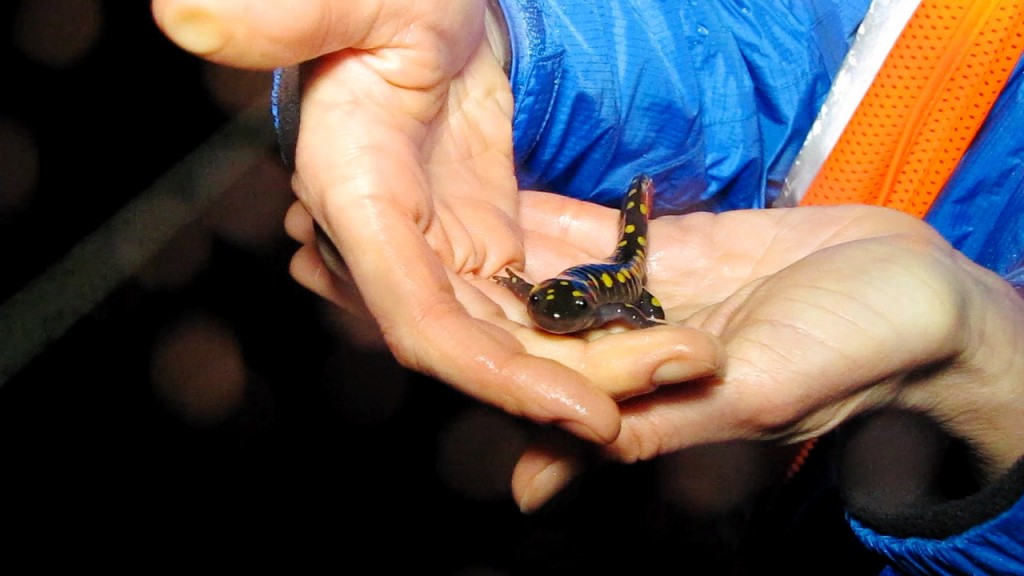
| Kelly holding a spotted salamander |
![]() |
| A yellow spotted salamander changing lanes |
| A spotted salamander being helped across a road. |
The Conserve Wildlife Foundation of New Jersey has assembled a resource package to help teachers educate students about New Jersey's reptiles and amphibians. The package includes the Field Guide to Reptiles and Amphibians of NJ and Calls of NJ Frogs and Toads CD, and a teacher's guide full of activities and lesson plans for grades 5-9. The activities are correlated to the state's Core Curriculum Content Standards.
Resource Package Flyer and Order Form (pdf)
Amphibians often play important and keystone roles in the natural world as indicators of functioning healthy ecosystems and as part of the predator - prey relationship. Like birds, they often signify a "canary in the coal mine" because widespread declines may indicate far reaching problems in the ecosystem. Herpetologists around the world have initiated research and conservation efforts to identify problems associated with these declines and come up with solutions to counteract them. The incredibly high extinction rate of some species can be attributed to:
* Human disturbance
* Habitat destruction
* Encroachment
* Pollution
* Introduced predators
The package includes the Field Guide to Reptiles and Amphibians of NJ and Calls of NJ Frogs and Toads CD, the Field Guide to Salamanders, Frogs and Toads of New Jersey's Vernal Pools and a teacher's guide full of activities and lesson plans for grades 5-9.
The activities are correlated to the state's Core Curriculum Content Standards.
Resource Package Flyer and Order Form (pdf, 50kb)
Below are links to pages concerning New Jersey's herp populations.
Field Guide to Reptiles and Amphibians of NJ and related CD
Field Guide to Reptiles and Amphibians of NJ and Related CD Order Form
Herp Atlas Project