Showing posts with label CHANJ. Show all posts

Monday, July 10, 2023

Report Wildlife Sightings in NJ With New App


The NJ Wildlife Tracker can be used to report rare wildlife species sightings and observations of wildlife (of any kind) on roadways.  

The rare species sightings help keep New Jersey’s Natural Heritage/Biotics inventory robust and current. These data contribute to critical habitat mapping and help monitor habitat occupancy and population trends over time. Ultimately, this helps manage the recovery of rare wildlife species across the state. 

Observations of wildlife on roadways inform our Connecting Habitat Across New Jersey (CHANJ) project, which aims to make our landscape easier for wildlife to move through.


Tuesday, April 14, 2020

Providing Wild Crossings for Endangered Species

Turtle using a tunnel under a roadway

CHANJ is Connecting Habitat Across New Jersey, an effort to make New Jersey's landscape and roadways more permeable for terrestrial wildlife. By identifying key areas and actions needed to achieve habitat connectivity across the state, CHANJ offers statewide mapping and a Guidance Document to help prioritize land protection, inform habitat restoration and management, and guide mitigation of road barrier effects on wildlife and their habitats.

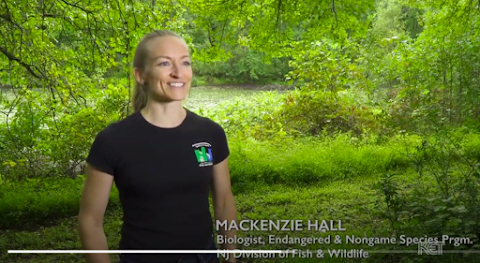
Mackenzie Hall
Mackenzie Hall, ENSP biologist


CHANJ is featured in a new episode of the PBS show, EcoSense for Living.  In this episode, "Wild Crossings," NJ is one of three major habitat connectivity projects, from North Carolina to New Jersey, that are helping wildlife navigate our increasingly developed world.  

In this program, CHANJ comes in at the 14-minute mark but I recommend watching the entire 26-minute episode. The CHANJ portion is 12 minutes and covers salamander migrations, turtle tunnels, timber rattlesnakes, and various connectivity projects of the NJ Division of Fish and Wildlife. You will even meet the Division's bobcat scat-sniffing dog, Fly.


In finding food and finding mates and adapting to climate change, these creatures must overcome all the obstacles humans and nature have put in their way. This project, which once relied solely on volunteers physically moving the smaller amphibians, is using more sustainable methods to help animals find safe passage in our increasingly developed state.

This time of year is especially important for amphibians who are coming out of hibernation and moving to area with water and vernal pools for their short breeding season.

Volunteer transferring a frog across a roadway on a spring night

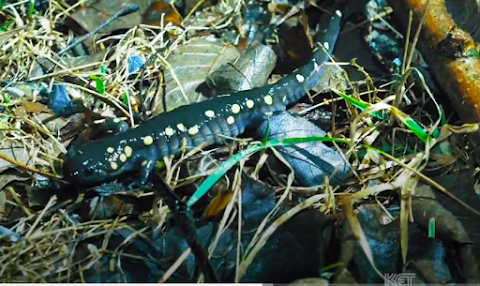
Spotted salamander entering a tunnel

Despite our well-known population density, we are fortunate that NJ is also a recognized leader in preserving open spaces for recreation, agriculture, and nature. Nearly one-third of the state’s landmass is now in permanent preservation. NJ boasts a higher percentage of publicly-owned forest land than any other state east of the Mississippi (Widmann 2004). Healthy, connected ecosystems are an important part of that.

bobcat
Bobcat in the northern NJ "Bobcat Corridor"

Bobcat using a dry terrestrial pathway under a road

All images via pbs.org video

Friday, November 3, 2017

A "New" Frog Species to NJ


Atlantic-coast-leopard-frog.png
Male Atlantic Coast Leopard Frog - Photo by Brian R. Curry CC BY 4.0, Wikimedia


The Atlantic Coast leopard frog, Rana kauffeldi, is a "new" species to our state, though it has probably been in New Jersey all along.

The Atlantic Coast leopard frog is one of several species of leopard frogs. Its species name, kauffeldi, honors the herpetologist Carl Frederick Kauffeld who in 1936 proposed that there could be a third species of leopard frog inhabiting the New York Tri-State Area. The author team that described the species in 2014 christened it after Kauffeld.

Classified as a true frog, it has smooth skin and a narrow waist. Its range stretches along the northern part of Eastern Seaboard, from Connecticut to North Carolina.

The species takes its common name from the speckles on its legs and back reminiscent of a leopard pattern.

The Atlantic Coast leopard frog tends to inhabit large wetland areas, such as marshes, wet meadows, or slow-flowing water. Its habitat usually includes clear, shallow water and it lives in or around open, vegetated spaces as well, with such plants as cattails, reeds, or river shrubs.

Species Profile  state.nj.us/dep/fgw/ensp/pdf/chanj_atlcst_leopardfrog.pdf

The Atlantic Coast leopard frog is a featured species for Connecting Habitat Across New Jersey (CHANJ) state.nj.us/dep/fgw/ensp/chanj_featspecies.htm


Atlantic Coast Leopard Frog distribution simplified.png

By Feinberg JA, Newman CE, Watkins-Colwell GJ, Schlesinger MD, Zarate B, et al. - Feinberg JA, Newman CE, Watkins-Colwell GJ, Schlesinger MD, Zarate B, et al. (2014) Cryptic Diversity in Metropolis: Confirmation of a New Leopard Frog Species (Anura: Ranidae) from New York City and Surrounding Atlantic Coast Regions. PLoS ONE 9(10): e108213. doi:10.1371/journal.pone.0108213, CC BY 4.0, Link

Wednesday, October 25, 2017

Connecting Habitat Across New Jersey


Connecting Habitat Across New Jersey (CHANJ) is a statewide effort to make our landscape and roadways more permeable to wildlife movement.

Whether they’re small like a salamander or big and wide-roaming like a bear, animals need to be able to move through the landscape to find food, shelter, mates, and other resources. Without that ability to move, healthy populations simply will not persist over the long term. Here in New Jersey, wildlife are up against steady urbanization, a dense network of roads, and now a changing climate, all of which put the connectedness of our habitats and wildlife populations in jeopardy.


For example, one project is the Waterloo Road Amphibian Passage System in Byram Twp., Sussex County.

At Waterloo Road in Byram, more than 300 salamanders and frogs per hour have been tallied crossing a quarter-mile stretch on peak migration nights. Their goal is to reach the vernal pool on the other side, lay eggs, and journey back to the forest again. The tiny migrants are up against about 50 vehicles per hour or more - grim odds given that just 15 cars per hour can kill more than 50% of all amphibians trying to cross a road. Even with rescue teams patrolling Waterloo on foot, roadkill rates are always over 10% (Hall and Triece 2012-2017). For Spotted Salamanders, annual road mortality of more than 10% can lead to local extirpation (Gibbs and Shriver 2005).

Another project is creating Bobcat Alley in Sussex and Warren Counties, which we have written about here before. For more information: state.nj.us/dep/fgw/ensp/pdf/chanj_bobcatalley.pdf