Showing posts with label volunteers. Show all posts

Thursday, May 1, 2025

Horseshoe Crabs By the Full and New Moons


horseshoe crabs spawning   (though I object to "invade" as the description)

Horseshoe crabs are commonly found along New Jersey's Delaware Bay beaches, particularly in May and June when they come ashore to spawn. The most significant concentration of spawning horseshoe crabs occurs in the middle reaches of the Delaware Bay. Beaches in Cumberland and Cape May counties are known for high horseshoe crab activity during this time. 

May 12 is the Full Moon, and the 26th is the New Moon and next monthJune 11 is the Full Moon date this year, with the New Moon on the 25th.

New Jersey is known for its sandy beaches, and horseshoe crabs can be found spawning all across the state. The most activity by far is found on the Delaware Bay coastline, in Cumberland and Cape May counties. (A map of spawning beaches

reTURN the Favor is a collaborative effort that enables organized volunteers to save horseshoe crabs stranded on New Jersey’s seasonally closed and open beaches. Since 2013, reTURN the Favor volunteers have been rescuing horseshoe crabs along New Jersey’s Delaware Bay beaches. The program has grown significantly over the past decade, substantially contributing to horseshoe crab conservation.


Thursday, January 23, 2020

Hooked on Fishing Not on Drugs Team Leader Training


The Division of Fish & Wildlife will host a 2-day Hooked on Fishing-Not on Drugs (HOFNOD) leader training May 15-17, 2020, at the Lighthouse Center for Natural Resource Education in Ocean County.

HOFNOD is a great way to introduce youth to fishing, their local waters and other natural resources while supporting positive outdoor recreation and life skills.

This workshop is for adult staff and volunteers of youth-centered organizations looking to offer a youth fishing program. The program is flexible enough to be tailored to fit most organizations.


Registration is required and due by May 1, 2020.
For more information about this training, visit the HOFNOD Team Leader Training announcement


Wednesday, January 9, 2019

'Hooked on Fishing-Not on Drugs' Team Leader Training Workshop


The NJDEP Division of Fish and Wildlife will host a 2-day Hooked on Fishing - Not on Drugs (HOFNOD) training for adult staff and volunteers of youth-centered community and/or faith-based organizations looking to offer an ongoing or year-round youth fishing, conservation, and aquatic education program. 

HOFNOD is a great way to introduce youth to fishing, learning about their local waters and other natural resources while supporting positive outdoor recreation activities and life skills. The program is flexible enough to be tailored to fit most organizations.

Participants in this training will be responsible for delivering the program to youth from beginning to end over the course of 22 or more sessions. Organizations that participate in the program are eligible to receive additional professional development in conservation education and angling skills and in-kind support for program materials and supplies including subsidized educational field trips. Supplemental training can be requested for content like fly tying and kayaking.

Hooked on Fishing-Not on Drugs Team Leader Training Workshop

May 17-19, 2019
7th Street & Navajo Drive
Waretown, New Jersey 08758


Your participation includes: two nights lodging, five meals (Saturday breakfast, lunch, dinner and snacks; Sunday breakfast, lunch and light snacks) and all workshop activities and materials. Please bring a sleeping bag or bedding, pillow and toiletries; a water bottle and/or coffee cup; a camera; any necessary medications, weather appropriate clothing and muck shoes or old sneakers that you don't mind getting wet. Please dress for the weather as some activities will be outside. This is a rain or shine training and registration is required.


There is a $40 non-refundable deposit to hold your space and to off-set training costs.

For more information on this workshop and to register, 


Tuesday, September 27, 2016

Volunteers Needed for Delaware Bay Reef Build on October 1

October 1, 2016
Delaware Bay Reef Build
2 PM- 6 PM
Dyers Cove
Dyers Creek Road
Newport, NJ 08345

Come lend a hand building an oyster reef at Dyers Cove in the Delaware Bay. The work will involve carrying bags of whelk shells to a site just off the beach. Layers and a change of clothes are recommended as it may be chillier on the Bay and the work can get messy. Gloves, snacks, and beverages will be provided for volunteers.

The American Littoral Society has restored 7 beaches following Hurricane Sandy and is now working to establish near-shore shell bars at those sites to prevent sand loss from wind-driven waves and have already established an oyster reef at South Reeds and Moores beaches.

For more information on Littoral Society reef building projects, see http://www.restorenjbayshore.org/oyster-reef-construction.html?utm_source=www.endangerednj.blogspot.com or contact Quinn Whitesall quinn@littoralsociety.org

South Reeds Beach oyster reef April 2015

Tuesday, April 26, 2016

Before They Are Endangered

A recent article from the Press of Atlantic City, reminds us that protecting New Jersey's snakes, birds, frogs and other animals and plants BEFORE they are endangered is really the goal of conservationists.

In that article, the focus is on effort in the far-from-barren NJ Pinelands. The post online includes a video and follows Emile DeVito, an expert on endangered species in the 1.1-million-acre Pinelands National Reserve, who studies the rarest plants and animals.


Those species include the Pickering’s morning glory and the iconic Pine Barrens tree frog.

The Pickering's morning glory is not currently listed in NJ and so its rarity makes it the kind of species that needs attention (and will not get as much federal or state funding support) so that it is not overlooked and it moves to a threatened or endangered status.
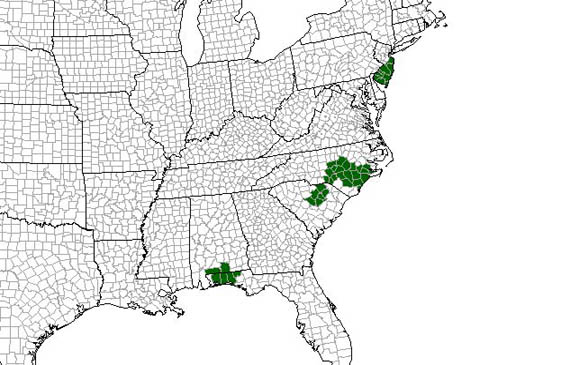
Current limited range for the Pine Barrens treefrog


The Pine Barrens treefrog is another kind of species case study. In 1979, iy was listed as an endangered species in New Jersey due to its restricted range, declining population, habitat loss, and pollution of breeding ponds. But conservation efforts moved the treefrog population to a point that it is currently considered stable.

New Jersey serves as a stronghold for this species throughout its entire range. In areas of suitable habitat, they may seem abundant. However, protection of this species is warranted, as quality habitat is limited to specialized Pine Barrens ecosystems patchily distributed throughout its range.

 Flower of Stylisma pickeringii Pickering's Dawnflower or Pickering's Morning Glory, near Batsto, New Jersey.
via Wikimedia
Conservationists have long known that addressing species in decline before they reach the the stages of being threatened or endangered is the real goal.

As members of the New Jersey Conservation Foundation, New Jersey Audubon and the NJDEP track species, they can identify important habitat for that species.

For example, the docile pine snake can be tracked using implanted transmitters that allow us to discover winter dens and nesting sites.

Pine snake moving across sandy soil

We have more than 80 species of wildlife from mammals to birds to insects in New Jersey that are considered endangered or threatened. (See list at www.state.nj.us) There are also dozens of plants that are in danger that probably get less attention than the "sexier" wildlifr.

Some habitats that need protectionare less than intuitive spaces. For example, Ryan Rebozo, director of conservation science at the Pinelands Preservation Alliance, says that the edges of roads in the Pinelands could replace some lost open areas, such as those lost by dousing fires that naturally create suitable habitat. But too often road departments are mowing these areas at inopportune times when some rare plants are flowering. He estimates that 11,000 acres of road edges could be suitable habitat for some of our rare plants, such as the the Pine Barrens gentian, which needs direct sunlight and flowers later in the fall when mowing is common.

As important as education and information, such as this post, can be, it alone isn’t going to save species. People, especially volunteers and the general public, need to take action.