Showing posts with label Pine Barrens tree frog. Show all posts

Tuesday, April 17, 2018

How About a State Amphibian and a State Reptile for NJ?

Look up the New Jersey state amphibian and state reptile and you will find - nothing. We don't have them. Well, we have amphibians and reptiles, but none are officially designated.

That may change soon.

Bills to make the Pine Barrens treefrog the official amphibian of New Jersey and to make the bog turtle the state reptile were approved by a state Senate committee this year.

Pine Barrens treefrog
a puffed up Pine barren Treefrog

According to S2297, the Pine Barrens Treefrog (Hyla andersonii) was listed by New Jersey as an endangered species in 1979 due to habitat loss and upgraded in 2003 to threatened “based on improved population numbers and a determination that its habitat in the state is well protected by the New Jersey Pinelands Comprehensive Management Plan.” The bill says designation as the state amphibian would further help in conservation of the species and its habitat by raising its profile among the public.

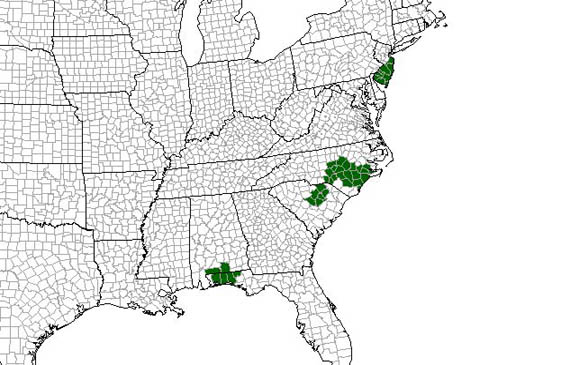
Populations of the Pine Barrens treefrog are found in only three places worldwide. They are the New Jersey Pinelands, the panhandle of Florida, and the sandy hills of North Carolina and South Carolina.

Then we have bill S1925, for the bog turtle (Clemmys muhlenbergii). It is one of the smallest turtles in the world. It has a distinct orange patch on either side of its head and a brown to black shell, and it is one of the rarest in North America.

bog turtle

The bog turtle can be found in wet areas in 12 New Jersey counties. It was listed as endangered in New Jersey in 1974 and threatened in the U.S. in 1997. Designation as the state amphibian should also give it more exposure and help conserve it by raising public awareness.

If the bills get past the state Senate and Assembly and are signed by the governor, these two species will join other official species such as:
  • the eastern goldfinch as the state bird
  • the horse as the state animal (the U.S. Equestrian Team is headquartered in New Jersey)
  • the brook trout as the state fish
  • the honeybee as the state “bug”
  • the black swallowtail as the state butterfly
  • Hadrosaurus foulkii, the fossil of which was discovered in Haddonfield, Camden County, as the state dinosaur

Tuesday, April 26, 2016

Before They Are Endangered

A recent article from the Press of Atlantic City, reminds us that protecting New Jersey's snakes, birds, frogs and other animals and plants BEFORE they are endangered is really the goal of conservationists.

In that article, the focus is on effort in the far-from-barren NJ Pinelands. The post online includes a video and follows Emile DeVito, an expert on endangered species in the 1.1-million-acre Pinelands National Reserve, who studies the rarest plants and animals.


Those species include the Pickering’s morning glory and the iconic Pine Barrens tree frog.

The Pickering's morning glory is not currently listed in NJ and so its rarity makes it the kind of species that needs attention (and will not get as much federal or state funding support) so that it is not overlooked and it moves to a threatened or endangered status.

Current limited range for the Pine Barrens treefrog


The Pine Barrens treefrog is another kind of species case study. In 1979, iy was listed as an endangered species in New Jersey due to its restricted range, declining population, habitat loss, and pollution of breeding ponds. But conservation efforts moved the treefrog population to a point that it is currently considered stable.

New Jersey serves as a stronghold for this species throughout its entire range. In areas of suitable habitat, they may seem abundant. However, protection of this species is warranted, as quality habitat is limited to specialized Pine Barrens ecosystems patchily distributed throughout its range.

 Flower of Stylisma pickeringii Pickering's Dawnflower or Pickering's Morning Glory, near Batsto, New Jersey.
via Wikimedia
Conservationists have long known that addressing species in decline before they reach the the stages of being threatened or endangered is the real goal.

As members of the New Jersey Conservation Foundation, New Jersey Audubon and the NJDEP track species, they can identify important habitat for that species.

For example, the docile pine snake can be tracked using implanted transmitters that allow us to discover winter dens and nesting sites.

Pine snake moving across sandy soil

We have more than 80 species of wildlife from mammals to birds to insects in New Jersey that are considered endangered or threatened. (See list at www.state.nj.us) There are also dozens of plants that are in danger that probably get less attention than the "sexier" wildlifr.

Some habitats that need protectionare less than intuitive spaces. For example, Ryan Rebozo, director of conservation science at the Pinelands Preservation Alliance, says that the edges of roads in the Pinelands could replace some lost open areas, such as those lost by dousing fires that naturally create suitable habitat. But too often road departments are mowing these areas at inopportune times when some rare plants are flowering. He estimates that 11,000 acres of road edges could be suitable habitat for some of our rare plants, such as the the Pine Barrens gentian, which needs direct sunlight and flowers later in the fall when mowing is common.

As important as education and information, such as this post, can be, it alone isn’t going to save species. People, especially volunteers and the general public, need to take action.

Wednesday, February 24, 2016

Threatened, Endangered, Extinction and Extirpation

It is not unusual to hear the words “extinct” and “extinction” used. Sadly, they tell us that a species has vanished from the planet. Every little kid knows that - despite the ideas in the Jurassic Park movies - the dinosaurs are extinct.

It is a process, like climate change, that naturally occurs and has been happening long before humans were around. Since life began on our planet, it is estimated that about 99 percent of all species that ever lived have gone extinct. Most of that is due to natural causes.

Humankind played no role in most of these extinctions, but for the most recent extinctions, we do play a part.

The passenger pigeon, wild dromedary camel, the dodo bird, the Javan tiger, the dusky seaside sparrow and others on a long list can be blamed on our hunting, harvesting and destruction of habitat.

Less commonly heard is the term extirpate. Some species are not gone forever (extinct) but have disappeared from large areas of their original, natural habitat. We say that they been extirpated which means completely gone from a particular region—in other words,”locally extinct.”

For example, the American red wolf used to be common throughout much of the Southeastern U.S., but by 1980, Canis rufus had been extirpated everywhere but along a narrow strip of coastal eastern Texas. Of course, if that last small population of wolves had been killed off, the species would have gone extinct.

In New Jersey, cougars, bobcats and bald eagles all went through being threatened, endangered and extirpated.  But bobcats and bald eagles were reintroduced to the state and have made comebacks. (I don't expect  a similar program for cougars!)

Pine Barren tree fog via conservewildlifenj.org

Another state example is the Pine Barrens tree frog (Hyla andersonii) which for a time was a logo favorite for state conservation programs. It is a species of New World tree frog that has become endangered due to habitat loss.

At only 1–3 inches (25–76 mm) long, it is one of the smaller species of tree frogs.

The Pine Barrens tree frog is currently distributed in three disjunct areas in the eastern United States: the New Jersey Pine Barrens; the Sandhills of North and South Carolina; and the Florida panhandle and southern Alabama.

It is the state frog of North Carolina. As far as I can find, NJ has no state frog. I nominate this little green wonder.

In our Pine Barrens, it is most commonly found in brushy areas, often near peat bogs or shallow ponds and areas carpeted with thick moss. The adults are terrestrial, but tend to reside near water sources. Unlike most frogs, they are tolerant of low pH levels, and often lay eggs in the shallow, acidic ponds which are found in the Pinelands.

Hyla andersonii was listed as endangered by the US Fish and Wildlife Service between 1977 and 1983, when additional populations were found in Florida.

Those red wolves were placed in a captive breeding program, and some have been released into one area of North Carolina, where they have since been breeding successfully. As with our Jersey eagles and bobcats, these programs have also brought back the California condor, the American bison to repopulate areas from which they were extirpated by humans.