Showing posts with label Cape May County. Show all posts

Thursday, September 3, 2026

Wildwood Coyotes


Coyote pup in Wildwood.
So cute, you might be tempted to go nearer and feed it. DON'T

Coyotes in New Jersey are not rare, endangered or threatened. But they are becoming more common, and many people are fearful of their presence. 

A recent increase in coyote sightings near Wildwood’s back bay has raised concerns among local residents. These cunning and very adaptable predators are digging underneath fences, entering backyards, and keeping frightened residents at home. Homeowners are keeping their pets inside, and they’re thinking twice about letting small children outside unattended. 

City officials say locals feeding the coyotes is contributing to the problem. The city has put up more than a dozen warning signs around town to not feed any coyotes. The mayor noted that the coyotes are fearless and that they don’t run and just stare when a car comes closer to them. 


These sightings have been concentrated near Wildwood’s former landfill, which is currently being redeveloped into a nature preserve. Officials are hoping the completion of the project will keep coyotes further from residential homes. 

Residents throughout the state are encouraged to follow these guidelines to mitigate coyote encounters:

  • No feeding 
  • Secure garbage and pet food 
  • Strengthen fencing 
  • Consider installing motion-activated lights or sound deterrents

Saturday, May 23, 2026

Horseshoe Crabs Return to Cape May County


In this annual rite of spring, the beaches of Cape May and the broader Delaware Bay region play host to one of the oldest, most spectacular wildlife phenomena on Earth: the mass spawning of Atlantic horseshoe crabs (Limulus polyphemus).

This ritual has been repeated for nearly 450 million years—meaning these "living fossils" arrived on these exact shores long before the first dinosaurs walked the earth.

While horseshoe crabs begin trickling onto the beaches in late April, the main event happens in May and June. The absolute peak centers around the Full and New Moons, specifically during evening high tides. May 2026 has two Full Moons to start and end the month.


Driven by the high spring tides, tens of thousands of crabs emerge from the deep bay waters simultaneously. Large, smooth-shelled females crawl up to the high-tide line, often trailing one or more smaller males holding onto her carapace (shell) with specialized, boxing-glove-like claws. The female digs a shallow nest in the sand to deposit up to 20,000 tiny, greenish-tan eggs. The males then fertilize them as the waves wash over the cluster.

At its height, the shoreline looks less like a beach and more like a cobblestone street paved in dark, gleaming, olive-green helmets jostling in the surf.

The arrival of the crabs triggers a second, equally spectacular natural event. The Delaware Bay is the largest horseshoe crab spawning site in the world, and the millions of eggs left in the sand are a vital fuel source for migrating shorebirds.


Among these birds is the Rufa Red Knot, a threatened species undertaking an incredible 9,000-mile journey from the tip of South America up to the Canadian Arctic. Cape May is their ultimate refueling station. The birds arrive emaciated, having lost up to half their body weight. They gorge themselves almost exclusively on the lipid-rich, easily digestible horseshoe crab eggs that are churned up to the surface by the waves.

In just about two weeks, a Red Knot must double its body mass to survive the final leg of its journey north to breed. Without a dense concentration of crab eggs, the birds cannot successfully reach the Arctic or reproduce.

If you head down to the Cape May area to see it, the Delaware Bay side beaches (like Reeds Beach, Cook's Beach, or Higbee Beach) offer far more intense spawning activity than the oceanfront Atlantic beaches, as the crabs prefer the calmer, wave-protected waters of the bay.

Because both the horseshoe crabs and the shorebirds are highly vulnerable, many of Cape May's key bay beaches are seasonally closed to the public during the peak weeks to prevent disturbing the birds. However, public viewing platforms and guided walks hosted by organizations like the Cape May Bird Observatory offer spectacular front-row seats to this ancient dance.


Wednesday, March 8, 2017

Hike All of New Jersey's 21 Counties

Lake Aeroflex in Kittatinny Valley State Park is considered the deepest natural lake in NJ

Some early spring days and temperatures may have gotten you thinking about more outdoor activities. Walks and hikes are my own favorite way to get outdoors these days. Back in the days when my knees were in better shape, I really wanted to through hike the Appalachian Trail, but I knew that was a reach. I joined a hiking club that did the Appalachian Trail in sections which seemed more doable. Though I never did the entire east coast AT, I did cover all of its sections in NJ, NY, PA and sections in other states.

NJ.com ran an artilce recently with suggestions of where you might hike in each of NJ's 21 counties.  Setting a goal of doing a hike this year in each county would be a good way to get into hiking and see more of the state.

Starting up north, you could try a Sussex County hike in Kittatinny Valley State Park. In its 5,600-acres, there are trails of varying difficulty. Actually, for almost all of the 21 suggested locations, you can take a hike and also a gentle walk. These are not backpacking expeditions requiring training and special equipment (though there are a few tougher hikes in our state).

Kittatinny features some glacial lakes and limestone outcroppings that will be seen from two rails-to-trails paths and those Stokes State Forest, a popular destination featuring a portion of the Appalachian Trail, cliffs, Tillman Ravine and miles of good hiking trails.


And down south, you can try Cape May Point State Park. With 244-acres along the Jersey Shore, this spot offers some flatland walks and hikes through wetland marsh, coastal dunes and beaches. The area is known for its wildlife and birding - along with a World War II-era bunker offshore. There are no mountaintops to scale, but you can climb the Cape May Lighthouse. 

Alternately, you can explore Belleplain State Forest, which is in Cape May County but extends north into Cumberland County. The Forest offers several trails including a flat but longer (7.2 miles) East Creek Trail.

In between and in my own backyard of urban Essex County, there is one of childhood stomping grounds: South Mountain Reservation. At 2,112-acres, this urban nature reserve is located between the first and second ridges of the Watchung Mountains.

It is a great escape with woodlands, streams, creeks, ponds, a reservoir and Hemlock Falls. There are trails from less than a mile (a short walk!) up to 6 miles. As with any of these locations, you can bundle several trails together to create a longer hike.

An alternative spot is the smaller 400-acre Eagle Rock Reservation which is also an easily-accessed spot for a short day hike or ramble.

Monday, January 2, 2017

Guided Walks at Higbee Beach

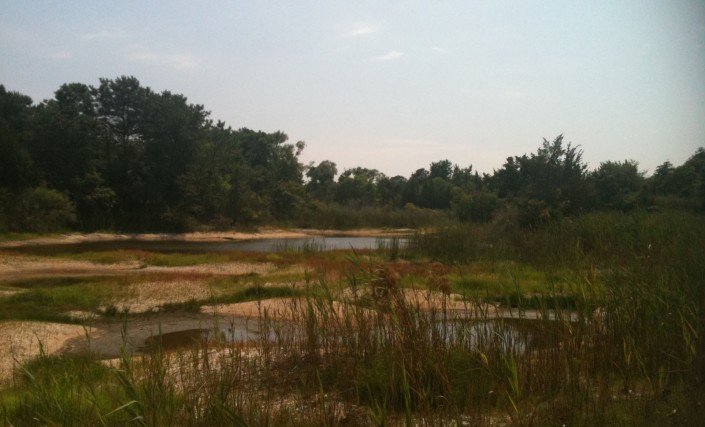
Higbee Beach via capemaybeach.com/higbeebeach.html

Guided walks in the Hidden Valley area of Higbee Beach WMA are being offered monthly by NJ Audubon in cooperation with the NJDEP Division of Fish and Wildlife.

The Higbee Beach Wildlife Management Area is important for its value to endangered, threatened and nongame wildlife.

This Cape May peninsula hosts one of the world's largest migrations each fall as millions of birds stop at the peninsula seeking food, cover and water. Higbee Beach plays a vital role in the migration, providing migrants with a stopover site as they increase their fitness before continuing their sojourn south.

The roughly 1,100-acre area offers a unique blend of several different habitats, including dune, forest, scrub-shrub and early successional fields. The Endangered and Nongame Species Program, in cooperation with the Bureau of Land Management, manages the fields and scrub-shrub areas for migrating songbirds and raptors.

There are two new viewing platforms that have been added to the nearly 2 miles of nature trails at the area. The platforms, which offer spectacular views of the field and forest canopy, feature educational signs on migration and habitat.

A a new dune trail which runs through forested dunes with views of the expansive Delaware Bay was added in 1999.
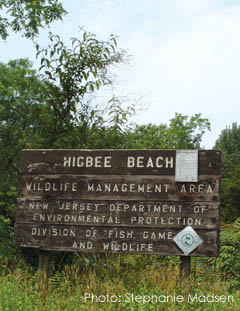

Higbee Beach is comprised of six different locales: Signal Hill, Davey’s (or Davis) Lake, Pond Creek, Sassafras Island, Hidden Valley, and the Magnesite Plant.

Hidden Valley's mix of varied habitats hosts a diversity of birds which may be encountered, including sparrows, hawks, waterbirds, and even the possibility of an owl.

According to capemay.com, Hidden Valley was once a 92-acre farm between Bayshore Road and the Pond Creek Marsh. The Dickinson family, preferring it be preserved rather than developed, sold it to the state in 1986. Part of the acreage is known as Hidden Valley Ranch, and is leased for equestrian activities. The fields, trails and swamps are well known to birders.


The next scheduled walk is Sunday, January 8 at 4:00 p.m.  
For more information visit community.njaudubon.org


If visiting during the fall migration, it is suggested that you go following a cold front with northerly winds. All you need is a set of binoculars and ID books.

In warmer weather, Higbee Beach is also home to lots of dragonflies and butterflies, including the long-distance migrant - the Monarch butterfly.

Wednesday, October 14, 2015

October Is Monarch Migration

October is the peak month for monarch butterfly migration, and along New Jersey's coastline there is a good chance of spotting these long-distance flyers. They migrate over 2,000 miles to the forests of central Mexico.

But the monarch population has declined tremendously - down 95% from the mid-1990s - mostly due to widespread loss of milkweed plants. The milkweed plant's leaves are the only food source for monarch caterpillars. Many people believe the monarch needs to be placed on the U.S. Endangered Species List.

Along the coast, you might see the monarchs on goldenrod flowers or roosting in Eastern red cedars, although their routes are highly affected by winds.

Cape May is a key point on their migration route. As with many birds, they use the tip of the state as a food stop before their next long flight. In the monarchs' case, it is a southern route over the Delaware that they need to power up for on this two month journey.

 New Jersey Audubon Society's Cape May Bird Observatory hosts the Monarch Monitoring Project which covers much of the tip and conducts counts at Stone Harbor Point and East Point on the Delaware Bay - see www.monarchmonitoringproject.com

Saturday, July 18, 2015

Cape May County Park & Zoo Ranked Nationally


Not all zoos get good reviews from environmentalists and protectors of wildlife. But for many people, especially in urban areas, it may be their only contact with some species, and they can be an educational experience for attendees about issues such as habitat loss and threatened species.

New Jersey has several small zoos and recently Cape May County Park & Zoo was selected as the 13th-best zoo in the world, according to TripAdvisor.com. The approximately 200-acre facility in the Cape May Court House section of Middle Township is also fifth among U.S. zoos. The rankings are based on thousands of user-submitted reviews.

The reviewers say “One of the best zoo's on the East Coast and it's free.


Monday, February 16, 2015

Green Eggs and Sand Curriculum Workshop


During the full and new moon events in May and June, thousands of horseshoe crabs come ashore to spawn, primarily in Delaware Bay. It is also during this time when migrating shorebirds descend upon the beaches to rest and feed on the horseshoe crab eggs before continuing onto their breeding grounds. This interaction between horseshoe crab, shorebird and humans is what lays the groundwork for the Green Eggs & Sand (GE&S) workshop.

A Green Eggs and Sand Curriculum workshop will be held May 29-31 at the Wetlands Institute in Stone Harbor (Cape May County). 

The workshop will delve into the ecological connections between horseshoe crabs and shorebirds, human connections to horseshoe crabs, and the challenges encountered in managing this resource via presentations, field trips and hands-on activities. Workshop participants will receive the award-winning, Green Eggs & Sand curriculum pack, recently updated with current information and new activities.

The GE&S workshop is a three-day workshop focuses on promoting understanding the issues, the science and the management of the horseshoe crab/shorebird controversy. 

Workshop participants learn from top researchers and natural managers in the field, as well as get to participate in a horseshoe crab count. 

Educators and natural resource managers from Delaware, Maryland and New Jersey developed the curriculum, and designed it for use with middle and high school students. It is broken down into four modules that introduce students to the lives of horseshoe crabs, their extraordinary history, ecological niche, interrelationships with other species and the challenges of managing horseshoe crabs. 

At the end of the workshop participants take home the activity rich GE&S curriculum package and video that has been correlated to the national-learning standards in science, social studies, math and language arts. 

Workshop FAQs (pdf, 43b)

For further information please contact Karen Byrne at 609-748-4347 or via e-mail at Karen.Byrne@dep.nj.gov.

For more information visit http://www.njfishandwildlife.com/greeneggs.htm 

Thursday, July 31, 2014

Hurricane Sandy Restoration: Middle Township


via the U.S. Fish and Wildlife Service  also see the USFWS Northeast website
Hurricane Sandy taught us that the coast is an ever-changing environment, vulnerable to sea-level rise and powerful storms. Since Sandy made landfall in October 2012, The U.S. Fish and Wildlife Service has been working with other federal agencies and conservation partners to restore the Atlantic Coast by enhancing habitats that protect our coastal communities and sustain people and wildlife. These efforts are supported by funding from the Department of the Interior through the Disaster Relief Appropriations Act of 2013.

Recognizing the interconnected nature of our conservation work, today we launch the first in a series of videos highlighting communities impacted by Hurricane Sandy and their journey toward recovery. This first video outlines a $1.65 million beach habitat restoration project along the shores of Delaware Bay that is already benefiting native horseshoe crabs and migrating shorebirds. At the same time, the project will help local communities like Middle Township, New Jersey, whose Mayor Tim Donohue describes how strengthening natural defenses will in turn protect homes and support the area's ecotourism industry.

This project and others like it are designed to support decisive and informed actions now with our partners to safeguard our coastal communities for years to come.

Friday, June 27, 2014

Testing the Waters at the Jersey Shore


Testing the Waters is a guide to water quality at vacation beaches. The state summary for New Jersey ranked our state third in beach water quality (out of 30 states. Only 3% of samples exceeded the national Beach Action Value for designated beach areas in 2013.

New Jersey has public beaches lining 127 miles of the Atlantic coast. The Cooperative Coastal Monitoring Program (CCMP), which is administered by the New Jersey Department of Environmental Protection, conducts quality monitoring from mid-May to mid-September.

You can find daily activity reports, including beach closings and advisories, at www.njbeaches.org (the CCMP website). As I write this, the Jersey shore beaches are all green lights and open.

In 2013, New Jersey reported 492 coastal beaches and beach segments, 288 of which were monitored. New Jersey also has "bracket" beaches that are adjacent to regularly monitored beaches; if high bacteria concentrations are found at a regularly monitored station, sampling is conducted at bracket stations to determine the extent of the affected area.

That 3% number means that of all reported beach monitoring samples, 3% exceeded the Beach Action Value (BAV) of 60 enterococcus bacteria colony forming units (cfu) per 100 ml marine or estuarine water in a single sample.

The 4 beaches in NJ that did exceed the rate with the highest percentages in 2013 were Berkeley Township at Beachwood Beach West in Ocean County (52%), Neptune Township at Shark River Beach and Yacht in Monmouth County (20%), Berkeley Township at West Beach Avon Road in Ocean County (18%), and Brick Township at Windward Beach in Ocean County (17%).

Thursday, January 3, 2013

Winter Visitors Flock to South Jersey

Western Grebe - FWS
It is that time of year when the Jersey shore gets a lot of visitors flying in for a stay. they don't use Newark or Atlantic City airports. They fly in on their own because winter in South Jersey is when dozens of species of bird not native to this area take vacations from their northern homes.

While people in NJ may be complaining about snow and cold weather, these avian tourists find the shores and estuaries of the Delaware Bay coast very appealing. The Downe and Commercial townships, as well as Maurice River and Lawrence along the bay and river shores are considered prime area for birding. There are also a number of wildlife management areas (WMAs) and other protected open spaces that offer good viewing.

“The Delaware bay shore is one of the best wintering strongholds in North America,” Pete Dunne, director of the NJ Audubon Society’s Cape May Bird Observatory, told The South Jersey Times. “This is what is called an eruption year. Food stocks are scarce up north and so the birds come south."

Already, sightings of the winter finch, Townsend’s warbler and the rare western grebe have been made. There are also birds of prey including owls, hawks, falcons and eagles despite Hurricane Sandy drowning many of the mice, rats and weasels that are the prey of raptors in these marshes.

This year, the Audubon Society’s annual Cape May Christmas count documented 168 distinct species.

Northern Saw-Whet Owl  -  FWS
 Dunne reported ten distinct great horned owl calls one morning at Turkey Point in Downe Township.

And the saw-whet owls are present in large numbers. As many as 80 have been captured and banded in a given area in a single night.

The saw-whet owl is very passive and are present in areas of open marshland along the coast should have its share of prowling raptors.

For those interested in learning more about birds and bird watching, Dunne and the NJ Audubon will be hosting Break into Birding, an informational session for new birders on February 16 and 17. Information on all activities and programs offered by the Cape May Bird Observatory can be found online at www.BirdCapeMay.org
Images: U.S. Fish & Wildlife Service (Public Domain)

Thursday, October 4, 2012

Volunteers Needed for Cox Hall Creek WMA in Cape May County


Volunteers are needed to help plant native trees, shrubs, grasses and wildflowers for wildlife inside Cox Hall Creek Wildlife Management Area in southern Cape May County.

October 10-11th from 10-2pm. (possibly the 12th if needed)
Cox Hall Creek Wildlife Management Area, Villas, NJ

This site is the former location for an old golf course named “Ponderlodge.” It was demolished last year and we need your help to install a series of gardens that will be used to demonstrate what people can do to help provide habitat for wildlife in lower Cape May County.

The entrance for Cox Hall Creek WMA is at the intersection of Bybrook & Delview Rd. We'll meet in the parking area. The area where we'll be working is right next to the parking area. Restrooms are on site. We'll provide some light refreshments.

Please bring some landscaping/planting tools, shovels, work gloves etc...that you can use to help plant.

We will have light refreshments. There is a bathroom on site. Please bring a pair of work gloves and dress accordingly.

Please RSVP by emailing Ben Wurst


Heavy rain will postpone till the following day.
 

More info about the project: conservewildlifenj.org/protecting/habitat/restoration/ponderlodge/

Tuesday, September 11, 2012

Whaling in Historic New Jersey

The Delaware Bay and the rivers of South Jersey have been a source of  food and economic sustenance to our region ever since it was the home of the Lenni Lenape Indians who traveled to the coast to fish and gather shellfish.

Peter Watson wrote from Perth Amboy in 1684 that, "the Indians in the summer, along with their wives come down the Rivers, in the Cannoas, which they make themselves of a piece of a great tree, like a little Boat, and there they Fish and Take Oysters."

All parts of the oyster and clam were utilized: Wampum, made out of the shells, was a common currency among the Indians.


We can learn much about New Jersey history by following, literally or via writing, the historic New Jersey Coastal Heritage Trail Route.

Image Nantucket Whaling Museum via capemay.com


The earliest recorded maritime-related industry in NJ was undertaken by the first settlers in Cape May Town, or Town Bank. It was started by whalers from New England who initially migrated south during the summer season. By the 1670s they had established a permanent residence there.


Whaling businesses such as Humphrey Hughes' Hughes and Company were established as early as 1666. Hughes, along with Nicholas Stevens of Boston and John Cooper of Southampton, were given the right to claim all beached whales.

Whale hunting was also a community effort. The whales were spotted from watch towers erected in the coastal towns. Upon sighting, six crewmen—a harpooner, boat-steerer, and four oarsmen—ran to the boats.

Although whaling today is seen as a cruel and environmentally unsound practice, in earlier times it was an economic powerhouse. And in a time when fossil fuels were not readily available, economy dictated that nearly all parts of the whale be used to some end.

Oil and bone was shipped to other colonies and Europe. Sperm oil, in particular, produced a clean and bright light, so it was used in domestic, street, and lighthouse fixtures; it was also an ingredient in soap, cosmetics, and lubricants. Bone was used in the manufacture of canes, whips, helmet frames, broom whistles, and as spines for corsets, umbrellas, and parasols. Bones and tissues were ground up and applied as fertilizer

But as early as 1700, the indiscriminate killing of cow whales caused the number of this species to decrease markedly. As a result, whalers turned to larger boats to take them farther off the coast for the hunt. This shift caused some jersey coast settlers to turn to cattle raising, farming, and trapping.

Whaling continued into the late 1700s with the last whaling transaction recorded in 1775 pertained to the leasing of Seven Mile Beach by Aaron Leaming to whalemen for thirty days.

Today, the Cape May County Museum displays whaling gear as a reminder of the once-thriving local industry.

SOURCE: Check out the history e-library on the National Park Service website.

Sunday, February 26, 2012

Salamanders At Cape May Vernal Pool

The new vernal pools  Photo: Dave Golden
 As a follow-up to yesterday's post about the spring amphibian crossings now taking place in NJ, here's a link to a post by Karena DiLeo, Wildlife Biologist for Conserve Wildlife Foundation (CWF).

Last fall, NJDEP's ENSP and CWF completed a project to enhance a complex of 12 vernal pools in Cape May County, creating habitat for state-endangered eastern tiger salamanders and other vernal pool breeding amphibians.

The interconnecting pools allowed eastern tiger salamanders to return to vernal pools to breed in early winter.

In mid-December, eastern tiger salamander egg masses were found in the pools. Egg masses collected from other sites have also been introduced into these pools as supplements.

Monday, February 13, 2012

New Jersey Coastal Heritage Trail

Click image for enlarged view

The New Jersey Coastal Heritage Trail will show you roads less traveled where you can find historic villages, migrating eagles, and boardwalks on miles of sandy beaches.

This auto-trail stretches nearly 300 miles along New Jersey’s shore and bays. The trail route begins at the Raritan Bay in Perth Amboy, flows to Sandy Hook and then south down the entire Atlantic coast of New Jersey to Cape May.  It then hooks back up the Delaware Bay and River from Cape May to Deepwater near the Delaware Memorial Bridge.  The New Jersey Coastal Heritage Trail encompasses five regions; Sandy Hook, Barnegat Bay, Absecon, Cape May and the Delsea.

You can explore the Trail’s five regions and you’ll find the nation’s oldest operating lighthouse; the town where revolutionaries burned British tea; and the state’s official tall ship.


Sandy Hook Region is the northern most and is approximately 40 miles long.

Barnegat Bay Region is near the center of New Jersey's Atlantic seaboard and is about 45 miles long.

Absecon Region includes Atlantic City and Forsythe National Wildlife Refuge and is 20 miles long.

Cape May Region is approximately 40 miles long and includes lighthouses, bird refuges, and the historic town of Cape May.

Delsea Region is the most remote with over 60 miles of wetlands, history, and migratory bird stop-over points.

The Coastal Heritage Trail is designed primarily as a vehicular tourism route in which interpretive themes link destinations throughout the Trail area.

One stop along the way is the Mount Mitchill Scenic Overlook which at 266 feet in Atlantic Highlands sits on the highest natural elevation on the Atlantic seaboard (excluding islands) from Maine to the Yucatan providing beautiful views of Sandy Hook, Sandy Hook Bay, Raritan Bay and the New York skyline.
This 12-acre site is also home to Monmouth County's 9/11 Memorial.          see  MonmouthCountyParks.com

All of the Trail destinations and welcome centers are operated by other organizations that maintain a variety of public hours. Availability of public transportation varies to and/or from destination to destination. 

Specific information is available by contacting the trail headquarters, welcome centers, and individual destinations. Trail welcome centers are located at Fort Mott State Park (off State Route 49 between Salem and Pennsville in Salem County near the Delaware Memorial Bridge) and at the Ocean View Tourist Information Center (Milepost 18.3 on the Garden State Parkway in Cape May County north of   Cape May).

Additional Information   http://www.newjerseycoastalheritagetrail.com/  

Thursday, June 2, 2011

Cape May Ocean, Land and Air To Explore

Spoontiques Resin Lighthouse - Cape May, NJ - Limited Edition  Cape May Light, NJ Bookmark

Some resources online for folks who want to do some birding in that beautiful and most southern tip of New Jersey.

BirdCapeMay.org offers birding maps

There is also info for kayaking the waters in and around Cape Island which are excellent for trips along the Delaware bayshore just North of the Cape May Canal, or through Spicers and Cape Island Creek. There are many spots to put in and casually enjoy the natural beauty and wildlife of Cape Island.  For a tour plan and map, visit Circumnavigation of Cape Island.
And for folks who don't want to go out into the ocean and who keep their gaze to the ground...

Cape May's Gingerbread Gems

Explorer's Guide The Jersey Shore: Atlantic City to Cape May: A Great Destination (Second Edition) (Explorer's Great Destinations)
Explorer's Guide The Jersey Shore: Atlantic City to Cape May: A Great Destination 

Cape May Walking Tours: Short, Fun, No-stress Tours for All Ages and Abilities

Cape May Point: The Illustrated History : 1875 to the Present (Schiffer Books)
Cape May Point: The Illustrated History : 1875 to the Present

    Wednesday, January 12, 2011

    Winter Birding

    Advice from Paul Kerlinger on birding this month: "Just because it is cold, dreary, and January, don’t miss some wonderful birding. Dress warmly, go to the right spots, and you are likely to get great views of species you normally wouldn’t see."

    January: Blizzards of birds in Cape May

    It was a blizzard, but the “snowflakes” weren’t falling from the sky. Instead, they were rising up from the marsh, swirling and milling in a rough semi-circle before moving off. More than 10,000 Snow Geese had just blasted off from the salt marshes of Forsythe (formerly Brigantine) National Wildlife Refuge (near Absecon in Atlantic County). The reason for this spectacle was a single, adult Bald Eagle that had taken off from the trees a half-mile away and flew slowly toward the geese. That eagle was looking for a meal; perhaps a sick or injured goosed or even a dead one. With more than a half-million Snow Geese in South Jersey during the winter, the pickings are generally easy.

    Thursday, December 2, 2010

    December Birding in South Jersey

    Birders don't give up when the weather gets cold. Migrations continue through the end of the year (though not in as great a number as autumn).

    A post by Paul Kerlinger about birding this month at Cape May reports gannets and other fish-eating birds at the Jersey Cape.

    With the summer and early autumn migrants (warblers, shorebirds, hawks etc.) gone to the tropics like some other New Jerseyeans, now we can view some late season migrating waterbirds

    The list includes Northern Gannets, scoters (mostly Black and Surf, with small numbers of White-winged), Red-throated Loons, diving ducks like Long-tailed, alcids (mostly Razorbills), jaegers (mostly Parasitic, with the occasional Pomarine), and kittiwakes.

    If you do spot any hawks, it will probably be the red-tailed hawks or fewer red-shouldered hawk, Northern Goshawks, sharp-shinned and Cooper’s hawks, and Northern Harriers. Don't be shocked if you spot a Golden or Bald eagle.
    Snowy Owl on NJ beach
    Moving towards the Delaware Bayshore marshes might allow you on a late afternoon to spot some of my favorites - the owls. Short-eared Owls can be seen and heard "barking" as they hunt rodents, as they swoop low over the marsh grasses. There are also Snowy owls, Great Horned, Long-eared and other owls in the area.

    If you're new to birding, you can sign up for one of the Cape May Bird Observatory owl field trips. Author Patricia Sutton (How to Spot an Owl) leads trips for the Observatory. You can purchase books and scopes at the Cape May Bird Observatory shop or at one of the other birding stores in the area.

    And in January, you can spot thousands of Snow Geese in the salt marshes of Forsythe (formerly Brigantine) National Wildlife Refuge (near Absecon in Atlantic County). A staggering half-million Snow Geese will be in South Jersey during the winter.


    Birds And Birding at Cape May

    WHERE TO GO

    The Cape's back bays, creeks, marshes and the Cape May Bird Observatory http://www.birdcapemay.org at 7th Street in Avalon are places to try this month.

    Behind the Coast Guard Base (along Ocean Drive in Wildwood Crest) is a good place for waterfowl like diving buffleheads and Hooded Mergansers. You will often spot the more- diurnal-in-winter Black-crowned Night-herons and Great Blue Herons hunting for crabs and fish.

    Delaware Bayshore spots like Jake’s Landing and Dennis Creek are good for spotting Short-eared Owls (and Northern Harriers) doing some marsh hunting for voles and mice. 

    How to Spot Hawks and Eagles

    And if you just want to walk the Cape and do some casual observing, try Cape May Walking Tours: Short, Fun, No-stress Tours for All Ages and Abilities