Showing posts with label oceans. Show all posts

Wednesday, June 3, 2026

World Ocean Day


World Oceans Day is observed every year on June 8. This date is consistent across all UN member states and has been officially recognized by the United Nations since 2008. It’s an annual international observance dedicated to ocean protection, awareness, and sustainable stewardship. 

If you're not involved in conservation efforts around our oceans, one way to celebrate World Ocean Day is with a collection of free educational resources about Earth’s oceans from The Open University's Science courses and qualifications.

The oceans cover more than 70 per cent of our planet. Discover the wonders of our oceans - on Earth and beyond. From interactive games like Ocean Explorer to free courses and thought-provoking articles (including oceans in space!), this collection brings together a wealth of learning to inspire curiosity and care for our marine world.

New Jersey has several ways to celebrate World Oceans Day and oceans in general throughout the year. 

  • New Jersey World Ocean Day Beach Cleanup — Wildwood Crest
    Date: June 6, 2026  11am (held the weekend before World Oceans Day)
    Rambler Road Beach, E Heather Road & The Beach, Wildwood Crest, NJ
    Volunteers remove debris, receive orientation, and may get a free event t‑shirt if registered early. All ages welcome; minors need an adult.
  • Clean Ocean Action holds Statewide Beach Sweeps (related coastal stewardship). While not tied specifically to June 8, Clean Ocean Action runs one of the largest coastal cleanup programs in the state. Their next major event is October 24, 2026. 9:00 AM–12:30 PM at 80+ beaches across New Jersey. This long‑running cleanup effort removes millions of debris items; volunteers of all ages welcome.


Tuesday, September 29, 2020

Plastiki and Plastic Pollution in Oceans

Expedition Kon-Tiki 1947. Across the Pacific. (8765728430)

I posted on another blog of mine back in August about the anniversary of the 1947 landing of Thor Heyerdahl's raft Kon-Tiki on a reef in French Polynesia which ended his sea journey.

I read his account of that journey,  Kon-Tiki, when I was in sixth grade for a book report and it really took hold of my imagination. The story by the Norwegian explorer and writer in his expedition across the Pacific Ocean from South America to the Polynesian islands wasn't intended as an adventure trip. Heyerdahl, a Norwegian ethnologist, had set out from Peru in April hoping to prove that early South Americans could have traveled across the Pacific and settled in the Polynesian Islands. 

The raft itself was historically accurate as they could make it. It was made entirely of pre-Columbian materials. The body was made of balsa logs lashed together with hemp ropes, and had gaps between the logs for the water to drain out. The cabin was built of bamboo and had a thatched roof of banana leaves. The mast was made of planks of mangrove, and it held a square sail. It was a replica of the rafts that native Peruvians were using at the time of the first European contact in the early 1500s. The journey took three and a half months. They traveled 4,300 nautical miles. 

In writing that post, I also found an article about a more recent explorer, David de Rothschild, who crossed the Pacific in a boat made from recycled plastic bottles. He is not an ethnologist but someone who wanted to call attention to the waste plastic that ends up in our oceans. 

This journey appeals to the environmentalist in me. His 60-foot catamaran was built almost entirely with waste material. I like that he named his boat Plastiki (for plastic Kon Tiki). There were 12,500 reclaimed soda bottles that are built into the hulls. Parts of the boat are held together with a new glue made out of cashew nuts and sugar. An old aluminum water pipe became the mast, and more recycled plastic was used to weave the sailcloth. 

They weren't trying to replicate any earlier explorers, so the boat had solar panels, a wind turbine and bicycle generators to provide electricity for the six crew members. There was a miniature greenhouse for some food, and a compost toilet.

Plastiki hull
The plastic bottlehull of Plastiki

Environmentalist David de Rothschild was the designer and sailor and he wanted the boat to be as environmentally green as possible. A team of engineers and marine architects helped build it and they tried to use the same materials that form most of the global marine pollution - the plastic of food and drink packaging. 

Plastiki puts a focus on the pollution but also that some trash can be a valuable resource for reuse instead of being dumped and becoming a pollutant. On its journey, Plastiki sailed through the Great Pacific Garbage Patch that has an estimated 100 million tons of plastic in an area twice the size of France. 

It takes 450 years for a plastic bottle to degrade, but even then, like other plastics, it will remain in the environment in small pieces. One of the concerns about ocean pollution is that those final tiny particles of plastic float around the surface where they are ingested by fish and marine life. Plastic makes up to 80 percent of all marine pollution and at least a million seabirds and 100,000 mammals are killed every year by eating plastic or getting caught up in it.

Though our Atlantic Ocean doesn't have a Garbage Patch like the Pacific, it certainly has a lot of plastic pollution. 


If you want to armchair either voyage: 

Kon-Tiki: Across the Pacific in a Raft 

Plastiki Across the Pacific on Plastic: An Adventure to Save Our Oceans 

map Plastiki's  Pacific-Voyage - Illustration by Andrew Rae - via theplastiki.com

Wednesday, May 16, 2018

Clean Waters


The Federal Water Pollution Control Act of 1948 was the first major U.S. law to address water pollution. Growing public awareness and concern for controlling water pollution led to sweeping amendments in 1972. As amended in 1972, the law became commonly known as the Clean Water Act (CWA).

Clean Water Action is one group that has worked to win strong health and environmental protections. They organize strong grassroots groups and coalitions, and campaigns to elect environmental candidates and to solve environmental and community problems.

Some of those campaignsTake action to protect drinking water and clean up polluted waterways:

  • Get health-harming toxics out of everyday products
  • Protect our water from dirty energy threats - drilling and fracking for oil and gas, and power plant pollution
  • Build a future of clean water and clean energy
  • Keep our clean water laws strong and effective to protect water and health.

In New Jersey, you can reach Clean Water Action at:
198 Brighton Avenue
Long Branch, New Jersey, 07740
p: 732.963.9714
and
559 Bloomfield Avenue
Montclair, New Jersey, 07042
p: 973.744.3005


A group protecting the water offshore is Clean Ocean Action which helps to identify the sources of pollution and attack each source by using research, public education, and citizen action to convince our public officials to enact and enforce measures which will clean up and protect our ocean.

Clean Ocean Action (COA) is a broad-based coalition of 125 active boating, business, community, conservation, diving, environmental, fishing, religious, service, student, surfing, and women's groups.

Their campaigns include:

  • Improve programs and laws that protect public health at swimming beaches.
  • Reduce plastics and litter that pollute waterways, spoil beautiful beaches, and harm or kill marine life including turtles, whales, seals, birds, and fish.
  • Protect coasts from oil and gas drilling in the ocean, including Maine to Florida.
  • Establish the nation’s first Clean Ocean Zone to start a national chain reaction for all coasts.
  • Reduce toxins in waterways to ensure fish and shellfish are free of pollution and safe to eat.
  • Educate and motivate citizens from the small to the tall.


Wednesday, November 23, 2016

Seabirds and Plastic Garbage

Petrel at sea
An article from Discovery discusses new research that answers why some seabirds consume so much plastic waste. The waste attracts them.

Eating plastic debris in the oceans by any sea life who mistake it for food is a major problem for marine conservation. In most cases - such as plastic bags and whales - it resembles a food that they normally eat. But new research found that in some cases it also smells like food.

Seabirds hone in on a specific chemical to locate food. That chemical is dimethyl sulfide (DMS). It is naturally produced by phytoplankton when crustaceans, squid and other small marine animals are feeding.

In a cruel twist, DMS is also produced by the algae that colonize pieces of plastic floating in the ocean.

Researchers tested three common plastics left in the ocean for three weeks and every bead contained a DMS signature above the threshold detectable by birds. The researchers looked at tube-nosed seabirds, that includes albatrosses, petrels and shearwaters, and they were all attracted to DMS, but they feel it is likely other marine predators use the same mechanism to find prey.

Research: http://advances.sciencemag.org/content/2/11/e1600395

Friday, July 24, 2015

Down the Shore: Fishing and Boating


Summers on the water is a big part of some New Jerseyeans life. Boating and fishing is a natural thing in a state with 127 miles of coastline, hundreds of miles of bay-shore, many inland lakes and tributaries and 17 of 21 counties bordering on saltwater.

Whether you fish or just want to enjoy the sunset on the water with children, friends and family, New Jersey offers opportunities for boat owners and people who just want to spend a day on the water in a rental boat or on a charter.

Sunday, December 14, 2014

NJ Bill to Ban Micro-beads Turned Back by Governor Christie

NJ Governor Chris Christie conditionally vetoed a bill that would ban micro-beads. They are tiny polyethylene particles found in cosmetics and personal care products. Christie sent the bill back to the Assembly with a request to lower fines to a maximum of $500 per violation, and to remove language concerning offenses that are “continuing in nature” saying that the bill’s penalties would have unintended consequences on small businesses. He also recommended that it be made clear that the penalties “may be pursued only by the Commissioner of Environmental Protection, and not private parties.”

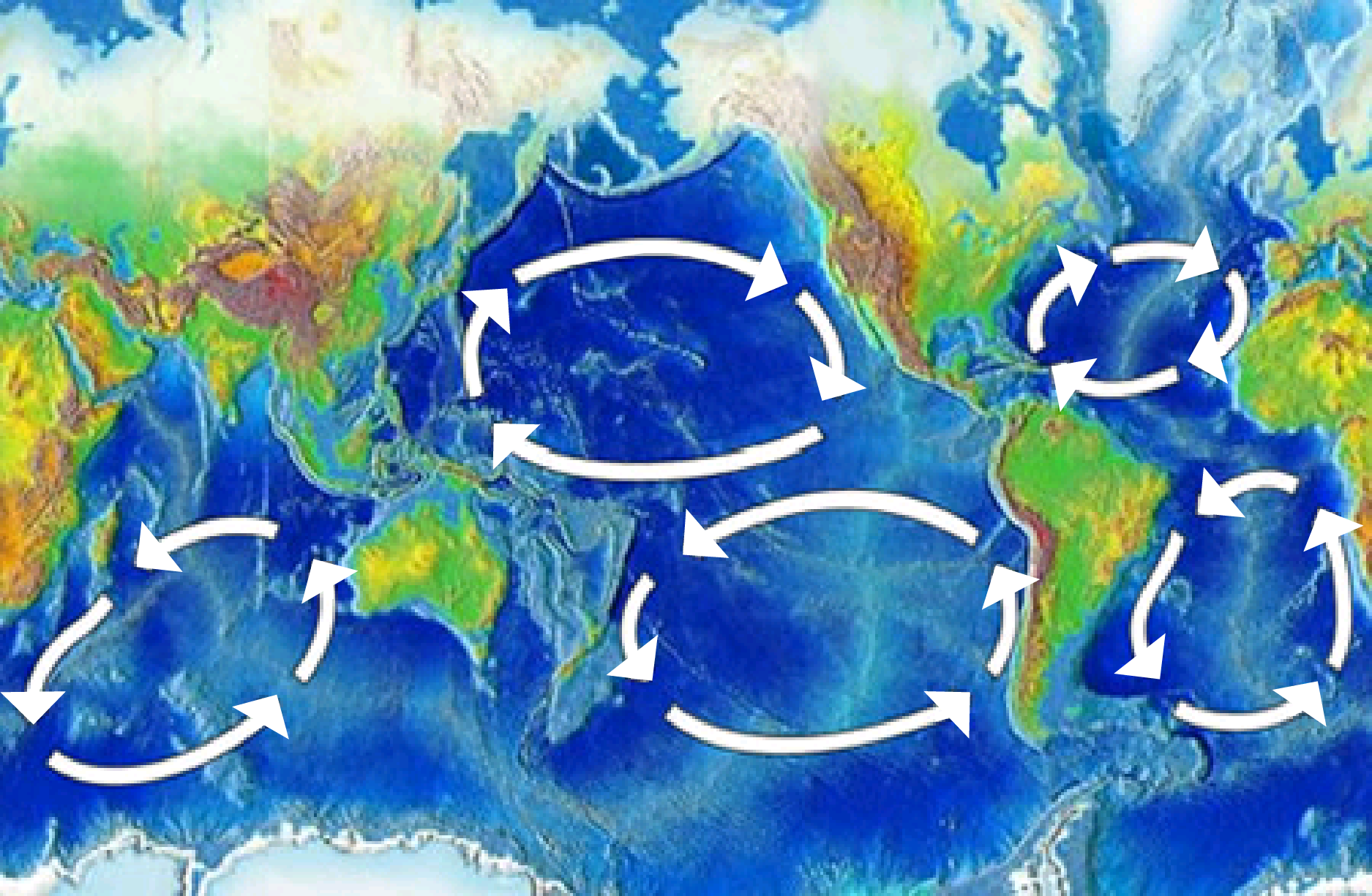
Micro-beads cannot be filtered from household waste water by sewage treatment plants. Eventually, they end up in the ocean. As with the Pacific garbage patch (photo above), the North Atlantic trash vortex is made up of trash fragments ranging from a millimeter to the size of a pencil’s eraser. The size of the Atlantic trash vortex compares in size to the area of France. The fine trash, like micro-beads, poison fish and kill seabirds whose guts become clogged with the beads making them unable to eat and so they starve to death.

The five major ocean gyres.
The North Atlantic garbage patch is an area of man-made marine debris found floating within the North Atlantic Gyre, originally documented in 1972. The patch is estimated to be hundreds of kilometers across in size with a density of over 200,000 pieces of debris per square kilometer. The debris zone shifts by as much as 1,600 km (990 mi) north and south seasonally, and drifts even farther south during the El Niño-Southern Oscillation, according to the NOAA.

The NJ Legislature will now decide whether to make the changes, attempt to override Christie's veto, or let the bill die.

A new study estimates nearly 270,000 tons of plastic is floating in the world's oceans. That's enough to fill more than 38,500 garbage trucks if each truck carries 7 tons of plastic. The figure appears in a study published, Dec. 10, 2014, in the scientific journal PLOS ONE. Researchers say the plastic is broken up into more than 5 trillion pieces.

Microbeads pollution - a drop in the ocean for the beauty industry


Source: Christie vetoes N.J. ban on micro-beads feeding Atlantic Ocean garbage patch the size of France | NJ.com

Friday, June 27, 2014

Testing the Waters at the Jersey Shore


Testing the Waters is a guide to water quality at vacation beaches. The state summary for New Jersey ranked our state third in beach water quality (out of 30 states. Only 3% of samples exceeded the national Beach Action Value for designated beach areas in 2013.

New Jersey has public beaches lining 127 miles of the Atlantic coast. The Cooperative Coastal Monitoring Program (CCMP), which is administered by the New Jersey Department of Environmental Protection, conducts quality monitoring from mid-May to mid-September.

You can find daily activity reports, including beach closings and advisories, at www.njbeaches.org (the CCMP website). As I write this, the Jersey shore beaches are all green lights and open.

In 2013, New Jersey reported 492 coastal beaches and beach segments, 288 of which were monitored. New Jersey also has "bracket" beaches that are adjacent to regularly monitored beaches; if high bacteria concentrations are found at a regularly monitored station, sampling is conducted at bracket stations to determine the extent of the affected area.

That 3% number means that of all reported beach monitoring samples, 3% exceeded the Beach Action Value (BAV) of 60 enterococcus bacteria colony forming units (cfu) per 100 ml marine or estuarine water in a single sample.

The 4 beaches in NJ that did exceed the rate with the highest percentages in 2013 were Berkeley Township at Beachwood Beach West in Ocean County (52%), Neptune Township at Shark River Beach and Yacht in Monmouth County (20%), Berkeley Township at West Beach Avon Road in Ocean County (18%), and Brick Township at Windward Beach in Ocean County (17%).

Thursday, January 16, 2014

Clean Ocean Action

Love the Jersey Shore (and hate the image it was given by that TV show)?

If you do, you certainly want our beaches clean and the water clean and safe to swim in.

Remember all those horror stories a few decades ago about medical waste washing up on beaches and the water being closed to swimming because of pollution?

Our Atlantic Ocean waters are still threatened by all kinds of pollution, but the water is cleaner and those stories appear a lot less frequently.

Some of that improvement comes from tougher laws and better enforcement, but we must also credit groups like Clean Ocean Action.

Photo: nj.com
Clean Ocean Action lives up to its name, taking actions to keep our ocean clean. They work to stop toxins and trash off the beach and out of the water. They mobilize volunteers who have picked up over 2.25 million pieces of trash weighing in at 606,000 pounds since 1993. They worked at Hurricane Sandy clean-up.

COA's Mission Statement: "Our goal is to improve the degraded water quality of the marine waters off the New Jersey/New York coast."  They identify the sources of pollution and mount an attack on each source by using research, public education, and citizen action to convince our public officials to enact and enforce measures which will clean up and protect our ocean.


You can volunteer to help and make a donation to the group. Clean Ocean Action is a 501(c)3 tax exempt nonprofit organization.


Saturday, June 26, 2010

New Jersey Is Monitoring the Gulf Oil Spill But Any Impact Is Unlikely

Via Brian T. Murray / The Star-Ledger

New Jersey is forming a team of specialists to monitor the BP oil spill off the coast of Louisiana in the unlikely, but worrisome event the slick reaches East Coast shores.

Fearing the potential impacts on Jersey Shore tourism and the state’s fishing industry, Department of Environmental Protection Commissioner Bob Martin said he is not taking any chances as he announced today the creation of a “Gulf Spill Team” to closely monitor the disaster. The team will create a scientific model of the likely path of the contamination and develop a plan of action, although scientists have said it will require a “sequence of unlikely events” for the slick to hit the east coast.

"Right now, we are very optimistic the oil will not reach New Jersey and will not affect fishing nor the summer beach season." said Martin. "However, we are keeping close watch on this situation to be prepared for any possible scenario.''
http://www.nj.com/news/index.ssf/2010/05/nj_gulf_oil_spill_task_force.html

However, more recent assessments in NJ say that ocean currents make pollution of our coast virtually impossible. Our beaches and fishing industry will not be affected by the Gulf oil spill this summer, but are more threatened by misinformation, state Environmental Protection Commissioner Bob Martin has said.

Martin told the Assembly Environment and Solid Waste Committee the leaking oil remains currently confined in the Gulf of Mexico and has not reached the Loop Current that could take it towards the tip of Florida, and north along the Atlantic Coast towards the Carolinas.

And should that happen, Martin noted, the Gulf Stream would then carry it eastward and out to sea. Martin said the oil could only reach New Jersey through a sequence of unlikely, atypical events – and even then would not reach our coast until at least late autumn.

"Our beaches are clean and our tourism industry is safe from oil throughout the summer,'' Martin said. "Our fishing and seafood industries are safe because all of the migratory fish were already here for the season before the spill occurred.

"The greatest risk the state faces right now from the Gulf oil spill is misinformation – so it's important to get the facts right,'' Martin added. "It is crucial that we make plans and decisions based on facts and science, and keep the public accurately informed in order to avoid creating issues where they may not exist.''

Friday, June 11, 2010

Night of the Moon Jellies

Night of the Moonjellies
by Mark Shasha


This beautifully illustrated picture book for ages 4-8 follows 7 year old Mark who discovers on the beach small jellylike objects that he places in a bag of seawater.

A moonlight ocean boat ride with his grandmother finds thousands of moonjellies shimmering in the water. (He wisely releases his own discovery among them.)

It's a nice book to bring to the beach this weekend with the kids. Unfortunately, it doesn't really explain what moon jellies are all about.

jellyfish live in water  http://www.photolib.noaa.gov/


New Jersey beachgoers of all ages have seen them.Unfortunately. they usually see them dead on the beach.

Their common name is Moon Jelly and their scientific name is Aurelia aurita.

The tentacles of a moon jelly are attached under the "umbrella shaped body." Moon Jelly are harmless to humans.

This is one of the most common jellyfishes found on the beach in New Jersey. Most of the time, they are found washed up on shore where they look like a round disk-shaped pad of fairly firm, clear jelly.

Most moon jellies you find will be about 4 or 5 inches in diameter. The disk that washes up on shore is only the remaining part of the creature. Yes, it's harmless to pick up.

When the creature was alive, it was a a carnivore that ate mostly plankton. They use stinging nematocysts to subdue the food they catch and also have a mucus layer that they pull food into. This sticky goo serves to trap their prey.

They stay close to the water surface for feeding, and that makes them food for by some large fish, turtles and even some birds.

Their locomotion is not that efficient, so currents often wash them ashore.


This video below shows a different species than the one that lives in NJ waters, but the behavior and appearance is very similar to our local moon jellyfish.


Thursday, April 22, 2010

Oceans - the film


Disneynature is an independent film label of The Walt Disney Company, that releases big screen nature documentaries.  Today, to coincide with Earth Day, they are releasing Oceans, a French-American nature documentary film by Jacques Perrin.

The film explores the oceans of the Earth's surface and the mysteries that lie beneath. It is Disneynature's second release following Earth in 2009.

Budgeted at 50 million euros, it was filmed in over 50 different places and took four years to film. It reflects the need to respect nature and demonstrates the negative impact of human interaction on animals, to the point of favoring the disappearance of species.

Their official website at  http://disney.go.com/disneynature/oceans/  has some beautiful video and images. (I downloaded the wallpaper and screensaver too!)

You can also watch a trailer for the film on YouTube that includes some history of Disney nature films. There are ones I still recall seing in my childhood.

This would be a great way to start your kids on an appreciation of the environment - or to reawaken your own childhood fascination with nature.


Disney Nature Earth

Wednesday, January 20, 2010

NOAA Considering Listing Atlantic Sturgeon as Endangered or Threatened

In a press release from NOAA's Fisheries Service last week, we learned that NOAA will consider listing Atlantic sturgeon as threatened or endangered under the federal Endangered Species Act. The agency received a petition from the Natural Resources Defense Council in October 2009 requesting that the species be listed throughout its range.

NOAA has been evaluating the need to list the species since 2007, when a formal status review was completed for the species by a team of biologists from NOAA, the U.S. Geological Survey, and the U.S. Fish and Wildlife Service. That review, which identified five Atlantic sturgeon populations off the U.S. East Coast, found that the most significant threats to the species' continued survival were unintended catch, vessel strikes, poor water quality, lack of regulatory mechanisms for protecting the fish, and dredging.

It also recommended that specific sturgeon populations centered in the New York Bight, Chesapeake Bay and off the Carolinas should be listed, but made no particular recommendation on listing those in the Gulf of Maine and in the Atlantic south of the Carolinas. NOAA is soliciting any new information about the status of these populations that may have been developed since the review was concluded in 2007.

Atlantic sturgeon are large, slow-growing, late-maturing, long-lived, estuary-dependent fish that are born and spawn in fresh water, and spend the majority of their lives in salt water. Historically, their range included most major estuary and river systems from Labrador to Florida. Atlantic sturgeon populations have been found in 35 U.S. rivers, and spawning is believed to occur in at least 20 of these. Historic catch records indicate that these fish were once abundant. The first major U.S. commercial fishery for them developed in the late 19th century, when demand grew for sturgeon caviar. The commercial fishery collapsed in 1901 when landings declined to about 10 percent of the peak.

Catching the fish was prohibited in 1998 by the Atlantic States Marine Fisheries Commission, and it is currently illegal to fish for, catch or keep Atlantic sturgeon from U.S. waters. An endangered species listing would increase protection for the sturgeon by making it illegal to "take" (harass, harm, pursue, hunt, shoot, wound, kill, trap, capture, collect, or attempt to do those things) the species, in addition to the current prohibition on catching it. Similar prohibitions usually extend to threatened species.

Saturday, December 5, 2009

Marine Turtles in New Jersey Waters

Green turtle surfacing for air
In New Jersey, we have 4 marine turtles that are protected.
  1. Atlantic loggerhead turtle, Caretta caretta - NJ Status: Endangered, Federal Status: Threatened
  2. Atlantic leatherback turtle, Dermochelys coriacea, NJ & Federal: Endangered
  3. Kemp's ridley turtle, Lepidochelys kempi, NJ & Federal: Endangered
  4. Atlantic green turtle, Chelonia mydas, NJ  & Federal: Threatened
  5. Atlantic hawksbill turtle, Eretmochelys imbricata, NJ & Federal: Endangered
Last week, cold-stunned Kemp's Ridley sea turtles began to wash up on Cape Cod beaches which unfortunately marks the beginning of the turtle stranding season here in the Northeast.

As water temperatures dip below 50 degrees, it becomes too cold for the sea turtles. These species should have moved south for the winter by now, but some marine reptiles get fooled by ocean anomalies around Cape Cod and Long Island.

Turtles described as "cold stunned" are in a torpid state with heart rates slowing down to as low as one beat a minute. They can appear to be dead, but this state actually allows the turtles' bodies to survive as the turtles can bury themselves in the mud on the bottom of the sea and survive for a few weeks in waters below 50 degrees.

Of course, they can survive the entire winter that way, so stragglers that wash up on the beach can be rescued by volunteers.

Unlike land turtles from which they evolved more than 150 million years ago, sea
turtles spend almost their entire lives in the sea. When active, they often come to the
surface to breathe, but can remain underwater for several hours at a time while resting.

Leatherbacks can dive to more than 3,000 feet below sea level. Their habitat preference is based on their preferred diet. Adult green turtles are herbivores, or plant eaters. All the other sea turtles are either carnivores (meat-eaters) or omnivores that eat both plant matter and meat.

Kemp's Ridley

The Kemp's Ridleys, which hatch off the coast of Mexico, are the most endangered of the sea turtles in our water. Kemp's ridley is the smallest of all sea turtles. From above, the short, chunky shell appears broadly heart-shaped to nearly round, with high vertebral projections and serrated edges. Adults weigh between 35 and 42 kg (77-92 lbs.).

The leatherback is the largest of all sea turtles. In fact, the leatherback is one of the largest living reptiles (only some species of crocodiles are larger). It is easily distinguished by its black, leathery skin, huge, spindle- or barrel-shaped bodies and long flippers. Adults generally weigh between 290 and 590 kg (638-1298 lbs.), but can weigh up to 2,000 pounds.

The most colorful sea turtle, the medium-sized hawksbill turtle has an elongated, oval shell
distinguished by overlapping scutes on the carapace.Color varies widely, from very bright colors to heavy dark brown (in the eastern Pacific).

Overharvesting of eggs for food, intentional killing of adults and immatures for their shells and skin and incidental drowning in commercial fishing gear are primarily responsible for the worldwide decline in sea turtle populations. Coastal residential and resort development has also degraded nesting habitat, and pollution of oceans threatens foraging habitats.

The federal government listed the Kemp's Ridley as endangered in 1970, the same year it also listed hawksbill and leatherback turtles as endangered. In 1978, it listed loggerheads as threatened and green turtles as threatened and, in the case of the green turtle's Florida and Mexico breeding populations, as endangered. New Jersey classified the species in 1979.

Tuesday, December 1, 2009

Sailing Trash Plastic Across the Oceans

Computer generated image of Plastiki
The adventurer and environmental storyteller, David de Rothschild, and a crew of leading scientists, adventurers and creatives are to set sail over 10,000 nautical miles across the Pacific from San Francisco to Sydney on a 60-foot catamaran made from post consumer plastic water and soda bottles and self-reinforced PET.

The 3 month journey is intended to inspire, educate and activate people to move towards a smarter more sustainable planet 2.0 way of living that can include. Its time to rethink waste as a resource.

The adventurer and environmental storyteller David de Rothschild and a handpicked crew of leading scientists, adventurers and creatives are to set sail over 10,000 nautical miles across the Pacific from San Francisco to Sydney on a 60-foot catamaran made from post consumer plastic water and soda bottles and self-reinforced PET.

By undertaking this daring expedition over three months, David and his Plastiki crew are on a mission to inspire, educate and activate individuals, communities and business’s to start moving towards a smarter more sustainable planet 2.0 way of living that can include waste as a resource.

The Plastiki Expedition will hopefully raise awareness about environmental disasters like the Great Pacific Garbage Patch, an area of the ocean loaded with floating trash that the Plastiki will sail through on its maiden voyage.

The Plastiki will be made of 12,500 two-liter plastic bottles; weigh 9 tons; and will have a composting toilet, on-board renewable energy, and a garden. The design team had a need to invent a glue that eliminates toxic epoxies, so they developed one from cashew sugar nuts.

http://www.theplastiki.com

Monday, November 30, 2009

Ocean Garbage


Image: SEAPLEX, Scripps Environmental Accumulation of Plastic Expedition


It may be a long way from the ocean waters off New Jersey, but the Great Pacific Garbage Patch, also described as the Eastern Garbage Patch or the Pacific Trash Vortex is a problem that also affects our ocean waters.

The patch is a gyre (any manner of particularly large-scale wind, swirling vortex and ocean currents) of marine litter in the central North Pacific Ocean located roughly between 135° to 155°W and 35° to 42°N.

It is full of suspended plastic and other debris that have been trapped by the currents of the North Pacific Gyre. The approximately 3.5 million tons of trash includes shoes, toys, bags, pacifiers, wrappers, toothbrushes, and bottles – all floating round and round midway between Hawaii and San Francisco.

The garbage patch stays relatively stationary in the North Pacific Ocean because of the North Pacific Gyre’s (AKA the horse latitudes) rotational pattern. This pattern draws in waste material from across the North Pacific Ocean, including the coastal waters off North America and Japan. Then, wind-driven surface currents move floating debris toward the center, trapping it in the region.


The existence of the Pacific Gyre garbage patch received more attention after articles written by Charles Moore, a California-based sea captain and ocean researcher, made it into the mainstream media. Moore, discovered it while returning home through the North Pacific Gyre after competing in a sailing race. After Moore contacted an oceanographer, Curtis Ebbesmeyer, the area began to be studies and was dubbed the “Eastern Garbage Patch” (EGP).

The actual size of the garbage patch is unknown. Estimates range from it being 0.41% to 8.1% of the size of the Pacific Ocean itself. It is often compared in size to the size of Texas.

In NJ, we see the same trash problem in the trash that washes up on our beaches and jetties. The durability and stability of plastic is what makes it practical for product, and what makes it a problem in the ocean. It is estimated that about 100 million tons of plastic are produced each year and that 10 percent ends up in the sea. Though we can blame about 20 percent of that seagoing plastic on ships and platforms, the rest comes from land.

Polythene plastic bags, bottles and containers, plastic drums, expanded polystyrene packing, polyurethane foam pieces, pieces of polypropylene fishing net and discarded lengths of rope are a good part of that garbage - plus an endless supply of plastic products like disposable lighters can be found.

Besides the larger items that we see in the water or on beaches, there are the remnants of those that do degrade. Via sunlight, wave action and mechanical abrasion, plastics break down slowly into ever smaller particles.

These particles join the small pellets of plastic lost at sea which are actually the way new plastics are marketed for manufacturers which make up a good part of the trash patches. Sometimes called "marine tumbleweeds,” huge quantities are found in beach cleanups and are found accumulated in sea areas where winds and currents are weak.

Will we be writing about the Great Atlantic Garbage Patch one day?

    Monday, November 9, 2009

    The NJ Keep It Green Campaign


    The New Jersey - Keep It Green Campaign is a coalition of 135 statewide, local and regional organizations ranging from sportsmen’s groups and environmental organizations to affordable housing and urban park advocates.

    The campaign's mission is to secure a long-term stable source of funding for the acquisition of open space, farmland and historic sites as well as the capital improvement, operation, maintenance, and stewardship of state and local natural areas, parks and historic sites in New Jersey.

    This work is guided by the belief that every New Jersey resident deserves well-maintained, accessible neighborhood parks, wildlife areas and historic sites.

    The organizations are both large and small. There's the Grover Cleveland Birthplace  http://clevelandbirthplace.org near me in Caldwell. There's also Clean Ocean Action http://www.cleanoceanaction.org, a leading national and regional voice working to protect waterways using science, law, research, education, and citizen action.

    COA's mission statement is to improve the degraded water quality of the marine waters off the New Jersey/New York coast. They work to identify the sources of pollution and mount an attack on each source by using research, public education, and citizen action to convince our public officials to enact and enforce measures which will clean up and protect our ocean.

    http://www.njkeepitgreen.org    Become a fan on Facebook at http://www.facebook.com/NJKeepItGreen

    Wednesday, August 12, 2009

    Beach Protection Legislation Passed

    The Senate Environment and Public Works Committee recently approved legislation Sen. Frank R. Lautenberg (D-NJ) and Sen. George V. Voinovich (R-OH) authored to increase funding to states to protect water quality, and to require tough new beach water quality testing and public notification standards so beachgoers are better informed about the safety of their beaches. Rep. Frank Pallone Jr. (D-NJ-06) is the sponsor of companion legislation in the House of Representatives.

    "New Jersey's beaches are a treasure we must protect. Our law nine years ago was an important step toward cleaner, safer beaches and this new measure will further protect our shores and our waters from pollution. Our bill also helps protect coastal economies by providing more timely and accurate information about beach quality and by keeping our shores clean," said Sen. Lautenberg, who along with Rep. Pallone authored the 2000 BEACH Act which set water quality testing and notification requirements so beachgoers are better informed about the safety of their beaches.

    The Clean Coastal Environment and Public Health Act of 2009 reauthorizes grants awarded to states through the Beaches Environmental Assessment and Coastal Health (BEACH) Act through 2013. It would increase the annual grant levels from $30 million to $60 million.

    The Clean Coastal Environment and Public Health Act mandates the use of rapid testing methods by requiring the Environmental Protection Agency (EPA) to approve the use of rapid testing methods that detect bathing water contamination as soon as practicable and not more than four hours after a water quality sample is received by the testing facility.

    Current water quality monitoring tests, like those used in New Jersey, only test for bacteria levels and take 24 to 48 hours to produce reliable results. During this time many beachgoers can be unknowingly exposed to harmful pollution. More immediate results would prevent beaches from remaining open when high levels of bacteria are found.

    In addition to the water quality monitoring and notification standards currently required under the BEACH Act, the Clean Coastal Environment and Public Health Act would expand the scope to include pollution source tracking efforts. The bill also would require that beach water quality violations are disclosed not only to the public, but to all relevant state agencies with beach water pollution authority.

    "The coastlines in New Jersey and throughout the country are environmental and economic treasures that need to be protected and preserved. They are central to multi-billion dollar tourism industries with an environmental value that is incalculable. This law will ensure that beachgoers will have clean shores and clean ocean water to enjoy for generations to come,” said Rep. Pallone.

    http://lautenberg.senate.gov


    http://www.house.gov/pallone/


    http://www.house.gov/list/press/nj06_pallone/pr_june18_beachprotectionsenate.html

    Monday, August 10, 2009

    About The Earth's Oceans

    From Mother Earth News, comes an interesting list of surprising facts about our oceans.

    Just to get you interested, how about these to get you started -
    • 94% of life on Earth is aquatic? That makes us land-dwellers a very small minority.
    • About 70% of the planet is ocean, with an average depth of more than 12,400 feet. Given that photons (light) can’t penetrate more than 330 feet below the water’s surface, most of our planet is in a perpetual state of darkness.
    • 50% of the United States (in terms of our complete legal jurisdiction, which includes ocean territory) lies below the ocean.
    • The deep sea is the largest museum on Earth: There are more artifacts and remnants of history in the ocean than in all of the world’s museums, combined.

    Friday, August 7, 2009

    Endangered Sharks

    Sandbar shark

    A third of the world's open water sharks, including the great white and hammerhead, face extinction, according to a major conservation survey. Those species that are hunted on the high seas are particularly at risk. In that group, more than half are in danger of dying out, reports the Shark Specialist Group at the International Union for the Conservation of Nature (IUCN).

    New Jersey waters have long been the home for a number of shark species. Though no species is on the NJ endangered list, their protection is still a concern as species are federally and globally endangered. The inevitable summer news story about a sighting or attack at the Jersey Shore always brings to mind images from films like Jaws and stories like that of the 1916 NJ attacks.

    The Jersey Shore shark attacks of 1916 were a series of shark attacks between July 1 and July 12 in which four people were killed. Scientists are still not sure which shark species was responsible and the number of animals involved, with the great white shark and the bull shark most frequently being blamed.

    Though there is an assortment of sharks that can be found in New Jersey waters, most would be found offshore in oceanic waters and are rarely a danger to swimmers, surfers or divers. Though they can often be put off by the noise and bubbles, they should still always be treated with caution.

    Blue, basking, great white, shortfin mako, porbeagle, thresher, and other "inshore" and "dogfishes " are all found in our waters. The "dogfish" is actually a generic name for a large number of small, generally harmless and unaggressive sharks, not all of which are very closely related.

    Most NJ shore visitors are familiar with skates which are closely related to sharks and rays. Skates can be found in shallow bays to deep-sea habitats and live on the bottom of the sea floor. If you have ever been fishing offshore, you probably have pulled one of these doormats up thinking you had a huge fish on the line.

    Their flat body and large fins give skates the appearance of flying when swimming through the water. They eat a variety of crustaceans, mussels, clams, snails, and
    worms. The best-known NJ species is the little skate, which is 1 to 2 feet (30 to 61 centimeters) long. A larger skate that lives along the New Jersey coast is the barn-door skate.

    Skate are oviparous (egg layers) and after a breeding season, female skates can store sperm to fertilize and secrete eggs continually throughout a 3-4 month period. The eggs are encased in a tough, leathery protective egg case that is black, with four points and are frequently found washed up on the beach by bathers.

    Collapsing shark populations are mainly caused by overfishing. Some 100 million sharks are caught in commercial and sports fishing every year. Sharks are especially vulnerable to overfishing because most species take many years to mature and have relatively few young. Sharks are prized for their meat, and in Asia especially for their fins, a prestige food thought to convey health benefits. For decades, significant numbers of sharks, including blue and mako, have perished as "by-catch" in commercial tuna and swordfish operations.

    The smooth hammerhead, great white, basking, and oceanic whitetip sharks are listed as globally vulnerable to extinction, along with two species of makos and three types of threshers.

    The Sand Tiger shark is fairly common off Atlantic City and Cape May.

    For example, the Spanish fleet of so-called surface longline fishing boats ostensibly targets swordfish, but 70 percent of its catch, by weight, from 2000 to 2004 were pelagic sharks. There are currently no restrictions on the number of sharks that these fisheries can harvest.

    Europe is the fastest growing market for meat from the porbeagle and another species, the spiny dogfish.

    What would be the impact from the loss of sharks from the world's oceans?

    "Removing large predators would deprive ecosystems of players that have been around for more than 400 million years," said Francesco Ferretti, a researcher at Dalhousie University in Halifax, Canada.

    Recent studies have shown that sharp reductions of coastal shark populations along the US East Coast and in the Gulf of Mexico caused major disruptions throughout the food chain, including on aquaculture.

    The IUCN issues the Red List of Threatened Species, the most comprehensive and authoritative conservation inventory of the world's plants and animals species.

    Shark Research Institute

    Scuba Diving NJ - info on sharks
    Images: nmfs.noaa.gov

    Tuesday, August 4, 2009

    Surfrider NJ

    The Surfrider Foundation is a grassroots, non-profit, environmental organization that works to protect our oceans, waves, and beaches.

    They were founded in 1984 and have 60 chapters located along the East, West, Gulf, Puerto Rican, and Hawaiian coasts. The Jersey Shore Chapter offers a a number of activities and projects.

    "Respect the Beach" is an educational program that introduces students to beach ecology and to the watershed process.

    The Surfrider Foundation's Blue Water Task Force is a water quality monitoring, education and advocacy program, to educate New Jersey citizens about coastal water quality problems and to build support for national coastal water quality testing and monitoring standards.

    The Jersey Shore Chapter often addresses political and environmental issues that threaten New Jersey beaches and waters, including beach replenishment, ocean dumping, and public beach access.

    Chris Carhart at an overpublicized inlet in Northern Ocean County during a 2009 spring run of North swell. Photo by Jack Ryan

    As you might guess from their name, they also strive to open and preserve surfing beaches in coastal communities all along the Jersey Shore. They host and participate in surf clinics and contests, including the Chapter's annual Manasquan Classic (this year it will be Sept. 19), to promote surfing to the young and young-at-heart.

    Many of their activities are aimed at increasing the public awareness of issues impacting NJ beaches by being visible at community and music festivals, beach cleanups and beach mapping projects, and at local beach/sporting events.

    You can read their State of the Beach report for NJ gives a good summary of state activities and concerns.

    One recent campaign was the Manasquan to Barnegat Beachfill. The Army Corps plans to do a massive dredge and fill for the beaches from Manasquan Inlet to Barnegat Inlet, NJ. This would include the towns from Point Pleasant to Seaside Park.

    If you are interested, their next monthly chapter meeting will be August 8 at 9 AM at the Monmouth Beach Cultural Center, Ocean Ave., Monmouth Beach, NJ.