Showing posts with label films. Show all posts

Tuesday, April 18, 2023

Film: Dark Sacred Night

Jared Flesher's “Dark Sacred Night,” is a short (16 minutes) documentary about the rapidly increasing problem of light pollution. Dark skies are threatened or endangered depending on where you are on the planet.

This is International Dark Sky Week. It's a good reminder to look up at the night sky and see the stars and planets - if you can see them.

The award-winning documentary is now live for all to watch on YouTube.


More than 80 percent of the world’s population, and 99 percent of Americans and Europeans, now live under light-polluted skies. Many people live and die without ever seeing the Milky Way. 

Princeton University astrophysicist Gaspar Bakos wants to change that. He is one of a growing number of experts championing simple, commonsense changes to outdoor lighting that can dramatically reduce light pollution. 

As Bakos teaches, light pollution is a problem that impacts far more than astronomical research and stargazers. New studies show that excessive amounts of outdoor lighting contribute to a range of human health problems, squander energy, and have a dramatic negative impact on wildlife, particularly birds and insects. 

Bakos’s approach is to promote change one streetlight at a time. Simple solutions to light pollution can be summed up in a few words: make lights dimmer, shield lights so they only shine downward, and use warm-colored lightbulbs. 

In Princeton, New Jersey, where Bakos lives and works, he dreams of a park set aside for dark sky viewing, where all surrounding lights are muted and properly shielded. By setting a good example, he hopes other communities will be inspired to do the same. 

Crossposted at Weekends in Paradelle 

Tuesday, February 25, 2020

'Pine Mud' Film Addresses Issue in New Jersey's Pinelands

In the vast Pinelands National Reserve of southern New Jersey, powerful vehicles trample protected sand dunes and drive circles through ancient ponds. Like in many wild places, “off-roading” has grown more popular here.

As a local conservationist works to protect habitat for threatened species, tensions flare with off-roading enthusiasts who don't want to see their access to the forest restricted.

Filmmaker Jared Flesher's Pine Mud is the first feature documentary to explore the complex, widespread and intensifying problem of off-road vehicle damage to public lands.


PINE MUD premieres at the Environmental Film Festival in the Nation's Capital on Saturday, March 14, 2020, at 3pm, in the theater of the Eaton DC hotel, just blocks from the White House.     Tickets are free but require advance registration

Monday, April 24, 2017

Environmental and Science Documentaries at the Montclair Film Festival


The Montclair Film Festival (April 28-May 7) has in its offerings this year a group of documentaries that should be of interest to readers of this blog and anyone who is concerned about the environment, science and activism.

You can find these films at montclairfilmfest.org/genres/environmental-interest/ but here are those films with some information and links to purchase tickets.


BILL NYE: SCIENCE GUY    May 6
Bill Nye is on a journey to change the world! Once the host of a popular kids’ show, Nye has transformed himself into a leading voice against the forces that would deny the value of science. Nye not only is speaking out, he is leading by example, on a mission to launch a solar-powered satellite into the cosmos and advocating for the importance of research and discovery. The film is a urgent portrait of a scientist on a mission, taking on climate change deniers and creationists in the real world to create a more scientifically literate and engaged universe. Directed by David Alvarado and Jason Sussberg   There will be a post-screening conversation between Bill Nye and Stephen Colbert, co-Presented by Audible.


DO DONKEYS ACT?    May 4 and 5
This film by David Redmon and Ashley Sabin is an unexpectedly moving, one-of-a-kind documentary that seeks a new form of empathetic understanding. Shot entirely on farms dedicated to rescuing beasts of burden from abuse and overwork, the film is a conversation between human curiosity and the experience of the animals. Immersed in their world, the camera never leaves the animals, constantly looking into their eyes and searching for meaning and comprehension of their lives. Featuring a warm narration by Willem Dafoe and filled with warmth and grace, DO DONKEYS ACT? is a must-see for those who love animals


TROPHY   May 6
In their new documentary TROPHY, filmmakers Christina Clusiau and Shaul Schwarz take an in-depth look into the powerhouse industries of big-game hunting, breeding, and wildlife conservation in the U.S. and Africa. The film is unflinching in its examination of the push and pull of illegal poaching, sanctuary, and legalized hunting, revealing a complex economic ecosystem manufactured by humans to both take and preserve the lives of the animals they covet. Featuring stunning photography that is at once intimate and terrifying, TROPHY is a necessary portrait of human behavior, unravelling the complex consequences of treating animals as commodities.


THROUGH THE REPELLENT FENCE: A LAND ART FILM   May 6 and 7
Follows art collective Postcommodity as they strive to construct Repellent Fence, a two-mile long outdoor artwork that installs a series of 28 huge, inflatable spheres that stretch across the U.S. – Mexico border. THROUGH THE REPELLENT FENCE is an adventure in the artistic process and a road trip of discovery, exploring how land art can generate community interaction and perceptual shifts in how we interpret, engage, and draw inspiration from our natural world. Director Sam Wainwright Douglas


NO MAN'S LAND April 29 and 30 
In recent years, a new battle between ranchers and the federal government have arisen in the American West over the issues surrounding federal land use and the lines between private business and the public interest. Bitter antagonism between right-wing militia and the federal government has boiled over into rebellion, with recent events in Nevada and Oregon creating a firestorm of recrimination, politics, and tragedy. NO MAN’S LAND is director David Byars’ incendiary look at these battles, following the insurrection from inception to demise and exploring the issues and people that are reshaping what remains of the American frontier. In Person: Director David Byars


DOLORES    April 29 and 30
This film is a reclamation of an heroic American life. The film sheds light on the enigmatic, intensely private Dolores Huerta, cofounder of the United Farm Workers union and among the most important activists in our nation’s history. But as woman standing atop an organization of men, her constant battle against injustice was mirrored by the gender discrimination she faced internally. Featuring interviews with Angela Davis, Gloria Steinem, Hillary Clinton, and Luis Valdez, the film reveals her ever-expanding wave of influence through decades of activism, and leading many to ask why her contributions have been erased from our history. In English and Spanish with English Subtitles. Dolores Huerta in attendance on Saturday, April 29

BENDING THE ARC   April 29 and 30
Thirty years ago, a group of improbable heroes came together on a mission that was medical and moral, and, by everyone’s estimation other than their own, highly unlikely to succeed. Their goal was simple but daring: to make high-quality health care available to everyone, even in the world’s poorest countries. Fighting entrenched diseases, political and bureaucratic machinery, and the charity-industrial complex itself, these crusaders forced the international community to embrace the idea that health care must be a basic human right in every society. BENDING THE ARC is a story of hope and courage in the face of seemingly insurmountable barriers. In English, Haitian Creole, Spanish, Kinyarwanda with English Subtitles.


Thursday, March 23, 2017

Princeton Environmental Film Festival


The 2017 Princeton Environmental Film Festival will be held March 28 – April 2, 2017. The Festival is sponsored by the Princeton Public Library and is held annually at 65 Witherspoon Street in downtown Princeton, New Jersey, with additional special events offered throughout the year.

Founded in 2006, the PEFF’s mission is to share exceptional documentary films and engage the community in exploring environmental sustainability from a wide range of angles and perspectives.

The film screenings are free of an admission charge and accompanied by a Q&A with film directors and producers, as well as talks by invited speakers visiting the festival or by those who live here in our community.


Birds of May trailer from Hundred Year Films on Vimeo.


Check out the full schedule of films, but one film that caught my attention is "Birds of May." It is a 30-minute film directed by Jared Flesher that will have its New Jersey premiere at the festival. It tells the story of the federally threatened rufa red knot bird and its annual visit to the Delaware Bay.

Following the movie, a Q&A with the director, and a presentation by shorebird biologist Larry Niles and Conserve Wildlife Foundation’s David Wheeler will be held. Wildlife art by James Fiorentino, and poetry readings by the Geraldine R. Dodge Poetry Program, featuring Cynthia Arrieu-King and Catherine Doty will also be part of the screening. The event is part of “Because We Come from Everything: Poetry and Migration,” a series organized by the newly formed National Poetry Coalition.

This screening is March 26 at 7 p.m. in the Community Room of the Princeton Public Library.

Sunday, January 26, 2014

8th annual Princeton Environmental Film Festival


The 8th annual Princeton Environmental Film Festival, sponsored by the Princeton Public Library will run from January 30 - February 9, 2014. All screenings are offered free of admission and will be in the Community Room of the Princeton Public Library unless noted otherwise.

The festival's mission is to engage the community in examining environmental sustainability from a wide range of perspectives via this annual presentation of exceptional documentary films.

The screenings are accompanied by Q&A with film directors and producers, and/or talks with guest speakers. Films exploring topics from climate change to rooftop farming and more shine a light on issues that are important to all of us.

There will also be a panel discussion "Farming at the Edge of Nature" on February 1 at 4 pm.
A group of farmers and naturalists from our region will talk about their farming practices, philosophy, ethics, business models, challenges and their optimism for the next generation who are embracing working closely with the land. Many on the panel are also visual artists and the presentation will exhibit their photography focused on their work. This session will also feature the opportunity for a Q&A and networking.

The panel features: Alec Gioseffi, Adam Martin and Lauren Nagy, Cooperative 518; Lindsay Napolitano and Johann Rinkens, Fields Without Fences; Jared Rosenbaum and Rachel Mackow, Wild Ridge Plants, Growers and Stewards of Native Plants; and Steve Tomlinson, who works at Great Road Farm.

Jared Flesher, documentary filmmaker and Edible Jersey editor will be the moderator of the panel. Jared is an award-winning reporter, photojournalist and documentary filmmaker, with a focus on the topics of energy, agriculture and ecology. His last two documentaries are “The Farmer and the Horse” (2010) and “Sourlands (2012.) His latest film “Field Biologist” is in production and will be released later in 2014. A trailer previewing this film will be featured during the session.

One film that interests me is "Tiny: A Story About Living Small" produced and directed by Merete Mueller and Christopher Smith (2013, 62 minutes) which is the story of Christopher Smith who, approaching his 30th birthday, decides it’s time to plant some roots. He impulsively buys a 5-acre plot of land in hopes of fulfilling a lifelong dream of building a home in the mountains of Colorado. With the support of his girlfriend, Merete, he sets out to build a Tiny House from scratch despite having no construction experience.

Friday, March 25, 2011

Hollywood on the Jersey Side of the Hudson

This site occasionally moves outside its usual domain of the environment to examine some of New Jersey's historical preservation for other thing endangered in our state.

I have long been a film fan and used to teach some film courses. Too many people (in and out of NJ) don't know about our state's important early role in the American motion picture industry.

Thomas Edison invented his motion picture system in New Jersey in the 1890s, and within a few years most American filmmakers could be found on either side of the Hudson River.

New York City offered actors, artists and financial backing. New Jersey provided settings and Thomas Edison.

Hollywood on the Hudson is a book that that explains that even after much of the film industry had moved to California, this area was still an economic and administrative location, and that many writers, producers, and directors continued to work here.

Fort Lee: Birthplace of the Motion Picture Industry (NJ) (Images of America)
Fort Lee, NJ: Birthplace of the Motion Picture Industry is a good book about a favorite location of film pioneers like D. W. Griffith and Mary Pickford. Fort Lee was the first center of the American motion picture industry and studios lined both sides of Main Street. Film laboratories produced thousands of reels of film for the nickelodeon market. Broadway stars and producers came across the Hudson to make many of their first feature-length films.

By the end of the 1920s, much of the business and stars like Theda Bara, Fatty Arbuckle, and Douglas Fairbanks had gone west. But a local film business continued for quite some time with some of the many behind the scenes roles such as printing, storage, and the distribution of movies being made in Hollywood.

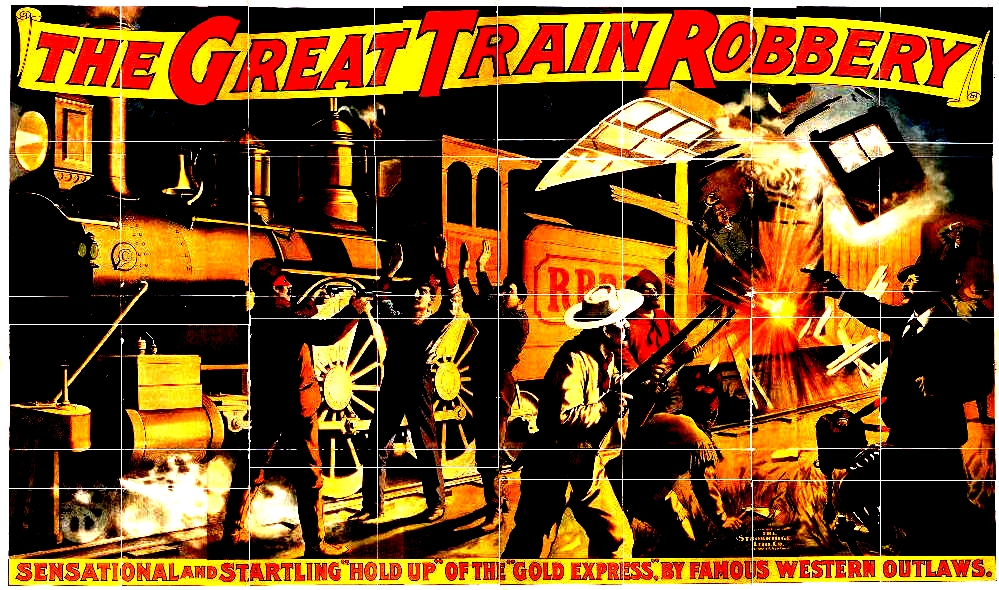
One milestone of film from NJ is the first "Western" – "The Great Train Robbery" in 1903. It was directed and photographed by Edwin S. Porter, a Thomas Edison Company cameraman and director.

Movie Poster via http://wikimedia.org

It is a one-reel (10-12 minutes) action picture. It has 14-scenes that were filmed in November 1903. The settings included Edison's New York studio, Essex County Park (NJ) and along the our Lackawanna railroad tracks.

It may look amateurish and primitive to an audience today, but some of the cinematic techniques were new because telling a story on film was new. Narrative storytelling, parallel editing, any camera movement, and location (rather than studio) shooting was groundbreaking.

The story's inspiration was with the real Butch Cassidy’s 1900 train heist, and the film includes blowing open a safe and escaping with the cash. (A scene done more grandly in Butch Cassidy and the Sundance Kid in 1969.) The film was originally advertised as "a faithful duplication of the genuine 'Hold Ups' made famous by various outlaw bands in the far West."

Porter worked for Thomas Edison's motion picture company and saw, perhaps more than Edison, the potential for film. In 1899, he joined the Edison Manufacturing Company and was soon in charge of motion picture production at Edison's New York studios. He operated the camera, directed the actors, and assembled the final print.

He was arguably the most influential filmmaker in America then. His earlier experiences as a touring projectionist gave him a good sense of what audiences enjoyed.

He borrowed techniques in his earlier films such as "Jack and the Beanstalk" (1902) and "Life of an American Fireman" (1903) from the French filmmaker Georges Méliès.

The first cowboy star, Gilbert "Broncho Billy" Anderson played several roles in TGTR including a bandit, a wounded passenger, and a tenderfoot dancer.

Porter used a title which was the same as a popular contemporary stage melodrama. He saw that in this pre-nickelodeon era that a film could be commercially-viable.

Porter used a number of innovative techniques, many of them for the first time, including parallel editing, some camera movement, and location shooting.

The film edits and intercutting (showing two different events happening at identical times but in different places) must have been almost jarring to the new movie audience. Film grammar that even unsophisticated modern viewer understand from experience were innovations. The very early film experiments all had fixed cameras, but this film had the first pan shots where the camera moved right/left while filming. Porter had experimented earlier with dissolves (overlapping scenes) and included an ellipsis in this film as a transition between scenes. A very obvious dummy standing in for the train's fireman is thrown off the moving train marking a kind of "special effect" used before stunt doubles.

All of the film's fourteen scenes would be redone many times in Western films in the 100+ years to follow.


In 1909 Porter left Edison and joined with others in organizing Rex, an independent motion picture company. He sold Rex after three years and became chief director of the new Famous Players Film Company. It was the first American company that regularly produced feature-length films. Porter directed the first five-reel American film, The Prisoner of Zenda (1913), and also directed Mary Pickford, Pauline Frederick, and John Barrymore in feature films.

Black Maria - Library of Congress image

Thomas Edison National Historical Park preserves Thomas Edison's laboratory and residence, Glenmont, in West Orange, New Jersey. From those laboratories came the motion picture camera, improved phonographs, sound recordings, silent and sound movies and the nickel-iron alkaline electric storage battery.

The Black Maria (pronounced mah-rye-ah, and also known as the Kinetographic Theater) was Thomas Edison's movie production studio in West Orange and is considered America's first movie studio.

The 1893 building was covered in black tarpaper and had a huge window in the ceiling that opened up to provide the tremendous amount of light required for early film stock and cameras. It was built on a turntable so the window could rotate toward the sun throughout the day and supply light all day. The studio was used for eight years and produced hundreds of short films.

Edison built a glass-enclosed rooftop movie studio in New York City in 1901, and stopped using the Black Maria. It was demolished in 1903, but a reproduction was made in 1954 at what is now the Edison National Historic Site in West Orange.  (A previous reconstruction had been built and dedicated in May 1940 when MGM held the world premiere of Edison, the Man starring Spencer Tracy in NJ theaters in West Orange, East Orange, South Orange, and Orange.)


The Centaur Film Company in Bayonne, New Jersey, 1907 Photographic Poster Print, 18x24
The Centaur Film Company in Bayonne, New Jersey, 1907


History of Edison Motion Pictures at The Library of Congress

The Movies Begin: Making Movies in New Jersey, 1887-1920
Fort Lee: The Film Town (1904-2004)
Fort Lee: Birthplace of the Motion Picture Industry
South Jersey Movie Houses
Cinema Treasures: A New Look at Classic Movie Theaters
Great Train Robbery - 100th Anniversay
Landmarks of Early Film, Vol. 1 Thomas Edison
Fort Lee: The Film Town (1904-2004)

Thursday, April 22, 2010

Oceans - the film


Disneynature is an independent film label of The Walt Disney Company, that releases big screen nature documentaries.  Today, to coincide with Earth Day, they are releasing Oceans, a French-American nature documentary film by Jacques Perrin.

The film explores the oceans of the Earth's surface and the mysteries that lie beneath. It is Disneynature's second release following Earth in 2009.

Budgeted at 50 million euros, it was filmed in over 50 different places and took four years to film. It reflects the need to respect nature and demonstrates the negative impact of human interaction on animals, to the point of favoring the disappearance of species.

Their official website at  http://disney.go.com/disneynature/oceans/  has some beautiful video and images. (I downloaded the wallpaper and screensaver too!)

You can also watch a trailer for the film on YouTube that includes some history of Disney nature films. There are ones I still recall seing in my childhood.

This would be a great way to start your kids on an appreciation of the environment - or to reawaken your own childhood fascination with nature.


Disney Nature Earth