Showing posts with label WMA. Show all posts

Friday, April 17, 2026

Sparta Mountain Wildlife Management Area

The Sparta Mountain Wildlife Management Area is a 3,461-acre landscape in Morris and Sussex counties. The site is part of a large tract of the Sparta Mountain Greenway that extends along the westernmost ridge of the New Jersey Highlands. 

The WMA is adjacent to the Newark Watershed Property, the Pequannock Watershed, and the Hamburg WMA, and is located within the Highlands Preservation Area. 

In 2009, NJDEP Fish & Wildlife partnered with New Jersey Audubon to create and implement a Forest Stewardship Plan at Sparta Mountain WMA with two primary goals: to manage aging portions of the forest providing essential habitat for species like the red-shouldered hawk and barred owl, and to create openings in the canopy allowing light to reach the ground, triggering new growth of oaks, blackberries and native grasses. This successful management has provided more diverse habitats and a greater variety of wildlife species.

Sparta Mountain WMA is one of the rare places in New Jersey where you might spot the state's endangered golden-winged warbler, a tiny, vibrant bird that serves as an "umbrella species". By creating the young forest it needs to survive, we are also helping at least 30 other declining species, including the Baltimore oriole, Canada warbler, scarlet tanager, and indigo bunting. Also commonly seen here are the mysterious whip-poor-will, as well as red-shouldered hawks and barred owls, which have benefited from the hunting areas created by the new growth following the forest management work. A variety of other species inhabit the WMA, including turtles, black bears and bobcats.

Ryker Lake can be found within the WMA. The lake was previously managed under special Conservation Regulations for bass, sunfish and yellow perch. These regulations were recently changed for 2026, and the lake is now managed under General Regulations for all species.  Pickerel, crappie and catfish can also be caught. It features a car-top boat launch, and propulsion at the lake is by paddle or electric motor only.

The Sparta Mountain WMA is open for deer, small game, turkey, and waterfowl hunting. Deer hunting in DMZ 6 is excellent, especially in forested areas where turkeys also flock in great numbers in THA 7 due to mast production from the trees. The WMA is also open for trapping. 

NJDEP| Fish & Wildlife | WMA Highlight - Sparta Mountain

Owned by the New Jersey Department of Environmental Protection, Fish & Wildlife, the Wildlife Management Area System is comprised of more than 360,000 acres in 122 areas throughout the state, which is more than 44% of New Jersey’s state-owned public open space. WMAs are maintained and supported with funding from hunting and fishing license sales, the Federal Wildlife and Sport Fish Restoration Program and the Wildlife Habitat Supporter Program.

Sunday, April 27, 2025

Pine Barrens Wildfire

A teenager was arrested for arson last week, accused of starting the the Jones Road Wildfire in southern New Jersey's Lacey and Ocean townships. The fire is on track to be the state’s largest in almost 20 years, burning at least 15,000 acres in three days.

The fire threatened the delicate Pinelands ecosystem, displacing wildlife, and forcing thousands of residents to evacuate. Igniting on April 22, 2025, in the Greenwood Forest Wildlife Management Area near Barnegat Township. It triggered a state of emergency, closed major highways including the Garden State Parkway, and left more than 25,000 homes without power. 

The wildfire broke out near 19-year-old Joseph Kling’s home. Prosecutors say he lit a bonfire in the Pine Barrens and abandoned the site after only partially extinguishing it. 

The Greenwood Forest Wildlife Management Area, a cornerstone of the Pinelands, is home to endangered species like the Pine Barrens tree frog and threatened species such as the northern pine snake. While the Pinelands' pitch pines and scrub oaks can adapt to periodic fires, the intensity of the wildfire could disrupt habitats and force wildlife into residential areas. Similar fires in Passaic County last fall saw animals seeking refuge in backyards, prompting experts to urge residents to provide water and space for displaced creatures.

New Jersey's 21 counties remain at heightened risk, with the New Jersey Forest Fire Service working tirelessly to contain the blaze. Helicopters and ground crews are deployed, but the fire's size and unpredictable winds pose significant challenges.

It's peak fire season for the area, with low humidity, winds, abd warming temperatures. New Jersey’s wildfire season, along with long-term drought, contributed to the spread. Firefighters have contained much of the Jones Road fire through controlled burns—removing dry vegetation that might otherwise fuel it. 

SOURCES

natureworldnews.com/articles/72571/20250423/massive-new-jersey-wildfire-devastates-8500-acres-threatens-wildlife-communities-amid-historic.htm

Photos: https://www.nydailynews.com/2025/04/24/new-jersey-wildfire-jones-road-fire-photos/ 

newjersey.news12.com/new-jersey-forest-fire-service-jones-road-wildfire-is-60-contained-15300-acres-burned

nbcnews.com/weather/wildfires/new-jersey-wildfire-continues-burn-thousands-evacuated-rcna202541

Tuesday, January 19, 2021

Prescribed Burn


Prescribed fire in a pine forest in Washington - Photo credit: Ken Meinhart, USFWS


The prescribed burn scheduled to take place on Peaslee WMA along 1st Avenue, beginning today on the northwest side of 1st Avenue, between Cape May Avenue and Route 49 has been postponed. The State Forestry Service was granted a timing restriction extension and will not enter this area until after archery deer season ends on January 31. The Forest Fire Service will attempt to wait until the end of the small game season on February 20, but if a window opens in February and the long-term planning forecast is not favorable it will be treated before the end of the small game season.

Peaslee Wildlife Management Area is the second-largest WMA in the state of New Jersey.

A controlled or prescribed burn (also known as hazard reduction burning, backfire, swailing, or a burn-off) is a fire set intentionally for purposes of forest management, farming, prairie restoration, or greenhouse gas abatement. Fire is a natural part of both forest and grassland ecology and controlled fire can be a tool for foresters. We have heard a lot about it in the news in connection with the fires on the West Coast 

Prescribed burns are also done in New Jersey. Hazard reduction or controlled burning is conducted during the cooler months to reduce fuel buildup and decrease the likelihood of serious hotter fires. 

Controlled burning actually stimulates the germination of some desirable forest trees, and reveals soil mineral layers that increase seedling vitality, thus renewing the forest. Some cones (such as those of lodgepole pine and sequoia) are serotinous, meaning they require heat from a fire to open the cones and to disperse seeds.

The Peaslee Wildlife Management Area is in Atlantic, Cape May & Cumberland Counties (Dennis, Estell Manor, Maurice River & Upper Townships) and covers 34,152 acres.

The NJ Forest Fire Service is facing a limited time frame when they can complete this prescribed burn which will function as a strategic fuel break that would hold fire from entering into the extensively inaccessible tract to the south. In addition to acting as a fuel break, it will increase public safety and reduce the possibility of fire impacting a much larger area. 

Map of the burn area

Birding and Wildlife Trails at Peaslee


Tuesday, November 27, 2018

Forest Stewardship at Sparta Mountain WMA


Forest stewardship activities in Stand 33 on Sparta Mountain WMA will begin on or about November 27, 2018. Weather permitting, the work should take about two weeks to complete. All cutting will cease from Dec 3 - 8, 2018 and again before April 1, 2019.

Approximately 17 acres will be managed to accelerate the development of old growth forest characteristics through a process known as "gap-phase replacement". Through the creation of small canopy gaps and growth of younger cohorts of shade-tolerant trees, this stand will contain three or more age classes at any given time.

The majority of woods at Sparta Mountain WMA are mature or middle aged. These woods are quite valuable to many species, but so are old growth and young forests too. The objective is to maintain the mature forests, foster old growth forests, and create new young forests.

Specifically, about 25% of the existing tree density will be cut or girdled (left as a standing dead tree) with chainsaws or hatchets. No heavy machinery or chemicals will be used, and none of the cut trees will be removed or sold.

More information www.spartamountainfacts.nj.gov

Monday, January 2, 2017

Guided Walks at Higbee Beach

Higbee Beach via capemaybeach.com/higbeebeach.html

Guided walks in the Hidden Valley area of Higbee Beach WMA are being offered monthly by NJ Audubon in cooperation with the NJDEP Division of Fish and Wildlife.

The Higbee Beach Wildlife Management Area is important for its value to endangered, threatened and nongame wildlife.

This Cape May peninsula hosts one of the world's largest migrations each fall as millions of birds stop at the peninsula seeking food, cover and water. Higbee Beach plays a vital role in the migration, providing migrants with a stopover site as they increase their fitness before continuing their sojourn south.

The roughly 1,100-acre area offers a unique blend of several different habitats, including dune, forest, scrub-shrub and early successional fields. The Endangered and Nongame Species Program, in cooperation with the Bureau of Land Management, manages the fields and scrub-shrub areas for migrating songbirds and raptors.

There are two new viewing platforms that have been added to the nearly 2 miles of nature trails at the area. The platforms, which offer spectacular views of the field and forest canopy, feature educational signs on migration and habitat.

A a new dune trail which runs through forested dunes with views of the expansive Delaware Bay was added in 1999.
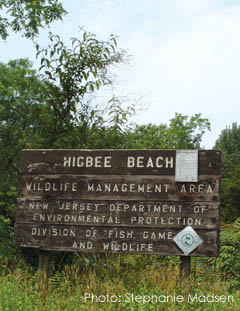

Higbee Beach is comprised of six different locales: Signal Hill, Davey’s (or Davis) Lake, Pond Creek, Sassafras Island, Hidden Valley, and the Magnesite Plant.

Hidden Valley's mix of varied habitats hosts a diversity of birds which may be encountered, including sparrows, hawks, waterbirds, and even the possibility of an owl.

According to capemay.com, Hidden Valley was once a 92-acre farm between Bayshore Road and the Pond Creek Marsh. The Dickinson family, preferring it be preserved rather than developed, sold it to the state in 1986. Part of the acreage is known as Hidden Valley Ranch, and is leased for equestrian activities. The fields, trails and swamps are well known to birders.


The next scheduled walk is Sunday, January 8 at 4:00 p.m.  
For more information visit community.njaudubon.org


If visiting during the fall migration, it is suggested that you go following a cold front with northerly winds. All you need is a set of binoculars and ID books.

In warmer weather, Higbee Beach is also home to lots of dragonflies and butterflies, including the long-distance migrant - the Monarch butterfly.

Thursday, September 8, 2016

Hamburg Mountain WMA Guided Hike


On Saturday, September 17, 2016, the NJ Highlands Coalition offers a Hamburg Mountain WMA Guided Hike. Discover and learn about one of NJ’s largest contiguous forests

Towering to an elevation of 1500 feet in height, the Hamburg Mountain ridges guard the southern approaches to scenic Vernon Valley. Adjoining the Pequannock Watershed, Hamburg Mountain is one of the largest contiguous forests in New Jersey.

According to slackpacker.com, this Wildlife Management Area is "Probably the least-used, most underrated hiking location in New Jersey" and that is "hard to understand, considering the numerous small mountains, ravines, cascades, cliffs, rock formations, and highlands swamps, as well as opportunities for spotting deer, turkey, black bear and other wildlife. Hamburg Mountain presents outstanding opportunities for hiking, bouldering, and photography, yet it seems that hunters are the only people familiar with the area."

Join Dennis Miranda on an easy walking tour to learn of the rich natural heritage and conservation struggle that led to the preservation of this important region of the New Jersey Highlands. You may glimpse Black Bear, Northern Raven and Bald Eagle, so bring your sturdy hiking boots and a pair of binoculars. Dress in layers in anticipation of a cool morning and seasonally warm afternoon. Heavy rain cancels. PLEASE RSVP TO julia@njhighlandscoalition.org to reserve your spot.

Facebook Event Page: https://www.facebook.com/events/335251686817222/

Map: http://www.state.nj.us/dep/fgw/pdf/wmamaps/hamburg_mt.pdf

Monday, March 28, 2016

Two Sides of the Sparta Mountain Forest Proposal

Ryker Lake,one of several bodies of water on the Sparta WMA | Photo by Wilma Frey

Sparta Mountain was preserved as part of the continuous forest of the Highlands that protects the drinking supply for half of New Jersey’s residents. But a proposed logging project may threaten that with increased silt and run-off that will affect trout streams and also that very high water quality water supply.

The NJDEP Division of Fish and Wildlife partnered with the NJ Audubon Society to revise the existing Forest Stewardship Plan (FSP) for the 3,461-acre Sparta Mountain Wildlife Management Area in Sussex County.

NJDEP states its primary goal of the plan is to "maintain ecosystem health, diversity, and integrity by creating a greater balance among the stages of forest succession throughout the property, minimizing further distribution of invasive exotic species, and enhancing biological diversity through responsible silviculture and mimicking natural 'gap disturbances'."


But some people view this "management" as just creating a different habitat more suitable for hunting. Groups such as the NJ Sierra Club say this proposal not only threatens the environment, but it will also interfere with public access, recreation, and hiking.

What NJDEP calls the "Sparta Mountain WMA Forest Stewardship Plan," environmental groups call "logging" and "clear-cutting" and a plan to "turn the Mountain into a field for bird habitat and deer over-population."

You only have until March 31st to let your feelings about this proposal be known, and can post those comments online for the NJDEP at http://www.state.nj.us/dep/fgw/spartamt_comments.htm

Monday, December 28, 2015

Sparta Mt. WMA Forest Stewardship Plan

The NJDEP Division of Fish and Wildlife is seeking comments on the draft Sparta Mt. WMA Forest Stewardship Plan.

Comments may be submitted until January 24, 2016.

To review the plan and submit comments, visit njfishandwildlife.com/spartamt_plan.htm on the Division's website.

Thursday, January 3, 2013

Winter Visitors Flock to South Jersey

Western Grebe - FWS
It is that time of year when the Jersey shore gets a lot of visitors flying in for a stay. they don't use Newark or Atlantic City airports. They fly in on their own because winter in South Jersey is when dozens of species of bird not native to this area take vacations from their northern homes.

While people in NJ may be complaining about snow and cold weather, these avian tourists find the shores and estuaries of the Delaware Bay coast very appealing. The Downe and Commercial townships, as well as Maurice River and Lawrence along the bay and river shores are considered prime area for birding. There are also a number of wildlife management areas (WMAs) and other protected open spaces that offer good viewing.

“The Delaware bay shore is one of the best wintering strongholds in North America,” Pete Dunne, director of the NJ Audubon Society’s Cape May Bird Observatory, told The South Jersey Times. “This is what is called an eruption year. Food stocks are scarce up north and so the birds come south."

Already, sightings of the winter finch, Townsend’s warbler and the rare western grebe have been made. There are also birds of prey including owls, hawks, falcons and eagles despite Hurricane Sandy drowning many of the mice, rats and weasels that are the prey of raptors in these marshes.

This year, the Audubon Society’s annual Cape May Christmas count documented 168 distinct species.

Northern Saw-Whet Owl  -  FWS
 Dunne reported ten distinct great horned owl calls one morning at Turkey Point in Downe Township.

And the saw-whet owls are present in large numbers. As many as 80 have been captured and banded in a given area in a single night.

The saw-whet owl is very passive and are present in areas of open marshland along the coast should have its share of prowling raptors.

For those interested in learning more about birds and bird watching, Dunne and the NJ Audubon will be hosting Break into Birding, an informational session for new birders on February 16 and 17. Information on all activities and programs offered by the Cape May Bird Observatory can be found online at www.BirdCapeMay.org
Images: U.S. Fish & Wildlife Service (Public Domain)

Thursday, October 4, 2012

Volunteers Needed for Cox Hall Creek WMA in Cape May County


Volunteers are needed to help plant native trees, shrubs, grasses and wildflowers for wildlife inside Cox Hall Creek Wildlife Management Area in southern Cape May County.

October 10-11th from 10-2pm. (possibly the 12th if needed)
Cox Hall Creek Wildlife Management Area, Villas, NJ

This site is the former location for an old golf course named “Ponderlodge.” It was demolished last year and we need your help to install a series of gardens that will be used to demonstrate what people can do to help provide habitat for wildlife in lower Cape May County.

The entrance for Cox Hall Creek WMA is at the intersection of Bybrook & Delview Rd. We'll meet in the parking area. The area where we'll be working is right next to the parking area. Restrooms are on site. We'll provide some light refreshments.

Please bring some landscaping/planting tools, shovels, work gloves etc...that you can use to help plant.

We will have light refreshments. There is a bathroom on site. Please bring a pair of work gloves and dress accordingly.

Please RSVP by emailing Ben Wurst


Heavy rain will postpone till the following day.
 

More info about the project: conservewildlifenj.org/protecting/habitat/restoration/ponderlodge/

Wednesday, March 23, 2011

Equine New Jersey

New Jersey's Wildlife Management Area System, administered by the Division of Fish and Wildlife's Bureau of Land Management, preserves a diversity of fish and wildlife habitats from Delaware Bay coastal marshes to Kittatinny Ridge mountain tops.

Ranging in size from the 0.68 acre Delaware River Fishing Access Site at the Pennsauken WMA to the 30,000-acre Greenwood Forest Tract in Burlington and Ocean counties, Wildlife Management Areas provide countless outdoor recreational opportunities for New Jersey residents and visitors from out of state.

Did you know that horseback riding is allowed on designated WMAs?

With a permit purchased ($25.00 per person, per calendar year, plus $2.00 application fee) from the Division of Fish and Wildlife's license Web site at www.wildlifelicense.com/nj/, horseback riding is currently permitted in designated areas at:

Flatbrook and Whittingham, Sussex County
Black River, Morris County
Alexauken Creek and Capoolong Creek, Hunterdon County
Assunpink, Monmouth County
Colliers Mills and Greenwood, Ocean County
Great Egg Harbor River, Atlantic County
Medford, Burlington County
Glassboro, Gloucester County
Winslow, Camden County
Bevans, Union Lake and Peaslee, Cumberland County
Higbee Beach and Tuckahoe (MacNamara), Cape May County

Permittees are responsible and liable for any damage which may occur and shall abide by regulations for use of Wildlife Management Areas.

Did you know that the state animal of New Jersey is the horse (Equus caballus)?

The U.S. Equestrian Team headquarters is located in Gladstone, New Jersey.

On the NJ Equine Calendar of Events, you'll find upcoming show horse events in the state.

The Horse Park of New Jersey is a 147-acre facility in Stone Tavern, Monmouth County that is fast becoming a world class equine exhibition facility. It has hosted Olympic Game trials and in March through November, equine events are scheduled for most weekends and many weekdays, including frequent multi-day events.

The New Jersey Equine Facilities site is a way to find a place to board your horse, buy a horse, rent a horse, get riding lessons, breed a horse, or see a horse show.


Horsing Around in New Jersey: The Horse Lover's Guide to Everything Equine

Monday, December 6, 2010

Being Out in Nature During Hunting Season

Yukon Gear Field Vest  Blaze Orange Polyester Cap

Now is the time to wear your orange blaze when you are out and about outdoors in some areas of New Jersey. It's hunting season and a hat, vest, or jacket, is a good idea - even one for your dog, especially if you let him off the leash.

The NJ Hiking blog has some good advice and reminders about Hiking in NJ During Hunting Season


The deer season runs September through February with bow season being early and then specific date ranges for shotguns. The new bear season was scheduled for today through the 11th. Small game season runs throughout the year - check http://www.njfishandwildlife.com/smgame_info.htm

There are some park areas that are closed on certain dates of shotgun season. For example, in Morris County, Pyramid Mountain, Black River, & Schooley's Mountain are closed on dates in December, January and February.

When I used to volunteer at the Pequest Education center, we got lots of questions about the confusing NJ hunting regulations.

Remington Orange and Yellow Large Safety Vests for Dogs
Don't forget your best friend!
One way to be safe is to remember that there is no hunting on Sunday in NJ except for certain Wildlife Management Areas and private lands. (Check WMAs at http://www.state.nj.us/dep/fgw/wmaland.htm )

You can also try out some of the non-hunting park areas such as Cheesequake State Park, Watchung Reservation and South Mountain. More on that tomorrow.

Tuesday, March 30, 2010

Volunteer to Help Replant the Villa Wildlife Management Area

The "Ponderlodge Golf Course" was purchased in February 2006 by New Jersey's Green Acres Program and is now known as Villas WMA. After being purchased, it was instantly prized by residents and outdoor enthusiasts for its size, location and recreational opportunities. Its location near the Cape May Peninsula gives it great potential value as a crucial habitat for migratory wildlife.

The 253-acre former golf course on the property has little habitat value to wildlife in its current state. The Division of Fish and Wildlife and the Conserve Wildlife Foundation of NJ (CWF) are partnering to restore and improve wildlife habitat on the former golf course portion of the Villas WMA.

Last year CWF began restoration efforts by planting over 900 tree seedlings on a former fairway. This spring CWF needs volunteers to help plant more tree seedlings to reforest additional former fairways.

Planting will begin the week of March 29 and will continue until all the available seedlings are planted. If interested in volunteering or know of a large group that would be interested in volunteering to help plant trees please contact:   Ben Wurst, Habitat Program Manager, Conserve Wildlife Foundation of NJ, ben.wurst@conservewildlifenj.org

The Ponderlodge Plan can be viewed at http://www.njfishandwildlife.com/ponderlodge_plan.htm

NJ Wildlife Management Areas   http://www.state.nj.us/dep/fgw/wmaland.htm 

Wednesday, June 17, 2009

NJ Wildlife Management Areas


New Jersey's Wildlife Management Area System, administered by the Division of Fish and Wildlife's Bureau of Land Management, preserves a diversity of fish and wildlife habitats from Delaware Bay coastal marshes to Kittatinny Ridge mountain tops.

The WMAs range in size from the 0.68 acre Delaware River Fishing Access Site at the Pennsauken WMA to the 30,000-acre Greenwood Forest Tract in Burlington and Ocean counties.

The areas provide outdoor recreational opportunities for New Jersey residents and visitors from out of state.

The purchase of the 387-acre Walpack Tract in Sussex County in 1932 marks the start of the system. The tract was purchased as a "Public Shooting and Fishing Ground" by the Board of Fish and Game Commissioners who were the forerunner of today's Fish and Game Council.
Part of the South Branch of the Raritan Wildlife Management Area

Today there are more than 324,000 acres in 120 areas which represents more than 44% of New Jersey's state-owned public open space.

The purchase of lands for the Wildlife Management Area System was initially funded entirely from the sale of hunting and fishing licenses, but, beginning in 1961, Green Acres bond issues have paid for about half of the present holdings.

The infusion of Green Acres monies has also broadened the mission of the Wildlife Management Area System from areas where fish and wildlife habitat is protected and enhanced, to providing a variety of compatible recreational and educational opportunities.