Showing posts with label forestry. Show all posts

Tuesday, January 19, 2021

Prescribed Burn


Prescribed fire in a pine forest in Washington - Photo credit: Ken Meinhart, USFWS


The prescribed burn scheduled to take place on Peaslee WMA along 1st Avenue, beginning today on the northwest side of 1st Avenue, between Cape May Avenue and Route 49 has been postponed. The State Forestry Service was granted a timing restriction extension and will not enter this area until after archery deer season ends on January 31. The Forest Fire Service will attempt to wait until the end of the small game season on February 20, but if a window opens in February and the long-term planning forecast is not favorable it will be treated before the end of the small game season.

Peaslee Wildlife Management Area is the second-largest WMA in the state of New Jersey.

A controlled or prescribed burn (also known as hazard reduction burning, backfire, swailing, or a burn-off) is a fire set intentionally for purposes of forest management, farming, prairie restoration, or greenhouse gas abatement. Fire is a natural part of both forest and grassland ecology and controlled fire can be a tool for foresters. We have heard a lot about it in the news in connection with the fires on the West Coast 

Prescribed burns are also done in New Jersey. Hazard reduction or controlled burning is conducted during the cooler months to reduce fuel buildup and decrease the likelihood of serious hotter fires. 

Controlled burning actually stimulates the germination of some desirable forest trees, and reveals soil mineral layers that increase seedling vitality, thus renewing the forest. Some cones (such as those of lodgepole pine and sequoia) are serotinous, meaning they require heat from a fire to open the cones and to disperse seeds.

The Peaslee Wildlife Management Area is in Atlantic, Cape May & Cumberland Counties (Dennis, Estell Manor, Maurice River & Upper Townships) and covers 34,152 acres.

The NJ Forest Fire Service is facing a limited time frame when they can complete this prescribed burn which will function as a strategic fuel break that would hold fire from entering into the extensively inaccessible tract to the south. In addition to acting as a fuel break, it will increase public safety and reduce the possibility of fire impacting a much larger area. 

Map of the burn area

Birding and Wildlife Trails at Peaslee


Wednesday, April 3, 2019

60,000 Free Tree Seedlings for New Jersey

The Department of Environmental Protection’s Division of Parks and Forestry is providing 60,000 free tree seedlings to residents through the New Jersey Tree Recovery Campaign, an ongoing effort of the New Jersey Forest Service, the nonprofit Arbor Day Foundation and other partners.

Residents are eligible to receive bundles of five free seedlings at any of 118 distribution sites across 19 counties beginning Saturday, March 30 and continuing through Sunday, May 5. Proof of residency in the community where seedlings are distributed is not required.

“Trees provide many benefits beyond beautifying our communities,” said DEP Commissioner Catherine R. McCabe. “Trees clean our air, fight climate change, provide habitat for wildlife, offer shade and improve the health of our environment.”

Planting trees can also help reduce global warming, by removing carbon dioxide from the air. Carbon dioxide is a greenhouse gas that is a major contributor to global warming.

The free tree seedlings program launched after Superstorm Sandy destroyed and damaged trees across the state in 2012. Since then, the program has made more than 500,000 trees available to residents. Although some of the seedlings are non-native species, they may actually be hardier than native species and are able to thrive in harsh conditions.

“While the tree seedlings stand just one to two feet tall now, with proper care they will soon grow to be powerhouses at cleaning the water we drink and air we breathe,” said New Jersey Forest Service Chief Todd Wyckoff. “In urban areas where there are many pollutants, these environmental benefits are especially important.”

The New Jersey Forest Service Nursery in Jackson Township, Ocean County, will distribute 37 different species of trees. Communities will receive species that grow well in their region.

Urban locations will receive hardy species that are able to tolerate urban landscapes. These species have a better chance of thriving despite limited growing space, temperature extremes and varying amounts of rainfall from drought to flooding.

Municipalities in the northern part of the state may receive persimmon or black oak trees, while towns in the southern region may receive Atlantic white cedar or other species that have adapted to this area. Seedlings distributed to shore towns may include bayberry or beach plum, shrubs commonly found on dunes and in other coastal environments.

To ensure successful growth of tree seedlings:

  • Plant seedlings promptly to ensure they take root and thrive.
  • Consider the location of where seedlings are planted and the size of trees when fully grown. Avoid planting seedlings near overhead utility lines and structures.
  • Moisten roots before planting.
  • Dig a hole two to three times larger than the roots when spread apart. Do not plant roots too deep or too shallow.
  • Add loose soil gently, then add more soil and pack down firmly. Add water to firm the soil if necessary.
  • Place wood-chip mulch around the base of the seedling.
  • Water the seedling regularly but do not over-water, which can cause roots to rot.


The New Jersey Tree Recovery Campaign is a public-private effort among the New Jersey Forest Service, the New Jersey Forest Service Nursery, Arbor Day Foundation, New Jersey Soil Conservation Districts, Sustainable Jersey, Verizon, BJ’s Wholesale Club and FedEx.

The Arbor Day Foundation’s Community Tree Recovery aims to replace trees in communities affected by natural disasters throughout the nation.

The New Jersey Forest Service Nursery grows 500,000 trees annually, helping to protect, preserve and promote native species. All New Jersey residents may buy additional tree seedlings in packets of 50, starting at $18.

For more information on these programs,
call (732) 928-0029 or visit www.forestnursery.nj.gov

For an interactive map of all distribution locations,
visit nj.gov/dep/tree recovery

To find seedling distribution locations and dates, as well as additional information about trees, visit the State Forest Service Facebook page at www.facebook.com/newjerseyforests or go to www.forestry.nj.gov

For more about the Arbor Day Foundation, visit www.arborday.org/newjersey

SOURCE:  nj.gov/dep/newsrel/2019/19_0019.htm

Tuesday, November 27, 2018

Forest Stewardship at Sparta Mountain WMA


Forest stewardship activities in Stand 33 on Sparta Mountain WMA will begin on or about November 27, 2018. Weather permitting, the work should take about two weeks to complete. All cutting will cease from Dec 3 - 8, 2018 and again before April 1, 2019.

Approximately 17 acres will be managed to accelerate the development of old growth forest characteristics through a process known as "gap-phase replacement". Through the creation of small canopy gaps and growth of younger cohorts of shade-tolerant trees, this stand will contain three or more age classes at any given time.

The majority of woods at Sparta Mountain WMA are mature or middle aged. These woods are quite valuable to many species, but so are old growth and young forests too. The objective is to maintain the mature forests, foster old growth forests, and create new young forests.

Specifically, about 25% of the existing tree density will be cut or girdled (left as a standing dead tree) with chainsaws or hatchets. No heavy machinery or chemicals will be used, and none of the cut trees will be removed or sold.

More information www.spartamountainfacts.nj.gov

Monday, October 1, 2018

Annual Fall Forestry Festival October 6


The 24th Annual Fall Forestry Festival will be held on Saturday October 6th, 2018 from
10 a.m. - 3 p.m.

The vent will be located at the Forest Resource Education Center in Jackson, NJ (enter through 370 East Veterans Highway for parking)

This is a FREE Rain-or-Shine event for everyone and a great opportunity for families to enjoy the day and learn about the forest surrounding you.

Some of the activities of the day will include:

• Maple Sugaring
• Nature Walks
• Crafts
• Forestry Displays & Demos
• Greater Pinelands Dulcimer Society
• Classroom Presentations Given by Naturalist

Questions? Call 732.928.2360

Like the Forestry Center on Facebook www.facebook.com/forestrycenter/

Friday, October 6, 2017

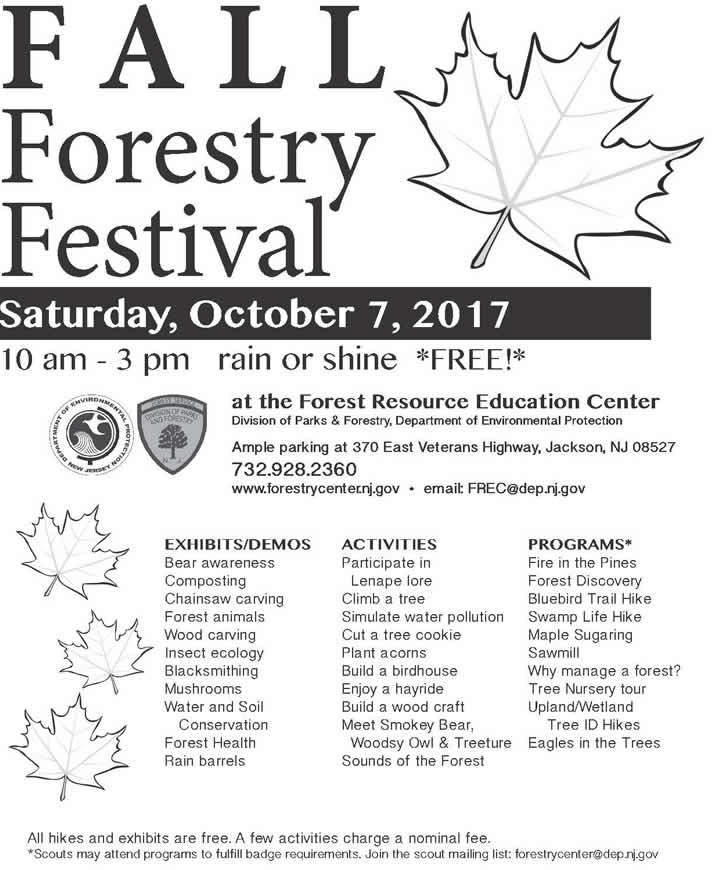
Annual Fall Forestry Festival October 7 in Ocean County


Outdoor enthusiasts, crafting devotees, and fans of all things arboreal will gather again on Saturday October 7 at the Department of Environmental Protection’s Forest Resource Education Center in Jackson Township, Ocean County for the 23rd Annual Fall Forestry Festival. The festival will be held from 10 a.m. to 3 p.m., rain or shine. Admission and parking are free.

“We invite all New Jerseyans to visit our Fall Forestry Festival to learn about trees and enjoy the outdoors,” said DEP Assistant Commissioner for Natural and Historic Resources Richard Boornazian. “The festival’s nature-themed activities and programs are sure to entertain and delight children and parents alike.”

“This festival is also a great time for birders, scouts, hikers, and anyone who appreciates forests and woods,” added State Forester John Sacco. “This event is here for people to gain a better understanding of New Jersey’s vast forest resource.”

Visitors will get the chance to meet beloved outdoor mascots Smokey Bear and Woodsy Owl, take a hayride, visit the New Jersey Tree Nursery, or join one of the many guided hikes scheduled throughout the day. Professionals in the natural resource field will also be on hand to give tips on water and soil conservation, composting, invasive insects and diseases, maple sugaring, managing your backyard forest, and more.

Children, teens, and parents alike can plant acorns, build a wooden craft, make music in “Sounds of the Forest,” and even put on a harness and climb the old white oak tree. Plans are in place for demonstrations of the center’s sawmill and the utilization of logs from storm and/or insect damaged trees from around the state to be milled into useable lumber.

On the forest safety side, fire wardens will be on hand showcasing firefighting tools and equipment, as well as demonstrating how homeowners in our wooded areas and forests can help make their property “firewise.”

“Living in our forested areas means living with the potential for wildfires impacting their homes and property,” said State Fire Warden Steve Holmes. “We will be providing information on firewise gardens, which is the practice of making smarter landscaping choices to best protect our homes from wildfires.”

In 1994, the Department of Environmental Protection’s Forest Resource Education Center in Jackson hosted the first Fall Forestry Festival, drawing attention to the work the center does in educating the public about forest stewardship — managing New Jersey's forest resources so that we have healthy trees and forests, clean air and water, and places to learn about and enjoy the outdoors. Food and beverage will be available for purchase at the Festival. Sturdy hiking shoes and insect repellant are encouraged.

Parking is available for the festival at 370 E. Veterans Highway, Jackson. For driving directions to the Forestry Festival, call the Forest Resource Education Center (FREC) at 732-928-2360 or visit www.forestrycenter.nj.gov .

The Forest Resource Education Center (FREC), operated by the DEP's NJ Forest Service, is committed to providing exceptional conservation education programs that promote benefits of trees and forest stewardship to all age groups at no cost. It is the sole public facility in NJ focused on forestry education. Located on 875 acres, the FREC also offers miles of trails for hiking, biking, and nature watching.

The Toms River, which runs through the FREC, is regularly stocked with trout to provide an exciting fishing experience for anglers. For more information, please visit the FREC’s website at: www.state.nj.us/dep/parksandforests/forest/njfs_frep.html. Many programs may fulfill requirements for scouting badges. To be added to the scout mailing list, email FREC@dep.nj.gov

The New Jersey Forest Tree Nursery, co-located on the same property, grows 300,000 seedlings yearly for reforestation efforts across the state. The Nursery has grown and distributed more than 220,000 tree seedlings for the Tree Recovery Program, providing them to New Jersey residents to replace trees lost in Superstorm Sandy. It also provides trees and seedlings for Arbor Day events and also boasts seedlings that flew in space on the Shuttle Columbia in 1997.

To learn more about the New Jersey Forest Tree Nursery, please visit their website at: www.state.nj.us/dep/parksandforests/forest/nj_forest_nursery.htm


Wednesday, September 20, 2017

The Attack of the Emerald Ash Borer,

 EAB - Photo: David Cappaert, www.forestryimages.org
It is possible that in another decade most of New Jersey's ash trees will be dead. The 24 million ash trees in our forests, neighborhoods, parks and backyards are very endangered because they are under attack from an invasive insect known as the Emerald Ash Borer (EAB).

This  tiny beetle came from Asia with wood products, first to the Great Lakes region, especially Michigan in the early 2000s. It has destroyed hundreds of millions of ash trees in the Midwest.

Emerald Ash Borer was discovered in New Jersey in May 2014 in Somerset County. Through July 2017, emerald ash borer has been found in New Jersey in Bergen, Burlington, Essex, Hudson, Hunterdon, Mercer, Middlesex, Monmouth, Morris, Somerset, Sussex and Warren counties.

Adult females deposit eggs in bark crevices and emerging larvae burrow under the bark and feed on the cambium, which transports water and nutrients and kill the tree.

An affected tree, will start looking bad  -  thinning out at its crown, leaves turning yellow, shredding bark, woodpecker holes and D-shaped holes where the insects exit. If a tree is at this point, it cannot be saved.

So, what can we do?  Very little.

Cutting ash trees down or treating untouched trees with insecticide are the only alternatives. Treatment costs about $200 per tree, and they have to be treated every two years, so, though individual trees can be protected, widespread treatment is cost-prohibitive and impractical.

One of the frightening statistics from the NJ Department of Agriculture is that 99 percent of untreated ash trees in our landscape will eventually become infested and die from EAB.

Wednesday, February 15, 2017

NJ State Forest Fire Seasonal Prescribed Burning Program Is Underway


The New Jersey State Forest Fire Service advises residents that its seasonal prescribed burning program – which reduces wildfire risks by burning away the buildup of undergrowth, fallen trees and branches, leaves, pine needles and other debris on forest floors – is under way. Residents are advised that they may see large plumes of smoke in areas where these controlled burns are being conducted.

Prescribed burns will take place through the end of March, conditions permitting. These burns are generally conducted during the winter – especially toward the late-winter months – to minimize the amount of smoke produced, and when weather conditions tend to be safer for controlled fires.

Forest Fire Service Prescribed Burn“Prescribed burning is an important tool in keeping our forests and other wildlands safe and healthy,” said Bill Edwards, Chief of the New Jersey Forest Fire Service. “These burns are conducted only under exacting conditions by highly trained personnel. By burning them away now, we can reduce the risk of these materials serving as tinder for wildfires later in the year. This practice also improves the overall ecological health of our forests and grasslands.”

The New Jersey Division of Parks and Forestry will provide as much notice as possible of prescribed burns through its Facebook page at: www.facebook.com/newjerseyforests.

The public may also contact the State Forest Fire Service at (609) 292-2977 about the prescribed burning program and where burns are expected to be conducted. When in doubt about the source of smoke or fire, call 9-1-1 or 877-WARN-DEP (877-927-6337).

The peak wildfire season in New Jersey typically begins in middle to late March and runs through late spring, when the weather tends to be dry, windy and warmer. This also is the time of year when forest canopies and undergrowth have yet to leaf out, making forest debris more susceptible to the drying effects of wind and sunshine.

Because of the types of trees and shrubs it supports, the sprawling Pinelands region of southern New Jersey is particularly susceptible to wildfires and is typically the focus of much of the prescribed burning activity conducted by the Forest Fire Service.

During prescribed burns, Forest Fire Service personnel use hand-held torches to set smaller fires to burn away fallen leaves, pine needles, fallen branches and other debris on the forest floor. The personnel take into account wind, moisture and other conditions. These prescribed fires do not reach the forest canopy or cause significant loss of mature trees as wildfires do.

While the annual burning program began late last year, the Forest Fire Service is entering peak season for controlled burns. The Forest Fire Service expects to burn between 10,000 and 20,000 acres of forests and grasslands this season, depending on weather conditions. Most burns take place on state-owned property, such as state forests, parks and wildlife management areas.

“Prescribed burning has been a successful wildland fire mitigation tool used by the Forest Fire Service since the 1920s, protecting property, lives and infrastructure by creating defensible space around developed areas and strategic fire breaks that help the Forest Fire Service quickly contain wildfires,” said Richard Boornazian, DEP’s Assistant Commissioner for Natural and Historic Resources.

In 2016, the Forest Fire Service responded to 1,065 wildfires, 75 percent of which were a quarter-acre or smaller. The largest was a 464-acre fire in Bass River State Forest in Burlington County.

Roads in areas where burns are taking place are clearly marked. Motorists traveling through these areas are advised to observe posted reduced speed limits and to be alert to the presence of trucks and Forest Fire Service personnel. During the burns, firefighters employ best management practices to control smoke impacts, but nearby residents and forest visitors should expect temporary smoke.

For more information on wildfires in New Jersey, steps you can take to protect your property and other resources, visit: www.njwildfire.org

For more information on New Jersey’s Statewide Forest Resource Assessment and Strategies, visit: www.nj.gov/dep/parksandforests/forest/docs/NJFSassessment.pdf

SOURCE:  http://www.nj.gov/dep/newsrel/2017/17_0009.htm

Thursday, April 9, 2015

130,000 Seedlings Being Distributed to Replace Trees Lost in Superstorm Sandy


The New Jersey Tree Recovery Campaign, a partnership between the Department of Environmental Protection’s State Forestry Services and the non-profit Arbor Day Foundation, is distributing some 130,000 free tree seedlings to residents through 178 locations across the state, Commissioner Bob Martin announced today. 
This is the second year of the effort, launched to help communities that were hit by tree losses resulting from Superstorm Sandy. Municipalities that registered last month for the seedlings will receive up to 1,500 trees each for distribution to residents. Any resident of the state is eligible to receive up to five free tree seedlings at any of the distribution locations. Proof of residency is not required.
imageState Forestry Services will deliver the trees to 13 regional distribution centers for pick-up by those municipalities, which will then distribute them to residents through May 9. 
“While we have made tremendous progress as a state in recovering from Superstorm Sandy, the storm destroyed a staggering number of trees across New Jersey – and not just in those communities hardest hit by the storm,” said Commissioner Bob Martin. “This campaign will allow residents to replace trees where they are needed most, right in their neighborhoods and backyards.” 
State Forestry Service’s New Jersey Forest Nursery is providing seedlings from more than 38 different tree species for the campaign after a hugely successful seedlings distribution effort last year. The species include a wide range of trees, from oaks to dogwoods and maples.
The seedlings, which are about knee-high when distributed, should be planted promptly to ensure survival. In choosing where to plant the seedlings, residents should consider the size of the tree when fully grown and be mindful of overhead utility lines and proximity to structures.
From now until May 9, each participating community will distribute seedlings on a designated date.  
Seedling distribution locations will be listed on the State Forestry Services Facebook pagewww.facebook.com/newjerseyforests and at www.forestry.nj.gov. 
The New Jersey Tree Recovery Campaign is a joint effort between the New Jersey State Forestry Services' Community Forestry Program and State Forest Nursery, New Jersey Soil Conservation 
Districts, Sustainable Jersey, Arbor Day Foundation, Brothers International, BJ’s Wholesale Club, Wyndham Vacation Resorts, and FedEx. 
The State Forestry Services’ Forest Tree Nursery opened in 1982 in Jackson, where foresters grow 500,000 trees annually. The nursery sells the majority of trees in packets of 100 to private landowners, including non-profits and New Jersey landowners who use the trees to reforest their land. Packet prices start at $30. 
The nursery also offers the Third Grade Tree Team program where each third grader in the state is eligible to receive a free tree seedling when requested by the student’s school. For Arbor Day celebrations, the nursery offers 98 tube seedlings for $25. For more information on these programs, visit: www.forestnursery.org  or call (732) 928-0029. 
The National Arbor Day Foundation has been helping communities cope with the aftermath of natural disasters through its Tree Recovery Campaigns since 2011. For more on the Arbor Day Foundation, visit:www.arborday.org/newjersey.