People in my suburban neighborhood are still raking leaves to the curb, and the leaf blowers are still working hard, but maybe there shouldn't be a fall clean-up frenzy.
Many of us have been brought up to believe that a tidy, sterile lawn is the sign of a "good gardener." That bare look is ecologically disastrous.
Walk through a forest now, and the floor is covered in a rich tapestry of leaves. That’s what nature intends.
Leaving the leaves is a matter of life or death for beneficial bugs.
Dozens of species that pollinate our crops, eat pests, and power the entire food web survive the winter by hunkering down in the leaf litter. We're talking about native bees, butterflies, moths, and more, who shelter there as adults, eggs, larvae, or cozy cocoons.
Scientists have been sounding the alarm about a global "insect apocalypse," and by tossing those leaves, we’re essentially trashing their winter homes and their only shot at surviving until spring.
Your birdfeeder is nice if you keep it stocked, but birds evolved to forage on native seed heads all winter long, so leaving them standing through winter is one of the easiest ways to support bird populations.
Raking and blowing is mostly about aesthetics. The lawn covered with leaves might not be the look you want and thick layers of leaves can turn a lawn patchy, but removing leaves from the lawn and then entirely from your whole landscape might not be necessary. I was even taught to be careful removing the leaf litter too ealy in late winter or early spring because the life beneath wasn't ready to handle the temperature fluctuations.
Putting leaves into my garden beds has become my habit. They become free, nutrient-rich mulch that suppresses weeds and feeds your soil. I do use a mulching mower to shred them into small pieces. And a lot of it goes into my compost, where they will decompose into beautiful leaf mold—one of the best, richest soil amendments on the planet.
Don't pile leaves or mulch right up against the base of tree trunks because tree roots need to breathe.
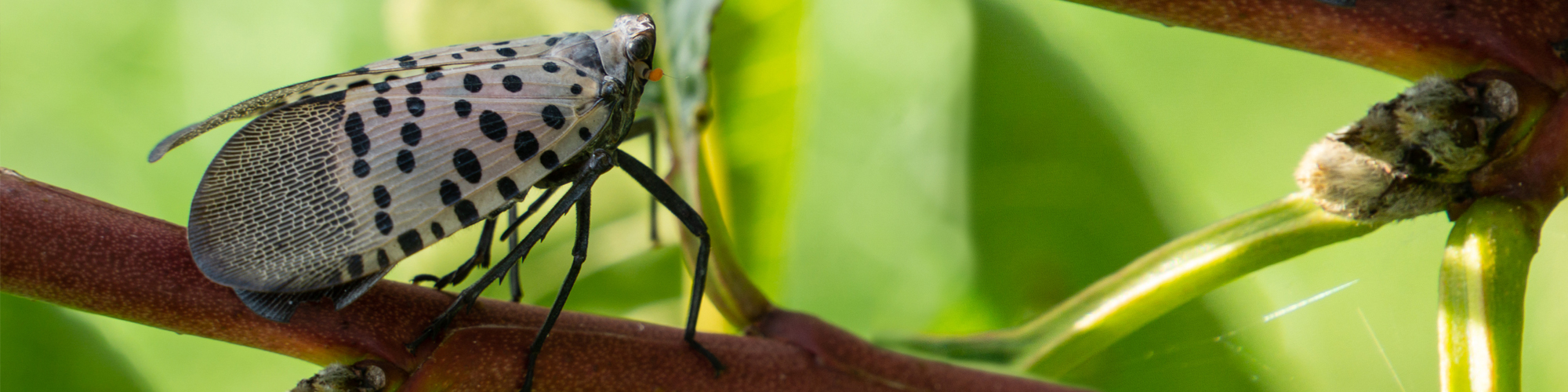
If you've stepped outside lately and spotted a bug with gray wings and a flash of crimson underneath, you're not imagining things—the spotted lanternfly is back. These invasive pests have returned to New Jersey in full force, and while they may look striking, they’re causing serious trouble for our environment.
After reading about how lanternflies are devastating Virginia's vineyards, I looked for updates from our own state. As of summer 2025, lanternflies are active across the Garden State, especially in North Jersey, where their populations are most concentrated. By now, they’ve reached their adult phase and will remain active until the first hard freeze. You’ll likely find them clinging to trees, hopping around your garden, or even hitching a ride on your car.
adult
Spotted lanternflies aren’t just a nuisance—they’re a threat to our local ecosystem. These insects feed on over 70 types of plants, including grapevines, maples, black walnuts, and fruit trees.
Their feeding weakens plants and leaves behind a sticky substance called honeydew, which attracts other pests and promotes mold growth. That means your backyard trees, local vineyards, and even public parks could be at risk.
One of the lanternfly’s favorite hangouts is the Tree of Heaven, itself an invasive species. These trees serve as prime egg-laying spots, making them a key target for control efforts. If you have one on your property, consider removal or treatment—it’s a proactive step in curbing the spread of the lanternfly.
New Jersey isn’t sitting idle. The state has extended grants to counties and municipalities to support lanternfly control efforts through 2026. But officials can’t do it alone—citizen action is crucial. So, here’s how you can help:
Stomp them: Yes, really. Squashing lanternflies is encouraged.
Oliver Milman’s book The Insect Crisis: The Fall of the Tiny Empires That Run the World, is about the precipitous decline of insects. Some people would joke that they wouldn't mind there being fewer insects - like Jersey mosquitoes - around. But that is very short-sighted and reading this book you see what the disappearance of insects means for human life and the other creatures around us.
These tiny invertebrates and their “tiny empires” when measured as a whole biomass, the size is more than enormous. Their decline affects the food we buy and medicines we take and much of the natural beauty around us both flora and fauna.
The threats to insects are familiar - pesticides, habitat destruction, electric lighting and climate change.
In 2019, Biological Conservation reported that 40% of all insect species are declining globally and that a third of them are endangered.
Sitting outside this afternoon, I tried guessing at the temperature by listening to some crickets. I do know that crickets chirp faster as temperatures rise, and slower when temperatures fall.
I'm sure my father was unaware of Dolbear’s Law when he told me about crickets and temperature. The actual formula is temperature = 50+[(N-40)/4] where N = the number of chirps per minute). I was an English major and math is not one of my strengths, but by counting I could tell it was getting cooler.
Actually, those summer insect love songs are disappearing as the weather cools. If you can't distinguish a cricket "song" from a cicada or a katydid, listen to a field cricket sound.
As an amateur phenologist (one who studies the seasonal changes in plants and animals), I'm interested in these sounds. Cicadas are kind of creepy looking and their cast-off skins that they leave attached around the backyard are also creepy.
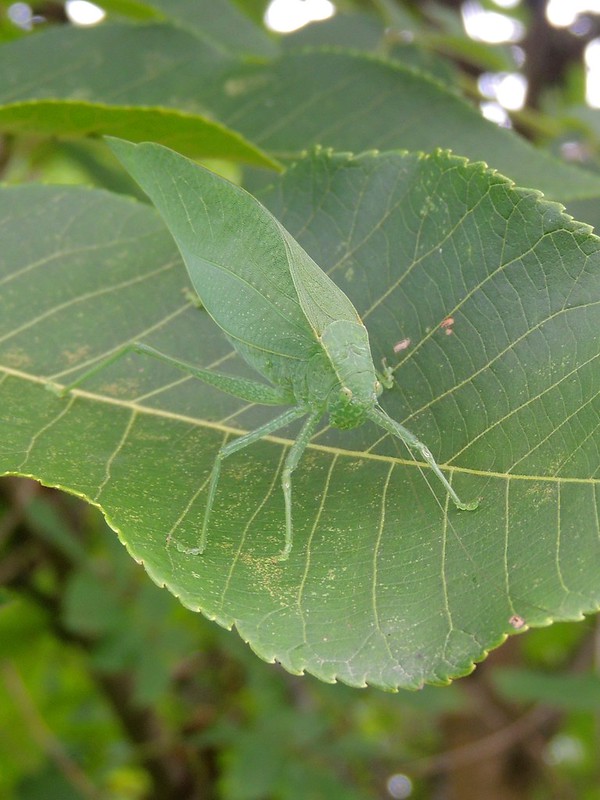
Katydids are much nicer looking in their bright green. It is difficult to find them, but easy to hear their eponymous "Katy did! Katy did!” call from the trees.
Can you hear females answering “Katy didn’t, didn’t, didn’t?” Take a listen to them They hide with their wings that look like leaves in the treetops. The katydids are singing for love, lust and a mate. The mating season runs August through mid-October.
They start singing sometime in August, but, if you can identify when they start their summer song, weather lore says that autumn will arrive 90 days later. I'm not sure I caught the first katydid, but I posted elsewhere that I noticed them for the first time on August 19. That would mean that autumn will arrive here in NJ November 17. Let's all mark our calendars.
Usually, I am writing here about things that are endangered or threatened in New Jersey, but thi spost is about a species we would like to see become extinct.
The spotted lanternfly (Lycorma delicatula) is a planthopper that is indigenous to parts of China, India, Vietnam, and eastern Asia. Although it has two pairs of wings, it jumps more than it flies.
In its native habitat it is kept in check by natural predators or pathogens but it was accidentally introduced and was first recorded in the United States in September 2014. By 2018 it was considered an invasive species in eastern Pennsylvania, southwestern New Jersey, northern Delaware, northern Virginia, and eastern Maryland.
What should you do if you spot one in New Jersey?
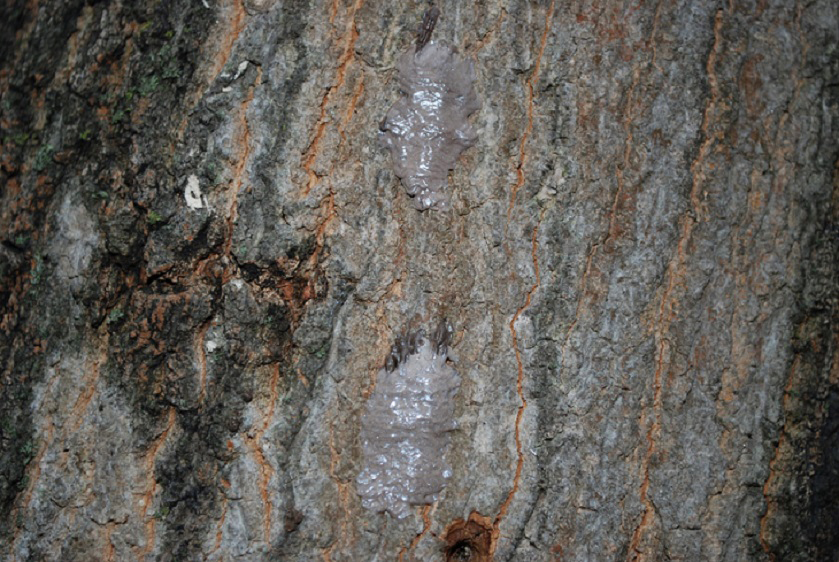
Egg masses
If you see egg masses (pictured above), scrape them off, double bag them and throw them away. You can also place the eggs into alcohol, bleach or hand sanitizer to kill them.
Kill and collect a specimen: Specimens of any life stage can be turned in to the New Jersey Department of Agriculture’s lab for verification.
Take a picture: With your GPS function turned on your smartphone or a camera with GPS, take a photograph of ANY life stage (including egg masses) and submit picture to:SLF-plantindustry@ag.nj.gov
Report a site: If you can’t take a specimen or photograph, call New Jersey Spotted Lanternfly Hotline at 1-833-223- 2840 (BADBUG0) and leave a message detailing your sighting and contact information.
EAB - Photo: David Cappaert, www.forestryimages.org
It is possible that in another decade most of New Jersey's ash trees will be dead. The 24 million ash trees in our forests, neighborhoods, parks and backyards are very endangered because they are under attack from an invasive insect known as the Emerald Ash Borer (EAB).
This tiny beetle came from Asia with wood products, first to the Great Lakes region, especially Michigan in the early 2000s. It has destroyed hundreds of millions of ash trees in the Midwest.
Emerald Ash Borer was discovered in New Jersey in May 2014 in Somerset County. Through July 2017, emerald ash borer has been found in New Jersey in Bergen, Burlington, Essex, Hudson, Hunterdon, Mercer, Middlesex, Monmouth, Morris, Somerset, Sussex and Warren counties.
Adult females deposit eggs in bark crevices and emerging larvae burrow under the bark and feed on the cambium, which transports water and nutrients and kill the tree.
An affected tree, will start looking bad - thinning out at its crown, leaves turning yellow, shredding bark, woodpecker holes and D-shaped holes where the insects exit. If a tree is at this point, it cannot be saved.
So, what can we do? Very little.
Cutting ash trees down or treating untouched trees with insecticide are the only alternatives. Treatment costs about $200 per tree, and they have to be treated every two years, so, though individual trees can be protected, widespread treatment is cost-prohibitive and impractical.
An interesting environmental advertising project - a billboard that produces real honey
for Honey Nut Cheerios.
What is the only insect that produces food eaten by humans? It is nature's most economical builders, bees. In 36 BC, Marcus Terentius Varro argued that honeycombs were the most practical structures around. Centuries later, Greek mathematician Pappus solidified the "honeycomb conjecture" by making the same claim.
The weather is warming and you're probably seeing bees out looking for spring flowers. Hopefully, you are a friend of bees. Of course, there are reasons to avoid doing things that might provoke a bee to go into a defensive mode and sting you. But encouraging bees in your garden and in nature in general is a good thing for all of us and for the planet.
The amazing little bees might surprise you with their good color vision. Flowers have many colors for that attractive reason. Bees especially like blue, purple, violet, white and yellow.
Did you know that honeybees can make out faces the same way we do? They take parts—like eyebrows, lips, and ears—and cobble them together to make out the whole face. It's called "configural processing," and it might help computer scientists improve face recognition technology
We need bees. One in three foods we eat is made possible by bees and other pollinators who spread the pollen that crops need to grow. That includes many of our favourite foods like apples, almonds, coffee, and of course, honey. 70 out of the top 100 human food crops are pollinated by bees
There are over 20,000 species of bees in the world. Honeybees have thrived for 50 million years, but colonies recently started dying in large numbers. 42% of bee colonies in the U.S. collapsed in 2015.
Why? Renowned entomologist and bee specialist Marla Spivak reveals four reasons why, and what we can do to help in this Ted Talk.
Common sense actions can restore and protect the world’s bees. Good starting places are:
- Ban the seven most dangerous pesticides.
- Protect pollinator health by preserving wild habitat.
- Restore ecological agriculture.
Cheerios cereal (General Mills) partnered early this year with Veseys Seeds to give away wildflower seeds so that people would plant them and make the world a bee-friendlier place. They quickly met their goal of distributing 100 million seeds.
The promotion hit a snag though because in sending free packets of wildflower seeds to people all over the country, they seem to have failed to take into account that some of the flowers included are invasive species in some areas that should NOT be planted there. For example, Forget-me-not (which was listed on their site but supposedly not included in the seed mix) is banned as a noxious weed in Massachusetts and Connecticut. And the California poppy is good in California, but listed as an “invasive exotic pest plant” in southeastern states. Some of the flowers on there list are not native to anywhere in the US, so they are not necessarily good matches for our local bees.
I am pleased to see General Mills making efforts for bees, even if this seeds project was less than perfect. By 2020, they expect their oat farms will host about 3,300 acres of nectar- and pollen-rich wildflowers, which are full of the nutrients bees and other pollinators need to stay strong.
Finally, it is important to remember that you can do more than just plant flowers to help create a bee-friendly habitat. Avoiding using pesticides outside on or near the flowers (including if you have a garden or lawn service spraying) is very important.
Also note that bees are not our only pollinators. Bees are the major pollinators - and this includes not just honey bees - but also hummingbirds and some kinds of butterflies, and to a lesser degree spiders, flies and wasps. Even bats who feed on the insects in the flowers as well as on the nectar and flower parts play a role in the pollination of over 300 species of fruit around the world.
A male F. whitcombi leafhopper. Credit: Andrew Hicks
A new grass-eating species of insect was discovered to be living in the Jersey Pine Barrens of New Jersey. This leafhopper (Flexamia whitcombi) had previously escaped notice. - and at least one scientist worried that it might not be around for very much longer.
As of now, scientists don't know for sure if the insect lives in the other regions of the eastern U.S. where the smokegrass also grows ( Tennessee and North Carolina).
If the leafhopper is unique to the Pine Barrens, there's a particular reason for concern, even though its food source is still relatively abundant there. Andrew Hicks of the Museum of Natural History at the University of Colorado writes:
"The Pine Barrens are already suffering the effects of a warming climate, as evidenced by the recent irruption there of the Southern Pine Beetle. Should the effects of climate change or other anthropomorphic pressures cause the local extinction of the host (as has apparently already occurred elsewhere in its range), there will be little opportunity for the survival of this Flexamia. But that might be said of most species described today."
Want to know why cicadas can get so loud? Biologist Kelly Rypkema and her Nature Minute video ventures into the thick of the 2013 appearance of periodical cicadas to show you the answer to the questions of why, who, and what body parts they use when they raise the roof after taking to the trees.
It has been 17 years. The cicadas are ready to emerge again in our area.
We all know their mating call that is a sound of summer - though their choppy chirp is not quite The Beach Boys. Only male cicadas use special muscles to vibrate two ridged, drum-like membranes called tymbals and make that sound to attract females.
They are not endangered or threatened, but they are rare because of the years that pass before we see them again. This year is expected to be one of the largest broods recorded. Entomologists are excited. You might be disgusted.
Their cycles runs13 or 17 years and the signal they are waiting for is the soil temperature 8 inches down to be a steady 64 degrees. Amazing.
After just a few hours from emerging, they go through a metamorphosis, transforming from a flightless, slow-moving nymph stage into a large, flying insect.And then they hit the sky. Perhaps in swarms this year.
Why? We're not quite sure.
Sometimes it happens in an off year. The Star-Ledger reports that in 2009, a swarm emerged in Union County four years early. But they didn't make. Predators got them before they could even be studied. They have many predators including birds, dogs, cats, snakes, squirrels, deer, raccoons, mice, ants, and wasps.
Some people eat them. It is said that they have a taste that is sort of asparagus and nutty. Supposedly best when they molt and are still soft. I have no personal experience with cicada cuisine.
Don't confuse these periodical cicadas for the annual cicadas that we hear every summer. Periodical cicadas are commonly known as "17-year locusts" or "13-year locusts", but they are not true locusts, which are a type of grasshopper. This species, Magicicada, adults have black bodies and striking red eyes and orange wing veins, with a black "W" near the tips of the forewings. The most common in New Jersey is called Macicada Septendecim, and they are the largest in size. Look for broad bands of orange on the abdomen. It is said that their mating call sounds like "pharaoh."
Most will emerge in May and June. You can report cicada spottings at www.magicicada.org and your data will help map where the cicadas emerge this year.
WNYC radio and Radiolab have created a citizen science project to track cicadas emergence in the northeast. To learn more about the project, including how you can build a device to predict in your backyard and participate, visit WNYC's Cicada Tracker homepage.
According to those sites, soil temperatures are generally still in the mid-50s across NJ and Rutgers University reported that the cicadas probably won't appear until late May. The soil warms slowly, so a week of 70 and 80 degrees days doesn't have much of an impact.