Showing posts with label weather lore. Show all posts

Monday, October 6, 2025

Will It Be a Mast Year in New Jersey This Year?

A mast year, also called a mast boom, is when a tree or group of trees produces an exceptionally large crop of their seeds, such as acorns. These years are natural cycles for many tree species, including oaks, which are common in New Jersey.

Some people consider a mast year to be a predictor of the coming winter. I'm sorry to report that it is not a predictor of winter. Lots of acorns or seeds do not mean a severe winter. Unfortunately, plants and animals are no better at predicting the future than humans.

The 2023 mast year was a significant event in New Jersey. The next mast event for many species, particularly oaks, is expected to be between 2026 and 2028. However, the timing can vary between different species, so other species might have their next mast year at slightly different times.

When trees produce a massive number of seeds, it creates a glut of food for wildlife. A surplus of food can lead to a booming population of animals like squirrels and chipmunks in the year following a mast event. That definitely happened in my North Jersey backyard.

Producing such a large seed crop is very energy-intensive for the tree, and it will typically have a very low yield of seeds the following year as it restores its energy.

The term "mast" in this context comes from Old English "mæst," which referred to the nuts of forest trees, especially those used as food for pigs. This Old English word is derived from Proto-Germanic "mastiz" and ultimately from Proto-Indo-European roots related to gathering or collecting food. Over time, the term evolved to encompass a broader meaning, including the seeds and nuts of various trees that serve as a food source for wildlife.

A mast year scene

Monday, November 25, 2024

What the Wooly Bears Say About the Winter Ahead

Pyrrharctia isabella, the Isabella tiger moth, whose larval (caterpillar) form is called the banded woolly bear, woolly bear, or woolly worm, occurs in the United States and southern Canada. It was first formally named by James Edward Smith in 1797.


mature eggs

This species is a generalist feeder, consuming many plant species, including herbs and trees. Based on the caterpillars' wide range of food plants, this moth could be found almost anywhere that plants grow

Canadian and U.S. folklore holds that the relative amounts of brown and black hair on a larva indicate the severity of the coming winter. It is believed that if a Pyrrharctia isabella's brown band is wide, winter weather will be mild, and if the brown band is narrow, the winter will be severe. In a variation of this story, the color of stripes predicts the winter weather, with darker stripes indicating a harsher winter. 

Another version of this belief is that the direction in which a Pyrrharctia isabella crawls indicates the winter weather, with the caterpillar crawling south to escape colder weather. 

Next year, the caterpillars that survive winter will become Isabella Tiger Moths.

There is no scientific evidence for winter weather prediction by Pyrrharctia Isabella, but that hasn't stopped many places across the country from having wooly bear festivals. And it hasn't stopped many people - including myself - from taking note of these fuzzy critters and noting what they are "predicting" for winter. Actually, hatchlings from the same clutch of eggs can display considerable variation in their color banding, and a larva's brown band tends to widen with age as it molts.

Curious about our coming NJ winter?
Here is my own wooly bear's prediction for my part of NJ this winter.


Wednesday, October 7, 2020

Katydid

Katydid
Katydid

Sitting outside this afternoon, I tried guessing at the temperature by listening to some crickets. I do know that crickets chirp faster as temperatures rise, and slower when temperatures fall. 

I'm sure my father was unaware of Dolbear’s Law when he told me about crickets and temperature. The actual formula is temperature = 50+[(N-40)/4] where N = the number of chirps per minute). I was an English major and math is not one of my strengths, but by counting I could tell it was getting cooler. 

Actually, those summer insect love songs are disappearing as the weather cools. If you can't distinguish a cricket "song" from a cicada or a katydid, listen to a field cricket sound

As an amateur phenologist (one who studies the seasonal changes in plants and animals), I'm interested in these sounds. Cicadas are kind of creepy looking and their cast-off skins that they leave attached around the backyard are also creepy. 

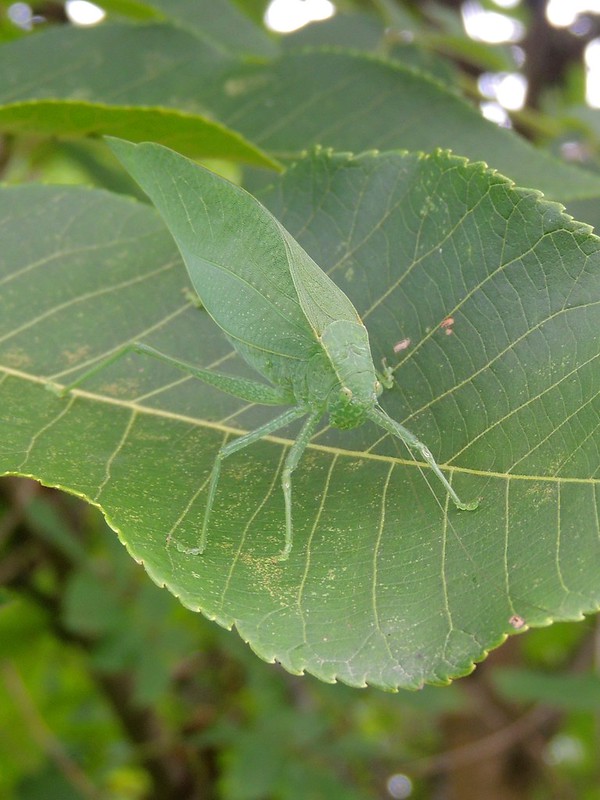
Katydids are much nicer looking in their bright green. It is difficult to find them, but easy to hear their eponymous "Katy did! Katy did!” call from the trees. Can you hear females answering “Katy didn’t, didn’t, didn’t?” Take a listen to them  They hide with their wings that look like leaves in the treetops. The katydids are singing for love, lust and a mate. The mating season runs August through mid-October.

They start singing sometime in August, but, if you can identify when they start their summer song, weather lore says that autumn will arrive 90 days later. I'm not sure I caught the first katydid, but I posted elsewhere that I noticed them for the first time on August 19. That would mean that autumn will arrive here in NJ November 17. Let's all mark our calendars.