Showing posts with label flora. Show all posts

Wednesday, May 3, 2017

90 Years of the Presby Iris Gardens in Montclair

The Essex County Presby Memorial Iris Gardens in Montclair - the "Rainbow on the Hill" - celebrates its 90th anniversary this May. The Presby Memorial Iris Gardens is recognized internationally for its horticultural and historical significance. 

Following them on Instagram, I am reminded that forsythia blooming means its time to fertilize my own irises. Autumn is the time to divide irises, but if you buy new ones or just have a really crowded bed, take a look at their YouTube channel which has a video on how to divide the clumps and replant. 

For many years, it was a Mother's Day tradition for me to take my mom to the gardens, as irises were always one of her favorites in our own home garden.

The anticipated bloom season is May 12 through June 2. The bloom season begins with the “minis” bearded collection, then to the famed tall bearded irises, and ends with the non-bearded irises.
The gardens were established in 1927 to honor Frank H. Presby, a Montclair resident involved in improving the town's parks and recreation as well as the Montclair Art Museum. Presby was also a founding member of the American Iris Society, hence the decision to focus on that plant.

Starting with two 4-foot-wide beds, the public gardens now contain nearly 14,000 irises of approximately 1,500 varieties.

In addition to enjoying the iris blooms, you can visit the Bloom Room gift shop, and their Plant Sale will offer iris dug from the gardens.

The Essex County Presby Memorial Iris Gardens is located at 474 Upper Mountain Avenue in Upper Montclair, New Jersey. During bloom season, admission is a suggested $8 donation to help fund garden costs. The Gardens are open daily from dawn until dusk.
Bloom Room Gift Shop Opens & Iris Plant Sale
Friday, May 12 through Sunday, May 14 from 10 a.m. to 3 p.m.
The Bloom Room Gift Shop features an exciting mix of affordable home and garden accents. Potted and bare root irises from our collection are available for purchase. Visitors also may reserve summer grab bags.
Mother’s Day
Sunday, May 14 from 11 a.m. to 3 p.m.
Enjoy the day with Mom at Presby. Treat her to a special iris or item from the Bloom Room Gift Shop. Enjoy a free music program. A special luncheon is planned; check the website for ticket information. Artist Lisa Palumbo will be available from 1 p.m. to 3 p.m. to sign artwork.
Family Garden Party
Saturday, May 20 from 11 a.m. to 3 p.m.
Essex County Family Garden Party is a free community event sponsored by the Essex County Department of Parks, Recreation and Cultural Affairs with entertainment, crafts, face painting, booths from local organizations such as the Essex County Environmental Center and Master Gardeners, and various food trucks. A student art exhibit will also be featured. Rain date: Sunday, May 21.
Live Jazz Music
Weekends during Bloom Season from 4 p.m. to 6 p.m.
TaikoZoku Japanese Drumming Show
Sunday, May 21 from 4 p.m. to 6 p.m.
Hear the thrilling sounds of this Japanese style drum troupe from Glenn Weber’s New Jersey School of Percussion in West Orange.
Outdoor Movie Screening Disney’s Moana
Saturday, June 3 at 9 p.m.
Hosted by the Montclair Film Festival and Essex County Parks System.


Friday, April 14, 2017

Bring Back the Bees

An interesting environmental advertising project - a billboard that produces real honey
for Honey Nut Cheerios.


What is the only insect that produces food eaten by humans? It is nature's most economical builders, bees. In 36 BC, Marcus Terentius Varro argued that honeycombs were the most practical structures around. Centuries later, Greek mathematician Pappus solidified the "honeycomb conjecture" by making the same claim.

The weather is warming and you're probably seeing bees out looking for spring flowers. Hopefully, you are a friend of bees. Of course, there are reasons to avoid doing things that might provoke a bee to go into a defensive mode and sting you. But encouraging bees in your garden and in nature in general is a good thing for all of us and for the planet.

The amazing little bees might surprise you with their good color vision. Flowers have many colors for that attractive reason. Bees especially like blue, purple, violet, white and yellow.

Did you know that honeybees can make out faces the same way we do? They take parts—like eyebrows, lips, and ears—and cobble them together to make out the whole face. It's called "configural processing," and it might help computer scientists improve face recognition technology

We need bees. One in three foods we eat is made possible by bees and other pollinators who spread the pollen that crops need to grow. That includes many of our favourite foods like apples, almonds, coffee, and of course, honey. 70 out of the top 100 human food crops are pollinated by bees

An important part of sustainable agriculture is bees.

There are over 20,000 species of bees in the world. Honeybees have thrived for 50 million years, but colonies recently started dying in large numbers. 42% of bee colonies in the U.S. collapsed in 2015.

Why? Renowned entomologist and bee specialist Marla Spivak reveals four reasons why, and what we can do to help in this Ted Talk.


Common sense actions can restore and protect the world’s bees. Good starting places are:
- Ban the seven most dangerous pesticides.
- Protect pollinator health by preserving wild habitat.
- Restore ecological agriculture.

Cheerios cereal (General Mills) partnered early this year with Veseys Seeds to give away wildflower seeds so that people would plant them and make the world a bee-friendlier place. They quickly met their goal of distributing 100 million seeds.

The promotion hit a snag though because in sending free packets of wildflower seeds to people all over the country, they seem to have failed to take into account that some of the flowers included are invasive species in some areas that should NOT be planted there.  For example, Forget-me-not (which was listed on their site but supposedly not included in the seed mix) is banned as a noxious weed in Massachusetts and Connecticut. And the California poppy is good in California, but listed as an “invasive exotic pest plant” in southeastern states. Some of the flowers on there list are not native to anywhere in the US, so they are not necessarily good matches for our local bees.

Of course, you can still plant wildflowers on your own that are bee-friendly. This guide for the mid-Atlantic states is useful to grow pollinator-friendly plants. For other parts of the country, go to xerces.org/pollinator-conservation/plant-lists/ or check the USDA site to see if a plant is native to your state.

I am pleased to see General Mills making efforts for bees, even if this seeds project was less than perfect. By 2020, they expect their oat farms will host about 3,300 acres of nectar- and pollen-rich wildflowers, which are full of the nutrients bees and other pollinators need to stay strong.

Finally, it is important to remember that you can do more than just plant flowers to help create a bee-friendly habitat. Avoiding using pesticides outside on or near the flowers (including if you have a garden or lawn service spraying) is very important.

Also note that bees are not our only pollinators. Bees are the major pollinators - and this includes not just honey bees - but also hummingbirds and some kinds of butterflies, and to a lesser degree spiders, flies and wasps. Even bats who feed on the insects in the flowers as well as on the nectar and flower parts play a role in the pollination of over 300 species of fruit around the world.


Thursday, February 19, 2015

Native Flora and New Jersey's Biodiversity in Danger

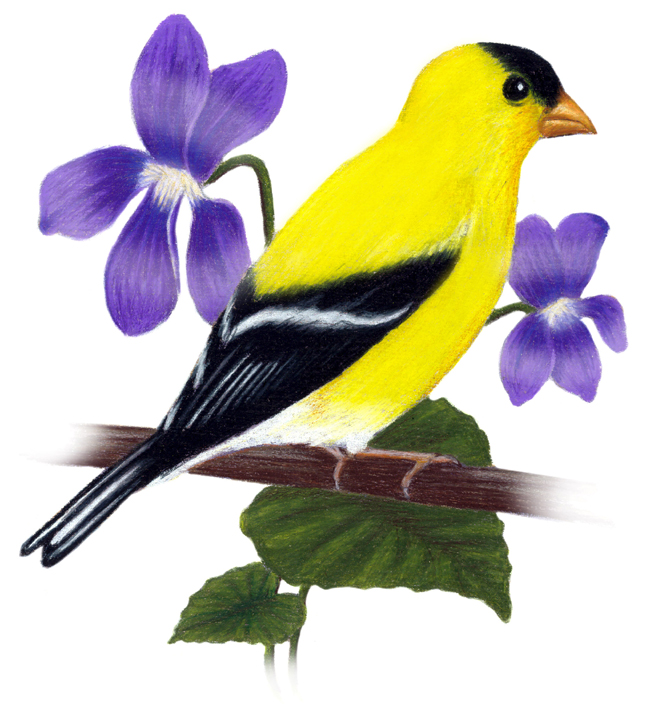
New Jersey State Bird and Flower.
Eastern Goldfinch / Carduelis tristis
Meadow Violet / Viola sororia

Flora is the plant life occurring in a particular region or time, generally the naturally occurring or indigenous—native plant life. The corresponding term for animal life is fauna. Flora, fauna and other forms of life such as fungi are collectively referred to as biota.


New Jersey's 4th graders learn that our state tree is the Northern Red Oak. Did you know that? Did you know that there are 17 species of oaks in New Jersey? Five are rare or endangered.

Our state wildflower is the Blue Woodland Violet or Viola sororia, which is a sure sign of spring. We have 30 native violets and 6 are unique violet species that are rare or endangered. The Cut-leaf Coast Violet no longer exists in the wild in New Jersey.

It might not surprise you that New Jersey is losing its native flora, but the situation is probably more critical than you would suspect.

Wild Blue Lupine
One example is the Wild Blue Lupine, Lupinus perennis, which was once common here but now only exist in four or five locations.

A lack of wildfires, alien weed invasions and deer over-browsing are causing increasing decline of many species.

Of course, the web in nature is always connected. The Wild Blue Lupine and the Yellow Wild Indigo are the only two plant species on which the female Frosted Elfin butterfly will deposit her eggs. Since her caterpillars only eat these two plants, it is no surprise that the Frosted Elfin butterfly is also critically endangered in our state.

One-third of our roughly 2,600 native plant species are designated as endangered or of special concern by the state's Natural Heritage Program.

You can download a list of all 822 rare plants at http://www.nj.gov/dep/parksandforests/natural/heritage/jan2010plantlist.pdf