Showing posts with label USFWS. Show all posts

Wednesday, October 30, 2019

Endangered Plants of New Jersey

The Fish and Wildlife Service website lists endangered plants and animals. There are 947 plants listed but only six listed species are believed to or known to occur in New Jersey.

Five of those are listed as "threatened" in NJ and only the American Chaffseed is listed as endangered in our state.

Endangered and threatened plants don't get the attention that animals do - which probably threatens them even more.

American chaffseed - USFWS, NJ Field Office

American Chaffseed (Schwalbea americana) is the sole species currently classified in the genus Schwalbea. It is an erect, hemiparasitic, perennial herb that is native to the southeastern United States where it is found in wet acidic grasslands. But the species has declined tremendously from its historical range due to fire suppression, and it is currently listed as "Endangered" by the U.S. Fish and Wildlife Service.

American chaffseed occurs in sandy (sandy peat, sandy loam), acidic, seasonally-moist to dry soils. It is generally found in early successional habitats described as open, moist pine flatwoods, fire-maintained savannas, areas between peaty wetlands and xeric (dry) sandy soils, bog borders, and other open grass-sedge systems.

American chaffseed is dependent on factors such as fire, mowing, or fluctuating water tables to maintain the crucial open to partly-open conditions that it requires. The species appears to be shade intolerant. American chaffseed occurs in species-rich plant communities where grasses, sedges, and savanna dicots are numerous.

American chaffseed is currently known to occur only in Burlington County, but the species formerly occurred in Camden, Gloucester, Atlantic, Cumberland, and Cape May Counties.

More at https://www.fws.gov/northeast/njfieldoffice/endangered/chaffseed.html

The other plants listed as threatened in NJ are:
  • Amaranth, seabeach (Amaranthus pumilus)
  • Beaked-rush, Knieskern's (Rhynchospora knieskernii)
  • Pogonia, small whorled (Isotria medeoloides)
  • Pink, swamp (Helonias bullata)
  • Joint-vetch, Sensitive (Aeschynomene virginica)

Thursday, February 2, 2017

The Rusty Patched Bumblebee Now Endangered

Rusty Patched Bumblebee         Photo: Dan Mullen via www.flickr.com
I had never heard of the rusty patched bumblebee, but it was a common sight across New Jersey twenty years ago. Now, I may have missed out on seeing one and knowing what I was seeing.

Last month, it became first bumblebee to appear on the U.S. Fish and Wildlife Service (USFWS) endangered species list.  Actually, it is also the first bee of any kind in the contiguous 48 states to be declared endangered, according to the USFWS.

Like all bumblebees, it is an important pollinator.

The name comes from a small rust-colored patch on the middle of its abdomen
We often associate pollinating bees with crops that we consume, but they are also important to forests, parks, meadows and shrublands. And, in turn, those places support wildlife.

Listing the bee as endangered will hopefully help gain partners and focus resources on stopping their decline.

The USFWS notes that there were hundreds of populations across 28 states including New Jersey and Pennsylvania. Since 2000, the bee has been missing from New Jersey. The only known location in these two states is one in Delaware County, PA.

As with other bees and insects that are threatened, pests and diseases spread by the commercial bumble bee industry, along with habitat destruction or alteration, pesticides and perhaps even a changing change, all threaten them.

To see the species return to our state there would need to be flowers upon which to forage from early spring through fall and safe places to build nests and overwinter. Those are things New Jersey can provide. But a further requirement - a pesticide-free environment protected from the pressures of introduced diseases from commercial bees - would be much more difficult to provide.

Wednesday, October 19, 2016

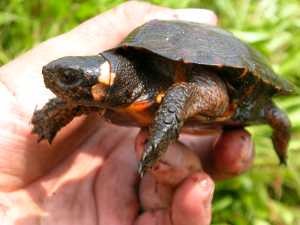
NJDEP Gets Grant to Protect Bog Turtle Habitat

The U.S. Fish and Wildlife Service has awarded the Department of Environmental Protection an $850,000 grant under the federal Endangered Species Act Grants Program. The Cooperative Endangered Species Conservation Fund (CESCF) Recovery Land Acquisition grant for New Jersey will go toward the future acquisition of hundreds of key acres of habitat for the bog turtle, which is found predominately in the northern half of New Jersey.

“Preservation of this unique habitat protects the federally threatened bog turtle, while also enhancing our environment and providing a better quality of life for residents of the state,” Commissioner Bob Martin said. “We are grateful to the U.S. Fish and Wildlife Service for our inclusion in this federal grant program.”

New Jersey is one of 20 states to receive funding to support projects that conserve at-risk species and their habitats.


“These grants will enable state fish and wildlife agencies to advance the stewardship of our nation’s fish and wildlife resources,” said Dave Chanda, Director of DEP’s Division of Fish and Wildlife. “We appreciate the strong ties formed by state agencies and their partners to protect these imperiled wildlife species and their habitats, which are critical to the on-the-ground success of these projects.”

The bog turtle is native only to the eastern United States and is found in the northern half of New Jersey. The species, considered threatened at the federal level and endangered at the state level, congregates in small colonies often of fewer than 20 individuals. They prefer calcareous wetlands (areas containing lime), including meadows, bogs, marshes, and spring seeps, that have both wet and dry regions.

Once the purchases of the properties are completed, the preserved lands will be managed by the New Jersey Natural Lands Trust in cooperation with the DEP’s Endangered and Nongame Species Program,

CESCF funding is provided through three competitive grant programs: the Habitat Conservation Planning Assistance Grants Program, which provides funds to support the development of Habitat Conservation Plans (HCPs) that protect habitat for listed species; the Recovery Land Acquisition Grants Program, which provides funds for the acquisition of habitat in support of approved and draft species recovery plans; and the HCP Land Acquisition Grants Program, which provides funds to acquire habitat for listed species associated with approved HCPs.

The grants are funded in part by the Land and Water Conservation Fund, which was established by Congress in 1965. The fund promotes access to outdoor recreation resources for present and future generations by providing funding to federal, state and local governments to purchase land, water and wetlands for the benefit of all Americans. For the past 51 years, the fund has supported more than 40,000 conservation and outdoor recreation projects nationwide.

To learn more about the U.S. Fish and Wildlife Service’s Ecological Services Program visit: www.fws.gov/endangered

For more information on the state’s Threatened and Endangered species, please visit: www.nj.gov/dep/fgw/ensphome.htm

For more information on turtles in New Jersey, please visit: www.nj.gov/dep/fgw/ensp/fieldguide_herps.htm#turtles

For more information about the New Jersey Natural Lands Trust, please visit:
http://www.njnlt.org/

Source:  http://www.nj.gov/dep/newsrel/2016/16_0088.htm

Monday, October 19, 2015

American Eel Does Not Make the Endangered Species Act List


American eels face a battle in migration because of changing stream habitats and dammed rivers. It was thought that they might make the Endangered Species List this year, but they will not says the U.S. Fish & Wildlife Service.

One reason for not listing them is the removal of 13 dams in the northeast U.S. The USFWS still recommends that efforts continue to build healthy habitats, and that harvest levels are monitored.  Efforts are also being made to upgrade river routes to make them easier for migrating eels.

The American eel is the only freshwater eel found in North America.. Eels were part of the diet of New Jersey colonial settlers who saw them harvested in large numbers by American Indians.

Their snakelike appearance makes most people imagine that they are not fish, but they are fish that have fins and can breathe underwater with gills instead of lungs. 

After Hurricane Sandy, the USFWS gained $10.4 million in resilience funding for fish passage and this is being used to remove 13 dams in Maryland, New Jersey, Rhode Island and Connecticut.

These eels begin their lives in the ocean, live in freshwater rivers, then spawn in the ocean. They live in rivers from Venezuela to Greenland and migrate to the North Atlantic to spawn with their preferred spawning ground being the Sargasso Sea.

Not all eels will migrate to freshwater for the winter, though why some eels move inland and others do not is not known. According to the U.S. Fish & Wildlife, many people once thought that male eels remained in the estuarine waters and only females went upstream to freshwater. Territories for eels may be determined more by density with higher concentrations more likely to be males.

American eels are not exclusively "American" as in the United States but as in "the Americas." Eels are panmictic, meaning that as a species they have one population worldwide, as a result of their random mating behavior.

Species Profile: American Eel in NJ


In 2013, the Aquarion Water Company, The Nature Conservancy, Sacred Heart University, the U.S. Geological Survey's Silvio O. Conte Anadromous Fish Laboratory in Turner's Falls, Mass., and the Connecticut Department of Energy and Environmental Protection (DEEP) collaborated to release and monitor 30 radio-transmitter-tagged eels into the Aspetuck River in Easton, Connecticut. The three releases, which included 10 eels each, were scheduled to coincide with significant rain events to spur the eels' migrations, encouraging them to move downstream to salt water where they spawn.

Tuesday, May 19, 2015

Federal Protection of Endangered Species


The NJ threatened Piping Plover (Charadrius melodus)

Federal protection of endangered species dates back to the Lacey Act of 1900, when Congress passed the first wildlife law in response to growing public concern over the decline of the passenger pigeon (Ectopistes migratorius). The Lacey Act prohibited interstate commerce of animals killed illegally and required the secretary of agriculture to preserve, introduce, distribute, and restore wild bird and game bird.

As public awareness of environmental problems initiated political activism in the 1960s, the Department of Interior formed a Committee on Rare and Endangered Wildlife Species to identify species in immediate danger of extinction.

The Redbook on Rare and Endangered Fish and Wildlife of the United States, published in 1964, served as the first official document listing species the federal government considered to be in danger of extinction. Two years after the Redbook list was published, Congress passed the Endangered Species Protection Act of 1966—the first piece of comprehensive endangered species legislation.

The goal, as stated in the 1966 Act, was to "conserve, protect, restore, and propagate certain species of native fish and wildlife." It was under the 1966 Endangered Species Preservation Act that the very first list of threatened and endangered species was created,

There are more than a thousand listed - see http://ecos.fws.gov/tess_public/pub/listedAnimals.jsp

Some are well known to the public and others are largely unknown. Here are some mammal examples

Indiana Bat - Myotis sodalis
Delmarva Peninsula Fox Squirrel - Sciurus niger cinereus
Timber Wolf - Canis lupus lycaon
Red Wolf - Canis niger
San Joaquin Kit Fox - Vulpes macrotis mutica
Grizzly Bear - Ursus horribilis
Black-footed Ferret - Mustela nigripes
Florida Panther - Felis concolor coryi
Caribbean Monk Seal - Monachus tropicalis
Guadalupe Fur Seal - Arctocephalus philippi townsendi
Florida Manatee or Florida Sea Cow - Trichechus manatus latirostris
Key Deer - Odocoileus virginianus clavium
Columbian White-tailed Deer - Odocoileus virginianus leucurus
Sonoran Pronghorn - Antilocapra americana sonoriensis


The Gray Wolf, (Canis lupus), is a good example of a species that is both loved and mythologized by the general public, but also seen as a nuisance predator by some farmers and ranchers.

It is a "keystone predator," and is an integral component of the ecosystems to which it typically belongs. The wide range of habitats in which wolves can thrive reflects their adaptability as a species, and includes temperate forests, mountains, tundra, taiga, and grasslands.

Gray wolves were originally listed as subspecies or as regional populations of subspecies in the contiguous United States and Mexico. In 1978, they were reclassifed as an endangered population at the species level (C. lupus) throughout the contiguous United States and Mexico, except for the Minnesota gray wolf population, which was classified as threatened. (Gray wolf populations in the Northern Rocky Mountains and Western Great Lakes were delisted due to recovery in 2011 and 2012)

Each state has its own unique list of species that are federally protect and exist in that state, and also species that are listed as threatened or endangered in that state but not across the country. (See the NJ list at state.nj.us/dep/fgw/tandespp.htm)

The general public often doesn't realize that listings include not only mammals but also birds, reptiles, amphibians, fishes, insects and plants.

An example of the plants is the NJ Swamp pink (Helonias bullata.

Swamp pink was federally listed as a threatened species in 1988.

A perennial member of the lily family, swamp pink has smooth, oblong, dark green leaves that form an evergreen rosette. In spring, some rosettes produce a flowering stalk that can grow over 3 feet tall. The stalk is topped by a 1 to 3-inch-long cluster of 30 to 50 small, fragrant, pink flowers dotted with pale blue anthers. The evergreen leaves of swamp pink can be seen year round, and flowering occurs between March and May.

Supporting over half of the known populations, New Jersey is the stronghold for swamp pink.  Swamp pink occurs in Morris, Middlesex, Monmouth, Ocean, Burlington, Camden, Gloucester, Atlantic, Salem, Cumberland, and Cape May Counties.

Saturday, August 2, 2014

5 National Wildlife Refuges in New Jersey

The U.S. Fish and Wildlife Service’s Northeast Region encompasses 13 states from Maine to Virginia. About 70 million people, nearly a quarter of the nation’s population, live within this area where the Service’s nearly 1,000 employees work in the regional headquarters, field offices, national wildlife refuges or fish hatcheries. Many of these 132 facilities are open to visitors and can provide exciting opportunities for wildlife-dependent education, recreation, and interpretation.

Part of the U.S. Department of the Interior, the Service conserves, protects, and enhances fish and wildlife and their habitats for the benefit of present and future generations. Service biologists contribute to the health of our environment — and consequently our quality of life — by protecting and restoring important habitat, safeguarding endangered species, minimizing environmental contamination, and restoring fish populations. In addition, the Service provides funds to support state fish and wildlife programs and enforces federal laws protecting wildlife.

In New Jersey, we have five Wildlife Refuges: Cape May National Wildlife Refuge (NWR), Edwin B. Forsythe NWR, the Great Swamp NWR, Supawna Meadows NWR, and the Wallkill River NWR.

Tidal Wetlands, Supawna Meadows National Wildlife Refuge - USFWS.gov photo


Not as well known to residents as the Great Swamp and Cape May Refuges, the Supawna Meadows National Wildlife Refuge is located in Pennsville, New Jersey. The refuge area is found along the Delaware River estuary just north of the Salem River in Salem County, NJ.

It is part of the larger Cape May National Wildlife Refuge and recognized as wetlands of international importance and an international shorebird reserve. The refuge currently owns approximately 3,000 acres. The tidal marshes that comprise nearly 80 percent of the refuge provide waterfowl with an important feeding and resting area, particularly during the fall and spring migrations.

The refuge supports visiting populations of black ducks, mallards and northern pintails during winter. Sandpipers and other shorebirds use the refuge marshes as a feeding area in summer and throughout seasonal migratory travel. Delaware's nearby Pea Patch Island Rookery hosts over 6,000 pairs of nine species, which make it the largest rookery of colonial wading birds on the east coast north of Florida. The marshes provide valuable foraging habitat for these colonial wading birds during the nesting season.

Warblers, sparrows, and other migratory birds use the upland areas of the refuge as resting and feeding areas during migration and for nesting during the summer. Thousands of tree swallows forage on the refuge in the late summer. Ospreys, bald eagle, northern harrier, short-eared owl and barn owls also nest on the refuge.          Download the refuge brochure


USFWS Facilities in New Jersey:


Ecological Services OfficesRefuges and Wildlife Offices

New Jersey Field Office
Cape May NWR
Law Enforcement Offices
Edwin B. Forsythe NWR

Elizabeth Law Enforcement
Great Swamp NWR

Supawna Meadows NWR

Wallkill River NWR


Thursday, July 31, 2014

Hurricane Sandy Restoration: Middle Township


via the U.S. Fish and Wildlife Service  also see the USFWS Northeast website
Hurricane Sandy taught us that the coast is an ever-changing environment, vulnerable to sea-level rise and powerful storms. Since Sandy made landfall in October 2012, The U.S. Fish and Wildlife Service has been working with other federal agencies and conservation partners to restore the Atlantic Coast by enhancing habitats that protect our coastal communities and sustain people and wildlife. These efforts are supported by funding from the Department of the Interior through the Disaster Relief Appropriations Act of 2013.

Recognizing the interconnected nature of our conservation work, today we launch the first in a series of videos highlighting communities impacted by Hurricane Sandy and their journey toward recovery. This first video outlines a $1.65 million beach habitat restoration project along the shores of Delaware Bay that is already benefiting native horseshoe crabs and migrating shorebirds. At the same time, the project will help local communities like Middle Township, New Jersey, whose Mayor Tim Donohue describes how strengthening natural defenses will in turn protect homes and support the area's ecotourism industry.

This project and others like it are designed to support decisive and informed actions now with our partners to safeguard our coastal communities for years to come.

Thursday, June 10, 2010

Endangered Species Northeast Region

From the lynx of the northern Maine forests to the Lee County cave isopod in southwestern Virginia, each of the Northeast Region's endangered and threatened species is unique, and each poses different conservation challenges.
Invasive species and advancing ecological succession plague bog turtles and Karner blue butterflies; beach-nesting piping plovers must avoid both predators and bathers to survive; eagles face continuing habitat loss; and swamp pinks suffer from changes in hydrology.

The biologists of the Northeast Region Endangered Species Division of the Fish & Wildlife Service work with many partners to protect and conserve listed and candidate species.

They have cooperative management agreements with all 13 states in our region, and they carry out a large share of the recovery work.

Private conservation groups also play a major role, particularly in providing permanent habitat protection for many listed species. Species ranging from Robbins cinquefoil to Cheat Mountain salamander to Michaux sumac all benefit from site protection.

Finally, private landowners play a significant role in this region because the federal land base is limited in size. Lynx and red-cockaded woodpeckers are two species that are benefiting from certain timber management regimes on private lands.

Endangered Species Program Partners

CONTACT INFO

Region Five — Northeast
Division of Endangered Species
U.S. Fish and Wildlife Service
300 Westgate Center Drive
Hadley, MA 01035-9589


New Jersey U.S. Fish and Wildlife Service
927 N. Main Street, Building D
Pleasantville, NJ 08232-1454
609-646-9310

Friday, May 21, 2010

Today Is Endangered Species Day

Today, May 21, 2010, is Endangered Species Day.

The U.S. Fish and Wildlife Service observes Endangered Species Day in order to recognize the national conservation effort to protect our nation’s endangered species and their habitats.

The day offers an opportunity for people young and old to learn about the importance of protecting endangered species and everyday actions that people can take to help protect our nation’s disappearing wildlife and last remaining open space.

Protecting America’s wildlife and plants today is a legacy we leave to our children and grandchildren, so that all Americans can experience the rich variety of native species that help to define our nation.

NJ beach-nesting piping plover
Our own NJ Endangered Species are those whose prospects for survival in New Jersey are in immediate danger because of a loss or change in habitat, over-exploitation, predation, competition, disease, disturbance or contamination. Assistance is needed to prevent future extinction in New Jersey.

Threatened Species are those who may become endangered if conditions surrounding them begin to or continue to deteriorate.

Every year, thousands of people throughout the country celebrate Endangered Species Day at parks, wildlife refuges, zoos, aquariums, botanical gardens, libraries, schools and community centers.

You can participate in festivals, field trips, park tours, community clean-ups, film showings, classroom presentations, and many other fun and educational activities.

Monday, November 23, 2009

Habitats and Partnerships

The NJFO’s Partners for Fish and Wildlife program recently wrote an article for the New Jersey League of Municipalities Magazine that highlights how the U.S. Fish and Wildlife Service can interact with municipalities across the State that want to create wildlife habitat.

Many of the 6,500 acres of wetlands, 3,000 miles of grasslands and other uplands, and 50 miles of riparian and in-stream habitat the Partners for Fish and Wildlife program has restored since it’s New Jersey inception in 1991 have come from partnerships with municipalities.


A good example of a successful partnership is Partners for Fish and Wildlife's "Partnership Project with NJ Audubon and Verizon" which won the Governor’s Environmental Excellence Award in 2007. That was a partnership of the USFWS's NJ Field Office’s Partners for Fish and Wildlife program, Verizon and the New Jersey Audubon Society.

The Verizon Center, located a mile upstream of the Great Swamp National Wildlife Refuge, is restoring 18 acres of uplands and 7 acres of riparian habitat. Verizon has also publicized the merits of voluntary corporate land stewardship.

Specific enhancements at the site include the removal and control of invasive vegetation; native grass and wildflower plantings; and the installation of a vernal pool, nest boxes and turtle nesting areas. These enhancements are currently providing suitable habitats for a variety of wildlife, including numerous bird and herptile species.

Verizon restored 25 acres on its property that are home to various grassland, riparian and wetland habitats. They planted over 500 native trees and shrubs on the site and plan to plant another 500 in 2008. They installed more than 10 acres of native grasses and wildflowers and removed invasive non-native vegetation on the land. They have implemented a delayed mowing schedule to promote wildlife breeding and have instituted a policy of zero chemical application on the restoration areas.

In addition they installed sand pits for turtle nesting areas, a vernal pool for amphibian breeding, installed numerous bird nesting boxes and outlined a monitoring and Stewardship Plan to track future progress on the site. A Stewardship Plan considers all aspects of resource management and documents management decisions and practices designed to maintain the land in a productive and healthy condition for present and future owners. It specifies actions that will increase the environmental and economic values of the land and the region.

The benefits extend beyond habitat restoration. The site extends along more than 3,700 feet of the Passaic River. In addition to improving water quality in the river the restored area in less than a mile upstream from a New Jersey Natural Heritage Priority Site known as the "Great Swamp Macrosite", an important area for the breeding of several threatened and endangered wetland species.

Restoring this habitat is part of Verizon's national commitment to green energy practices that include pursuing aggressive network equipment and building energy-reduction initiatives; utilizing alternative energy sources in the network, buildings and vehicle fleet; and promoting the company's technology as an alternative to travel, among other efforts.

Friday, November 20, 2009

U.S. Fish and Wildlife Service Northeast Region


Service special agent examines carcasses of an immature bald eagle and an osprey during an investigation of bird shootings on private hatchery property. USFWS photo


The Northeast Region of the US Fish and Wildlife Service (USFWS) includes field offices that cover ME, VT, NH, MA, CT, NY, NJ, PA, MD, RI, WV, DE, and VA.

I was surprised to discover this past weekend that the Northeast Region is now on Twitter! You can follow their latest updates.


A good example of the state-centric information that is available there is The Hackensack Meadowlands Initiative: Preliminary Conservation Planning.

Though it was released in 2007, this report prepared by the U.S. Fish and Wildlife Service details human recreational, agricultural, industrial, and scientific activities in the Hackensack Meadowlands and their effect on the Meadowlands ecosystem in some 450 pages.

It is a great resource for understanding ecological issues in the Meadowlands.

450 pages is overwhelming to most of us, but an overview available online (pdf) summarizes ideas and issues discussed in the original document. It may also serve as a guide to direct you to specific areas in the Plan


New Jersey Field Office