Showing posts with label mammal. Show all posts

Tuesday, December 29, 2015

What Has Happened to the Animals on the Original Endangered Species List?

 
Indiana Bat  (Myotis sodalis)
Photo: Andrew King, USFWS via Wikimedia

What Happened to the Animals on the Original Endangered Species List is what a post on time.com
recently asked and answered.

The mammals that had the unfortunate distinction of being included in the first cohort of endangered species when the Endangered Species Act was approved December 28, 1973, were put on the first U.S. government list of endangered and threatened species.
  1. Indiana Bat, Myotis sodalis.Status: Endangered. The only member of this first group that is also listed on New Jersey's Endangered and Threatened Species list. For more on the Indiana bat in NJ, see http://www.nj.gov/dep/fgw/ensp/pdf/end-thrtened/indianabat.pdf
  2. Delmarva Peninsula Fox Squirrel, Sciurus niger cinereus. Status: Delisted due to recovery, in 2015.
  3. Timber Wolf, Canis lupus lycaon. Status: Varied. The Gray Wolf is endangered in some portions of the mountain-prairie region, threatened in the Great Lakes region and delisted due to recovery in other areas. Recently, the Eastern Timber Wolf was found to be a separate species from the Gray Wolf, Canis lupus, and the status of the Eastern Wolf was put up for review.
  4. Red wolves, Canis rufus. Status: Endangered except, as of 1986, a non-essential experimental population in North Carolina and Tennessee. ("Experimental" populations are those that have been reintroduced within the species' historical range but outside the regions where it is currently found. Experimental populations can be deemed either essential or inessential to the species' survival.)
  5. Indiana Bat, Myotis sodalis. Status: Endangered.
  6. San Joaquin Kit Fox, Vulpes macrotis mutica. Status: Endangered.
  7. Grizzly bears, Ursus horribilis. Status: Downgraded to 'threatened' status in 1975, with an additional non-essential experimental population in Idaho and several other regional populations under review.
  8. Black-footed Ferret, Mustela nigripes.  Status: Endangered except, as of 1991, a non-essential experimental population in Wyoming and portions of other Western states.
  9. Florida panther, Felis concolor coryi. Status: Endangered.
  10.   Florida manatee, Trichechus manatus latirostris. Status: Endangered.
  11.   Guadalupe Fur Seal, Arctocephalus philippi townsendi. Status: Threatened.
  12.   Key Deer, Odocoileus virginianus clavium. Status: Endangered.
  13.   Sonoran Pronghorn, Antilocapra americana sonoriensis. Status: Endangered except, as of 2011, a non-essential experimental population in Arizona
  14. Columbian White-tailed Deer, Odocoileus virginianus leucurus. Status:Endangered in the area surrounding the Columbia River, but delisted due to recovery in an area of Oregon
You can see that many remain endangered, but some have been moved to “threatened” status or removed from the list entirely.

The unfortunate exception to the rule is that Caribbean Monk Seal, Monachus tropicalis, which was removed from the list due to extinction. The seal had not actually been seen since 1952, but it took decades for scientists to conclude that there were no members of the species left. Fortunately, it remains the only mammal in the first class of listed species to have gone extinct.

Friday, November 13, 2009

Encountering Bobcats in New Jersey

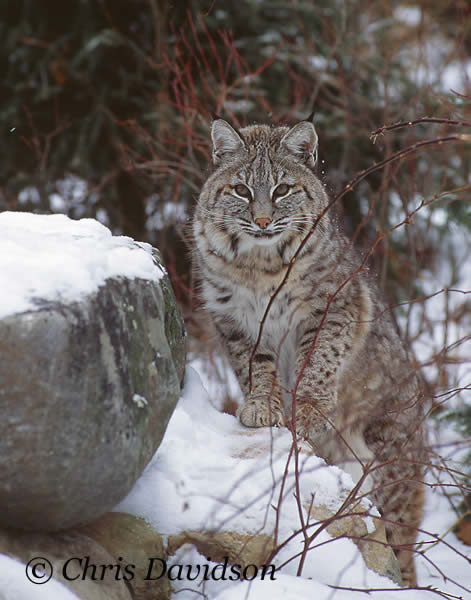
Bobcat by Chris Davidson via http://www.state.nj.us/dep/fgw/

The bobcat (Lynx rufus) is one of NJ's endangered mammals. The are not usually seen by residents because of their habits, but I was not shocked to read an article recently in via The Daily Record that a photographer was able to get a shot of one last month in the Delaware Water Gap National Recreation Area.

"I was doing nature photography and in early spring, I spotted it numerous times," George Draney recalled. So be began staking out a narrow, scrub-lined path twice a week, for about three or four months. A couple of times the bobcat crept by him but was gone before he could shoot a photo, he said.

The morning he finally got the shot, he was sitting in his car near the path and the bobcat was between 25 and 50 yards away, he said.

"I saw it going up the pathway in a hurry, so I thought to make a noise to make it look my way," Draney said. "So I whistle real loud, and it stopped. When I shot, it turned, and I got two more shots."

He described it as appearing healthy, about the size of a medium dog and weighing about 25 pounds.

The State estimates our population of bobcats to be at least 90, with most living north of Route 80.

They had disappeared from NJ by the early 1970s because of habitat loss. About 20 bobcats (from Maine) were reintroduced from 1978 to 1982 to repopulate them here.

One unfortunate indicator of their return are the dozen road kills found in the past year, including one on Route 46 in Parsippany near the Boonton Reservoir this past spring.

Taxonomically, bobcats belong to the order Carnivora, or carnivores, meaning that they are
primarily flesh-eaters. They are members of the Felidae family and are commonly known as felines. All members of this family look somewhat similar in appearance. (here is a comparative track guide)


Bobcats live in both the northern and southern portions of NJ. In the north, typical bobcat habitat consists of large areas of contiguous forest and fragmented forests interspersed with agricultural areas or early succession vegetation.

Bobcats often use areas with rock outcrops, caves, and ledges that provide shelter and cover for hunting, resting and rearing young. Where rocky areas are not available, swamps, bogs, conifer stands and rhododendron and mountain laurel thickets provide good cover and excellent hunting grounds.

In southern New Jersey, dense thickets of briars and conifers serve as resting and escape cover, so the bobcat have the ability to adapt to a wide variety of habitat types and prey species.


The Delaware Water Gap and other areas of Kitatinny Ridge are the best habitat areas the state has for bobcats, says Mick Valent, a wildlife biologist for the state Division of Fish and Wildlife, who said there's no reason to doubt Draney's account.

State biologists have found bobcat tracks and scat in the Water Gap area, and have photographed them there with motion-sensitive cameras baited with scent, Valent said.

Bobcats are so shy that they pose no danger for people, and are so reclusive that you would be lucky to actually see one.

Their individual territories ranging from one square mile to 25 square miles. Habitat continues to be the major problem in maintaining their numbers. They find a good supply of mice, chipmunks, squirrels and birds in the areas where they exist.

NJDEP document on bobcats

Bobcats in the Conserve Wildlife Newsletter, Winter 2007


Monday, May 25, 2009

The Eastern Woodrat


It's hard to get a lot of sympathy when I do a speaking engagement on NJ's endangered species for the eastern woodrat.

Unfortunately, eastern woodrats have been declining at an alarming rate throughout the northeastern portion of their range. The decline has been attributed, at least in part, to lethal infections of the parasite, raccoon roundworm.

The state's last remaining eastern woodrat Neotoma floridana population is at the Palisades Interstate Park in Bergen County.

A study of the raccoons at the Palisades revealed infection rates among raccoons to be relatively low compared to other areas where woodrats have disappeared. In 1998, observations found a growing woodrat population, possibly because the raccoon population had declined.

Woodrats typically live in rocky areas associated with mountain ridges such as cliffs, caves, talus slopes and rocky fissures. The rocky barrens where they den are generally devoid of vegetation with the exception of the occasional tree that manages to survive among the rocks.

Active primarily at night, woodrats leave the security of their rocky dens to visit adjacent areas to feed on the available vegetation.

In New Jersey, Allegheny woodrats occur in extensive talus fields at the base of
rock outcrops where the vegatation is birch, chestnut oak and the exotic paulownia (Paulownia tomentosa) trees found growing among the slopes of the Palisades.

Woodrats were considered extirpated in New York state by 1987 and surveys in Pennsylvania have shown that their numbers declined in the northeastern portion of the state and have disappeared from approximately one third of their former range there.

Back in 1984 and 1985, the Division of Fish and Wildlife’s Endangered and Nongame
Species Program conducted surveys of three historic sites and 16 sites that had suitable habitat. No animals were captured, although old sign was discovered at several sites.

The eastern, or Allegheny, woodrat was afforded protection under the New Jersey Endangered Species Act when it was added to the list as endangered in 1991.

The Palisades population has been monitored by live trapping since the mid-1980s. Trapping results between 1999 and 2001 indicate that this population has remained stable and may be increasing slightly.