Showing posts with label world species. Show all posts

Friday, June 14, 2013

Wildlife Without Borders

In an interesting story about the way the endangered and threatened listings work, I saw that the U.S. Fish and Wildlife Service has called for the protection of chimpanzees. It is interesting and unusual because we don't think of chimps and apes as species from the United States. So, why would we need to protect them with a listing? And what impact could this possibly have on New Jersey?

The FWS is currently monitoring the population wherever it is found in the wild as "endangered" and wherever it is found in captivity as "theatened." This what is considered to be a "split listing."
Image via ecos.fws.gov

The greatest impact would be that it would require a special permit to use chimps in medical research or to sell them interstate. Currently, about 2,000 chimps are held in captivity in the United States. Half of those are used for research.

In a wider world context, primatologist Jane Goodall and her Jane Goodall Institute have been calling for protections like this for many years.  Outside the U.S., chimps are threatened by habitat loss and disease. Unfortunately, poaching of animals for sale has increased since they were listed as endangered in 1990. The Jane Goodall Institute applauded the USFWS announcement which could greatly expand protection of chimpanzees, including the thousands of chimpanzees currently held captive in the United States.

The U.S. Fish and Wildlife Service’s Division of International Conservation works with partners worldwide to conserve fish, wildlife, plants and their habitats, and maintain the integrity of ecological processes beyond our borders, for present and future generations.

In 2000, the U.S. Congress passed the Great Ape Conservation Act and since then Wildlife Without Borders has been building the capacity of governments and private organizations to address the threats to great apes through the Great Ape Conservation Fund.

Wildlife, fish, and plants do not recognize national boundaries. Conservation of wildlife is a global responsibility, with the survival of species largely dependent on habitats extending beyond national boundaries. With human populations growing – and corresponding increases in development, pollution and consumption of natural resources – the need for international collaboration has never been greater.

The U.S. Fish and Wildlife Service is supporting efforts to fight poaching and illegal trafficking in great apes; to increase habitat protection by creating national parks and protected areas; and engaging the community through local initiatives to conserve the most threatened great ape species.




Monday, July 26, 2010

Renaming Endangered Species

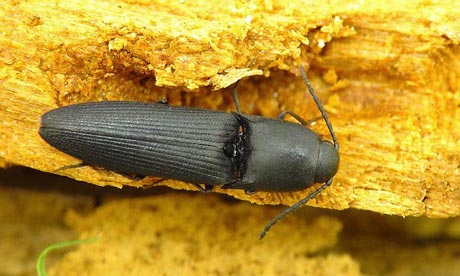
The Queen's Executioner  via http://static.guim.co.uk
Can giving endangered species more common English names help save them? That was the idea behind the Oxford University Museum of Natural History’s "Name a Species" competition.

Would you be more interested in and more likely to remember a beetle if it was named megapenthes lugens or if it was called the Queen’s executioner?

The competition invited the public to give popular names to ten species of endangered British beetle, bees, jellyfish, shrimps and lichens. The competition itself was one way to get people thinking about the species, and perhaps they will be more familiar.

Among the winning names picked from the three thousand entries received were:
  • skeetle, a beetle that escapes predators using natural ‘jet skis’  stenus longitarsis
  • sea piglet, a deep-sea ‘pseudo shrimp’  arrhis phylonyx
  • kaleidoscope jellyfish, which is a beautiful stalked jellyfish
  • St John’s jellyfish, which takes the shape of a Maltese cross
  • Mab’s lantern, a rare spotted beetle
  • cuckoo bee, which lays its eggs in the nest of other bees
  • blue pepper-pot beetle, whose larvae live in willow trees
  • witches’ whiskers lichen, which have medicinal properties
  • pixie gowns lichen, which turn green when wet
  • And, the overall winner is the Queen’s executioner, a beetle found only in Windsor Great Park megapenthes lugens. The common name's creator, in a statement accompanying his entry, gave the following rationale for his choice of name: "I've gone with this for the link to Windsor and the royals. The executioner is to represent that it kills (and eats) the larvae of others and also links to its black colour (the hood of an executioner is traditionally black)."[10]

Source: http://www.ox.ac.uk/media/news_stories/2010/100720_1.html

Wednesday, October 14, 2009

What Are The Walruses Telling Us?


Have you ever heard the expression "a canary in a coal mine"? Early coal mines did not have ventilation systems, so miners would bring a caged canary into new coal seams. Canaries are especially sensitive to methane and carbon monoxide, which made them ideal for detecting any dangerous gas build-ups. As long as the canary in a coal mine kept singing, the miners knew their air supply was safe.

Many species that are threatened or endangered act in the same way for us - signaling dangers in our environment before we can actually sense them ourselves.

This year, researchers flying along the Alaska coast discovered 100 to 200 walrus carcasses along the shoreline of Icy Cape, southwest of Barrow, according to the Fairbanks Daily News-Miner.

Thousands of walrus forming unusual congregations on Alaska’s North Slope seems to indicate that the relatively low autumn ice coverage within arctic water is another indicator of climate change.

While debate on climate change continues, during September, Arctic sea ice had receded to the third lowest extent on record.

Those walruses who have gathered along the northwest coast of Alaska saw the sea ice retreat beyond the continental shelf. When that occurs, it is over water too deep for the walruses to feed in and they are forced to feed from land rather than from the sea ice.

In September, the Fish and Wildlife Service announced a review of the walrus’ status, to determine whether it should be added to the list of threatened and endangered species under the Endangered Species Act. According to the FWS, the decision was based “in part, upon projected changes in sea ice habitats associated with climate change.”


MORE INFORMATION

Riddle of 200 dead walruses discovered on the Alaskan shore

What happens when sea ice melts