Showing posts with label Atlantic County. Show all posts

Wednesday, November 30, 2016

Coastal Protection for Atlantic County

The U.S. Army Corps of Engineers has awarded a $63.3 million contract to build engineered beaches and dunes in Margate and Longport and to replenish beaches in Atlantic City and Ventnor, Department of Environmental Protection Commissioner Bob Martin announced today.

The Absecon Island Coastal Storm Damage Reduction project is a joint effort of the Army Corps’ Philadelphia District and the DEP.
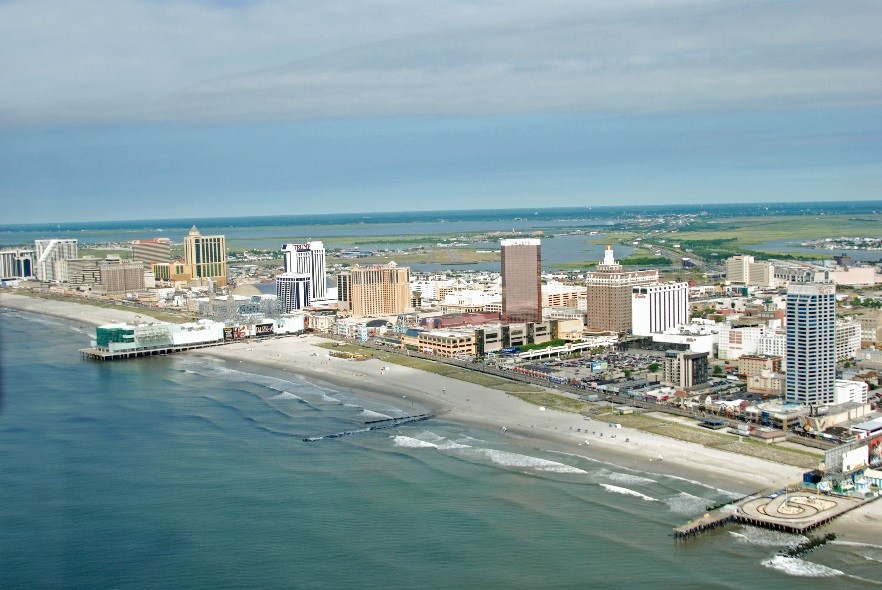
DEP PHOTO/Atlantic City

“This project is vital to the protection of homes, businesses, lives and infrastructure in these Atlantic County communities,” Commissioner Martin said. “I want to thank the Army Corps of Engineers for working closely with the DEP to ensure this project moves forward as an important part of the Christie Administration’s integrated strategy to make our economically vital shore communities more resilient by protecting them from storms and flooding.”

“I'm proud of the efforts of the team that has worked so hard to move this project forward,” said U.S. Army Corps of Engineers' Philadelphia District Commander Lt. Col. Michael Bliss. “When complete, the engineered dune and berm will be one system with the purpose of reducing damages to the infrastructure on the island.”
The contract was awarded to Cranford-based Weeks Marine Inc. and covers about eight miles of shoreline stretching from Brigantine Inlet south to Great Egg Harbor Inlet. The contract amount could increase based on options for placement of additional sand based on conditions that exist when the sand is placed.

The Army Corps will issue a notice to Weeks Marine Inc. directing work to commence before the end of the year. The work is expected to be completed by October 2017.
Work involves constructing an engineered dune and berm system in Margate and Longport as well as the scheduled nourishment of the previously constructed sections of the project in Atlantic City and Ventnor.

The contract calls for a 200-foot-wide beach, also known as a berm, and a dune built to an elevation of nearly 15 feet above sea level for Atlantic City. A 100-foot wide berm and a dune to an elevation of nearly 13 feet above sea level will be built for Ventnor, Margate and Longport.

More than 3.8 million cubic yards of sand will be dredged from approved offshore areas and pumped through a series of pipes onto the beaches of the four municipalities. The sand will then be built into a dune and beach system designed to reduce potential damages to infrastructure, businesses, and homes that can occur from coastal storm events.
In addition, the contract includes the construction of public access dune crossovers, placement of sand fencing, dune grass plantings, and the repair or extension of existing storm water outfalls and drainage structures.
The Absecon Island project was only partially completed when Superstorm Sandy slammed the state in October 2012. The project in place helped to dramatically reduce damages along those sections of the island.

The Army Corps had completed the initial construction of the project at Atlantic City and most of Ventnor in 2004. These sections of the project received sand nourishment in the spring of 2012, months before Sandy. The areas were restored in 2013, just months after Sandy.

The Army Corps will closely coordinate with Weeks Marine on the construction schedule and will post updates to its project website when further information is available.

Completing the initial construction in Margate and Longport is funded entirely by the federal government through the 2013 Disaster Relief Appropriations Act, commonly known as the Hurricane Sandy Relief Bill.

The periodic nourishment of the Atlantic City and Ventnor portion of the contract is cost-shared, with the federal government paying 65 percent of the project and the DEP paying 35 percent. Following the completion of initial construction, the project is eligible for continued periodic nourishment.

The Absecon Island project is one of several along the New Jersey coastline being funded by $1.2 billion appropriated by Congress to rebuild and strengthen the state’s beaches following Superstorm Sandy in October 2012. Many of these projects have either been completed or are well under way.

The coast-wide system of engineered beaches is part of an overall post-Sandy resiliency strategy. These efforts include hardening of infrastructure, developing innovative strategies to restore wetlands and build natural bay shorelines to buffer against storm surge, moving willing sellers out of harm’s way, and establishing new requirements for elevating structures in flood zones.

For more information on post-Sandy coastal projects in New Jersey, visit: www.nj.gov/dep/shoreprotection/projects.htm

SOURCE  nj.gov/dep/newsrel/2016/16_0114.htm


Friday, January 15, 2010

Searching for the Jersey Devil

The Jersey Devil. No, we're not talking hockey (though that's where the team gets its name), but that legendary creature said to inhabit the Pine Barrens in southern New Jersey.

The Pine Barrens has a rich folklore in its oddly-named towns (Double Trouble, Ong's Hat, Mount Misery - even a few "ghost towns" like Martha and Colliers), and it also has rich
ecosystems.

There are many studied and protected birds, animals and rare flora in the 1.1 million acres. And lovers of nature walk the the white-sand trails and paddle tea-colored cedar rivers.

And most natives of New Jersey have heard of the Jersey Devil, a creature whose legend dates back more than two centuries.

If you had to pick a place in NJ to be the home of a strange and elusive creature, the isolated Pinelands would be it.

Once, the area was known for its ironworks, but if you find the 18th-century ironmaking town of Martha, you'll find that it has been deserted and swallowed up by the Pinelands.
The remaining stone foundations and cellars where houses once stood would be a good habitat for the Jersey Devil.

"Pineys" (the not-so-complimentary but common term for residents of the Barrens) go back three to five generations. They are an independent group. Their musical tastes often go to fiddle, mandolin, harmonica, banjo, guitar, and dulcimer tunes. It's a part of NJ that most outsiders would have trouble identifying with Jersey. Here is where the legend of the Jersey Devil took root.

It probably started with Lenni Lenape Indians who called the region Popuessing, or "place of the dragon."

Following the Native Americans of the area, Swedish explorers named the area "Drake Kill" - "drake" being a Swedish word for dragon, and "kill" meaning channel or arm of the sea, river, or stream.

The Jersey Devil (AKA the Leeds Devil) is a legendary creature (cryptid) and it's hard to even find agreement on a description of it. Commonly, it has been described as a flying biped with hooves.

As far as the Leeds Devil story:  Mother Leeds had 12 children and, after giving birth to her 12th child, stated that if she had another, it would be the Devil. In 1735, Mother Leeds (supposedly a witch) gave birth (on a stormy night) to #13. Though it looked normal at birth, she claimed the father was the Devil himself.

Soon after the birth, the baby changed form to a creature with hooves, a horse's head, bat wings and a forked tail. It growled, killed the midwife, flew up the chimney and headed for the pines.

History-checkers say Deborah Leeds was the mother. Her husband, Japhet Leeds, named twelve children in the will he wrote in 1736. They lived in the Leeds Point section of what is now Atlantic County.

There are records of searches for the creature. Joseph Bonaparte (brother of Emperor Napoleon) is said to have witnessed the Jersey Devil while hunting on his Bordentown, New Jersey estate around 1820.

Reports of sightings peaked 101 years ago in January 1909. Thousands of people claimed to witness the Jersey Devil during the week of January 16–23. Newspapers nationwide followed the story and published eyewitness reports about the creature flying over Woodbury, leaving tracks in Bristol, Pennsylvania and Burlington.

A Gloucester couple saw the creature outside their window and said: "It was about three feet and a half high, with a head like a collie dog and a face like a horse. It had a long neck, wings about two feet long, and its back legs were like those of a crane, and it had horse's hooves. It walked on its back legs and held up two short front legs with paws on them. It didn't use the front legs at all while we were watching. My wife and I were scared, I tell you, but I managed to open the window and say, 'Shoo!' and it turned around, barked at me, and flew away."

In Haddonfield and Collingswood, posses were formed to find the devil. They supposedly watched the creature fly toward Moorestown, where it was later seen by at least two more people. It got bolder and attacked a trolley car in Haddon Heights.

Despite several reports of a few rifle shots hitting the creature, it always seemed to get away.

And, even though the Jersey Devil terrified people, a report of it biting a dog that month was one of the few reported attacks on a living creature - and there are no reports of an attack on a human.

The Philadelphia Zoo supposedly posted a $10,000 reward for the creature's capture that year. In 1960, the merchants around Camden also offered a $10,000 reward for the capture of the Jersey Devil. (A pretty safe offer to make for a legendary creature.)


Sightings after the 1909 frenzy have been infrequent. In Freehold in 2007, a woman supposedly saw a huge creature with bat-like wings near her home. In August of the same year, a young man driving home near the border of Mount Laurel and Moorestown, reported a similar sighting. He claimed that he spotted a "a creature resembling a gargoyle with enormous bat-like wings" perched in some trees near the road.

In 2008, the Jersey Devil was supposedly spotted in Litchfield, Pennsylvania by a resident that claims to have seen the creature come barreling out of the roof of his barn.

Last September, a young man driving home on Interstate 80 near Parsippany, NJ (far from the Pine Barrens in North Jersey, but not the only North Jersey sighting) claimed he saw "a black long-necked creature with a with a long tail" run across the road, and disappear into the darkness on the other side of the road.

Some have credited the sightings to misinterpreted encounters in the dark with bears, wild dogs, sandhill cranes and even antlered deer. Most people think it's a fun legend to scare kids with on a visit to the Barrens. (I am guilty of doing that with my own sons on camping trips to Wharton State Forest - and it was fun.)

Outdoorsman and author Tom Brown, Jr. says he has scared hikers who mistook him for the Jersey Devil, when he emerged from the woods covered in mud (to repel mosquitoes).

Not surprisingly, the Jersey Devil legend is fueled by the various testimonials from alleged eyewitnesses who have reported to have encountered the creature, from precolonial times to the present day, as there are still reported sightings within the New Jersey area.

Those who study the creature with cryptozoological interest point out that for it to exist over a span of several hundred years, we are talking a species rather than a single creature. Could it be a pterosaur or a dimorphodon? Oh, that would be great!

People have been adding to the Wikipedia entry on the creature since the wiki began. 

Sightings have been collected at http://www.njdevilhunters.com/sightings.html


More Reading


The Jersey Devil
Tales Of The Jersey Devil
Mystery of the Jersey Devil 


Yes, there is a Jersey Devil action figure.

Friday, July 10, 2009

Wind Adds Power To Ocean Gate

After two years of efforts, Ocean Gate, NJ broke ground to build the first "small wind" municipal turbine in the state.
"Ocean Gate is just a phenomenal role model for other communities," said state Board of Public Utilities President Jeanne M. Fox. "This is a historic ground-breaking. While you're small [about 2200 residents], you're really mighty in what you've done. I really commend you for what you've done for the state and for Ocean Gate."

Starting with a proposal to the borough council from retired Navy engineer Jim Fry in 2007, the town began researching the project.

That included having an anemometer installed to test the wind, adopting the Small Wind Model Ordinance, and researching turbines.

According to the N.J. Board of Public Utilities, Ocean gate will utilize two 50 kilowatt turbines to power the municipal office building and the water treatment plant solely on wind energy.

The system is estimated to save the borough 224,000 kilowatts of electricity purchased from traditional sources, and thus prevents 18 tons of carbon dioxide from being released into the air. The borough has received nearly $200,000 in financial incentives from the state's Clean Energy Program for the approximately $600,000 project.

The borough was also recognized last fall as being the state's Clean Energy Municipality of the Year by the state Board of Public Utilities.

A wind feasibility study done by Rowan University confirmed that Ocean Gate and surrounding communities along the Toms River near the mouth of Barnegat Bay have consistent and reliable wind, with an average daily speed of 6 m.p.h. year around. That amount rates the area, according to the United States Wind Resource Map, as consistently "good" as a potential wind resource.

The state's first wind farm was built in 2007 outside Atlantic City by the Atlantic County Utilities Authority and a private energy group. It is also the first such coastal facility in the United States. Five pinwheel-like 40-story-tall turbines are utilized.

Ocean Gate's turbine will probably be only about as high as the town's water tower.

Ocean Gate is located on the south bank of the Toms River in an area popular with sailors for its confluence of wind with those from Barnegat Bay.

Officials plan to have the first municipal wind turbine in the state finished by the end of summer.

Monday, June 8, 2009

Peregrine Falcons


I recently read online that the peregrine falcon is being removed from Iowa's endangered species list and it sent me back to check on the speies status in NJ.

Peregrine falcons (Falco peregrinus) are sometimes called an "indicator" species because they begin to vanish when pollution, over-hunting and other environmental factors encroach, an indicator of serious problems.

When the chemical DDT was widely used as a pesticide years ago, it turned out to be killing more than just bugs. Peregrines were nearly wiped out by DDT. The federal list was created in 1972 when DDT was banned nationwide and the Endangered Species Act was implemented.

Peregrine falcons were removed from the federal list in 1998, but remain on NJ's endangered species list.

Peregrine falcons are amazing. Like all falcon species, they are designed for speed. In a dive, peregrines can reach speeds of up to 200 M.P.H., making it the planet's fastest bird.

Traditionally, peregrine falcon nest sites were restricted to cliffs and rock outcrops, but as people began to inhabit areas occupied by peregrines, the birds took to nesting on buildings and bridges. In NJ, they continue to nest on these structures. There are no remaining cliff nests on the Hudson Palisades or the Delaware River in New Jersey. NJDEP has also built artificial nesting platforms in coastal marshes which are still active today.

It seems hard to believe today, but into the 1950s, egg collectors and falconers looted peregrine nests, while gunners, game wardens, and pigeon fanciers shot adult falcons, which were viewed as vermin.

DDT was heavily used in NJ for mosquito control and had a devastating effect on population declines for the peregrine falcon, osprey and bald eagle. Because these predators are high on the food chain, DDT had accumulated at levels that inhibited calcium metabolism which caused eggshell thinning in the birds. The resulting eggs cracked under the weight of the incubating adult.

By the 1960s, they were extirpated - there were no known nesting peregrines in the East.

DDT was banned in New Jersey in 1968 and in the United States in 1972. The peregrine falcon was classified as a federally endangered species in 1970 and as a New Jersey endangered species in 1974.

NJ biologists released young peregrines into the wild during the latter half of the 70s. This "hacking" was intended to reestablish nesting populations. Peregrines often return to their birth sites to breed.

The first releases in the traditional cliff sites unfortunately experienced high mortality due to great horned owl predation. The coastal man-made nesting structures were in locations where owl numbers were lower and prey was abundant.

The first nest site was at the Edwin B. Forsythe National Wildlife Refuge in Atlantic County. An analysis of eggshells from NJ nests still contained residual contaminants during the early 1980s, but were low enough that they shouldn't have impaired reproduction.

The peregrine had reached its NJ recovery goal of 10 pairs by 1986, and had stabilized at that level through the early 1990s.

Owl predation continued to be a problem for nests along the Delaware Bay and River. Unhatched eggs there and in the Barnegat and Manahawkin bays may have been a result of PCB contamination as well as DDE, chlordane, and dieldrin in the early 1990s.


Currently, the state’s peregrine population remains stable at about 15 pairs and exhibit good productivity, averaging 1.7 young per nest on buildings and towers since 1986.

Though the peregrine falcon was removed from the federal endangered species list in 1999, they continue to be listed as endangered in New Jersey because they remain threatened by environmental contaminants and human disturbance, and rely on active management of their nesting sites.

http://www.state.nj.us/dep/fgw/ensp/pdf/end-thrtened/peregrine.pdf