Showing posts with label turkeys. Show all posts

Monday, July 1, 2024

Wild Turkey Brood Sighting Survey


Have you seen turkey hens and their poults?  Then let us know in the NJDEP Fish & Wildlife's Turkey Project's Wild Turkey Brood Sighting Survey.

This survey information is used as a measure of wild turkey productivity in New Jersey and nationally as one way of estimating how well turkeys raise broods each year.  

The Wild turkey (Meleagris gallopavo) is an upland ground bird native to North America, one of two extant species of turkey, and the heaviest member of the diverse Galliformes (a group of game birds which includes grouse, pheasants, and partridges). It is the same species as the domestic turkey.

Information from this wild turkey brood survey is useful as a measure of wild turkey productivity. This survey is used in New Jersey and nationally as a means of estimating how well turkeys did raising broods each year. This survey will run from June 15th - September 15th. Since hens may lose their young or may not nest at all, it is important to record lone hens as well as those with poults. To the best of your ability, each of your record entries should be of new broods when this is known. 

Please do not submit the same brood you see every day as a separate survey entry. Example: If the same brood visits your backyard every day, this would be one entry for the entire period of the study.

If you cannot tell poults from hens, especially in the later months of the survey, please record them in the "unknown" section of this survey.

Each time data is submitted, via the submit button at the bottom of the screen, it is counted as a single record.

Sunday, November 30, 2014

Jersey Wild Turkeys


Tired of turkey talk? What about wild turkeys?

They are not endangered in New Jersey. In fact, nationwide there were only 100,000 turkeys in the wild in the 1950s, but today there are an estimated 3 million of them in the wild.

A form of our wild turkey has been on the planet in one form or another for 10 million years.

If you live in suburban New Jersey, you might view turkeys as not being terribly "wild" as they might wander in your driveway or walk up the neighborhood sidewalk. Hunters know that wild turkeys are quite elusive and clever in evading hunters. The wild turkey can see five times better than a person and hear up to eight times more accurately than humans.

Wild turkeys - not so much the suburban variety - avoid humans. They can and will take flight to avoid you and can fly at speeds up to 55 miles an hour. They can run at speeds up to 25 miles an hour.

We all know the questionable fable of the first Thanksgiving, but turkeys were game birds for the Native Americans and colonists. The early Spanish Explorers enjoyed them so much they took Mexican Turkeys back to Europe in the 1500’s.


But by the mid-1800s, turkeys had disappeared in New Jersey due to habitat changes and over-hunting.

The Division of Fish and Wildlife started a successful Turkey Restoration Project in 1977 in cooperation with the NJ Chapter of the NJ Chapter of the National Wild Turkey Federation and reintroduced wild turkeys starting with 22 birds. The following year, biologists and technicians began to live-trap and re-locate birds to establish populations throughout the state.

In the wild, turkeys have become widely distributed and flocks (known as rafters) are common in backyards and in the woods, parks and along roadsides. Part of that recovery during the early 20th century also occurred because abandoned farms and some saved woodlands allowed a wild turkey comeback.

Wild turkeys are very adaptable and thrive almost anywhere. They do like oak forests and patches of woods near farmlands and suburbs which provide additional food. They are present in South Jersey too, though not in as great a number.


New Jersey's turkey population had grown large enough to support a spring hunting season and a limited fall season began in 1997. Wild turkeys are now abundant throughout the New Jersey, with the Division of Fish & Wildlife estimating the population at 20,000 to 23,000 birds.

I am most likely to see them in my suburban north Jersey non-hunting area in the early morning when they are foraging in or near a wooded reservation nearby. But these omnivores venture down sidewalks in search of insects, acorns and nuts, plant buds, salamanders, snails, mosses and underground plant bulbs.

Wild turkeys don't migrate and are are in New Jersey all year round. If it's a tough, snowy winter, they can last as long as two weeks without eating. Different foods are preferred during the four seasons, so turkeys may use different areas in the winter than they do during the spring and summer and so they may seem to have "just moved in" to your neighborhood.


MORE INFORMATION
About turkey hunting seasons in New Jersey,
Cornell Lab of Ornithology  www.allaboutbirds.org/guide/wild_turkey/id

Friday, November 29, 2013

Beyond Thanksgiving

Now that the turkey has been digested, maybe you can chew on some information about that first Thanksgiving and consider visiting an exhibit in Paterson, NJ.

The Paterson Museum's permanent Delaware-Lenape exhibit, opens in early December. You can see tolls like axes, harpoons and fishing nets,plus murals and an 11-foot dugout canoe and a full-size eight-foot diameter wigwam. This is believed to be the only permanent Lenape exhibit in the mid-Atlantic states.

Sam Beeler, elder of the Sand Hill Delaware Indian tribe, was the technical adviser for the exhibit. He says that American Indians (not "Native Americans" which he dislikes) play a much wider role than the Thanksgiving story.

Beyond that historic meal is the idea that potatoes, peppers, tomatoes, chocolate, corn, and all the beans we use comes from this hemisphere and were passed on and exported by those colonists.

The Thanksgiving story has always been a little vague and is now full of popular cultural additions. We know that the first pilgrim Thanksgiving in 1621 has lots of venison. We're not sure about turkey, although it makes sense that it might have been included.(A letter from a colonist tells us that the local Wampanoag Indians brought five deer.)

In the 392 years since, we have added a lot of information - much inaccurate and some offensive to the Indians.


In what we know of as northern New Jersey,  the people of the Munsee ("stony country") region of the Lenni-Lenape held a  regional autumn celebration that, Beeler says, that broght people to the Great Falls in Paterson for "The Rendezvous" or "The Pawwaw."

The Lenni Lenape Indians knew the Falls as a prime camping and fishing site and called it “Totowa” (to sink or be forced down beneath the waters by weight).

Passaic County's 5,000 or more Lenape celebrate on the Thursday before the federal holiday. A typical meal will include the "three sisters" (corn, beans and squash). Since the Indians were the original American locavores, the meal would include what was available here in the season, including seafood, venison, turkey, rabbit and squirrel.

SOURCE: northjersey.com/community/233195111_Thanksgiving__the_Lenape_way.html

Monday, November 25, 2013

Turkey Time in New Jersey

Wild turkey hen with poults (chicks)           Photo: Kevin Cole via Wikimedia

Turkeys are the symbolically American bird - at least when November rolls around. Experts say the nation’s wild turkey population has rebounded from about 300,000 in the early 1950s to an estimated seven million now.

In fact, in our area of the country, they have rebounded so much that they are sometimes viewed more a nuisance - as with the case of some turkeys on New York’s Staten Island.

Though we associate turkeys with that first Thanksgiving in Virginia, Wild turkeys evolved on the North and South American Continents exclusively and became a great game bird for Indians and settlers. Indians of the American Southwest, Mexico and Central America first hunted the wild turkey and also domesticated them. Spanish Explorers enjoyed them so much they took Mexican turkeys back to Europe in the 1500s.

Usually, we see wild turkeys from a bit of distance in suburban areas, but occasionally they can be aggressive. They will sometimes peck at windows, automobile mirrors or reflections in shiny surfaces (like your nicely polished car).

You won't find turkeys on the NJ endangered or threatened species list,because the Division of Fish and Wildlife started a Turkey Restoration Project in 1977 in cooperation with the New Jersey State Chapter of the National Wild Turkey Federation.

Wild turkeys had been extirpated from New Jersey by the mid-1800s because of their use as food and increasing loss of habitat. Reintroducing 22 birds in 1977 was so successful that we now have an current population is estimated at over 20,000.

Wild turkeys are found throughout the state wherever there is suitable habitat. Even in South Jersey, where wild turkeys had been struggling just a few years ago, intensive restoration efforts have improved population numbers significantly.

You will find rafters (flocks of turkeys) more commonly in rural areas of the state where these omnivorous eaters can forage. They prefer eating acorns, nuts, and various trees, including hazel, chestnut, hickory, and pinyon pine as well as various seeds, berries such as juniper and bearberry, roots and insects. Turkeys also occasionally consume amphibians and small reptiles such as lizards and snakes. Poults (chicks) have been observed eating insects, berries, and seeds.

Wild turkeys often feed in cow pastures, sometimes visit back yard bird feeders, and favor croplands after harvest to scavenge seed on the ground. Turkeys are also known to eat a wide variety of grasses.

Early morning and late afternoon are the desired times for eating.

If we have a harsh winter, they can survive up to two weeks without eating. But then they will move into more populated areas.

Neither endangered or threatened in NJ, there is legal hunting of wild turkeys regulated by the State Division of Fish, Game and Wildlife. The 2013 spring wild turkey hunting season (April 20 - May 24) had a total harvest of 3,073 male wild turkeys, up 1.4% from 2012. The fall hunting season was from Oct. 26 to Nov. 2, 2013, so NJ wild turkeys are safe this Thanksgiving week.

http://www.nj.gov/dep/fgw/turkey_info.htm


Saturday, September 7, 2013

New Jersey Wild Turkey Population Increasing


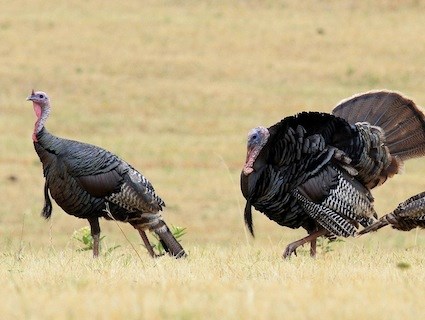
Male Eastern Wild Turkeys (Meleagris gallopavo silvestris)
Photo: KenThomas.us via Wikimedia

Several news outlets reported last week that a wild turkey smashed through the window of a Smoke Rise, NJ home and caused $5,000 in damage before smashing another window to escape pursuing police officers.

Due to its size, the suspect was assumed to be a male turkeys, referred to as toms and gobblers, which are much larger than the female hens. The average wild turkey weighs in at 20 lbs compared to the domestic variety which can be as large as 15-30 lbs. Domestic turkeys can be identified by their black legs, while wild turkeys have pink legs.

Wild turkeys are occasionally aggressive and have been known to peck at windows, automobile mirrors or reflections in shiny surfaces such as polished cars.

Wild turkeys had been extirpated from New Jersey by the mid-1800s because of their use as food and increasing loss of habitat. But the efforts to reintroduce them with 22 birds in 1977 were so successful that we now have an abundance of them throughout New Jersey. They have been moving more frequently into suburban neighborhoods. (I see them regularly in my own west Essex County town.)

The current population is estimated at 20,000 to 23,000.

Wild turkey hen with poults (chicks)           Photo: Kevin Cole via Wikimedia

Rafters (flocks of turkeys) are more commonly seen in rural areas of the state. Wild turkeys are omnivorous, foraging on the ground or climbing shrubs and small trees to feed. They prefer eating acorns, nuts, and various trees, including hazel, chestnut, hickory, and pinyon pine as well as various seeds, berries such as juniper and bearberry, roots and insects. Turkeys also occasionally consume amphibians and small reptiles such as lizards and snakes. Poults (chicks) have been observed eating insects, berries, and seeds. Wild turkeys often feed in cow pastures, sometimes visit back yard bird feeders, and favor croplands after harvest to scavenge seed on the ground. Turkeys are also known to eat a wide variety of grasses.

Turkey populations can reach large numbers in small areas because of their ability to forage for different types of food. Early morning and late afternoon are the desired times for eating.During harsh winters, they can survive up to two weeks without eating, but will move into more populated areas.

Turkeys are neither endangered or threatened in NJ. Legal hunting of wild turkeys is regulated by the State Division of Fish, Game and Wildlife. The NJ fall turkey hunting season is from October 26– November 2, 2013.

Wild turkeys evolved on the North and South American Continents exclusively and became a great game bird for Indians and settlers. Indians of the American Southwest, Mexico and Central America first hunted the wild turkey and also domesticated them. Spanish Explorers enjoyed them so much they took Mexican turkeys back to Europe in the 1500s.

New Jersey State Chapter of the National Wild Turkey Federation


Friday, June 18, 2010

Wild Turkeys


In the 1950’s, there were only 100,000 turkeys in the wild, today there are an estimated 3 million of them in the wild.

Turkeys have been on this planet in one form or another for 10 million years and have become one of the most popular, well known wild birds.

In the United States around the 1930’s, it is reported that their numbers were dwindling due to overhunting, disease and forest clearing. Thanks to preservation efforts involving a new form of herd trapping and transplanting the birds to more tranquil habitats, the Wild Turkey is now plentiful, residing in all lower 48 states and Hawaii.

New Jersey is home to thousands of wild turkeys, flourishing in woodsy rural, suburban and even some urban areas where they can feed on grains, berries, beechnut, acorns, oats, grasses, ferns and insects. When winter is tough, they can last as long as two weeks without eating.

Turkeys are neither endangered or threatened in NJ.  Hunting is regulated by the State Division of Fish, Game and Wildlife and it is legal in New Jersey.

There are six species of wild turkeys: the Eastern , Merriam’s, Rio Grande, Florida, Mexican and an offshoot species from the Yucatan.

Domestic turkeys can be identified by their black legs, while wild turkeys have pink legs.

Turkeys evolved on the North and South American Continents exclusively and became a great game bird for Indians and settlers. Indians of the American Southwest, Mexico and Central America first hunted the wild turkey and also domesticated them. Spanish Explorers enjoyed them so much they took Mexican Turkeys back to Europe in the 1500’s.

Male turkeys, referred to as Toms and Gobblers, are much larger than the female hens, have more colorful plumage and have different calls.

The average wild turkey weighs in at 20 lbs compared to the domestic variety which can be as large as 15-30 lbs.

On myth is that turkeys are stupid birds, but hunters know that wild turkeys can be elusive and clever in evading hunters. The wild turkey can see five times better than a person and hear up to eight times more accurately than humans. Wild turkeys avoid humans, they can and will take flight to avoid them, while domestic varieties tolerate humans as their caretakers. Wild Turkeys can fly at speeds up to 55 miles an hour, they are good at running too, they can reach speeds of 25 miles an hour.

There are many sounds and calls of the turkey, as many as 50 including the more popular “gobble, gobble” call of the male turkey, which can be heard from a mile away.

A turkey has a snood but no ears. The snood is the fleshy thing that hangs off the turkey’s chin, sometimes referred to as a beard. Even though the wild turkey has no ears to speak of, they have excellent hearing.

Only 50% of turkey eggs hatch and mature into adults. Many don’t survive for various reasons, including becoming part of the next level of the food chain when they are still eggs or baby hatchlings. Typically, a hen produces a clutch of 9-18 eggs. These eggs are very tasty and a great source of protein in the diet of animals like the raccoon, skunk and opossum.


One of the largest organizations in the world dedicated to the wild turkey is the National Wild Turkey Foundation which promotes safer hunting and well planned preservation of the turkey and it’s habitat.

High Ridge Gobbler: A Story of the American Wild Turkey

A proud suburban wild turkey

Wednesday, November 25, 2009

Wild Turkeys in New Jersey


Though you won't find them on the NJ endangered or threatened species list, this is a good time to write a bit about wild turkeys in NJ.

The Division of Fish and Wildlife started a Turkey Restoration Project in 1977 that is a great wildlife management success story for New Jersey. That was needed because by the mid-1800s, turkeys had disappeared in New Jersey due to habitat changes and killing for food.

Division biologists, in cooperation with the NJ Chapter of the National Wild Turkey Federation, reintroduced wild turkeys in 1977 with the release of 22 birds.

In 1979 biologists and technicians began to live-trap and re-locate birds to establish populations throughout the state. By 1981 the population was able to support a spring hunting season, and in December, 1997, a limited fall season was initiated.

There is now an abundance of wild turkeys throughout the state with turkeys found wherever there is suitable habitat. People from outside NJ are always amazed when I tell them that wild turkeys are present even in suburban areas. I pass them every week on my daily commute through suburban Essex County and into Passaic County.

Even in South Jersey, where wild turkeys had been struggling just a few years ago, intensive restoration efforts have improved population numbers significantly.

The population is estimated at 20,000 - 23,000 with an annual harvest of more than 3,000.

The kind of food, cover and water present in an area determines the suitability of that habitat for turkeys. Different foods are preferred during the four seasons. Turkeys may use different areas in the winter than they do during the spring and summer.

Because food plants are distributed variably throughout turkey range, principal foods are given here as generalities.

      Principal Foods During the Four Seasons
Winter Spring Summer Fall
Acorns Acorns Grass, leaves Sedges
Grass, sedge Grass, sedge Blackberries Acorns
Corn Corn Acorns Insects
Wild grapes Beechnuts Wild cherries Beechnuts
Dogwoods Burdock Huckleberries Wild grapes
Sumacs Ferns Bristle grasses Wheat
Beechnuts Non-woody legumes Blueberries Corn
Honeysuckle Wild grapes Wild grapes Insects
Wild cherries Insects Black gum Hawthorn
Insects
Buckwheat Buttercup
Hawthorns
Sedges Wild rye
Persimmons

Hornbeam


Violets


2009 Wild Turkey Hunting Season Information Booklet
 
2009 Turkey Hunting Area Map and Lottery Quota Information