Showing posts with label water quality. Show all posts

Friday, July 27, 2018

Be a Watershed Steward in New Jersey


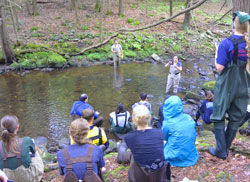
The NJDEP is seeking recruits for its AmeriCorps New Jersey Watershed Ambassadors, a program that engages communities to protect and improve water quality. Watershed Ambassadors are the DEP’s facilitators in the field, collecting water quality information, giving presentations on clean water and championing partnership projects in which the public help make a difference in their communities.

New Jersey's waters are a valuable and vulnerable resource. The AmeriCorps New Jersey Watershed Ambassadors Program plays an important role in raising awareness of how human activities can affect water quality, especially in the most densely populated state in the nation. Each year, a new group of 20 Watershed Ambassadors engage with community members, channeling awareness into action.

The program is now in its 18th year and is administered by the New Jersey Department of Environmental Protection, Division of Water Monitoring & Standards. The goals of the program are to promote watershed stewardship through education and direct community involvement, and to monitor stream health through performing visual and biological assessments. Individual AmeriCorps members are assigned to each of New Jersey's 20 watershed management areas (WMAs) to serve as "Watershed Ambassadors" to their watershed communities.


Info on the Watershed Ambassadors Program
More info in DEP news release

Monday, May 14, 2018

National Drinking Water Week


As part of national Drinking Water Week, the New Jersey Department of Environmental Protection is working to educate residents about how lead enters drinking water and the steps they can take to reduce any risk to their families.

“Clean and safe drinking water is important to all of us,” DEP Acting Commissioner Catherine R. McCabe said. “As we mark national Drinking Water Week, it’s important for families to take a little time to become better informed about how to find out if lead is in their water and what they can do about it.”

Drinking Water Week is held each May to draw attention to the importance of drinking water and the efforts that government and system operators take to ensure safe and reliable supplies. Drinking Water Week is sponsored by the American Water Works Association and its members.

In New Jersey, the DEP is responsible for enforcing the U.S. Environmental Protection Agency’s Lead and Copper Rule. The DEP evaluates results of testing done by water systems at properties most likely to contain lead. If more than 10 percent of the result are above 15 parts per billion, the water system will conduct more frequent sampling and perform corrective actions.

In almost all cases, minute particles of lead enter drinking water as the result of leaching from customers’ service lines, internal plumbing, lead-based solder, and certain fixtures. Lead is rarely found in the source of water delivered by water systems.

While lead is a concern in urban areas with older houses and buildings, it can also be a concern in other areas. According to the EPA, lead is more likely to be present in structures built prior to 1986.

Many factors affect the amount of lead that leaches into the water, including lead content of pipes, fixtures, and solder, the length of time that water remains standing in the plumbing; water temperature; pH; and water hardness.

Lead presents health concerns for people of all ages, but particularly pregnant women, infants and young children. If consumers live in homes where lead is in contact with drinking water, they may be at risk of exposure.

A study from the American Water Works Association suggests that lead service lines (lines that connect a system’s water mains to properties the system serves) may be present in 6 million to 10 million homes nationwide.

Water systems can adjust water chemistry to reduce leaching of lead into water. Property owners can also take steps to reduce potential exposure to lead.

To determine if lead is present in pipes or plumbing, homeowners or tenants can consult with a licensed plumber or their public water supplier. If you are unsure who your supplier is, click here. If lead components are found, it is recommended that property owners explore options for replacing them.

Until lead service lines or plumbing can be replaced, the following steps can be taken to reduce exposure to lead in drinking water:

  • Run your water to flush out lead. If a faucet hasn’t been used for several hours, run the water for 15 to 30 seconds or until it becomes cold or reaches a steady temperature before using it for drinking or cooking.  This flushes any lead particles in water from the pipes.
  • Use cold water for cooking and preparing baby formula.  Do not cook with or drink water from the hot water tap; lead dissolves more readily in hot water. 
  • Test the water. Contact your water system or a certified drinking water laboratory to have your home drinking water tested for lead. (Please note that the homeowner may be responsible for any costs).
  • Do not boil water to remove lead.  Boiling water will not remove lead from the water.
  • Use alternate sources or treatment of water.  Consider using bottled water for drinking and cooking, or a water filter designed to remove lead.  Read the package to be sure the filter is approved to reduce lead or contact NSF International at 800-NSF-8010 or www.nsf.org for information on performance standards for water filters.  Be sure to maintain and replace a filter device in accordance with the manufacturer’s standards to ensure water quality.
  • Get your child tested.  Contact your local health department or healthcare provider to find out how to get your child tested for lead if you are concerned about lead exposure.
  • Ask your school or child care about their lead sampling results. Any drinking water outlet (i.e. fountain or sink) with a result over the action level of 15 ppb should be taken out of service immediately. Click here for more information on school testing. 

Finding information about local water is simple. As required by federal law, water suppliers must provide customers with an annual water quality report, also called a Consumer Confidence Report. This report identifies the quality of drinking water and lists sampling results as well as drinking water standards. Information on each community’s local source or sources for drinking water is also provided in the Consumer Confidence Report.

Although customers are directly notified of any violations by their water system, the DEP’s  Drinking Water Watch website provides current online access to drinking water data, including water testing results and any violations.

More information about lead in drinking water at: www.DrinkTap.org 
and


SOURCE: http://www.nj.gov/dep/newsrel/2018/18_0036.htm

Sunday, March 26, 2017

Tracking and Stopping Wastewater Pollution

Shark River
Shark River enter the Atlantic Ocean

Working in collaboration, the New Jersey Department of Transportation, Department of Environmental Protection, Monmouth County and Neptune City have tracked down and repaired a significant source of bacterial contamination that affected water quality and contributed to the closure of shellfish beds in the Shark River late last year.

Barely 12 miles in total length, the Shark River is comprised primarily of a large, U-shaped estuarine basin that is connected to the ocean by a relatively narrow inlet.

Using dye tests and cameras provided by NJDOT, the partners were able to locate sewage leaking into a stormwater discharge pipe at West Sylvania Avenue in Neptune City. The source of the infiltration into the stormwater pipe was then traced to two leaking municipal sewer lines, which the city recently repaired.

In early November, the DEP’s Bureau of Marine Water Quality Monitoring suspended any harvesting of clams from two stretches of the river totaling 266 acres – 122 acres in the northern portion of the river in Neptune City and 144 acres in the western portion of the river at Belmar – due to extremely elevated levels of bacteria, a strong indicator of sewage leaks.

“This has been a team effort in the truest sense of the term,” said DEP Commissioner Bob Martin. “Our scientists worked very closely with NJDOT engineers, who provided extensive technical and resource support.

“We also had the strong support of Monmouth County, local officials and Senator Jennifer Beck to track down the source of this pollution, no easy task considering the size of the area that had to be investigated and the complexity of piping networks in the area. Neptune City also stepped up and fixed the leaks promptly. I commend everyone who went the extra yard to protect the quality of water in the Shark River.”

“NJDOT personnel have the experience and skills needed to investigate the vast network of underground water and sewer pipes that run beneath the roadways in New Jersey – whether they are State, county, or municipal roads,” NJDOT Commissioner Richard T. Hammer said. “Neptune City approached the Department of Transportation last year regarding an issue with erosion on one of its roads. NJDOT led a coordinated inter-agency effort in which our engineers, through the use of Transportation Trust Funds, investigated the issue and in the process identified the source of long-term and persistent bacteria infiltration into the Shark River.”

“It has been a real pleasure to work with the DEP, NJDOT, and Monmouth County on this project to preserve our natural resource,” said Neptune Mayor Robert Brown. “This is proof how you can make great progress on such an important project when we all have the same goal.”

The DEP and its partners are currently launching a similar effort to track down the source of bacteria being discharged into the western portion of the basin. This situation may also be the result of an underground sewage pipe leak.

“We still have a lot more work ahead of us, but this is a great step toward identifying and tracking sources of bacteria that impact shellfish beds and can diminish the public’s recreational enjoyment of the river,” said Ray Bukowski, DEP’s Assistant Commissioner for Compliance and Enforcement, who organized the track-down effort.

Prior to their closure, the shellfish beds were classified as restricted due to degrading water quality, and have not been harvested in years because they would need to be taken to a special plant for cleansing, a process known as depuration, before they could be shipped to market.

“The DEP’s goal is to improve overall water quality in the river so that in the longer term we can make the naturally productive shellfish beds found there commercially viable again,” said Dan Kennedy, DEP’s Assistant Commissioner for Water Resources.

Due to strong programs protecting and monitoring shellfish beds, the percentage of beds considered safe for harvesting across the state is now nearly 90 percent, compared to about 75 percent in 1977.

Founded in 1912, the Bureau of Marine Water Monitoring actually precedes the formation of the DEP by nearly six decades. The bureau collects thousands of samples from shellfish waters which, among other things, measures temperature, salinity, nutrients and bacteria.

SOURCE: http://www.nj.gov/dep/newsrel/2017/17_0019.htm