Wednesday, June 22, 2016

The Burrowing Pine Snake

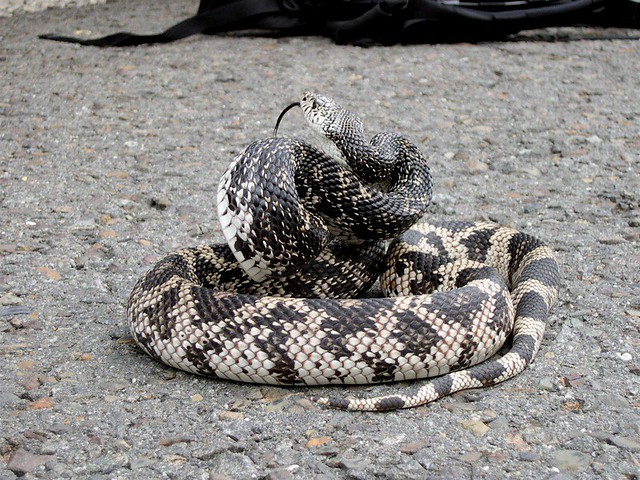
Northern pine snake
Northern pine snake - Pituophis melanoleucus - State Threatened Species - Photo via Zack Bittner, Flickr

Some snakes are tree snakes, some make nests, but the Northern Pine Snake is one of the only burrowing snakes in New Jersey. They make dens and have a nose designed for digging.

They are also currently listed on the Threatened and Endangered species list of New Jersey along with three other snakes.

Most of our pine snake populations are found in the southern part of the state, as they like sandy soils to burrow like those found in the Pine Barrens.

Pine snakes can be hit by cars when trying to move across roads, and are threatened by natural occurrences such as fires. Habitat loss from human development is a factor, as it is for many species in our state. And, unfortunately, a lack of knowledge about snakes in general cause people to fear all snakes, poisonous or not, and people often kill them.

Source: Pine Snake Still Capturing Interest

Wednesday, June 15, 2016

Diamondback Terrapins


There is a proposed ban on the commercial harvesting of diamondback terrapins in New Jersey. These turtles could be on the edge of extinction if more measures are not taken to protect them.

In 2013, the Fish and Wildlife Service alerted the state that it had discovered several harvesters had illegally trapped 3,522 adult terrapins from South Jersey marshes for sale to an aquaculture facility in Maryland for breeding.

This medium-size turtle is the only species in the world that lives exclusively in brackish waters with some salinity. It has a patterned brown, black, and sometimes orange and yellow carapace.

They are vulnerable to overharvesting because they "brumate," or hibernate in the mud, at shallow depths, in large clusters during the winters. Commercial harvesters currently are permitted to collect them by hand in New Jersey, but wildlife investigators found many terrapins were raked from the marshy bottom by illegal harvesters using crab dredges and were then scooped into nets.

After the discovery of the illegal harvesting, the Fish and Wildlife Service recommended the state "immediately close the season . . . and begin to develop a longer term solution," the DEP said. The season this year was curtailed in January.

The federal government classifies the terrapin, known as Malaclemys terrapin, as a species of "special concern" and the majority of the states where the terrapins reside have already imposed complete bans or strict controls. Maryland has prohibited all harvesting since 2007, and Delaware places a limit of four terrapins per day during its designated season. Some states, including Rhode Island, have declared the terrapin an endangered species. New Jersey and New York are the last to take action on the terrapins.

SOURCES:

articles.philly.com

www.dailyitem.com/news/

Horseshoe Crab Harvesting


The past month was the time when horseshoe crabs were once again in the news as their egg-laying on the Delaware beaches in New Jersey once again coincided with the arrival of shorebirds that rely on those eggs for sustenance during their migration. Late spring and early summer are the peak Horseshoe Crab mating and spawning time.

Horseshoe crabs are marine arthropods that will be seen throughout the year on New Jersey beaches and bays. We commonly find crabs that are dead and have washed up on the shore. Kids are fascinated by their unusual shape.

Horseshoe Crabs may look like a crustacean, but they are actually a closer relative of spiders and are classified with Arachinda along with scorpions and ticks.

The species found in NJ, limulus polyphemus, is distributed from the coasts of northeastern Maine to Mexico.

They are commonly referred to as “living fossils” that outlasted the dinosaurs and are probably the distant relatives of the more ancient trilobites and Eurypterida or sea scorpions that existed from the Cambrian period 520 million years ago to the Permian 240 million years ago.

The horseshoe crab's threatening-looking spike-shaped tail is not a defensive poisonous stinger. This tail or telson is an adaptation to upright itself after landing in its back or used in steering when swimming upside down underwater.


The ventral side of a horseshoe crab with 5 pairs of walking appendages and overlapping book gills
via Flickr

Horseshoe crabs are harvested as bait. Each year, half a million horseshoe crabs are captured and bled alive. A chemical found in their blue blood is unique. This chemical is found only in the amoebocytes of its blood cells and it can detect mere traces of bacterial presence and trap them in inescapable clots. Pharmaceutical companies use that coagulogen to detect contamination in any solution that might come into contact with blood.

We can question whether or not this bleeding is humane to horseshoe crabs, but we know that the number of horseshoe crabs is decreasing dramatically. Even more so than the medical industry, fisherman use far more horseshoe crabs as bait. They are commonly used in traps meant to catch American eel and conch.

Millions of horseshoe crabs every year as bait. By comparison, the medical industry uses a few hundred thousand horseshoe crabs each year, and the vast majority are returned to the ocean and probably survive.


Friday, June 3, 2016

Salt Water Fishing in New Jersey


Did you know that salt water fishing in New Jersey requires a permit from the state of New Jersey? But, that registration is free.

The New Jersey Saltwater Recreational Registry Program is part of an improved data program to help protect long-term sustainability of recreational fishing. In 2006 the National Oceanic and Atmospheric Administration (NOAA) was charged with the creation of a universal registry of all current saltwater anglers in the United States. The registry was developed to allow NOAA to quickly and easily contact current saltwater anglers in an effort to gain more accurate and timely information on recreational fisheries.

States were allowed to establish their own registry program for saltwater anglers that fished in their state, and the New Jersey Department of Environmental Protection established its own registry program (New Jersey Saltwater Recreational Registry Program) in order to exempt saltwater recreational anglers fishing in New Jersey’s marine and tidal waters from the federal registry and the federal registration fee that was imposed in 201. Hurray!

Find out more at:
nj.gov/dep/saltwaterregistry
visitnj.org