Saturday, March 17, 2018

Jersey Tomatoes


Late winter always gets me longing to get out in the garden. Now is the time to think about garden planning, starting seeds and cleaning up garden spaces. And I can't help but think about my Jersey tomatoes. Any NJ gardener with space for vegetables should be growing tomatoes and though there are many varieties, at least one should be a Rutgers-developed "Jersey Tomato."

I got my 2018 order form for Rutgers 250, Ramapo, Moreton and KC-146 tomatoes (You can also use it to order a Jersey tomato t-shirt.)


In 2008, the "Rediscover the Jersey Tomato" program began with the re-introduction of the Ramapo tomato. That type was released in 1968 and was celebrating 50 years, but it is not your only choice.

The Rutgers 250 resulted from crossing the same parent varieties as the original 1934 "Rutgers’ tomato" with ones featuring high fruit quality and flavor. It was named in honor of the University’s 250th anniversary in 2016. It has a mid-season maturity and firm, crack-resistant fruit with a uniform color. These are semi-determinate plants and best if staked. Rutgers 250 was not bred specifically for disease resistance, but it shows good resistance to bacterial spot and bacterial speck.

The "Ramapo F1" hybrid tomato was developed at Rutgers NJAES and released in 1968. The seeds were unavailable for many years, but Rutgers reintroduced it in 2008. This is a mid to late season tomato (about 80 days) that has medium to large fruits that are resistant to cracking and Verticillium and Fusarium wilt.

The less well known Moreton F1 was Harris Seeds’ first F-1 hybrid, released in 1953 and one of the first hybrids grown by Jersey tomato growers. This early maturing, tasty variety was off the market and re-introduced in a cooperative effort by Harris and Rutgers. Moreton makes a good earlier maturing (70 days) garden choice. Many gardeners will plant several varieties to get ealy, mid and later yields. Moreton is also a treated seed that is popular in extreme climates with short growing seasons and in containers.

KC-146 tomato is also known as Campbell’s 146 because it was developed by Campbell’s Soup Company as a better flavored processing tomato and released in 1956. It was eventually replaced with newer varieties with a more disease resistance, but Campbell’s maintained the KC-146 stock as their flavor standard. A mid to late season tomato, resistant to Fusarium wilt, semi-determinate plants that take 78 days to maturity. This was developed for processing (soup etc.) but has great flavor as a fresh tomato.


Tuesday, March 13, 2018

Spring at the Duke Farms' Eagle Cam


Eagle cam at Duke Farms in Hillsborough. Alexis Johnson speaks with Executive Director Michael Catania.


An "Eagle Cam," like the one at Duke Farms, is the only way most of us will get a close up view of a wild eagle's nest. The coming of spring means eggs and eaglets - hopefully!

The Duke Farms live webcam in Somerset County has been active for 10 years. It has had 13 million viewers who have seen an unfiltered view of eagle life.

There are two eggs there that will likely hatch within the next few weeks.

According to Michael Catania, you are likely to see the eagles bring in food at some point and hat might be fish, turtles, even a young fawn. The action isn't always cute or tame. The Eagle Cam once caught a red tail hawk landing on the nest just as the chicks were hatching and in a flash that hawk became the first meal for those chicks.

In the past decade, 23 chicks have been raised and fledged from the nest. Last year was a year without eggs, so things look more hopeful for 2018.

The first egg this year was laid on Valentine's Day with a second coming three days later.

New Jersey now has about 170 active nests, and in 2007 bald eagles were removed from the federal list of threatened and endangered species.

The eggs are expected to hatch between March 21 and March 24.


Live Eagle Cam view

Friday, March 9, 2018

Eagle Scout project helps ospreys at Cheesequake State Park

One Cedar Grove Boy Scout, Dylan Green, chose for his Eagle Scout project chose to help a bird species other than an eagle that is also threatened in New Jersey. He coordinated the construction and installation of three osprey nesting platforms in Cheesequake State Park in Old Bridge.

Dylan had an earlier interest in raptors having brought orphaned birds to the Raptor Trust wild-bird rehabilitation center in Long Hill Township.

Ospreys are the only water-based raptors in America. These "fish hawks" are one of New Jersey’s largest raptors. They are well known and highly visible along coastal marshes. When hunting, they can completely submerge in water for fish which makes up almost all of their diet.

Ospreys winter in southern Florida and South America, but return to their previous nesting areas north to breed.

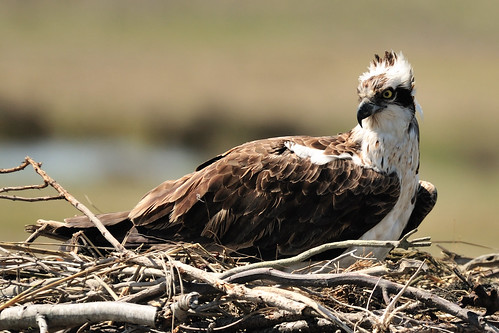
Osprey
Osprey - photo via flickr.com/photos/albertovo5


Another species, like the eagle, that has been threatened by the past use of certain pesticides and loss of their natural habitat, the osprey is a threatened species of wildlife in New Jersey.

Listed as endangered in New Jersey in 1973, the osprey’s status rose to “threatened” in 1986 due to an increase in pairings increased from about 50 to more than 100. And our coastal sightings in NJ for 2017 were at 668 pairings.

Dylan worked with Ben Wurst, a habitat program manager for the Conserve Wildlife Foundation of New Jersey. Environmentalists began providing platforms for nesting in the 1970s and today about 75 percent of the state's ospreys nest in platforms.

The nesting areas have a 3-foot perch for the birds on 16-foot posts. Like many Scout projects, Dylan had many helpers. Major Hardware, a Cedar Grove store, donated all the hardware and
West Essex Building Supply Co. in nearby Verona discounted the lumber. The project cost still amounted to $1400 for the three platforms.

Eagle Scout project helps ospreys - via northjersey.com

Monday, March 5, 2018

Using Trail Tracker for Your NJ Outdoor Adventures


We had a taste of warmer weather recently and some snow coming back this week. The former is good for a trail walk or hike, and the latter may be better for some planning.

The State Park Service launched Trail Tracker at the end of 2017 which is an app that helps park visitors make detailed plans tailored to trails, activities, and terrain that interest them. It is available through Google Play, the Apple app store and the Microsoft app store.

It was developed by the Division of Parks and Forestry’s Geographic Information System (GIS) department as part of a project to map and highlight amenities in the state park system. The state park system boasts nearly 1,000 miles of officially designated trails.


Batso Trail in Wharton

Our NJ park system is comprised of 50 parks, forests recreation areas and marinas, from High Point State Park in Sussex County to Cape May State Park at the southernmost tip of the state.

Hiking opportunities range from the rocky woodlands of the Highlands and Skylands regions to secluded sojourns through coastal marshes, Revolutionary War battlefields, and Pine Barrens forests. Some trails are designated for foot traffic only while others also accommodate bicyclists and horseback riders.

Trail Tracker NJ quick start guide (pdf)